Math
Position Words for Kids
The words that say where things are, in the order children learn them, what is normal at each age, how to teach them at home, when left and right come, games, picture books, and free worksheets.
Grades: pre-K to kindergarten · Common Core: K.G.A.1 · Texas PreK: PK4.V.C.3 · Head Start: P-MATH 10
Position words, also called positional words, tell where something is compared with something else: the ball is in the box, on the box, or under the box. Children learn in, on, under, and next to first, then between, in front of, and behind, and left and right last, because each one asks them to keep track of more. A 3-year-old who has in and on but not between is right on schedule, and left and right come at about 7 or later.
In most states, position words are kindergarten math, in the Common Core standard K.G.A.1. In Texas they are a pre-K skill. The free position words worksheets are at the end of this guide: a set of picture cards, and a “Where Is the Ball?” sheet with an answer key.
Position words list: the first words, and the ones that come later
Position words are words that tell where something is compared with something else, such as in, on, under, next to, between, above, below, in front of, and behind. Most of them are prepositions, the grammar name for these words. Children learn them in an order, and the list below keeps it, with a scene for each word that you can set up with a toy and a box.
| Order | Words | Example | Why this order |
|---|---|---|---|
| First | in, on, under, next to (beside) | The bear is in the box | One object: inside it, touching it, or alongside it |
| Then | between, in front of, behind | The bear is between two boxes; behind the chair | Between needs two objects; in front of and behind need an object with a front, such as a chair, a car, or a person |
| Then | in front of and behind with a ball or a box | The bear is behind the box | No front, so it means “the side away from you” |
| By 5 | up, down, above, below, over, top, bottom, near, far, inside, outside | The lamp is above the table | Not in Johnston and Slobin’s study; Head Start pairs up and down with in front and behind by 60 months, and the Common Core lists above and below in kindergarten |
| Later | left, right | Your left hand | Needs to know whose left: own body at about 7, someone facing you at 8 or 9 |
The first three rows are the order Johnston and Slobin found in children learning four languages; the other words were not in their study. Johnston and Slobin (1979) studied children from 2 to nearly 5 learning English, Italian, Serbo-Croatian, and Turkish, and found the same sequence in all four: in, on, under, and beside first, then between, and back and front with objects that have a front, then back and front with objects that do not.
Beside and next to mean the same thing, and the Common Core’s list uses both. First, next, and last are order words: they say where something is in a line, not where it is compared with something else. They have their own page on ordinal numbers.
What age do kids learn position words?
Most children understand in, on, and under by about 3 or 4, and use between, in front of, and behind by kindergarten. Position words are taught in pre-K and kindergarten, under three frameworks: the Common Core’s kindergarten standard K.G.A.1, Texas’s prekindergarten outcome PK4.V.C.3, and goal P-MATH 10 of the federal Head Start Early Learning Outcomes Framework (ELOF), “Child explores the positions of objects in space”.
| Age | What most children do | Source |
|---|---|---|
| Toddlers (1–3) | Watch a ball roll under a table; put small things into a box | ELOF IT-C 9 (“a ball thrown under a table”) |
| 3–4 | Understand and use more location words, like inside, on, and under; follow “stand up and stretch your arms to the sky” with help | ASHA 3–4 milestones; ELOF P-MATH 10, 36–48 months |
| 4–5 (pre-K) | Use position words, including up and down and in front and behind; follow “move to the front of the line” | ELOF P-MATH 10, by 60 months; Texas PK4.V.C.3, “Child demonstrates use of position words” |
| Kindergarten | Describe where objects are with above, below, beside, in front of, behind, and next to | Common Core K.G.A.1; no Texas kindergarten standard |
| 1st grade and up | Left and right on their own body at about 7, and on a person facing them at 8 or 9 (more below) | Rigal 1994 |
The 3–4 row is in the words of the American Speech-Language-Hearing Association, whose communication milestones for 3 to 4 years include “Understands and uses more location words, like inside, on, and under.” The kindergarten row is K.G.A.1, which asks children to “describe the relative positions of these objects using terms such as above, below, beside, in front of, behind, and next to.”
In Texas, position words are a pre-K skill and do not appear in the kindergarten standards, so a Texas child meets them a year earlier than a child in a Common Core state. The outcome is PK4.V.C.3 in the Texas Prekindergarten Guidelines (2022, page 25).
No framework asks a baby or toddler to say position words. Say them while you play: “the ball went under the table”, “the spoon is in the cup”.
Is it normal for a 3-year-old not to understand behind and between?
Yes. Behind and between come after in, on, and under, so a 3-year-old who does not have them yet is on time. Between needs two objects held in mind at once, and behind needs an object with a front. Johnston and Slobin’s study of four languages found both after the first words, in children from 2 to nearly 5. Head Start puts in front and behind at 4–5. A child one row behind their age in the age table above is within the normal spread.
Teach them with the toy-and-box step in how to teach position words at home, using two of something for between.
A child who does not follow simple directions at all, or says few words of any kind, has a language question rather than a position-word one. The speech delay guide says when to talk to your pediatrician or a speech-language pathologist, and when babies start talking says what to expect month by month.
How to teach position words at home
Teach position words with your child’s body first, then one toy and one box, then pictures, and paper last. Each step moves further from your child’s own body. A session needs only 5 minutes.
Start with your child's own body
Give directions that put your child somewhere: "sit on the chair", "crawl under the table", "stand behind me". Say the position word clearly each time, and do it together the first few times.
Use one toy and one box
Put a toy bear in the box, on it, under it, and next to it, saying each word. Then let your child move the bear while you say the word. Then swap: your child tells you where to put it. If they can tell you, they have the word.
Teach the words in pairs, and say the difference
Teach above and below one at a time, then together. Show on and above side by side: the cup is on the table and touches it, the lamp is above the table and does not. Use two of anything for between, such as "sit between me and Daddy".
Move to pictures and books
Once the words work with real things, point at a picture and ask "where is the cat?". Let your child point first, then say the word together.
Then paper
Use the picture cards and the Where Is the Ball? worksheet last, after the words work with real things. Read each word aloud, and act it out with a real toy first if your child is unsure.
The body comes first because Head Start’s own examples start there. Its examples for P-MATH 10 are directions about the child’s own position: “Stand up and stretch your arms to the sky” and “Move to the front of the line”. The ELOF also notes that preschoolers learn “the position of their own bodies in space” through play.
The swap in step 2 is also your check that the word has stuck.
Blocks work like the toy and the box. Texas’s pre-K guidance says that “as children build with blocks, their teacher can introduce concepts such as higher, lower, in front of, beside” (page 23). Blocks and other things to build with at home are in the math manipulatives guide.
Pictures come after real things because a picture flattens the scene. In a drawing, behind becomes one thing covering part of another. Once the word means something with a real toy, a picture helps.
How do I teach the difference between in front of and behind?
Start with your child’s own body, then use a thing that has a front, and only then a ball or a box. Say “stand in front of me”, then “now stand behind me”. Next, use a chair, a toy car, or a doll: in front of is where it faces, and behind is its back. A ball or a plain box has no front, so with those, behind means “the side away from you”, which is harder.
Ünal and colleagues (2025) describe the same order in a review that cites Johnston and Slobin: children’s earliest uses of front and behind are “in reference to their own body”, then for “objects that have intrinsic front and behind sides (e.g., a teddy bear, a car)”, and then for objects that do not (“e.g., a box”).
Say these three sentences as you play:
- “The car is in front of the garage.”
- “Teddy is hiding behind the chair.”
- “You are in front of me, and I am behind you.”
The mistake that matters most is starting behind with a ball. Start with a car or a chair. Then line up three toys and ask: “Who is in front of the bear? Who is behind it?”
Common mix-ups, and the fix for each
Mixing up position words is a normal step in learning them, and each mix-up has a simple fix:
- On for above. On touches and above does not: “the cup is on the table, the lamp is above it.”
- Under for below. Under is usually touching or covered (under the blanket), and below is just lower down (the shelf below the window). Show both in one scene.
- Behind from the child’s side, not the object’s. Use things with a front until it settles.
- Between with one object. It always needs two, so put out two cushions or two chairs.
When do kids learn left and right?
Children start using left and right correctly on their own body at about 7, and on a person facing them at around 8 or 9. A study of 406 children on right-left orientation, Rigal (1994), found that children use the words “first on their own bodies as early as seven years of age, then on people facing away, and finally on people facing them around eight to nine years of age.” Even at 11, it found, “half of the subjects … still did not apply the words right and left properly onto other persons.”
Left and right come last because they always depend on whose left you mean. A child has to keep their own body as the reference first, and later imagine someone else’s.
How to practice:
- Use your child’s own body only: a sticker or a watch on one hand, “wave with your right hand”, “Simon says, touch your left knee”.
- Walk or stand side by side, facing the same way, rather than face to face.
- Never say “my left” while you face your child, because your left is on their right.
The common mistakes are getting it right on their own body and wrong on yours, and swapping the two words while knowing there are two sides. Getting it wrong on someone facing them is normal at 8 or 9 and later.
Should you worry? A child under 7 or 8 who mixes them up is on time. Mixing up the words left and right is not the same thing as writing letters backwards, which has its own page on letter reversals.
Left and right are the last two picture cards, and they stay off the Where Is the Ball? worksheet.
Position word games to play at home: Simon says, hide-and-seek, and obstacle courses
None of these seven games needs anything you have to buy, and in each one your child hears the word and does or finds what it says.
- Simon says, with position words. “Simon says put your hands above your head”, “behind your back”, “stand next to the door”. Then your child is Simon.
- Hide-and-seek: where is the bear? Hide a toy and give clues in position words: “it is under something soft”. Hide it between two cushions to practice between. Then your child hides it and tells you where.
- Obstacle course. Use pillows and chairs: crawl under, step over, walk around, go through, and say each word as your child does it.
- Build what I say. With two sets of blocks, one person builds a small tower and says where each block goes (“the red block is on top of the blue one, the yellow one is next to it”). The other copies it without looking. It is close to an example in the Common Core’s Geometry Progressions, written by the standards’ authors: kindergartners building a model of their classroom with blocks (page 7). Pattern blocks and tangrams work too, as the tangrams and pattern blocks guide shows.
- Tidy-up directions. Every day, with no game kit: “put the shoes under the bed, the book on the shelf”.
- I spy, where. “I spy something above the window.” Your child guesses, then gives one.
- The playground course. Go up the steps, down the slide, under the bridge, around the tree, between two swings. Then your child calls the route.
For crafts, make a collage where your child glues a sticker on, under, or next to a drawn box. For drawing, say “draw a sun above the house”. There are many right answers, which makes it a game rather than a worksheet.
Any board game becomes a position word game when you say where the pieces go: “put your piece next to mine”, “you are behind the red one”.
Picture books for teaching position words
These four picture books are built on position words, and the first two tell their whole story in them:
- Rosie’s Walk by Pat Hutchins (Macmillan, 1968). Rosie the hen walks across the yard, around the pond, over the haystack, past the mill, through the fence, and under the beehives, while a fox comes to grief behind her.
- Bears in the Night by Stan and Jan Berenstain (Random House, 1971). Seven bears go out of bed, out the window, through the woods, and up Spook Hill, then down Spook Hill and back in bed.
- Inside, Outside, Upside Down by Stan and Jan Berenstain (Random House, 1968). A small bear rides to town in a box on a truck: inside, outside, upside down.
- Over, Under & Through, and Other Spatial Concepts by Tana Hoban (Macmillan, 1973). Photographs of twelve spatial words, such as around, across, between, against, and behind.
Rosie’s Walk and Bears in the Night are the two to start with, because a child can act out the route with a toy.
How to read one so it teaches: stop and ask “where is the hen?”, let your child point before you say the word, and act out one page with a toy. On the next page, your child tells you where things are.
Songs and rhymes work the same way. Action songs that move a hand in, out, up, and down say the word while the body does it. Storytelling does too: tell a short story with your child’s toys, and let your child place each one as the story says where it goes.
Why are position words important? Talking, reading, and math
Position words matter because a child uses them to follow directions, reads many of them among the first sight words, and meets them again in kindergarten math.
Talking and following directions. Position words are how a child follows “put it on the table” and answers “where is it?”. Head Start’s P-MATH 10 asks for both halves: a child “understands and uses language related to directionality, order, and the position of objects”. For language in general, see when babies understand words and follow directions.
Reading. Many position words are among the first words a child learns to read on sight. On the Dolch sight word list, in, up, and down are pre-primer words, on, out, under, and into are primer words, over and by are first grade, and around and off are second grade. A child who knows what under means is reading a word they already own.
Math. The Common Core puts position words in kindergarten geometry, in the same standard that asks children to name the shapes of things around them. The Geometry Progressions, written by the standards’ authors, say kindergartners study “two perspectives on space: the shapes of objects and the relative positions of objects” (page 6). They also say “spatial relations such as above/below and right/left” are understood within rows and columns, the same structures that later carry multiplication and area (page 4). The shapes half is on the shapes page, with flat shapes and solid shapes. Later in the strand come shapes by number of sides, quadrilaterals, symmetry, and patterns.
Saying position words on purpose is worth doing. In one experiment, Loewenstein and Gentner (2005) hid a card in a box while children aged about 3½–4½ watched. The children found the matching card in a second box more often when the adult said where it was with words like on, in, and under. The advantage was still there two days later. It is one lab task. How much parents talk about space also varies widely between homes. In a study by Pruden, Levine, and Huttenlocher (2011), parents used words for the shape, size, and features of things anywhere from 5 to 525 times over about 13½ hours of home visits (the study did not count position words).
Free position words worksheets with pictures
Our two free position words worksheets are for pre-K and kindergarten, and every word on them is printed for the grown-up to read aloud. A 4-year-old is not expected to read them, which is why the sheets use pictures rather than sentences. Play the toy-and-box version first, and use the sheets after.
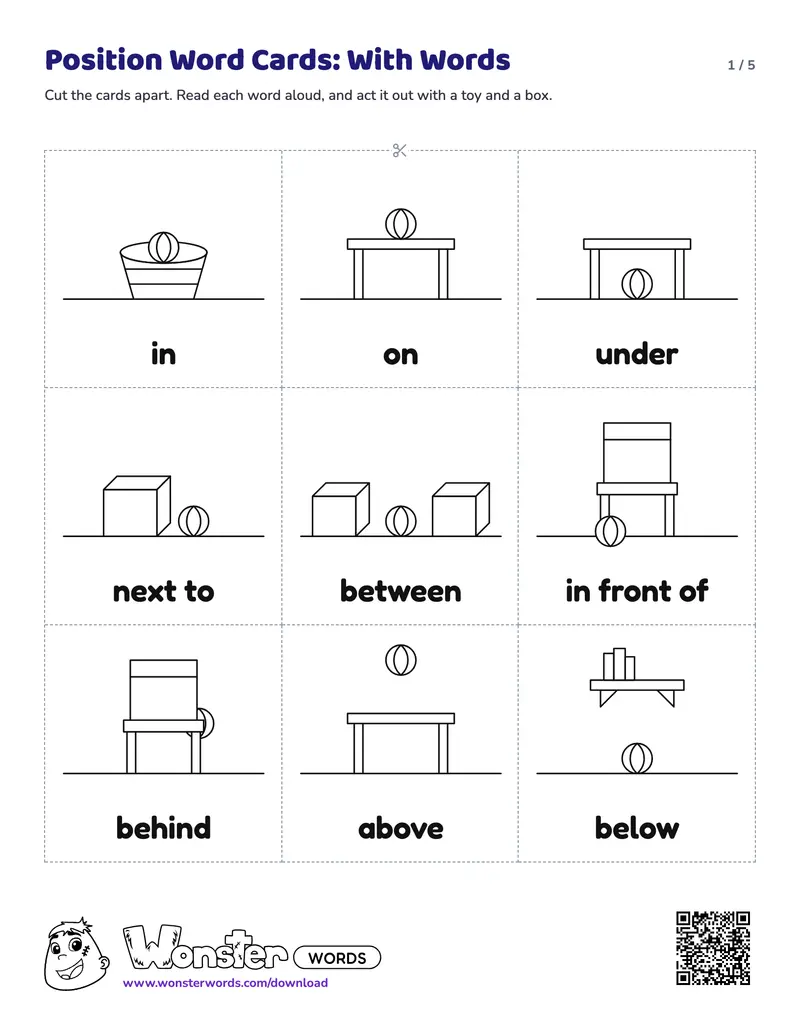
- Position Word Cards. Picture cards with the word under each picture: in, on, under, next to, between, in front of, behind, above, below, top, bottom, near, far, inside, and outside, then left and right as the last two. Then the same pictures without words, for the “where is the ball?” game: you hold a worded card and your child finds its picture, or your child tells you where the ball is. The worded cards are the key to the wordless ones.
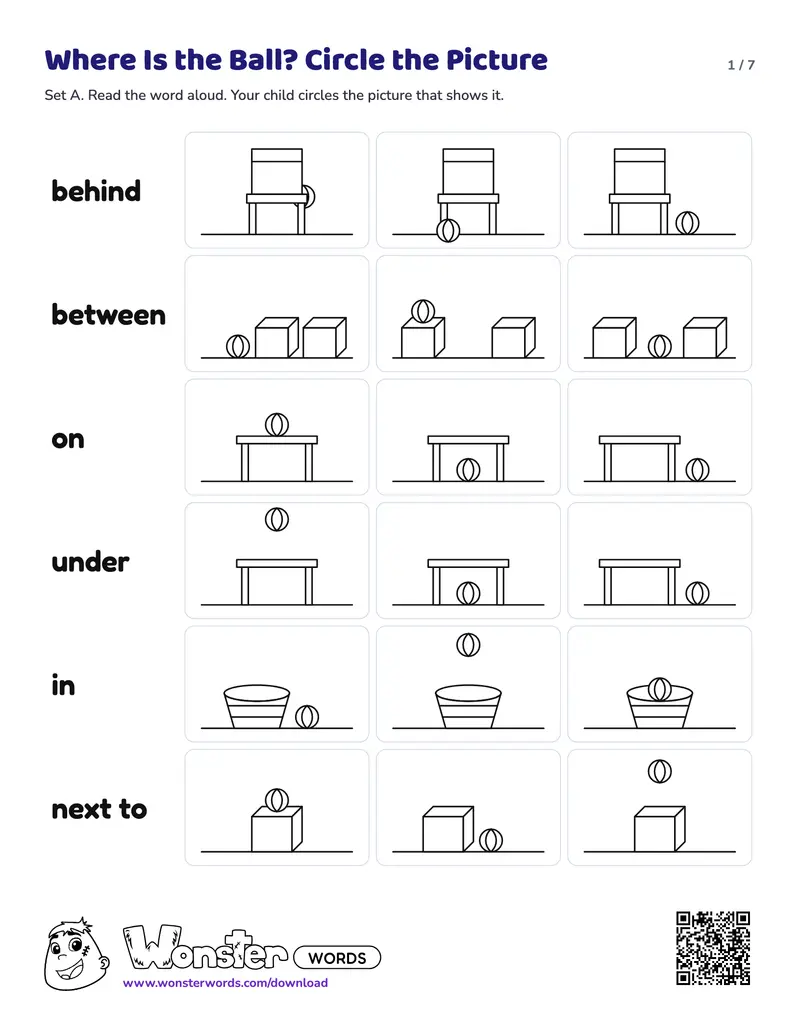
- Where Is the Ball? Two activities. In the first, each row starts with a position word, which you read aloud, and shows three pictures with the ball in three places: your child circles the one that matches. In the second, one picture has two words under it, such as on and under, and your child circles the right one. The words are the kindergarten list and the first words, with no left or right. Each activity prints twice, with the same pictures in a new order, and the answer key follows.
Each PDF ends with a page for grown-ups on what the sheet practices and how to use it, prints in black and white, and needs no account or email. More sheets for this age, shape tracing and shape cards among them, are on the shapes worksheets page.
Free PDF · no sign-up
Free position words worksheets with pictures
Two free PDFs in black and white, with no account and no email: Position Word Cards, with and without words, and Where Is the Ball?, with answer keys. Each ends with a page for grown-ups.
- Position Word Cards (PDF)17 cards · 5 pages
Preview page 1Preview
- Where Is the Ball? (PDF)14 pictures · answer key included · 7 pages
Preview page 1Preview
Frequently asked questions
What are position words with examples?
Position words tell where something is compared with something else. Examples are in (the ball is in the box), on (the cup is on the table), under (the cat is under the chair), next to, between, above, below, in front of, and behind. Left and right are position words too, and children learn them last.
What are some examples of positional math words?
The Common Core kindergarten math standard lists above, below, beside, in front of, behind, and next to, which children use to say where objects are. They are the same words a child hears every day, so they are learned in talk and play first and named as math in kindergarten.
What position words should be taught first to early learners?
Teach in, on, under, and next to first, because each one needs only one object, such as a toy and a box. Then teach between, which needs two objects, and in front of and behind, starting with something that has a front, such as a chair. Leave left and right until last, often until about 7.
Position words for toddlers vs. preschoolers: What is the difference?
Toddlers hear position words in play and start to understand in, on, and under, but no framework expects them to say the words. Preschoolers, from about 3, understand and use more of them, add between, in front of, and behind after in, on, and under, and by 4 or 5 follow directions such as move to the front of the line.
How does teaching the word 'above' differ from teaching 'between'?
Above needs one object and a gap, so show the difference from on, which touches. Between needs two objects at once, so always use two of something, such as two chairs or two cushions. Between usually comes a little later because a child has to keep two things in mind.
Are position words the same as prepositions?
Most position words are prepositions, the grammar name for words such as in, on, under, and between. Position words is the name used in early math and preschool, where the point is saying where something is. A preschooler does not need the grammar name.
Should I be concerned if my child is not using these words in conversation?
A 3-year-old who does not use behind and between yet is on time: most children learn them after in, on, and under, by about 4 or 5. If your child understands and uses few words of any kind, or does not follow simple directions, that is a language question for your pediatrician or a speech-language pathologist.
What are common mistakes kids make when learning left from right?
The most common is getting left and right right on their own body and wrong on yours, because your left is on their right when you face each other. Another is knowing there are two sides but swapping the two words. Both are normal at 8 or 9, and getting left and right wrong on another person is common even at 11.
Should I prefer indoor games or outdoor games for teaching position words?
Both work. Indoors, a toy and a box, Simon says, and a pillow obstacle course are enough. Outdoors, a playground gives you up the steps, down the slide, under the bridge, and between two swings. Saying the word as your child does the move is what teaches it, wherever you are.
Can teaching in front of and behind improve my child's language skills?
Practicing them teaches your child those two words and the directions built on them, such as stand behind me or move to the front of the line. Both are part of the everyday language a child is learning.
Related guides
Last updated