
Math
What Shape Has 6 Sides?
Every shape name from 3 to 12 sides, why a shape's name is its number of sides, regular and irregular shapes, why a stop sign is an octagon, and how to help your child remember the longer names.
Grades: kindergarten to grade 2 · Common Core: 2.G.A.1 · Texas: 2.8(A), 2.8(C), 1.6(D), 1.6(A), K.6(E) · Related: Common Core K.G.B.4, K.G.B.5, 1.G.A.1, 3.G.A.1; Texas 3.6(B)
A shape with 6 sides is a hexagon, and a shape with 5 sides is a pentagon. Every shape name counts the sides: a shape with 3 sides is a triangle, 4 a quadrilateral, 7 a heptagon, 8 an octagon (the shape of a stop sign), 9 a nonagon, 10 a decagon, 11 a hendecagon, and 12 a dodecagon. Any closed shape with six straight sides is a hexagon, whether it looks like a honeycomb cell or like the letter L. It always has as many corners as sides.
The Common Core names the hexagon in kindergarten and the pentagon in second grade, and Texas second graders sort shapes with up to 12 sides. The table of shape names gives every name with its corners, an everyday example, and the grade it belongs to. A free chart and practice sheet put it on paper.
What shape has 5, 6, 7, 8, 9, or 10 sides? Shape names by number of sides
A polygon is a closed, flat shape with straight sides, and its name tells you how many sides it has. A shape with 5 sides is a pentagon, a shape with 6 sides is a hexagon, a shape with 7 sides is a heptagon, a shape with 8 sides is an octagon, a shape with 9 sides is a nonagon, and a shape with 10 sides is a decagon. The names and their second names are the ones in Wolfram MathWorld’s table of polygons.
| Sides | Corners | Name | Two shapes to draw | An everyday example to count | Learned in |
|---|---|---|---|---|---|
| 3 | 3 | Triangle | Equal sides; a long, thin one | A yield sign | Pre-K and kindergarten |
| 4 | 4 | Quadrilateral (square, rectangle, rhombus, trapezoid) | A square; a kite | A door, a book | The shapes by name in K–1; the word in grade 2; the families in grade 3 |
| 5 | 5 | Pentagon | Equal sides; a house shape | A school sign; a drawn house | Grade 2 (Common Core and Texas) |
| 6 | 6 | Hexagon | Equal sides; the letter L | A honeycomb cell; a nut | Kindergarten (Common Core); grade 1 (Texas) |
| 7 | 7 | Heptagon (also septagon) | Equal sides; an arrow | The arrow on a sign | Grade 2 (Common Core progression; Texas) |
| 8 | 8 | Octagon | Equal sides; a stretched one | A stop sign | Grade 2 (Common Core progression; Texas) |
| 9 | 9 | Nonagon (also enneagon) | Equal sides; an uneven one | Rare in everyday things | Grade 2 in Texas |
| 10 | 10 | Decagon | Equal sides; a star outline | The outline of a five-pointed star | Grade 2 in Texas |
| 11 | 11 | Hendecagon (also undecagon) | Equal sides; an uneven one | Rare in everyday things | Grade 2 in Texas |
| 12 | 12 | Dodecagon | Equal sides; a plus sign | The outline of a plus sign | Grade 2 in Texas |
A shape with 4 sides is a quadrilateral, and squares, rectangles, rhombuses, and trapezoids are all quadrilaterals. How they sort into families is on the quadrilaterals page.
Four things hold for every row:
- The corners always match the sides. A closed shape with straight sides has one corner where each pair of sides meets. “Vertex” is the math word for a corner, as on the 2D shapes page.
- Neighbors differ by one side. A heptagon and an octagon, or a decagon and a hendecagon, can look alike, so count rather than compare the look.
- A circle has no straight sides, so it is not a polygon and has no number name.
- Past four sides, the name comes from the number: penta is five, hexa six, octa eight, and deca ten, which is how a child can remember the longer names.
What shape has the most sides?
No shape has the most sides. Whatever shape you draw, you can draw one with one more side, so no number of sides is the largest. Past twelve, the names keep going. MathWorld’s table gives a 13-sided shape as a tridecagon, a 20-sided shape as an icosagon, a 100-sided shape as a hectogon, and a 10,000-sided shape as a myriagon. The table names every count to 20, then every ten to 90, then 100 and 10,000, and it gives no name for 1,000 sides.
Draw a regular shape with more and more sides and it looks more and more like a circle. A circle is still not the winner, because it has no straight sides at all.
The rhombicosidodecahedron, which MathWorld describes as “the 62-faced Archimedean solid”, answers this question in some searches, but it is a solid, and a solid has faces, not sides. The solids, with their faces, edges, and vertices, are on the 3D shapes page.
What shape has 6 sides? The hexagon, and how it differs from a pentagon
A hexagon is any closed, flat shape with six straight sides. It always has six corners too. Does a shape with six sides always have six angles? Yes, every time, because a corner sits where each pair of sides meets. The honeycomb shape, with all six sides the same length, is the regular hexagon. Any other closed outline with six straight sides is a hexagon too, the letter L included, because the count names the shape, not the look.
To check a hexagon, put a finger on one corner and count each side going around until you are back where you started. Six sides means hexagon, whatever the shape looks like.
A pentagon has five sides and five corners, and a hexagon has six. A house shape (a pentagon) and a stretched hexagon can look alike, and turning either one changes how it looks, so counting is the only test.
The Common Core lists hexagons among the first shapes kindergartners “identify, name, and describe” (Kindergarten introduction), and second graders identify them again with pentagons: “Identify triangles, quadrilaterals, pentagons, hexagons, and cubes” (2.G.A.1). Texas names hexagons in first grade (1.6(D), TEKS grade 1).
Pattern blocks show a hexagon built from other shapes. The Common Core writing team’s Progressions describe second graders “making with pattern blocks, a regular hexagon from two trapezoids, three rhombuses, or six equilateral triangles” (2023 edition, p. 121). The math manipulatives guide puts pattern blocks at ages 5–7.
Can a pentagon or a hexagon have sides of different lengths? Regular and irregular shapes
A pentagon does not need equal sides. Any closed shape with five straight sides is a pentagon, and it still has five corners. The same holds for every name in the table: Wolfram MathWorld notes that the names for shapes with five or more sides “can refer to either regular or non-regular polygons, depending on context”.
Regular means every side is the same length and every corner the same, like a stop sign or a honeycomb cell. MathWorld’s definition is a polygon with “equal side lengths and angles”. Irregular means anything else, like the house shape a child draws or a letter L. A regular pentagon and the house shape of a school sign are both pentagons.
Does every hexagon look like a honeycomb? No. A stretched hexagon, a hexagon with a dent, and the letter L (count it: six sides) are all hexagons.
A dent is allowed. A shape with a corner pointing inward is still named by its sides, and the math word for it is “concave”. That is why a star is not a pentagon: the outline of a five-pointed star has ten sides, five going out to the points and five coming back in, so it is a decagon with dents.
Two things are not allowed. A curved side makes the shape not a polygon at all, so a six-sided shape with one curved side is not a hexagon. A gap does too, because a polygon has to be closed.
A child taught only the textbook picture often calls an L shape “not a hexagon”. The Common Core writing team’s Geometry Progressions describe young children naming shapes “often based initially on visual prototypes”, the typical picture (p. 117). They warn that “it is important to vary the examples in many ways so that students do not learn limited concepts that they must later unlearn” (p. 114). The fix is to count, and to see many different shapes with the same count.
Texas asks kindergartners to “classify and sort a variety of regular and irregular two- and three-dimensional figures regardless of orientation or size” (K.6(E), TEKS kindergarten), and first graders to sort “regular and irregular two-dimensional shapes” (1.6(A)). The Common Core asks first graders to tell the attributes that define a shape from those that do not (1.G.A.1), which what defines a shape explains.
Where can kids see shapes with 3, 5, 6, 7, and 8 sides?
Shapes with 3, 5, 6, 7, and 8 sides are all around a child, on signs, in the kitchen, and outdoors. Each of these is something to go and count:
- Three sides: a yield sign, which the federal Manual on Uniform Traffic Control Devices makes an “Equilateral Triangle (downward-pointing)”.
- Five sides: the school sign shaped like a house, a “Pentagon (upward-pointing)” with “squared bottom corners”, and home plate on a baseball field. The Official Baseball Rules call home plate “a five-sided slab of whitened rubber”, with one edge 17 inches, two 8½ inches, and two 12 inches (Rule 2.02). Both are irregular pentagons.
- Six sides: a honeycomb cell, the head of a nut or bolt (a “hex” nut), and a six-sided pencil seen end on.
- Seven sides: an arrow, drawn or on a sign. Count it: seven sides. Heptagons are rare in everyday things, and the arrow is the easiest one to find.
- Eight sides: a stop sign.
- Ten and twelve sides: the outline of a five-pointed star has ten, and the outline of a plus sign has twelve.
In nature, the six-sided shape is the one to look for. Honeycomb cells are hexagons because of the way bees build them. A study in Scientific Reports found the cells start round and become hexagons once “each one is surrounded by six other similar cells” (Nazzi, 2016). Caltech physicist Kenneth Libbrecht writes on snowcrystals.com that a snow crystal starts as a tiny six-sided column or one of the “thin, flat, hexagonal plates”. Its six-sided shape comes from “the arrangement of water molecules in the ice crystal lattice”. A branched snowflake’s outline is not a hexagon, though: count six plates or six branches, not six sides.
On the way to school, count the sides of every sign you see. The shapes guide’s shape hunt turns it into a game.
Why is a stop sign an octagon?
A stop sign is an octagon, eight sides and eight corners, because in the early 1920s highway officials gave each sign shape a level of danger, and federal rules still keep the octagon for stop alone. The federal manual’s table of sign shapes (MUTCD, 11th Edition, §2A.05, Table 2A-1) gives the octagon to the stop sign and says “This sign shall be exclusively the shape shown”. The octagon is also reserved for it: “This shape shall be limited exclusively to the sign(s) indicated”, so the shape by itself says stop. A history of the manual by the Federal Highway Administration tells how the 1920s ranking worked: a round sign marked a railroad crossing, and “The octagon advised of the next level of danger”, the need to stop at intersections. The idea was that “drivers would respond to the shape of the sign even when they couldn’t see the letters”. Count the sides of the next stop sign you pass.
How to help your child remember the names of shapes with more sides
To help your child remember the names of shapes with more sides, start from the count and get to the name through the number inside it. The Common Core writing team says second graders “describe pentagons, hexagons, septagons, octagons, and other polygons by the number of sides, for example, describing a septagon as either a ‘seven-gon’ or simply ‘seven-sided shape’” (progression for second grade, 2023 edition, p. 121). A child who says “a seven-sided shape” is already right.
Count from a marked corner
Put a finger or a pencil dot on one corner and count the sides going around until you are back at the dot. The dot stops a common slip, counting one side twice.
Say the number shape first
Call it "a seven-sided shape" or "a seven-gon" before you teach the word heptagon. The Common Core writing team offers both for second graders, and your child is right before they know the name.
Then learn the name through the number inside it
Penta means five, hexa six, hepta seven, octa eight, nona nine, deca ten, and dodeca twelve. An octopus has eight arms and a decade is ten years. Learn 2 names at a time, starting with hexagon and octagon, and say each one aloud: octagon is OCK-tuh-gon.
Build them
Join straws or sticks with small balls of play dough. Six straws can make a honeycomb shape, a long hexagon, or the letter L, and all three are hexagons.
Draw one to order
Ask for "a shape with 5 sides". Each shape has an easy way to draw it: a house for a pentagon, a long rectangle with a point at each end for a hexagon, an arrow for a heptagon, a square with its four corners cut off for an octagon, and the outline of a star for a decagon. Then count to check.
Go and find them
Look for a stop sign, the head of a nut or bolt, and a star drawn on paper, and count each one's sides.
The American Heritage Dictionary gives penta- as “Five” and hexa- as “Six”, traces “-gon” to the Greek word for angle, and gives octagon as OCK-tuh-gon. Dictionary.com defines hendeca- as “a combining form meaning ‘eleven’”. Not every number part comes from the same language: nona- is Latin, which is why a nonagon is also called an enneagon. Step 4 is the Common Core’s own kindergarten idea, “building shapes from components (e.g., sticks and clay balls)” (K.G.B.5). Step 5 is the second-grade one: draw “a shape with five sides or a shape with six angles” (Progressions, p. 121). None of the step 5 drawings needs to be regular. Pattern blocks make hexagons too, as the hexagon section shows.
Five mix-ups come up often, and each has a fix. A pentagon gets called a hexagon, or the other way round, because the two look alike: count from the dot. A star gets called a pentagon: count its outline, which has ten sides. An octagon gets miscounted because its sides are many and short: the dot again. A shape gets called “not a hexagon” because it is not a honeycomb: count its sides, as in regular and irregular shapes. And “heptagon” and “septagon” are both heard: they are two names for one shape.
A child who names an L shape a hexagon after counting its sides knows the rule. One who says “not a hexagon, it is the wrong shape” is going by the picture, and needs more counting. The shapes guide explains why shapes matter for young children.
When do kids learn pentagons, hexagons, and octagons?
Children meet the hexagon in kindergarten or first grade, and learn the pentagon, the octagon, and the other names by number of sides in second grade.
- Kindergarten. The Common Core lists hexagons among the first shapes, with squares, triangles, circles, and rectangles, and kindergartners describe shapes by their “number of sides and vertices/‘corners’” (K.G.B.4). Texas kindergarten has no hexagon (K.6(A)) but sorts “regular and irregular” shapes (K.6(E)).
- First grade. Texas names the hexagon (1.6(D)). In the Common Core, “hexagons have six straight sides” is the kind of fact first graders use to say why a shape is what it is (Progressions, p. 119; 1.G.A.1).
- Second grade, the main year. The Common Core names triangles, quadrilaterals, pentagons, and hexagons, and asks children to draw shapes with “a given number of angles” (2.G.A.1). Its progression has second graders describe septagons, octagons, “and other polygons by the number of sides”. Texas goes to 12 sides: second graders “classify and sort polygons with 12 or fewer sides according to attributes, including identifying the number of sides and number of vertices” (2.8(C), TEKS grade 2), and create shapes from a given number of sides and vertices (2.8(A)).
- Third grade. Four-sided shapes are sorted into families (3.G.A.1; Texas 3.6(B)), on the page about four-sided shapes.
Each school follows its own state’s standards. The shapes guide sets out which shapes to expect at each age, from the first four on.
Free shapes by number of sides chart and practice sheet
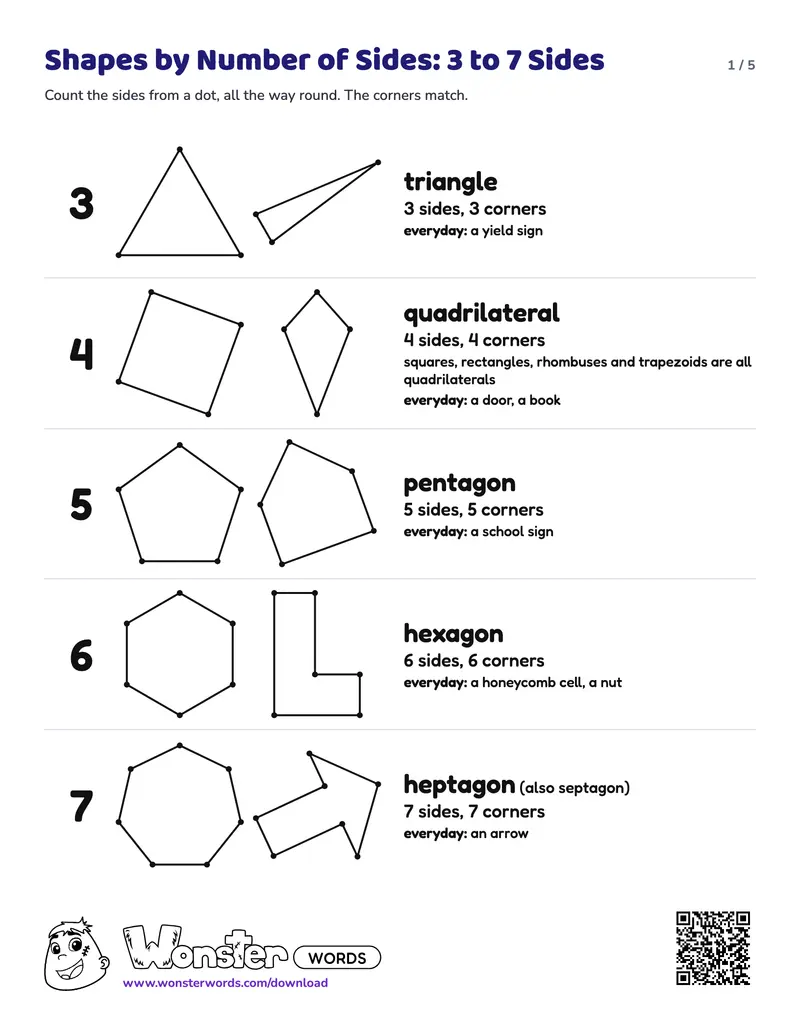
The shapes by number of sides chart puts every shape from 3 to 12 sides on one page, for a fridge or a homework folder, for children aged 6–8. Each count has its name, its corners, an everyday example, and two drawings, one regular and one irregular. One page, “all of these are pentagons” and “all of these are hexagons”, sets shapes that look different but share a count beside shapes that are not hexagons, each with its reason. Another page lists the number inside each name, and a page for grown-ups comes last. Printed large, it works as a classroom poster.
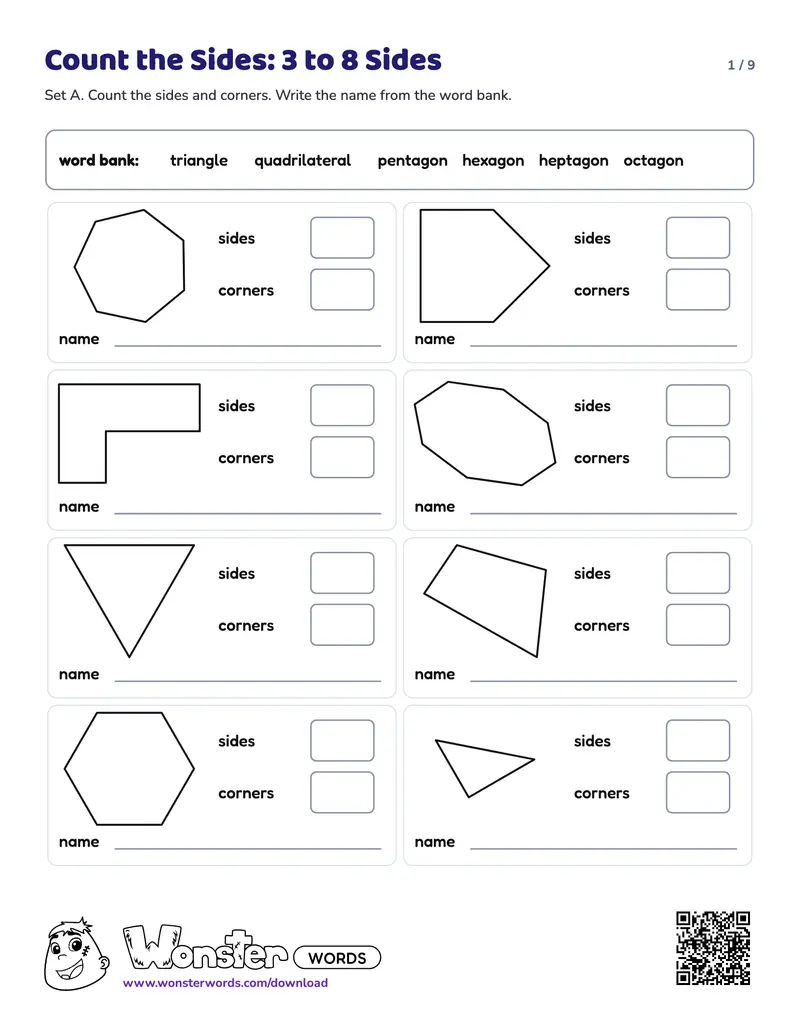
The practice sheet, Count the Sides, has your child count the sides and corners of shapes from 3 to 8 sides and then 7 to 12, some regular, some irregular, and some turned. Your child writes each name from a word bank. The arrow, the star outline, and the plus sign are among them. A last activity sets pairs of shapes at mismatched sizes and asks which has more sides. Every activity prints twice, with the same shapes in a new order, and answer keys and a page for grown-ups follow.
Both print in black and white, with every shape drawn as an outline. The first-shapes chart is the free 2D shapes chart, and practice sheets for younger children are in the shapes worksheets.
Free PDF · no sign-up
Free shapes by number of sides chart and practice sheet
Two free PDFs, with no account and no email: the shapes by number of sides chart, and the Count the Sides practice sheet with its answer keys.
- Shapes by Number of Sides (PDF)34 shapes · 5 pages
Preview page 1Preview
- Count the Sides (PDF)24 shapes · answer key included · 9 pages
Preview page 1Preview
Frequently asked questions
What is a shape with 6 sides called?
A shape with 6 sides is called a hexagon. Any closed, flat shape with six straight sides is a hexagon, whether its sides are all the same length, like a honeycomb cell, or not, like the letter L. A hexagon always has 6 corners too.
Why is a pentagon called a pentagon?
A pentagon is called a pentagon because "penta" means five, and the name counts its five sides. The other names work the same way: hexa means six, octa eight, and deca ten.
Can a pentagon have sides of different lengths?
Yes. A pentagon needs five straight sides and a closed outline, not equal sides. A pentagon with sides of different lengths, such as the house shape of a school sign or home plate on a baseball field, is an irregular pentagon, and it still has five corners.
Is a star shape a type of pentagon?
No. The outline of a five-pointed star has ten straight sides, five going out to the points and five coming back in, so it is a decagon. It has five points, but a shape is named by its sides.
Can hexagons be constructed with curved sides?
No. A hexagon has six straight sides, so a shape with a curved side is not a hexagon or any other polygon.
Is there a 100-sided shape?
Yes. A shape with 100 sides is called a hectogon. There is no limit to the number of sides a shape can have, because you can always draw one with one more side.
Why is a circle not considered a polygon?
A circle is not a polygon because it has no straight sides. A polygon is a closed, flat shape made of straight sides, and a circle is one curved line, so it has no sides and no corners to count.
Is a heptagon the same as a septagon?
Yes. Heptagon and septagon are two names for a shape with seven sides. MathWorld lists heptagon first, and the Common Core writing team uses septagon. A child can also simply say a seven-sided shape.
Related guides
Last updated