
Math
Free Shapes Worksheets for Preschool and Kindergarten
Shape tracing, shape name cards and a poster, a sort by sides and corners, and a shape hunt, in black and white with answer keys, and what tracing shapes does and does not do for handwriting.
Grades: pre-K to grade 1 · Common Core: K.G.A.2, K.G.B.4, K.G.B.5 · Texas: K.6(A), K.6(E), K.6(F) · Texas PreK: PK4.V.C.1, PK4.V.C.4 · Head Start: P-MATH 9 · Related: Common Core 1.G.A.1, K.G.A.3; Texas K.6(D), 1.6(B), 1.6(D); Texas PreK PK4.V.C.2, PK4.IX.B.1
The free shapes worksheets for preschool and kindergarten here are four PDFs: shape tracing, shape name cards, a sort by sides and corners, and a shape hunt. Every sheet is designed to print in black and white, the sort and the hunt have answer keys, and there is no sign-up.
Tracing is the warm-up. Drawing the shape alone, in the empty box at the end of each row, is the practice.
Tracing and the cards suit a child from about 3. The sort and the hunt are kindergarten work, the year the Common Core asks children to “Correctly name shapes regardless of their orientations or overall size” (K.G.A.2).
Free printable shapes worksheets
The shapes worksheets are four PDFs, one for each step: follow a shape, name it, sort it, and find it. Print them in this order.
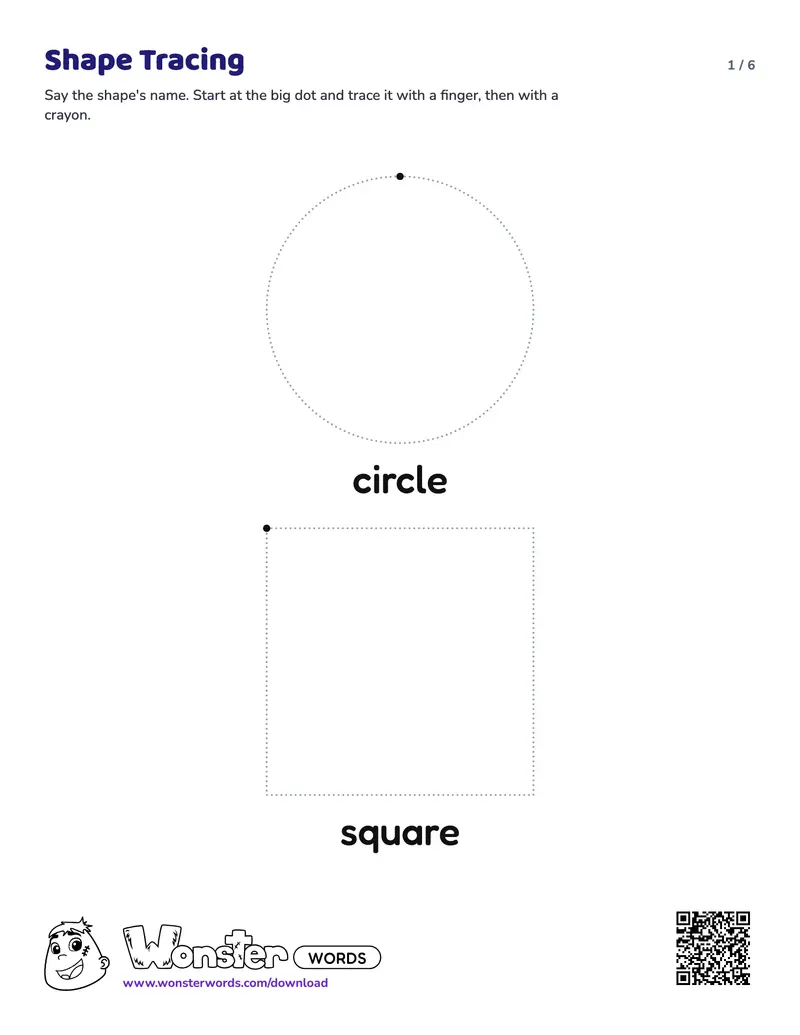
- Shape Tracing, 6 pages. Big shapes first, two to a page: a circle, a square, a triangle, and a rectangle, each with its name. Then rows: the shape drawn solid with its name, dotted copies with a small start dot, and an empty box to draw it alone. The rows run circle, square, triangle, rectangle, oval, hexagon, and rhombus, with a star and a heart last. Print this one for a preschooler with a crayon.
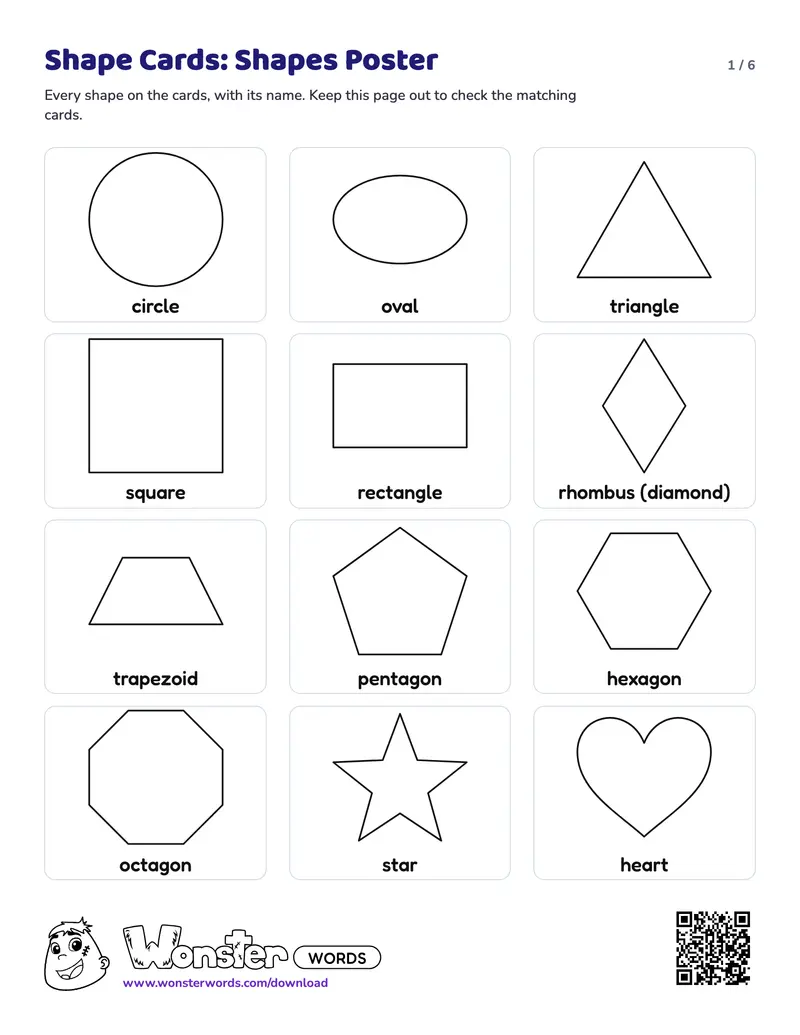
- Shape Cards, 6 pages. A one-page shapes poster, then flash cards for 12 shapes: circle, oval, triangle, square, rectangle, rhombus (diamond), trapezoid, pentagon, hexagon, octagon, star, and heart. Then matching cards: the same shapes turned or stretched, and cards with the names alone, to pair up. Print this one while your child is learning the names, and keep the cards out all week.
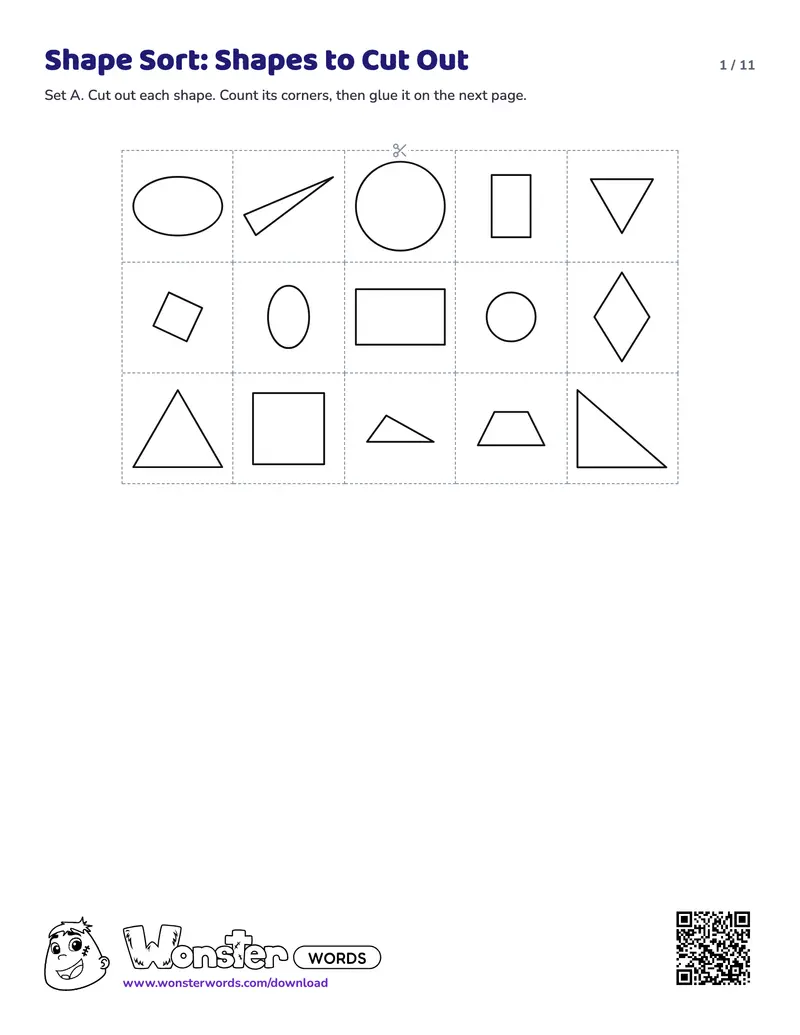
- Shape Sort, 11 pages. Cut out 15 shapes and glue them into three columns, No corners, 3 corners, and 4 corners, with triangles and rectangles turned, stretched, big, and small. Then two find pages: circle every triangle, then every rectangle, among look-alikes. Print this one for a kindergartner telling shapes apart.
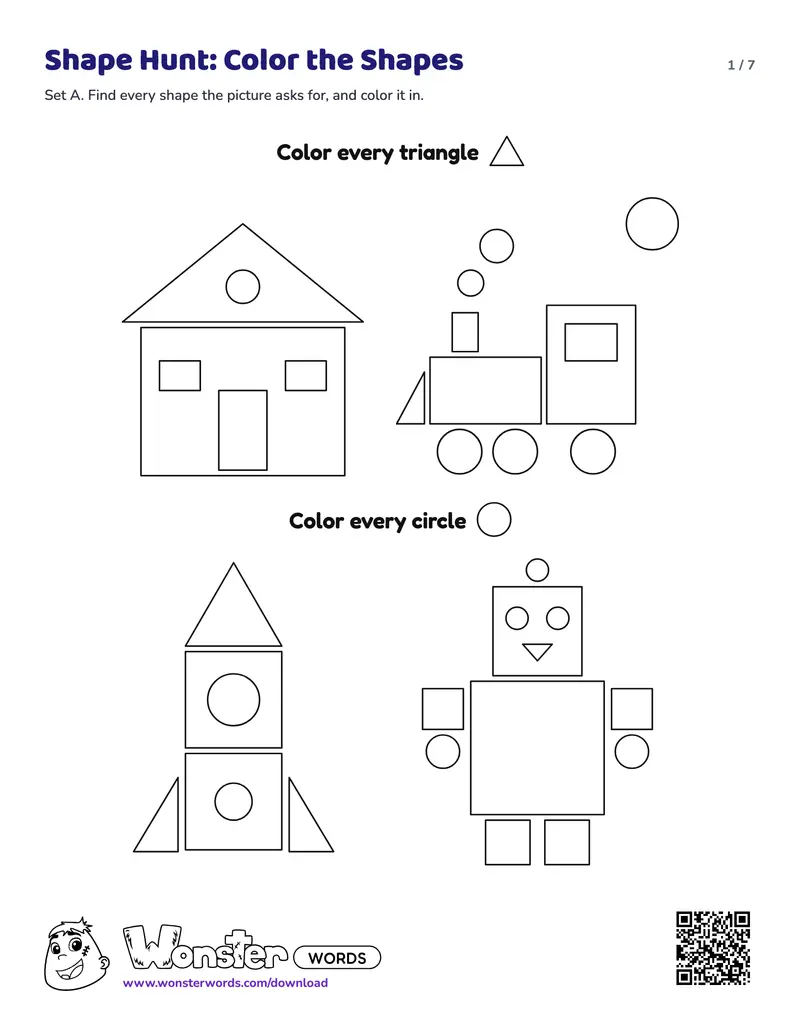
- Shape Hunt, 7 pages. Pictures built only from shapes, a house and a train, a rocket and a robot. Color every shape of one kind, then count each kind in a table. Print this one to finish, or as the coloring sheet.
Every sheet is black and white by design. The shapes are told apart by their outlines and names, never by color, so each sheet prints on any printer. Each practice activity prints twice, as set A and set B. The sort’s set B mixes the same shapes into a new order, and the hunt’s set B asks your child to color a different shape in the same pictures. The answer keys follow the practice pages. Each PDF ends with a page for grown-ups on what the sheet practices and how to use it.
Free PDF · no sign-up
Free printable shapes worksheets
Free to download, with no account and no email.
- Shape Tracing (PDF)9 shapes · 6 pages
Preview page 1Preview
- Shape Cards (PDF)36 cards · 6 pages
Preview page 1Preview
- Shape Sort (PDF)39 shapes to sort · answer key included · 11 pages
Preview page 1Preview
- Shape Hunt (PDF)2 pictures · answer key included · 7 pages
Preview page 1Preview
The 3D shapes page has 3D shape nets, a faces, edges, and vertices sheet, and a 3D shapes chart. A 2D shapes chart with every shape’s name is on the 2D shapes page. Sheets for counting sides, quadrilaterals, symmetry, tangrams and pattern blocks, patterns, and position words are on the pages for those topics.
Shape tracing worksheets: which shapes first, and how big?
The first shapes to trace are the circle, the square, the triangle, and the rectangle. They are the four shapes the Texas kindergarten standard names, with “squares as special rectangles” (TEKS K.6(A)), and the first four in the Common Core’s kindergarten list of “squares, triangles, circles, rectangles, and hexagons”. The tracing sheet runs in this order:
| Shape | Row on the tracing sheet | Common Core | Texas |
|---|---|---|---|
| Circle | 1st | Kindergarten | Kindergarten (TEKS K.6(A)) |
| Square | 2nd | Kindergarten | Kindergarten, as a special rectangle (TEKS K.6(A)) |
| Triangle | 3rd | Kindergarten | Kindergarten (TEKS K.6(A)) |
| Rectangle | 4th | Kindergarten | Kindergarten (TEKS K.6(A)) |
| Oval | 5th | Not in the kindergarten list | Not in kindergarten or first grade |
| Hexagon | 6th | Kindergarten | First grade (TEKS 1.6(D)) |
| Rhombus | 7th | Not in the kindergarten list | First grade (TEKS 1.6(D)) |
| Star | 8th | Drawing practice, in no standard’s list | Drawing practice, in no standard’s list |
| Heart | 9th | Drawing practice, in no standard’s list | Drawing practice, in no standard’s list |
The star and the heart come last because both are everyday names a child wants to draw, not shapes the standards teach.
The order runs from one curved stroke to slanted lines. A circle is a single curve, and the CDC lists “Draws a circle, when you show him how” as a milestone at 3. Head Start’s Early Learning Outcomes Framework places “drawing simple shapes like circles” at 36–48 months (P-PMP 3, p. 73). The square brings straight sides and corners next, and the triangle the first slanted lines. The rhombus, whose four sides all slant, comes near the end, because a slant is harder for a young hand to aim.
The first pages print each shape large, two to a page, because a young child draws big. The rows after them are smaller, and no traced shape on the sheet is under 25 mm (1 inch) across. Each row holds the shape drawn solid with its name under it, a small start dot where the pencil begins, dotted copies to trace, and an empty box to draw the shape alone. The dot marks where to start, not which way to go: there are no arrows.
Do shape tracing worksheets help with pencil control and handwriting?
Tracing shapes is a good warm-up and a poor program. The studies on early handwriting test handwriting instruction, letter tracing, and copying, not shape tracing sheets themselves. What they found favors drawing a form alone over following dots.
- Motor practice alone did not improve handwriting. A meta-analysis of handwriting instruction by Santangelo and Graham (2016), covering studies from kindergarten up, found that teaching handwriting improved legibility and fluency (effect sizes 0.59 and 0.63). Motor instruction on its own did not: it “did not produce better handwriting skills (ES = 0.10 for legibility and -0.07 for fluency)”.
- Copying beat tracing for letters. In a ten-week study of about 50 kindergartners by Hirsch and Niedermeyer (1972), every group improved, and the children who practiced letters by copying them did significantly better than those who practiced by faded tracing.
- Copying shapes goes with legible letters. In a study of 54 kindergartners tested early in the year by Daly, Kelley, and Krauss (2003), the children who could copy the first nine forms of a standard copying test copied letters more legibly than those who could not.
Your child gets the most from the end of the row, where the dots stop and they draw the shape alone, and from saying its name, which is the kindergarten math. Tracing shows the hand a path, drawing asks the hand to find it, and coloring and cutting build the grip. The Texas Prekindergarten Guidelines put it this way: “Cutting with scissors, manipulating modeling dough, and drawing are the foundational skills needed for the demands of handwriting” (p. 76). Do some of each rather than more pages of one.
A worksheet does not teach a grip. In the CDC’s milestones, a child typically “Holds crayon or pencil between fingers and thumb (not a fist)” by 4. That grip comes from handling crayons, scissors, and dough over time.
When should my child move from tracing shapes to letters?
A child is ready to move from shapes to letters when they can copy the shapes, not when they have finished the tracing pages. Shapes first makes sense as a stage, because letters are built from the same straight lines, curves, and slants. Three signs show a child is ready:
- They can copy a circle, a cross, and a straight line without dots, which is the practical test on the letter formation page.
- They hold the crayon in their fingers, not their fist.
- They draw the shape in the empty box with its corners where they belong.
No source sets an age for leaving shapes, and the research measures readiness by copying. In a study of 54 kindergartners by Daly, Kelley, and Krauss (2003), the children who could copy the first nine forms of a standard copying test copied letters more legibly. The ages that do exist are for writing letters:
- Head Start’s framework puts “drawing letter-like forms” at 48–60 months (P-PMP 3).
- The Texas guidelines expect a 4-year-old to write their first name “using legible letters” (PK4.IV.C.1, p. 45).
- The Common Core asks kindergartners to “Print many upper- and lowercase letters” (L.K.1.a).
- A study of 60 kindergartners aged 5–6 by Weil and Amundson (1994) concluded that most children like them “will be ready for handwriting instruction in the latter part of the kindergarten year”.
When the signs are there, move on to letter tracing worksheets, and to number tracing, since kindergartners write numbers too. A child does not need to finish every shape page first: trace shapes and letters in the same week if your child wants to. If your child resists letters, go back to drawing big shapes on paper taped to a wall for a week, then try again.
How to use a shape tracing sheet with your child
To use a shape tracing sheet at home, name the shape, trace it with a finger, trace a few dotted copies, and have your child draw it alone. A few minutes with a crayon is a session.
Say its name and count its corners
Point at the solid shape at the start of the row and name it together: "A square. One, two, three, four corners." The name and the corners are the math on the sheet, and the kindergarten standard asks children to describe shapes by their sides and corners.
Trace it with a finger first
Have your child run a finger around the solid shape, starting at the start dot, before picking up a crayon. The finger learns the path without the worry of staying on the line.
Trace 2–3 dotted copies
Use a crayon or a thick pencil on the dotted copies, 2–3 of them rather than all of them. Start each one at its dot.
Draw it alone in the empty box
Have your child draw the shape in the empty box at the end of the row, without dots. This is the step the sheet is built around. A wobbly square with four corners is a square.
Stop while it is still going well
End after a few minutes, on a shape that went well. No study sets a number of minutes or sheets a week, so come back another day rather than finishing every row at once.
Sit with a 3-year-old rather than leaving them to it. The naming and the corner counting are the parts a child cannot do alone.
Two mistakes are common, and each has a fix:
- Pressing hard and racing along the dots, which practices speed rather than the shape. Slow down and say the name while tracing.
- Correcting a wobbly shape. Count its corners with your child instead: three corners make it a triangle.
To check progress, cover the dots. If your child can draw the shape in the empty box without looking at the dotted copies, and name it, that shape is learned. No study gives a timeline for pencil control.
Shape names and matching: what a shapes worksheet should teach
A shapes worksheet should teach the names of shapes and the words for describing them: side, corner, straight, curved, and flat. “Corner” is the everyday word for a vertex, and the Common Core’s kindergarten standards use both. The full list of shape names, with what makes each one, is on the 2D shapes page. The cards use the same names, with one card labeled “rhombus (diamond)”: a diamond is a rhombus drawn with corners that are not square.
Matching should include the same shape turned and stretched. A child who only ever sees a triangle point-up may decide an upside-down one is not a triangle. The Common Core asks for names “regardless of their orientations or overall size” (K.G.A.2). The Texas Prekindergarten Guidelines describe a 4-year-old who “identifies and matches the two triangles… even though one is oriented sideways, and one is oriented with the tip pointing downwards” (PK4.V.C.4, p. 55). The matching cards print triangles tip-down, long thin rectangles, and tilted squares for that reason. Why a turned triangle is still a triangle is explained with the other 2D shapes.
Color and size do not make a shape. The Common Core calls them “non-defining attributes” in first grade, against what does define a shape: “triangles are closed and three-sided” (1.G.A.1). That is why the sheets are black and white and the cards mix big shapes and small ones. A worksheet that only asks a child to color the red circles is testing colors.
Should my kindergartner sort shapes by sides and corners?
Yes, a kindergartner should sort shapes by their sides and corners: it is kindergarten work in both the Common Core and Texas. The Common Core asks kindergartners to compare shapes by their “number of sides and vertices/‘corners’” (K.G.B.4), and Texas asks them to classify and sort shapes “regardless of orientation or size” (TEKS K.6(E)). Sort by corners, not by color or size, which do not change what a shape is.
The sort works best with shapes that almost fit. The What Works Clearinghouse practice guide for teaching math to young children recommends showing “examples and non-examples of shapes so children can learn to categorize them” (p. 27). The Shape Sort’s two find pages do that. On the first, your child circles the 6 triangles among 6 look-alikes: a triangle with a gap, sides that do not meet, rounded corners, a curved side, a side curved in, and a four-sided shape. On the second, the 6 rectangles hide among a slanted four-sided shape, a trapezoid, a rectangle with rounded corners, a triangle, a rectangle with a gap, and one with a curved side. No page asks whether a square is a rectangle.
To help, count the corners aloud before gluing each shape, and ask “Why does it go there?” The answer, “It has three corners”, is the skill.
Cut-and-paste is how the sort is done, not a separate skill. Cutting is one of the foundations for handwriting in the Texas guidelines, and a glued sort stays put, so you can check it with your child against the answer key. For a preschooler who cannot cut yet, cut the shapes out yourself and let your child do the sorting, because the sorting is the math. Sorting blocks and toys is the hands-on version. Sorting quadrilaterals by type is third grade.
Shapes worksheets by age: toddlers, preschool, kindergarten and first grade
A shapes worksheet for kindergarten asks a child to name shapes turned any way, compare their sides and corners, and draw them. Toddlers need no worksheet yet, preschoolers come to it through names and tracing, and first graders learn what makes a shape that shape.
| Age | What children are asked to do with shapes | Standards | The sheet |
|---|---|---|---|
| Toddlers, about 2 | Handle shapes, fit shape puzzles, and hear the names | Head Start IT-C 10: sorts objects by shape by 36 months | No worksheet yet: a big crayon and big circles |
| Preschool, 3–4 | Name and describe common flat shapes, recognize them turned or a different size, and make them from materials | Texas PreK PK4.V.C.1, V.C.2, V.C.4; Head Start P-MATH 9 | Shape Tracing and Shape Cards |
| Kindergarten, 5–6 | Name shapes in any orientation and size, compare sides and corners, and draw shapes | Common Core K.G.A.2, K.G.B.4, K.G.B.5; TEKS K.6(A), K.6(D)–(F) | Shape Sort and Shape Hunt |
| 1st grade | Tell what defines a shape from what does not: closed and three-sided, against color, orientation, and size | Common Core 1.G.A.1; TEKS 1.6(B), 1.6(D) | Shape Sort’s find pages, then the 2D shapes chart |
At 2, shapes are for handling. A toddler learns shapes from puzzles, blocks, and naming them out loud, which are the shape activities for young children that come before paper.
At 3 and 4, a child names the common shapes. Head Start’s framework describes a 3-year-old who “Recognizes and names typical circle, square, and sometimes a triangle” (P-MATH 9, p. 60). The Texas guidelines expect a 4-year-old to recognize shapes “regardless of orientation and size” (PK4.V.C.4). The tracing sheet and the cards fit this age.
In kindergarten, the frameworks differ in two places. The Common Core lists the hexagon in kindergarten, and Texas treats squares “as special rectangles” (TEKS K.6(A)). The sort and the hunt fit this year.
In first grade, Texas adds rhombuses and hexagons (TEKS 1.6(D)), and the Common Core separates what defines a shape from color, orientation, and size (1.G.A.1). The sort’s find pages fit, then the 2D shapes chart. Shapes by their number of sides come next. Solid shapes at every age are on the 3D shapes page.
Shape flashcards, posters and coloring sheets
The Shape Cards PDF is both a poster and a deck. Page 1 is a one-page shapes poster for the fridge, with every shape on the deck named. The pages after it are flash cards and matching cards.
A poster is for looking up a name, and cards are for asking. Put the poster up first, while the names are new. Once the names are coming, hold up a card and ask “What is this one?”, or lay the picture cards and the name cards face up and match them. The poster is the check.
The Shape Hunt is the coloring sheet. Your child colors every triangle in the picture, then counts them, so the coloring follows a shape’s name rather than its color. Any of the sheets can be colored in too.
Frequently asked questions
Are shape tracing worksheets good for a 3-year-old?
Yes, as a short warm-up with a grown-up beside them. Start with the big circle, because a circle is one curved stroke, and the CDC lists drawing a circle when shown how as a milestone at 3. Drawing the shape alone in the empty box matters more than tracing the dots. In the CDC's milestones, a grip in the fingers rather than the fist typically comes by 4.
Are shape tracing worksheets good for a 2-year-old?
Usually not yet. At 2, shapes are for handling, fitting into shape puzzles, and naming out loud. The best tracing practice at that age is a big crayon and a big sheet of paper to draw circles on. A tracing sheet fits better around 3.
How do you assess progress in pencil control using shape tracing worksheets?
Look at the empty box at the end of each row, not at the dotted copies. If your child can draw the shape there without looking at the dots, with its corners where they belong, and can name it, the shape is learned. Staying on the dots shows less, because the dots do part of the work.
Are cut and paste shape worksheets good for preschoolers?
Yes, when the cutting serves a sort. Cutting is practice for the hand, and sorting the shapes into columns by their corners is the math. For a preschooler who cannot cut yet, a grown-up can cut the shapes out and the child can do the sorting, because the sorting is the part that teaches shapes.
Is tracing shapes better on paper or on a screen?
On paper, for the hand. A tracing sheet has your child hold a crayon or pencil, move it along a path, and then draw the shape alone. A finger on a screen does not practice that grip. A screen can still help a child learn shape names.
Do the shapes worksheets print in black and white?
Yes, by design. The shapes are told apart by their outlines and their names, and the sort's columns by their headings and a small drawing, never by color. Every sheet prints clearly on any printer. A child who wants color can color the shapes in.
Are there answer keys?
Yes, for the Shape Sort and the Shape Hunt, after the practice pages in the same PDF. The Shape Tracing sheet prints a solid model at the start of every row, and the Shape Cards poster shows every shape with its name, so neither needs a key.
How do I make my own shape tracing worksheet?
Draw the shape large with a thick marker and write its name under it. Beside it, draw 2–3 dotted copies of the same shape with a pencil, and put a small dot where each one starts. End the row with an empty box for your child to draw the shape alone.
Related guides
Last updated