
Math
Patterns for Kids
What a pattern and its core are, what AB, AAB, ABB, and ABC mean, what children do with patterns at each age, how to teach patterns at home in six steps, and what a growing pattern is.
Grades: pre-K to grade 1 · Texas PreK: PK3.V.E.3, PK4.V.E.3 · Head Start: P-MATH 7
A pattern is something that repeats in the same order: red, blue, red, blue. The part that repeats is the pattern’s core, and some teachers call it the unit. An AB pattern is a pattern whose core is two different things, repeated: clap, stomp, clap, stomp. AAB, ABB, and ABC patterns have longer cores, such as clap, clap, stomp.
Children learn patterns in a set order: first copying one, then extending it (what comes next?), then making their own, then making the same pattern with different things. Every step is about seeing the core. Patterns are a preschool skill: the Texas prekindergarten guidelines expect a 4-year-old to extend and create them. The Common Core has no pattern standard before third grade, and its first one is about number patterns. Two free pattern worksheets that print in black and white are described at the end of this guide.
What is a pattern? AB, AAB, ABB, and ABC patterns explained
A pattern is a row of things that repeats in the same order, so you can always say what comes next. Red, blue, red, blue is a pattern: after blue comes red. Teachers name the parts with letters. A is the first thing, B is the second, and C is a third, so red, blue, red, blue is an AB pattern. The letters name the core, the part that repeats, not the things it is made of.
| Pattern | Pieces in the core | Said out loud | With things |
|---|---|---|---|
| AB | 2 | A B, A B, A B | clap, stomp, clap, stomp |
| AAB | 3 | A A B, A A B | square, square, circle, square, square, circle |
| ABB | 3 | A B B, A B B | big bead, small bead, small bead, big bead, small bead, small bead |
| ABC | 3 | A B C, A B C | red, yellow, blue, red, yellow, blue |
| AABB | 4 | A A B B, A A B B | cracker, cracker, grape, grape, cracker, cracker, grape, grape |
A pattern can repeat any attribute: color, shape, size, sound, or movement. The letters stay the same whatever the pattern is made of: red, blue, red, blue is AB, and so is clap, stomp, clap, stomp. That is why the letters are worth teaching: they show what two different-looking patterns have in common. An ABC pattern adds a third thing to the core, so three different things come before the first one comes back.
Two kinds of row look like patterns and are not. A row that changes its order partway, such as A B B A B, does not repeat. A row sorted into groups, such as A A A A B B B B, is a sort, because nothing comes back. Children make both on the way to patterns, and the mistakes section has the fix for each.
What does “the core of a pattern” mean?
The core of a pattern is the part that repeats. In red, blue, red, blue, red, blue, the core is red, blue, and it shows 3 times. A worksheet that says “circle the core” wants one repeat ringed, such as the first red and blue together. Some teachers say “unit” or “repeating part” for the same thing.
Worksheets ask for the core because finding it is the last and hardest step. On Douglas Clements and Julie Sarama’s Learning Trajectories site, a child who “identifies the smallest core unit” has reached the last level for repeating patterns. Copying, extending, and moving a pattern to new materials come before it, and number patterns come after. A child who can show the core understands the pattern, rather than copying it piece by piece.
When do children learn patterns?
Children start working with patterns in preschool: at 3 they notice and copy a pattern, and at 4 they continue one and make their own. The 2022 Texas Prekindergarten Guidelines put the steps in that order. A 3-year-old “recognizes and duplicates patterns” (PK3.V.E.3, TEA, PK3), and a 4-year-old “recognizes, duplicates, extends, and creates patterns” (PK4.V.E.3, TEA, PK4). The federal Head Start Early Learning Outcomes Framework (2015) sets the same goal, “Child understands simple patterns” (P-MATH 7, page 59).
| Age | What most children do | Texas | Head Start | Common Core |
|---|---|---|---|---|
| 3 | Notice a pattern and copy one with the model in front of them; with help, fill a gap in an AB pattern | PK3.V.E.3, “recognizes and duplicates patterns” | P-MATH 7, 36–48 months: “Duplicates and extends ABABAB patterns” | None |
| 4–5 | Continue a pattern, make their own, and start AAB, ABB, and ABC; by 5, copy a pattern away from the model, make patterns with sounds and movements as well as things, and find the core | PK4.V.E.3, “recognizes, duplicates, extends, and creates patterns” | P-MATH 7, 48–60 months: “Creates, identifies, extends, and duplicates simple repeating patterns in different forms”; by 60 months, “Identifies the core unit” | None |
| Kindergarten and 1st grade | Keep practicing the core and new things; simple growing patterns | No repeating-pattern standard (K.5 and 1.5 are number patterns) | Not covered | No standard |
| 3rd grade | Number patterns in the addition and multiplication tables | None of this kind (3.5 is number pairs) | Not covered | 3.OA.D.9 |
Repeating patterns are a preschool skill, and the Common Core leaves them out of every grade. Its first pattern standard comes in third grade and is about numbers: “Identify arithmetic patterns (including patterns in the addition table or multiplication table)” (3.OA.D.9). From kindergarten to second grade, the Texas standards name patterns only as number patterns. Some kindergarten programs keep repeating patterns and some do not. From first grade, number patterns take over: skip counting, and the rows and columns of a hundreds chart. In both preschool frameworks, patterns are part of early math beside counting and shapes.
A 3-year-old who copies a pattern but cannot continue it yet is on time. Texas puts extending and making at 4. Head Start lists extending an AB pattern in the year from 3 to 4, and filling a gap in one “with adult assistance”.
How to teach patterns: copy, extend, then make your own
Teach patterns in six short steps: show and say it, copy it, extend it, fix it, make your own, then make the same pattern with new things. Ten minutes with toys or snacks already in the house is a session. Say the letters aloud as well as the things. In a study of 62 preschoolers by Emily Fyfe, Nicole McNeil, and Bethany Rittle-Johnson in Child Development (2015), children who heard a pattern named A-B-A-B did better at making the same pattern with new materials than children who heard blue-red-blue-red. In the authors’ words, “children exposed to abstract labels solved more problems correctly than children exposed to concrete labels”.
Show it and say it
Build an AB pattern with two kinds of toy or snack, such as a car and a block, and say it as you point: "car, block, car, block." Then say it with letters: "A, B, A, B."
Copy it
Your child builds the same pattern right under yours, piece by piece, matching each piece to the one above it.
Extend it
Ask "What comes next?" and leave the end open for your child to add 3 or 4 more pieces. Stop your pattern on different parts of the core, so your child cannot simply alternate.
Fix it
Make one mistake on purpose, such as car, block, car, car, and ask your child to find it and fix it. Children enjoy catching a grown-up in a mistake.
Make your own
Let your child choose the things and the core, then ask them to say the pattern aloud, with the things and then with letters.
Same pattern, new things
Turn your child's clap, stomp pattern into red and blue blocks: "Can you make my pattern with these?" Then ask which part keeps repeating, and have your child snap one core off a train of linking cubes.
Step 6 is the one most often left out. Vanderbilt University’s 2015 news release on Bethany Rittle-Johnson’s pattern studies reports that parents and teachers “regularly asked children to duplicate and extend patterns”. It advises “more sophisticated patterning activities like pattern abstraction”, which is making the same pattern with new things, and asking children to “talk about the part of the pattern that repeats”. Step 4 can be played as early as step 2: Clements and Sarama put fixing an AB pattern beside copying and extending it. It sits fourth because a child has to know what comes next before they can spot what does not.
To check how far your child has come with patterns, go through the steps in order. Can your child copy a pattern, continue it past the end, make their own, make the same pattern with new things, and show the core? The furthest step your child manages is where to play next. There is no score.
How can I help my child continue an AB pattern?
For a child who copies a pattern but stops at the end, change how you build the model:
- Show the core at least 3 times before the open end, never once. Clements and Sarama advise “three complete repetitions of a pattern’s core unit”.
- End the model on a whole core at first. Extending “is easier for children if the pattern ends with a complete unit”. Once that is easy, stop partway through a core.
- Say it aloud together, and let the voice carry on: “red, blue, red, blue, red…”
- Clap or stomp it first. A rhythm runs past the end on its own.
- Leave a gap of 1 piece, then 2.
- Go back to copying for a day if the pattern still breaks.
The Texas guidelines put copying at 3 and continuing at 4, so a child who copies but does not yet continue is on time.
What patterns should we try after AB?
After AB, try longer cores, one change at a time: ABC, then AABB, then AAB and ABB. ABC adds a third different thing. AABB keeps two things and doubles each. AAB and ABB put a repeated thing inside the core, and teachers find them harder. In its Early Years progression chart for pattern, the UK’s National Centre for Excellence in the Teaching of Mathematics (NCETM) says “ABB is more challenging because they have two items within the same unit of repeat”. It adds that “AABB may be simpler as there are just two items, both repeated”. With each new core, go on to steps 5 and 6. Then try growing patterns.
Do not stay on AB too long. Clements and Sarama’s caution is “Do not perform so many AB patterns that children begin to think only that way”.
Pattern activities for kids with toys, snacks, blocks, and claps
Most of these activities use what is already in the house, and only pattern blocks and linking cubes need buying. End each one with your child saying the pattern aloud.
- Snacks. Lay out cereal, crackers, or grapes in a pattern on a plate. At the end, eat one core and ask, “Which part did you eat?”
- Toys. Line up cars and blocks, or stuffed animals in a parade: bear, bunny, bear, bunny.
- Beads. Thread big and small beads on a string or a pipe cleaner: big, small, small is ABB.
- Blocks and linking cubes. Build a cube train in two colors and snap off one core. The manipulatives guide puts linking cubes from age 4. Solid blocks work too, as 3D shapes in a row: cube, cylinder, cube, cylinder.
- Claps, stomps, and pats. Clap, clap, pat your knees is AAB with the whole body. A song’s chorus repeats too.
- Daily routines and clothes. Find the stripes on a shirt, the tiles on a floor, or the steps of the bedtime routine that come back every night.
- Pattern blocks. Lay the flat wooden shapes in a row: hexagon, triangle, hexagon, triangle. The tangrams and pattern blocks guide covers what else they do.
- A folded-paper print. Paint on one half of a sheet, fold it, and press: the print repeats on the other half, a first look at symmetry.
- A pattern hunt on a walk. Look for fences, bricks, and railings, and say the pattern you find: post, rail, post, rail. Saying where each piece sits, the white brick next to the red one, uses position words.
- Two games. Take turns at “copy my pattern”, then play “fix the mistake” with one piece wrong on purpose.
Color patterns and shape patterns
Color patterns and shape patterns are the same skill, and many children see color first. Start with color, then change the shape while the color stays the same, then mix both. A pattern of shapes in mixed colors is harder, because your child has to ignore the color. Children name circle, square, and triangle first, and the 2D shapes page shows them. An older child can find a pattern in the number of sides: triangle, square, triangle, square is 3 sides, 4 sides, 3 sides, 4 sides (shapes by number of sides). A square, rhombus, square, rhombus pattern asks for a close look, because both have 4 sides, and the quadrilaterals page tells them apart.
The printed sheets on this page use shapes and fills, such as stripes and dots, rather than colors, so they print on any home printer. A child can color them in afterwards.
Common mistakes when kids learn patterns
Most pattern mistakes are a lost core, and each has a fix in one of the six teaching steps above.
- Making every pattern AB. Your child turns big, small, small into big, small, big, small. Say the letters together, “A B B, A B B” (the “Show it and say it” step).
- Sorting instead of repeating. All the red ones, then all the blue ones. Have your child copy right under the model, piece by piece (the “Copy it” step).
- Random order. Pieces go down with no rule. Use fewer pieces and go back to copying (the “Copy it” step).
- Stopping at the end of a core. Your child finishes the last core and stops. Leave the end open and ask what comes next (the “Extend it” step).
- Starting the next core in the wrong place, such as A B B A B. Find the core together and push the cores slightly apart, so each repeat stands alone (the “Same pattern, new things” step).
Grown-ups make mistakes too:
- Only ever doing AB.
- Always ending the model at the end of a core.
- Showing a single core and calling it a pattern. Show the core at least 3 times.
- Moving to paper before your child has done the pattern with things.
- Saying “no” to a pattern your child made that is a real pattern, just not yours.
What is a growing pattern?
A growing pattern is a pattern that gets bigger by the same amount each time: a tower of 1 block, then 2 blocks, then 3. What comes next is a tower of 4. A staircase of blocks is a growing pattern, and so is a row of 1 dot, then 3 dots, then 5, which grows by 2 each time. With a child from preschool to first grade, build a growing pattern and continue it with blocks rather than writing it as numbers.
A repeating pattern has a core that comes back, and a growing pattern has no core: it adds the same amount at each step. A shrinking pattern is the same idea run backwards: a tower of 5, then 4, then 3.
To show one, build the first 3 steps side by side. Ask what the next one looks like, then ask, “How many more each time?” Your child builds the next step to check.
Many answers online point to a growing plant or a shell as a growing pattern. Keep to things your child can build. A plant does not grow by the same amount each day, and a child cannot check it.
Counting by 2s (2, 4, 6, 8) is a growing pattern in numbers, and there are more number patterns on a hundreds chart.
Teach repeating patterns first. Marina Papic, Joanne Mulligan, and Michael Mitchelmore (Journal for Research in Mathematics Education, 2011) studied 53 children in the year before school at two similar preschools. One preschool spent six months on repeating and spatial patterns, and its children showed a “greater understanding of unit of repeat” than the children at the other. In the authors’ words, “most were also able to extend and explain growing patterns 1 year later”.
Why are patterns important for kids’ math?
Pattern knowledge in preschool predicts later math. A long study of 517 children from low-income homes, by Bethany Rittle-Johnson, Emily Fyfe, Kerry Hofer, and Dale Farran in Child Development (2017), found that “in preschool, nonsymbolic quantity, counting, and patterning knowledge predicted fifth-grade mathematics achievement”. Patterns still mattered at the end of first grade, when “symbolic mapping, calculation, and patterning knowledge were the important predictors”. The study shows that pattern skill and later math go together. It does not show that patterns cause better math.
Not everyone gives patterns this weight. In 2008 the federal National Mathematics Advisory Panel wrote that in school algebra “patterns are not a topic of major importance”, and that their prominence from prekindergarten to eighth grade “is not supported” by comparisons of curricula (Final Report, page 59). The Common Core has no pattern standard before third grade. The prediction study above came after both.
Finding the core is spotting a rule, and a child does the same later with skip counting, the hundreds chart, and number patterns.
Free pattern worksheets
Our two free pattern sheets are a cut-and-glue make-a-pattern sheet for 3- and 4-year-olds and a set of pattern strips for 4- to 6-year-olds, in black and white, with no account and no email.
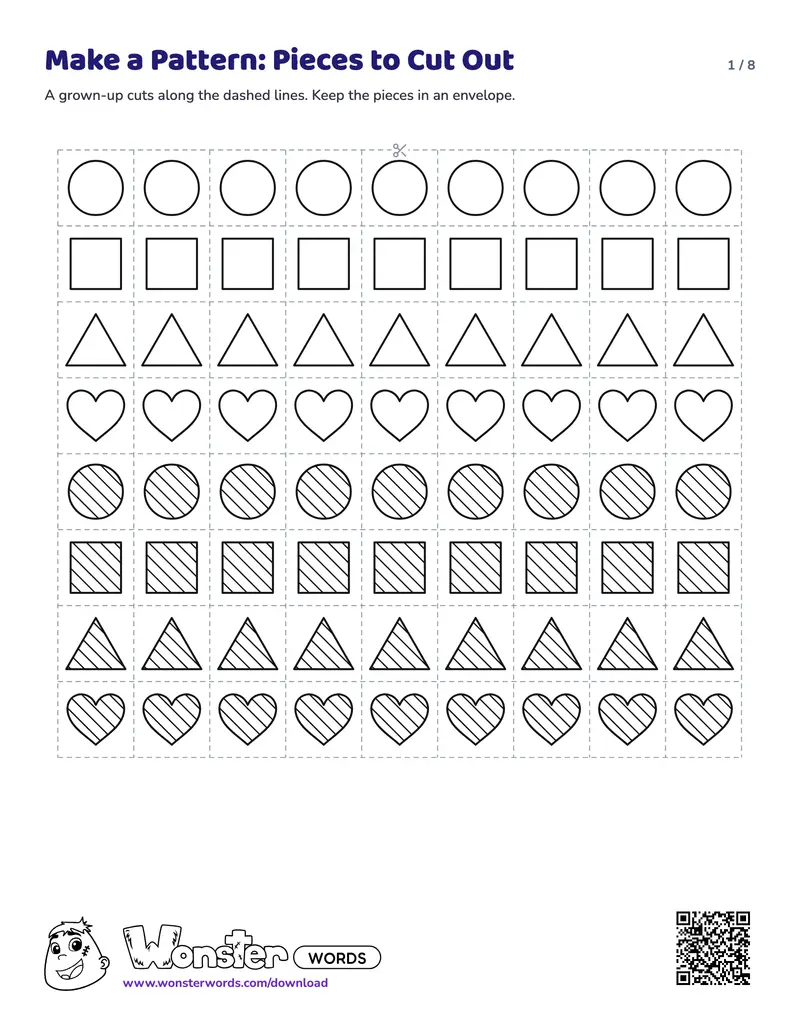
- Make a Pattern is the place to start, for a child who builds with cut-out pieces. Your child cuts out large shapes, glues them on to continue a pattern, copies a pattern box for box, and then makes their own, with “Say your pattern” under each strip.
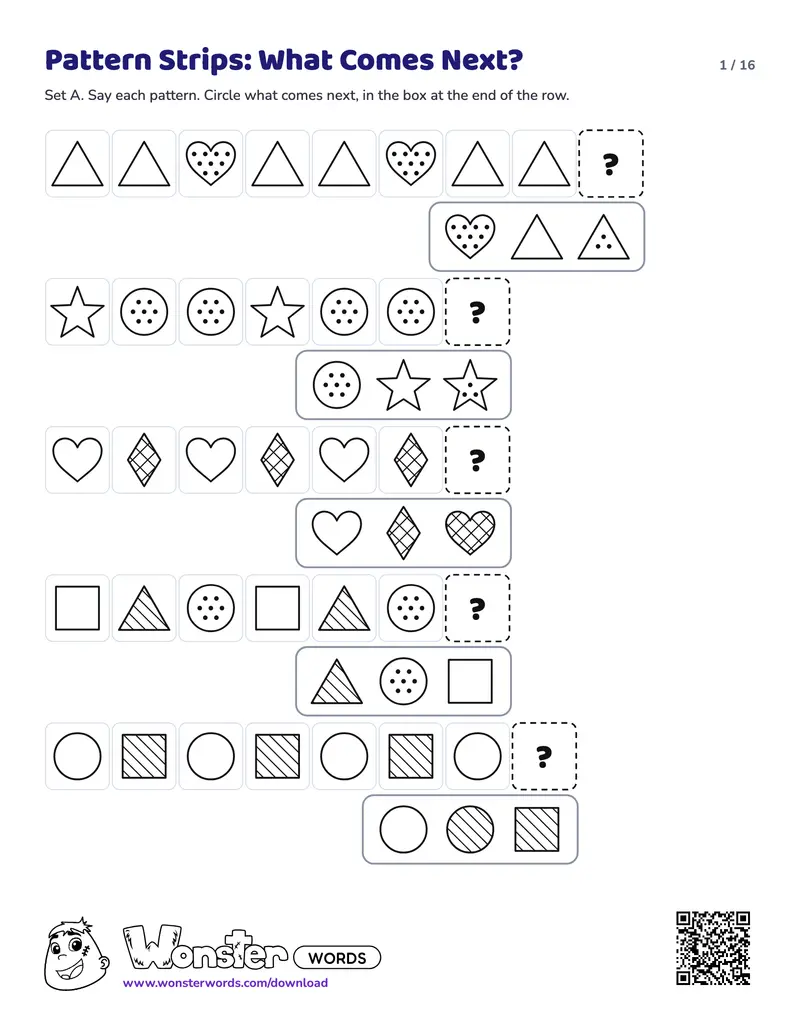
- Pattern Strips: What Comes Next? is for a child who can continue a pattern on paper. It has five activities, each printed twice in a new order: circle what comes next, find the mistake, find the same pattern in new shapes, ring the core, and circle the next step of a growing pattern. Every answer is circled, so no drawing is needed.
Both use AB, AAB, ABB, and ABC patterns drawn as outline shapes with plain, striped, dotted, or cross-hatched fills, never color. Do each pattern with things first and the sheet after, and say every pattern aloud. Shape tracing and a shape sort are on the shapes worksheets page.
Free PDF · no sign-up
Free pattern worksheets
Two free PDFs in black and white, with no account and no email: Pattern Strips, with an answer key for each activity, and Make a Pattern, with pieces to cut out and a key. Each ends with a page for grown-ups.
- Pattern Strips: What Comes Next? (PDF)25 patterns · answer key included · 16 pages
Preview page 1Preview
- Make a Pattern (PDF)13 patterns · answer key included · 8 pages
Preview page 1Preview
Frequently asked questions
What is the difference between AB patterns and ABC patterns?
An AB pattern has two things in its core, such as red and blue. An ABC pattern has three different things in its core, such as red, yellow, and blue. To spot an ABC pattern, find the core: three different things come before the first one comes back. Teach AB first.
How do you make an AB pattern?
Pick two different things, such as a car and a block, and lay them one after the other. Say the pattern as you go, "car, block, car, block", until the core has shown at least 3 times. Then stop and let your child carry on.
What is an ABA pattern?
Repeated, an ABA core makes A B A, A B A, which is the same row as an AAB pattern started in a different place. Three items alone, A B A, have not repeated yet, so on their own they are not a pattern.
What age do children typically start creating their own patterns?
Most children start creating their own patterns at about 4. The Texas prekindergarten guidelines expect 4-year-olds to create patterns, and Head Start lists creating patterns between 4 and 5. At 3, most children copy a pattern with the model in front of them.
What is the difference between growing and repeating patterns?
A repeating pattern has a core that comes back again and again, such as red, blue, red, blue. A growing pattern has no core. It adds the same amount at each step, such as a tower of 1 block, then 2, then 3.
Can music help in teaching repeating patterns to kids?
Yes. Clapping and stomping a pattern, and songs with a chorus that comes back, are repeating patterns a child can hear and feel. Turning a clap, stomp pattern into blocks of two colors is the step where a child shows they see the core.
Are there specific books that focus on teaching patterns for preschoolers?
Two picture books to read together are Beep Beep, Vroom Vroom! by Stuart J. Murphy (HarperCollins, 2000), in which toy cars are put back in the right order, and Pattern Bugs by Trudy Harris (Millbrook Press, 2001), which is about repeating patterns, including sound patterns.
Related guides
Last updated