Math
3D Shapes for Kids
The names of the solid shapes children learn, how many faces, edges, and vertices each one has, why schools count a cylinder's edges differently, which nets to fold first, and how to teach it all at home.
Grades: kindergarten to grade 2 · Common Core: K.G.A.2, K.G.A.3, K.G.B.4, 2.G.A.1 · Texas: K.6(B), K.6(C), 1.6(E), 2.8(B) · Related: Common Core K.G.A.1, K.G.B.5, 1.G.A.2; Texas K.6(E), 2.8(D), 3.6(A); Texas PreK PK4.V.C.1
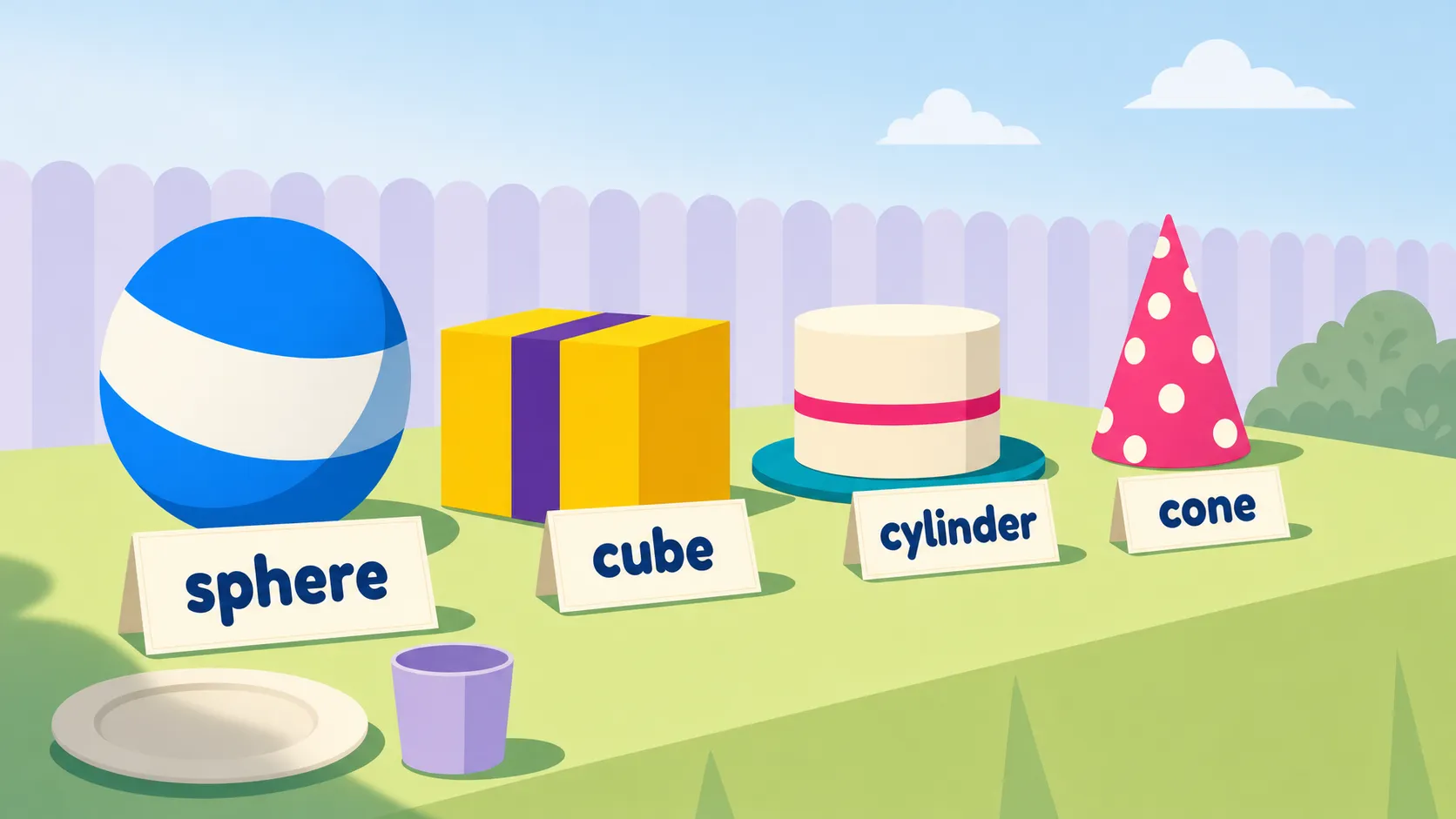
3D shapes are solid shapes: they have length, width, and height, so you can hold them, and some roll, stack, or slide. The seven a young child meets each have an everyday match: a cube is a die or a square block, a rectangular prism a cereal box, a triangular prism an A-frame tent, a pyramid the pyramids in Egypt, a cylinder a can, a cone an ice cream cone, and a sphere a ball.
The parts have names too. A face is a flat side, an edge is where two faces meet, and a vertex is a corner: a cube has 6 faces, 12 edges, and 8 vertices. Schools disagree on whether a cylinder has edges and a cone has a vertex, so use the words on your child’s class chart. Free printable nets to cut and fold, a faces, edges, and vertices worksheet with an answer key, and a 3D shapes chart are at the end of this guide.
What are 3D shapes? The names kids learn
3D shapes are solid shapes, with length, width, and height, that you can hold in your hand. A ball, a box, and a can are all 3D shapes. A circle or a square drawn on paper is flat, a 2D shape, and the shapes guide explains the difference between the two.
The Common Core asks kindergartners to name “three-dimensional shapes such as cubes, cones, cylinders, and spheres” (the kindergarten introduction). Texas asks them to find “cylinders, cones, spheres, and cubes, in the real world” (K.6(B), TEKS kindergarten). These are the seven 3D shapes children meet from kindergarten to second grade, with something from home for each:
| Shape | What it looks like | Everyday example | Flat faces | Rolls? | Common Core | Texas |
|---|---|---|---|---|---|---|
| Cube | 6 squares | Dice, a square block | 6 squares | No | K, 1, 2 | K, 1, 2 |
| Rectangular prism | A box | Cereal box, brick | 6 rectangles | No | 1 | 1, 2 |
| Triangular prism | A tent | A-frame tent, some chocolate boxes | 2 triangles, 3 rectangles | No | Not named K–2 | 1, 2 |
| Square pyramid | A point over a square | The pyramids in Egypt | 1 square, 4 triangles | No | Not named K–2 | ”May be included” in 2 |
| Cylinder | A can | Can, oatmeal container | 2 circles | Yes, on its side | K, 1 | K, 1, 2 |
| Cone | An ice cream cone | Ice cream cone, party hat (both open at the wide end) | 1 circle | Yes, in a circle | K, 1 | K, 1, 2 |
| Sphere | A ball | Ball, orange, globe | None | Yes, any way | K | K, 1, 2 |
Sort them flat against curved. Shapes with only flat faces stack and slide, and shapes with a curved surface roll. Illustrative Mathematics, a published school curriculum, has kindergartners sort solids the same way.
There are many more 3D shapes than these seven. Three more a child may see are the triangular pyramid, made of four triangles, and the pentagonal and hexagonal prisms, with two five-sided or six-sided ends and rectangles around the side. The seven in the table are the ones the Common Core or Texas names from kindergarten to second grade, the square pyramid as one Texas says “may be included” in second grade.
For a kindergartner, four names are enough: sphere, cube, cylinder, and cone, the four both standards above name.
Faces, edges, and vertices: what they are and how many each shape has
A face is a flat side of a 3D shape, an edge is the line where two faces meet, and a vertex is a corner where edges meet. “Vertices” (VUR-tuh-seez) means more than one vertex. Hold a box while you say them: each flat side is a face, each fold line is an edge, and each corner is a vertex.
The faces of a solid are flat shapes. A cube’s faces are squares, and Texas asks kindergartners to name these “two-dimensional components of three-dimensional objects” (K.6(C)). Its own example is that “the face of a tissue box is a rectangle” (TEA’s TEKS Supporting Information). The 2D shapes guide has the names of the flat shapes.
The words change with the grade. The Common Core’s kindergarten standard K.G.B.4 says “vertices/‘corners’”, so a 5-year-old can say corners. The Texas Education Agency expects “formal geometric language such as ‘vertex,’ ‘edge,’ and ‘face’” from first grade.
| Shape | Faces | Edges | Vertices | Curved surfaces |
|---|---|---|---|---|
| Cube | 6 | 12 | 8 | 0 |
| Rectangular prism | 6 | 12 | 8 | 0 |
| Triangular prism | 5 | 9 | 6 | 0 |
| Square pyramid | 5 | 8 | 5 | 0 |
| Cylinder | 2 flat | 0 or 2 | 0 | 1 |
| Cone | 1 flat | 0 or 1 | 0 or 1 | 1 |
| Sphere | 0 | 0 | 0 | 1 |
The cylinder and the cone have two numbers because schools count a curved rim two ways, as no edge or as a curved edge. Use the numbers on your child’s chart.
The cube and the rectangular prism have the most edges on the list, 12 each, and they are the one pair with the same counts: 6, 12, and 8. A sphere has no faces, edges, or vertices. Against a square pyramid, a cube has one more face, four more edges, and three more vertices. The cube’s 6, 12, and 8 match Wolfram MathWorld’s entry on the cube.
Here is a check for the grown-up, not one to teach: for every flat-faced shape on this page, faces plus vertices is two more than edges. A cube has 6 + 8 = 14, and 12 + 2 = 14. This is the polyhedron formula, stated by MathWorld, and it shows a miscount at once.
Does a cylinder have edges? How many vertices does a cone have?
A cylinder has two flat faces that are circles, one curved surface, and no corners. A cone has one flat face that is a circle, one curved surface, and one point. Every source agrees on that much. Where they differ is in the words for the rims and the point.
One way of counting gives both shapes 0 edges and 0 vertices. In definitions written for shapes with only flat faces, an edge is a straight side and a vertex “is a point where two or more edges meet”, in the words of the Illustrative Mathematics grade 6 glossary. A curved rim is not a straight side, and no edges meet at a cone’s tip.
The other way calls each rim a curved edge. On those charts a cylinder has 2 edges, where its circles meet the curved side, a cone has 1 edge, and the cone’s tip is a vertex. Both ways are in use on school charts and worksheets.
Two lessons written for young children avoid the question: Illustrative Mathematics’ kindergarten lesson says “this shape only has one point” of a cone, and the Eureka Math first-grade lesson describes a cone as having “only one circle or oval face and one point”. Neither Common Core nor Texas gives a count of edges or vertices for either shape. Common Core’s writers place the formal count of faces, edges, and vertices in sixth grade, and only for “polyhedral solids”, shapes with flat faces, in the Geometry Progression (page 18).
Use the words on your child’s worksheet or class chart. Both answers describe the same shape, so the worked example or the chart at the front of the room is the rule for that class. A teacher who says a cone has a vertex is using the second way of counting, and is not wrong. If a sheet marks one answer wrong and shows no example, a short note to the teacher settles it.
Three related questions have one-line answers:
- Why do some sources say a cylinder has edges? They use “edge” for any line where two surfaces meet, curved or straight.
- How is a cone’s point different from a pyramid’s? A pyramid’s top is a vertex under every definition, because four edges meet there. No straight edges meet at a cone’s point, which is why it is the case that differs.
- Which shapes have edges? Every flat-faced shape has edges and vertices, and a sphere has neither. The cylinder and the cone are the two that depend on the chart.
When do kids learn 3D shapes?
Children name 3D shapes in kindergarten, and in Texas they use the words vertex, edge, and face from first grade. In the Common Core, kindergartners describe their parts in everyday words such as “corners”, and its writers’ Geometry Progression places the full count of faces, edges, and vertices in sixth grade.
| Age or grade | What children do | Common Core | Texas |
|---|---|---|---|
| Preschool (3–5) | Handle, sort, and build with solids; everyday names such as ball, box, and can | No PreK standard | PK4.V.C.1: “names and describes common 2D shapes and names at least 1 solid 3D shape” |
| Kindergarten | Name cubes, cones, cylinders, and spheres in any size or turn; tell flat from solid; describe parts with words such as “corners” | K.G.A.2, K.G.A.3, K.G.B.4 | K.6(B), K.6(C), K.6(E) |
| 1st grade | Build shapes from cubes, rectangular prisms, cones, and cylinders; Texas adds triangular prisms and the words vertex, edge, and face | 1.G.A.2 | 1.6(E) |
| 2nd grade | Shapes with “a given number of equal faces”, and cubes; Texas sorts solids by their parts | 2.G.A.1 | 2.8(B), 2.8(D) |
| 3rd grade | Texas sorts 2D and 3D figures using “base, vertex, edge, and face” | No new 3D standard until grade 5 | 3.6(A) |
The preschool row comes from the 2022 Texas Prekindergarten Guidelines. The first- and second-grade standards are on the Common Core’s grade 1 and grade 2 geometry pages, and on Texas’s grade 1, grade 2 and grade 3 pages. The sixth-grade counting is on page 18 of the Common Core writers’ Geometry Progression.
A preschooler who calls a cylinder “a can” is using the everyday name, which is where the Geometry Progression starts. A toddler needs balls, boxes, and blocks to handle, not names.
In the Common Core, nets are a sixth-grade standard, used for surface area (6.G.4). A K–2 child folds one as a hands-on activity, and the same Progression describes first graders folding paper “to make a given two- or three-dimensional shape” (page 9).
Nets of 3D shapes: which ones to start with
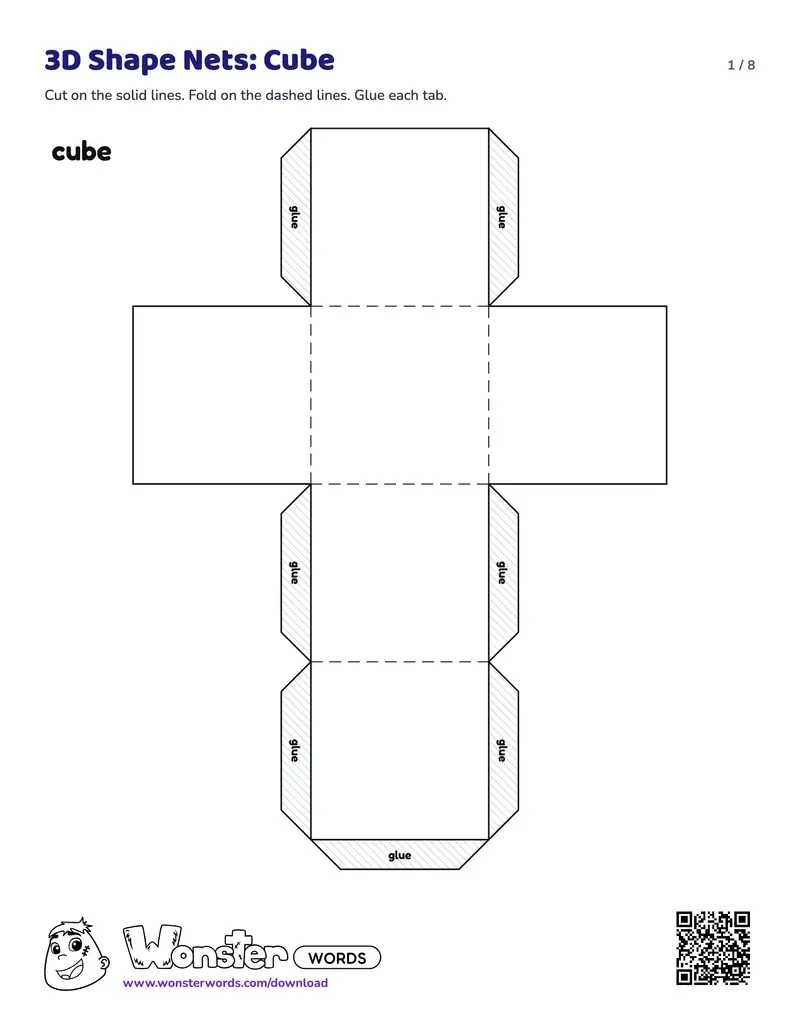
A net is a flat pattern that folds up into a 3D shape. Illustrative Mathematics defines it as a pattern that “can be folded to make a polyhedron”. Unfold an empty cereal box and lay it flat: that is its net, six rectangles joined at their edges.
To make your own net, stand a box on paper and trace around its bottom face. Roll the box over one edge onto the next face and trace again, and keep going until every face is drawn, then add small tabs for glue.
The easiest net to start with is the cube’s, because all six faces are the same square. Try them in this order:
- Cube. Six equal squares, often laid out in a cross.
- Rectangular prism. A box, with three pairs of matching rectangles.
- Triangular prism. Two triangles and three rectangles.
- Square pyramid. A square with a triangle on each side.
- Cylinder and cone. The hardest two. A flat rectangle or part circle has to curl, and the circles need many small tabs.
Fold one in five steps:
- Print on card stock if you have it.
- Cut on the solid lines.
- Crease every dashed line before gluing, by running a dry pen along a ruler.
- Fold all the creases.
- Glue the tabs one at a time.
For a kindergartner, the grown-up cuts and the child folds.
Once a net is folded, count its faces, edges, and vertices. A folded net is the easiest object to count on, because your child can mark one face at a time.
A cube has 11 different nets, according to MathWorld’s entry on the cube. There are 35 ways to join six squares edge to edge, so ask your child whether every one folds into a cube. Only 11 do, and sorting the 35 is a good puzzle for older children.
How to teach 3D shapes at home, step by step
To explain 3D shapes to a young child, start from things they can hold, and name each one as they hold it. These six steps take about 20 minutes and use only what is already in the kitchen.
Collect the shapes from the kitchen
Gather a ball, a box, a can, a cone such as an ice cream cone or a party hat, and a die or a square block. That is a sphere, a rectangular prism, a cylinder, a cone, and a cube.
Feel and name them
Name each shape as your child holds it. Start with the everyday words, ball, box, and can, and add the math names, sphere, cube, cylinder, and cone, once your child knows the objects.
Roll, stack, and slide
Sort the shapes into the ones that roll and the ones that stack. Shapes with a curved surface roll, and shapes with only flat faces stack and slide.
Print the faces
Press each shape into play dough or dip it in paint and look at the print it leaves. A can prints a circle and a box prints a rectangle. The flat faces of a solid are flat shapes.
Build one
Make the frame of a cube from 12 straws or toothpicks for the edges and 8 small balls of play dough for the corners. Count the straws and the balls together when it stands.
Unfold a box, then fold a net
Open a cereal box out flat to see its net, the flat pattern it folds from. Then cut out a cube net, fold it, and glue it into a cube.
The order follows the Geometry Progression, which has children start with “balls,” “boxes,” “cans” and move to “sphere,” “cube,” “cylinder,” and “cone” (page 6). The straw-and-dough cube in step 5 is the Common Core’s own kindergarten example of building shapes from “sticks and clay balls” (K.G.B.5).
For kindergarten or first-grade homework, steps 2 and 4 cover naming the shapes and finding their flat faces.
How to help your child count faces, edges, and vertices
Count faces, edges, and vertices on a real box first, and mark each part as you count it. These five moves are for the counting homework of first and second grade, which Texas asks for by name:
- Count on a real object, not the picture. A box in your child’s hand has no hidden back.
- Mark as you count. Put a sticker on each face and a dot on each corner, so nothing is counted twice.
- Run a finger along each edge and count aloud. A cube’s 12 edges come in three groups: four on the top, four on the bottom, and four standing up, so a child counts three fours instead of one run of 12.
- Use the build. On the straw-and-dough cube, the edges are the straws and the vertices are the dough balls, so counting them is counting objects.
- Say the word with the part. Say “edge” while touching a line and “vertex” while touching a corner with one fingertip.
On a worksheet drawing, the back of the shape is hidden. Dashed lines show the edges at the back, and a child needs to know that dashed means behind. Without them, a drawn cube shows only 9 of its 12 edges.
To explain an edge to a 7-year-old, use move 3: an edge is a line you can run your finger along. A vertex is a point you can touch with one fingertip, where edges meet.
3D shape activities and games
Each of these six 3D shape activities uses things you already have, and the first one works in any room of the house.
- 3D shape hunt. Ask your child to find a cylinder, a sphere, and a cube in one room, starting in the kitchen: a can, an orange, and a bouillon cube or a die. Take one turn per shape, then swap, and let your child set the next hunt.
- Feely bag. Put one solid in a pillowcase. Your child names it by touch, then says how they knew: “It has corners,” or “It is round all over.”
- Roll, stack, or slide. Race the shapes down a tilted tray or a book. Which roll, which slide, and which stay put?
- Block copying. Build a small structure from blocks, and your child copies it with their own. This is the task 3-year-olds did in a 2014 block study.
- Straw-and-dough builds. Make a cube, then a square pyramid, from straws and play dough, and count the parts of each.
- Print the faces. Press each solid into play dough and match the prints to the shapes.
Read a picture book about shapes with the solids on the table, and stop at each shape to find its match. A set of blocks is a set of 3D shapes, and one of the math manipulatives a child learns with at this age. The shapes guide has sorting games for flat and solid shapes.
Common mistakes kids make with 3D shapes
Six mistakes with 3D shapes show up on homework and in play, and each one has a fix you can make at the table.
- Calling a solid by a flat name, such as “square” for a cube or “circle” for a ball. Fix: “A square is one of its faces. The whole shape is a cube.” Telling flat from solid is a kindergarten standard (K.G.A.3).
- Missing the hidden faces and edges on a drawing. Fix: count on a real object, or follow the dashed lines to the back.
- Counting an edge or a corner twice. Fix: mark each one as it is counted.
- Mixing up edges and vertices. Fix: an edge is a line you can run a finger along, and a vertex is a point you can touch with one fingertip.
- Thinking a shape changes when it is turned, such as a pyramid on its side “not being a pyramid”. Fix: turn it in the hand. The Common Core asks children to name shapes “regardless of their orientations or overall size” (K.G.A.2).
- Thinking any six squares fold into a cube. Fix: draw a row of six squares and try to fold it.
Two answers for a cylinder’s edges, 0 and 2, are not a mistake. The cylinder and cone section explains why both are used.
Why 3D shapes matter for young children
Handling and building with solid shapes uses spatial thinking: picturing how shapes fit together and turn. In a study of 102 three-year-olds, children who were better at copying block structures were also better at early math. The study, by Verdine and colleagues in Child Development (2014), found that spatial skill “independently predicted a significant amount of the variability in concurrent mathematics performance”. The Society for Research in Child Development summarized it for parents. The two go together in the study. It does not show that block play causes better math.
The same thinking is at work when a child packs a bag, follows a map, or builds a tower that stays up.
Free 3D shape worksheets and nets
Our three free 3D shape printables are a set of nets to fold, a faces, edges, and vertices worksheet, and a 3D shapes chart, all in black and white, with no account and no email.
- 3D shape nets. Cut-and-fold nets for the cube (two different nets), rectangular prism, triangular prism, square pyramid, cylinder, and cone, in the order to try them, with a page for grown-ups on cutting, creasing, and gluing. Kindergartners fold while a grown-up cuts, and children in grades 1–3 can do it alone.
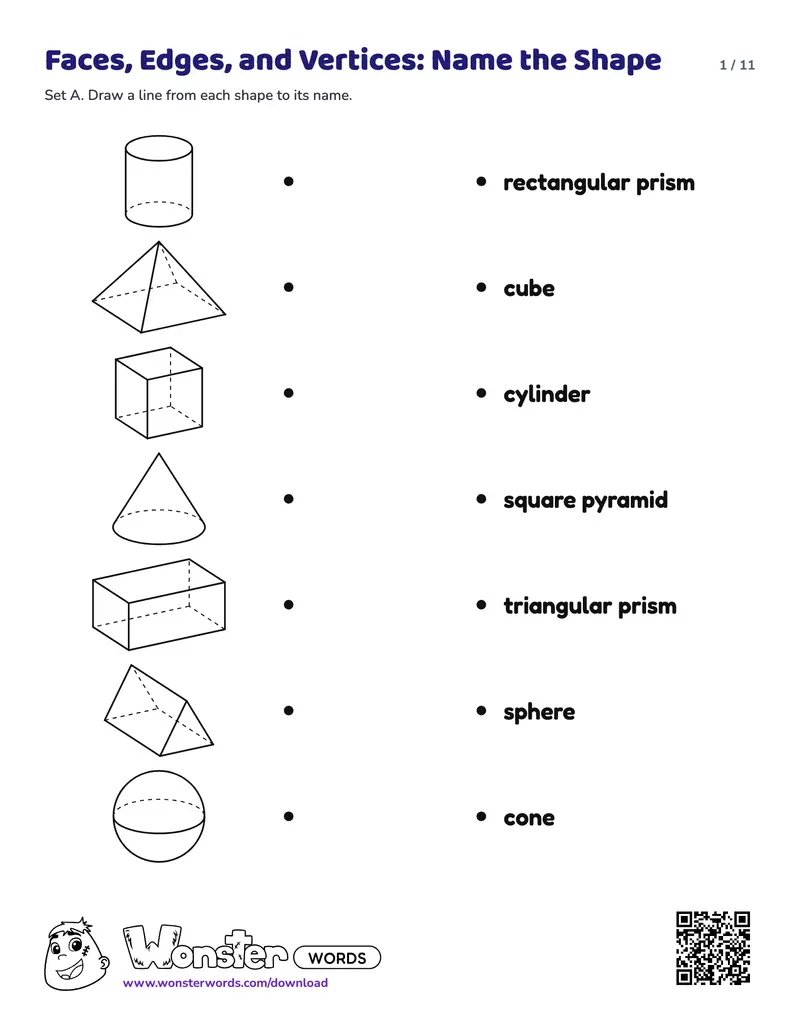
- Faces, edges, and vertices worksheet. For first and second grade, with naming pages a kindergartner can do with a grown-up reading the names. Four activities: match each shape to its name, count the faces, edges, and vertices of flat-faced shapes, circle the flat shapes that are a solid’s faces, and match each net to its shape. Every activity prints twice, in a new order. The sheet never asks for edges or vertices on a cylinder, cone, or sphere, so it never disagrees with a class chart. Two answer key pages and a page for grown-ups follow.
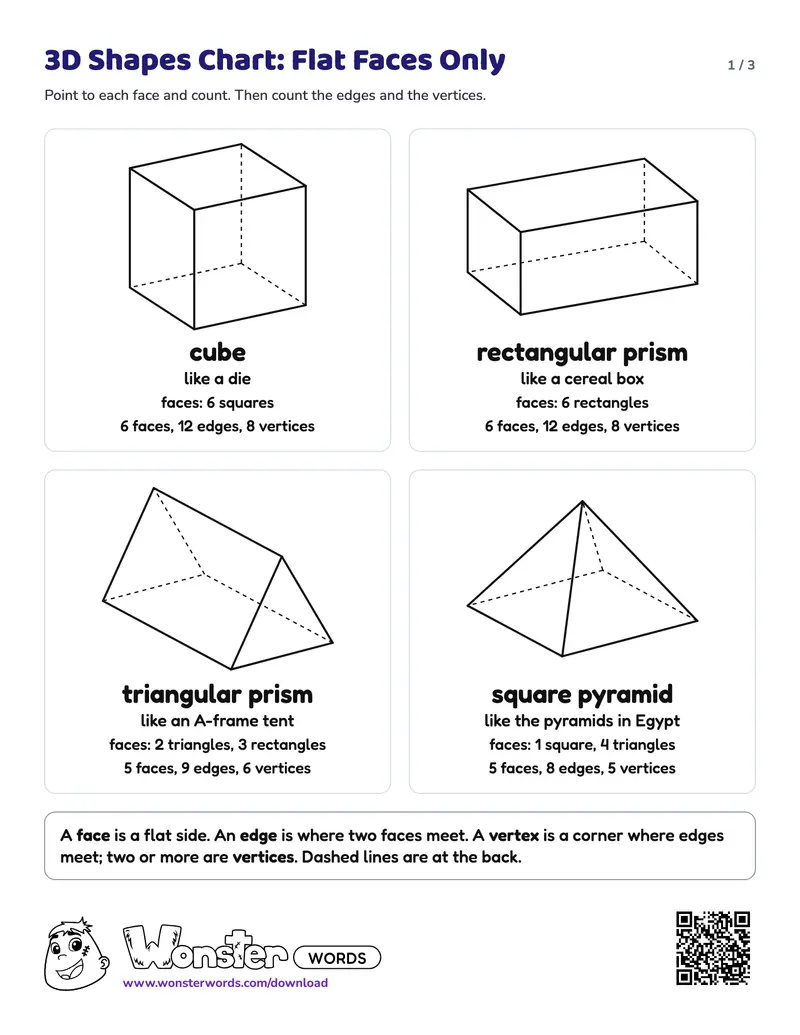
- 3D shapes chart. The seven shapes drawn large with their names and an everyday example, for the fridge or beside homework. The four flat-faced shapes have their faces named and their faces, edges, and vertices counted. The curved shapes are described in words every chart agrees on: a cylinder has “2 flat faces (circles), 1 curved surface, no corners”. A page for grown-ups follows.
Flat shape tracing and naming sheets are on the shapes worksheets page.
Free PDF · no sign-up
Free 3D shape worksheets and nets
Three free PDFs in black and white, with no account and no email: the nets to cut and fold, the faces, edges, and vertices worksheet with its answer keys, and the 3D shapes chart. Each ends with a page for grown-ups.
- 3D Shape Nets (PDF)7 nets · 8 pages
Preview page 1Preview
- Faces, Edges, and Vertices (PDF)24 shapes · answer key included · 11 pages
Preview page 1Preview
- 3D Shapes Chart (PDF)7 shapes · 3 pages
Preview page 1Preview
Frequently asked questions
What are the faces, edges, and vertices of a cube?
A cube has 6 faces, 12 edges, and 8 vertices. Each face is a square. The edges are the 12 lines where two faces meet, four on the top, four on the bottom, and four standing up. The vertices are the 8 corners, where three edges meet.
Why do some sources say a cylinder has edges?
Some sources use the word edge for any line where two surfaces meet, so they count the two circular rims of a cylinder as curved edges. Others define an edge as a straight line where two flat faces meet, which gives a cylinder 0 edges. Both describe the same shape, so use the words on your child's worksheet or class chart.
How is a cone different from a cylinder?
A cylinder has two flat faces that are circles, one curved surface, and no corners. A cone has one flat face that is a circle, one curved surface, and one point at the top. Both roll, a cylinder in a straight line and a cone in a circle.
Which 3-dimensional shape has faces?
Every common 3D shape has at least one flat face except the sphere. A cube has 6 faces, a square pyramid 5, a cylinder 2, and a cone 1. A sphere has one curved surface and no flat faces at all.
Can you explain vertices to kids?
A vertex is a corner, the point where edges meet, and vertices means more than one. A cube has 8. Ask your child to touch each corner of a box with one fingertip and count. In kindergarten the word is usually corners, and Texas expects the word vertex from first grade.
Can you give me 10 examples of 3D shapes?
Ten 3D shapes are the cube, rectangular prism, triangular prism, square pyramid, cylinder, cone, sphere, triangular pyramid, pentagonal prism, and hexagonal prism. The first seven are the ones children meet from kindergarten to second grade.
What are the nets of 3D shapes?
A net is the flat pattern a 3D shape unfolds into, and it folds back up into the shape. A cube's net is six squares, a cylinder's is a rectangle and two circles, and a cone's is part of a circle and a whole circle.
What are the basic 3D shapes for kindergarten?
The basic 3D shapes for kindergarten are the sphere, cube, cylinder, and cone. They are the four that the Common Core names for kindergarten and the four in the Texas kindergarten standard.
What 3D shapes can I find in my house with my child?
A can of soup is a cylinder, a cereal box is a rectangular prism, an orange is a sphere, and a die is a cube. An ice cream cone is a cone, open at the wide end. Look in the kitchen first, where most of them are.
What are the easiest 3D shape nets for beginners?
The easiest net to start with is the cube's, because all six faces are the same square. Then try a rectangular prism, a triangular prism, and a square pyramid. The cylinder and the cone are hardest, because a flat piece has to curl and the circles need many small tabs.
What is the difference between 2D and 3D shapes?
A 2D shape is flat, such as a square or a circle drawn on paper, and it has only length and width. A 3D shape is solid, such as a cube or a ball, and it has length, width, and height, so you can hold it.
What is the difference between a face and a surface?
A face is a flat surface, such as each square side of a cube. A surface can also be curved, such as the side of a can or the whole outside of a ball, and a curved surface is not called a face.
Related guides
Last updated