
Math
Tangrams and Pattern Blocks for Kids
What a tangram is and how to solve one, how to make one from paper, the six pattern blocks, whether they are good for math, how to teach tangrams step by step, activities by age, and free puzzles and mats.
Grades: pre-K to grade 2 · Common Core: K.G.B.6, 1.G.A.2 · Texas: 1.6(F), 2.8(D) · Head Start: P-MATH 9 · Related: Common Core K.G.B.5, K.MD.B.3, 2.G.A.1, 1.G.A.3, 2.G.A.3; Texas K.6(F), 1.6(C), 2.8(E); Texas PreK PK4.V.C.2
A tangram is a puzzle of seven flat pieces (five triangles, a square, and a parallelogram) cut from one square, and the game is to use all seven to make a picture from its outline. Pattern blocks are a set of six wooden or plastic shapes (a hexagon, a trapezoid, a square, a triangle, and two rhombuses) that fit together because their sides match. Pattern blocks are one of the math manipulatives that children use with their hands.
Both teach the same thing: joining shapes to make new shapes. The Common Core asks it of kindergartners and first graders (K.G.B.6 and 1.G.A.2). Children start with pattern blocks at about 3 or 4 and move on to tangrams at about 5–7. Free printable tangram pieces, tangram puzzle cards from easy to hard with solutions, and pattern block mats are described in the free printables section.
What is a tangram?
A tangram is a square cut into seven pieces: two large triangles, one medium triangle, two small triangles, one square, and one parallelogram. The five triangles are the same shape in three sizes, each with one square corner. Put back together, the seven pieces make the square again, and they can also make one large triangle.
A tangram has four rules. Use all seven pieces. Lay them flat. Pieces may touch but never overlap. Any piece may be turned or flipped over. A tangram card shows the outline of a picture, such as a cat, a boat, or a running person, and the puzzle is to fill it exactly.
The tangram was invented in China around 1800. The Smithsonian’s National Museum of American History records that it “proved wildly popular in Europe and then in the United States in the early nineteenth century.”
Tangrams are made of wood, plastic, or card, and a set can be cut at home from one square.
How do you solve a tangram puzzle?
To solve a tangram puzzle, place the big pieces first and save the small ones for the gaps. Try these four, in order:
- Place the two large triangles first. Together they take up half the square, so where they go decides where everything else can go.
- Look for the corners of the outline that only one piece can fill, such as a sharp point or a square corner at the end of a narrow part.
- If the parallelogram will not fit, flip it over. It is the only piece that is different upside down, so it is the piece most likely to be the wrong way up.
- If your child is still stuck, show where one piece goes and let them try again from there.
A puzzle that stays too hard is a sign to step back to an easier one, with fewer pieces or with the lines drawn in. The steps for teaching tangrams go through each one.
How do you make a tangram out of paper?
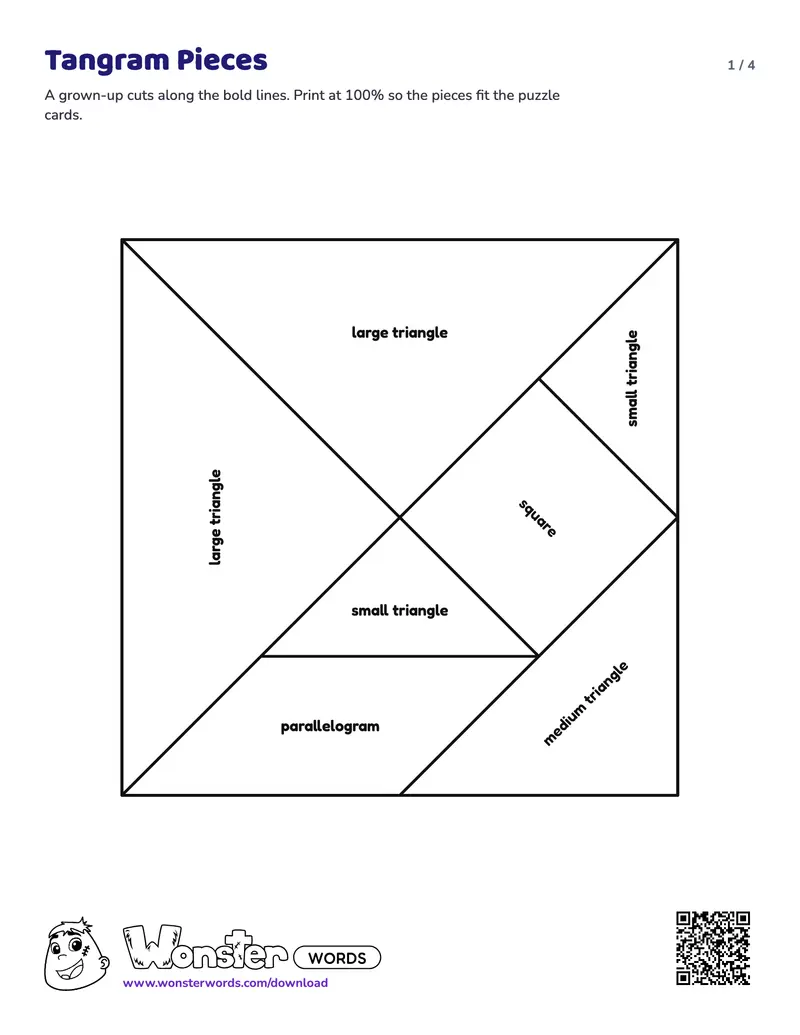
The quickest way to make a tangram is to print the free Tangram Pieces sheet on card and cut along the bold lines. Without a printer, fold and cut a square of paper into the seven pieces. Open each fold and cut along the crease:
- Fold the square corner to corner and cut. You have two half-squares, each a triangle.
- Fold only one half-square in half, point to point, and cut. These are the two large triangles. Set them aside.
- On the other half-square, pinch a mark at the middle of the long side. Fold the square corner down to touch the mark and cut. You have the medium triangle and a long trapezoid.
- Fold the trapezoid in half so its two pointed ends meet, and cut. You have two matching pieces.
- On one of them, fold the pointed corner over to touch the square corner at the other end of the long side, and cut. You have a small triangle and the square.
- On the other one, fold the square corner at the end of the long side over onto the blunt corner across from it, and cut. You have a small triangle and the parallelogram.
- Check your work: put all seven pieces back into the square.
Two mistakes leave you with the wrong pieces. Cutting both half-squares at step 2 gives four large triangles and no medium one. Making the same fold on both matching pieces at steps 5 and 6 gives two squares and no parallelogram. The NSW Department of Education has a short video of the same cuts.
Any size of square works, but the puzzle cards are drawn for a 15 cm square, about 6 inches across. A paper or card set does the same puzzles as a wooden one. It wears out sooner, card less than paper, so keep it in an envelope. More homemade tools are on the math manipulatives page.
What are pattern blocks? The six shapes, and what to look for in a set
Pattern blocks are a set of six flat shapes, cut so that almost any two fit side by side.
| Block | Color in most sets | What it is | What it makes |
|---|---|---|---|
| Hexagon | Yellow | Six equal sides; the biggest block | |
| Trapezoid | Red | Four sides, one pair parallel, the long side twice the others | 2 make a hexagon |
| Rhombus | Blue | Four equal sides, corners not square | 3 make a hexagon |
| Triangle | Green | Three equal sides | 6 make a hexagon; 2 make the blue rhombus |
| Square | Orange | Four equal sides, four square corners | |
| Thin rhombus | Tan | Four equal sides, a narrow diamond |
They fit because every side is the same length, except the long side of the trapezoid, which is two sides long. Standard blocks have 1-inch sides (about 2.5 cm), with the trapezoid’s long side 2 inches. That is why printed mats must be printed at 100 percent, so real blocks sit inside the outlines. The blue block is often sold as a “parallelogram”. It is one, and it is also a rhombus, the shape children call a diamond. The hexagon and its six sides are on the shapes by number of sides page. Two trapezoids make a hexagon, so each is half of it, and that is where pattern blocks lead into fractions.
Pattern blocks were developed by Edward Prenowitz at Education Development Center (EDC) for its Elementary Science Study, and EDC dates them to 1964. Its timeline lists the same six colors as the table above. Sets are also sold as shape blocks or math shape blocks.
Choosing a set. Look for the six standard shapes at the standard size, so the blocks fit each other and printed mats. Buy enough of each to fill a picture: sets are sold by the hundred. Wood, plastic, and foam all work. Foam is light and quiet, and less exact. Sets are usually labeled for 3 years and up, and anything small enough to swallow is for children over 3, with an adult, as the math manipulatives guide explains. You can make your own pattern blocks: the free Pattern Block Mats sheet starts with a set to print on card at actual size and cut out.
Are tangrams and pattern blocks good for math, or just toys?
Tangrams and pattern blocks are toys that teach a math standard: joining shapes to make new shapes. Children also use pattern blocks for other math: counting how many of each block a picture took, and, in later grades, fractions of the hexagon.
Joining shapes is a standard in kindergarten and first grade. Common Core K.G.B.6 reads “Compose simple shapes to form larger shapes”, with its own example: “Can you join these two triangles with full sides touching to make a rectangle?” First graders go further in 1.G.A.2: make a shape from rectangles, squares, trapezoids, triangles, and parts of circles, “and compose new shapes from the composite shape”. Head Start’s preschool goal P-MATH 9 includes it: by 60 months (age 5), a child “creates and builds shapes from components” (Head Start ELOF). Texas starts composing shapes in first grade, a year after Common Core’s kindergarten standard, and adds “in more than one way”, which is what the pattern block mats ask. Its first graders “compose two-dimensional shapes by joining two, three, or four figures to produce a target shape in more than one way if possible” (1.6(F), TEKS grade 1). Its second graders compose shapes “with given properties or attributes” (2.8(D), TEKS grade 2).
A tangram also asks a child to see a shape inside a shape, and to turn and flip pieces in their head. The Common Core writing team describes kindergartners deciding “which piece will fit into a space in a puzzle, intuitively using geometric motions (slides, flips, and turns)”. That is why the parallelogram flip matters. The same document reports “suggestive evidence” that joining shapes “may support” children’s ability to put numbers together and take them apart. The shapes guide’s teaching steps compare this to making a ten.
What does the research say about tangrams and pattern blocks?
Two studies link puzzles and tangrams with spatial skill and math, and neither shows that tangrams or pattern blocks on their own make a child better at math. In a study by Levine and colleagues (2012), toddlers who played with puzzles between the ages of 2 and 4 did better at 4½ on a task of turning shapes in the mind. The shapes guide explains what that link can and cannot show. In a second study, 17,648 children aged 6–8 each did seven weeks of math training alongside one of three kinds of spatial training (Judd and Klingberg, 2021). Working memory and reasoning training helped their math most, and mental rotation or tangram training helped less. A tangram does ask a child to try a piece, check it, and try again, and that is the problem solving in it.
How to teach tangrams, and how to make them easier
To teach tangrams, start with fewer pieces and pictures that show every piece, and take the help away one step at a time. A full tangram is hard for three reasons: the outline shows no lines, all seven pieces must fit, and the parallelogram may have to be flipped. A frustrated 5-year-old is usually on a level that is too high, not failing. To make a tangram easier, go back down the steps below: use fewer pieces (step 2), draw the lines in (step 3), and use full-size pictures before small ones. Stop while it is still going well.
Start with pattern blocks on a drawn picture
Give your child a pattern block mat where every block's place is drawn. Your child finds the block that matches each shape and covers it. Talk about turning: "turn it so the point goes up."
Join two tangram pieces
Put out the two small tangram triangles and ask for a square, then a bigger triangle, then a parallelogram. Then use three pieces, the medium triangle and the two small ones, to make a square.
Build on a full-size picture with the lines drawn in
Use a tangram picture drawn at the size of the pieces, with every piece's outline shown. Your child works out which piece goes in each place and lays it on top.
Fill an outline with no lines
Use a full-size outline with no inner lines. Place the two large triangles first and flip the parallelogram if it will not fit. If your child is stuck after a few minutes, show where one piece goes.
Copy a small silhouette, then make your own
Show a small picture, smaller than the pieces, with some pieces turned. Your child builds it full size beside the card. Then your child makes a new picture, traces around the outside, and gives it to someone else to solve.
The steps follow the order the Common Core writing team describes in the Common Core geometry progression: children combine shapes “first, through trial and error, then gradually using attributes,” such as side lengths and corners. They also follow the levels that researchers Clements and Sarama of the University of Denver name for composing shapes, from Piece Assembler and Picture Maker to Shape Composer. Step 5 is the writing team’s too: kindergartners “construct their own outline puzzles and exchange them.”
Talk while your child builds. Name the pieces, the moves (“flip it,” “turn it”), and where each piece goes (“next to the big triangle”). Words like “next to” and “on top of” are the position words children use to describe where things are.
Tangram and pattern block activities by age
Children can play with pattern blocks from about 3, join two tangram pieces from about 3 or 4, and do full seven-piece tangrams from about 5. Both run through second grade, and one tangram activity reaches third. The standard in each row is what the frameworks expect at that age.
| Age | Pattern blocks | Tangrams | Standard |
|---|---|---|---|
| Toddlers (about 2–3) | Chunky shape puzzles, not pattern blocks yet (sets are for 3 and up) | Not yet | ELOF IT-C 9: puzzles with interlocking pieces by 36 months |
| Preschool (about 3–4) | Free building; cover pictures where every block is drawn | Two pieces make a square | ELOF P-MATH 9 |
| Pre-K (about 4–5) | Fill outlines with some lines shown; make a hexagon from triangles | Full-size pictures with lines drawn in | P-MATH 9 by 60 months; Texas PK4.V.C.2 (related) |
| Kindergarten (about 5–6) | Fill a bare outline; make a hexagon three ways | Full-size outlines with no lines | K.G.B.6 |
| 1st grade (about 6–7) | Build a shape, then use it to build another; count the blocks used | All seven pieces, outline only | 1.G.A.2; TEKS 1.6(F) |
| 2nd grade (about 7–8) | Mirror designs; patterns that repeat | Small silhouettes with turned pieces; invent puzzles | TEKS 2.8(D) |
| 3rd grade (about 8–9) | Make each four-sided shape from tangram pieces | 3.G.A.1 (related) |
Children move up and back. A turned silhouette can send a 7-year-old back to pictures with lines for a week, and that is normal. Pattern blocks start teaching how shapes make other shapes at about 5, which is the age the manipulatives age table gives them. Free play and covering drawn pictures come earlier. For third grade, the quadrilaterals page sorts the four-sided shapes into families, and every age for shapes in general is in the shapes guide’s age table.
These five activities need nothing beyond the blocks or a printout:
- Make a hexagon every way. Use triangles, rhombuses, and trapezoids, and count the ways. This is Texas first grade’s “in more than one way”, and it shows a preschooler which shapes the blocks can make.
- Feely bag. Put a few blocks in a bag and ask your child to find the trapezoid by touch.
- Build what I build. One person builds behind a book and describes it, and the other copies it without looking. The words “above”, “beside”, and “under” do all the work.
- Mirror match. Build half a design on one side of a line and ask your child to build the mirror half. The symmetry page has more.
- Tangram animals story. Each person makes an animal from a tangram set, and together you tell a story about them. Trace around the animals and color them for an art project.
Repeating patterns with blocks, such as hexagon, triangle, hexagon, triangle, are on the patterns page.
How is a tangram different from a jigsaw puzzle?
A jigsaw puzzle has one place for every piece, found by the picture and the shape of the edge. A tangram has seven plain pieces, and the same seven make every tangram picture. A child has to reason from the shapes alone, their side lengths and corners, and turn and flip pieces to fit. A jigsaw is matching; a tangram is joining shapes. Pattern blocks sit between the two: a mat that draws every block works like a jigsaw, and a bare outline can be filled in many ways, like a tangram.
Two other toys are often compared with pattern blocks. A geoboard makes the outline of a shape with rubber bands, so it is about sides and corners. Building bricks build in three dimensions, the subject of the 3D shapes guide. Pattern blocks fill a flat shape with shapes. Each does a different job, and a child can use all three.
How to use pattern block mats and templates
A pattern block mat, also called a pattern block template or picture, is a picture outline your child fills with blocks. A guided mat draws every block’s place. An open mat shows only the outside, so your child decides which blocks to use. Use them in the order children learn: guided mats first, then mats with some lines, then outline only.
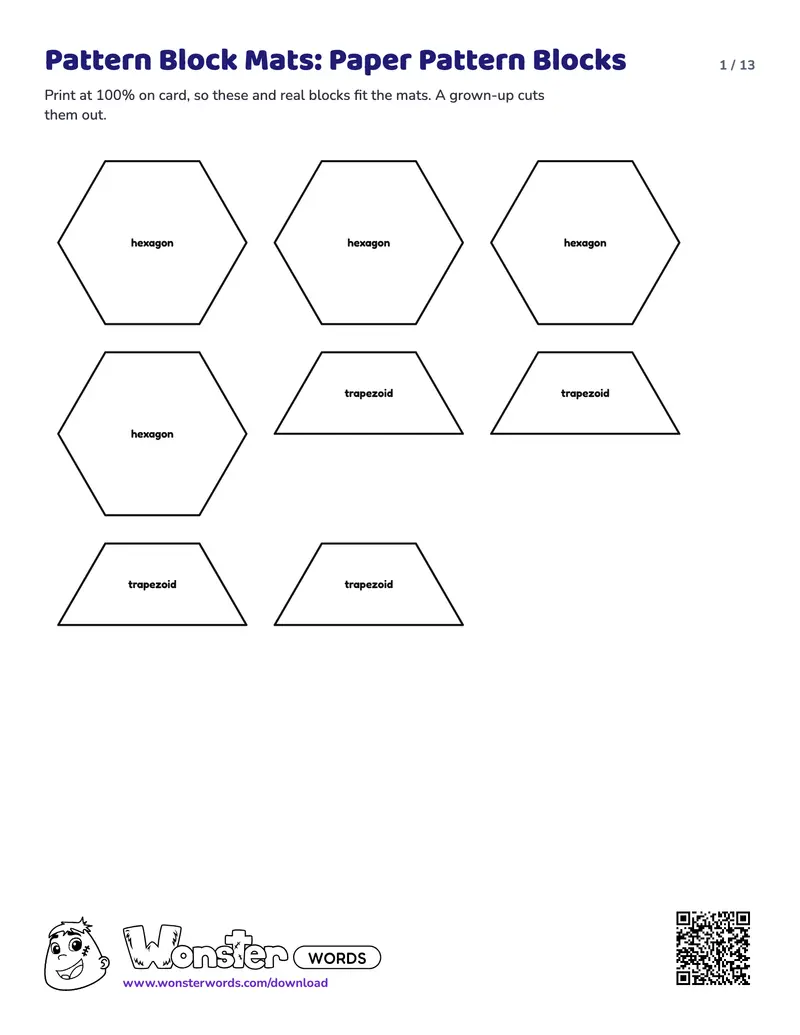
The outlines are drawn at the size of standard blocks, so print mats at 100 percent. With no set at home, cut out the paper blocks on the first page of the Pattern Block Mats sheet.
After filling a mat, your child counts how many of each block it took, which is the counting and sorting kindergartners do (K.MD.B.3). Then try to fill the same picture with fewer blocks, or with more. Two trapezoids can take the place of a hexagon, and three triangles the place of a trapezoid.
To make your own mat, build a picture from blocks, trace around the outside, and swap with someone else to solve.
Free printable tangram puzzles and pattern block mats
The tangram and pattern block sheets build on each other, from paper pieces to puzzle cards to mats.
- Tangram Pieces. A 15 cm tangram square with bold cut lines and each piece named, a second set for a second player or a lost piece, and a picture of the pieces put away in their square and in the large triangle. This is the sheet for making a tangram from paper.
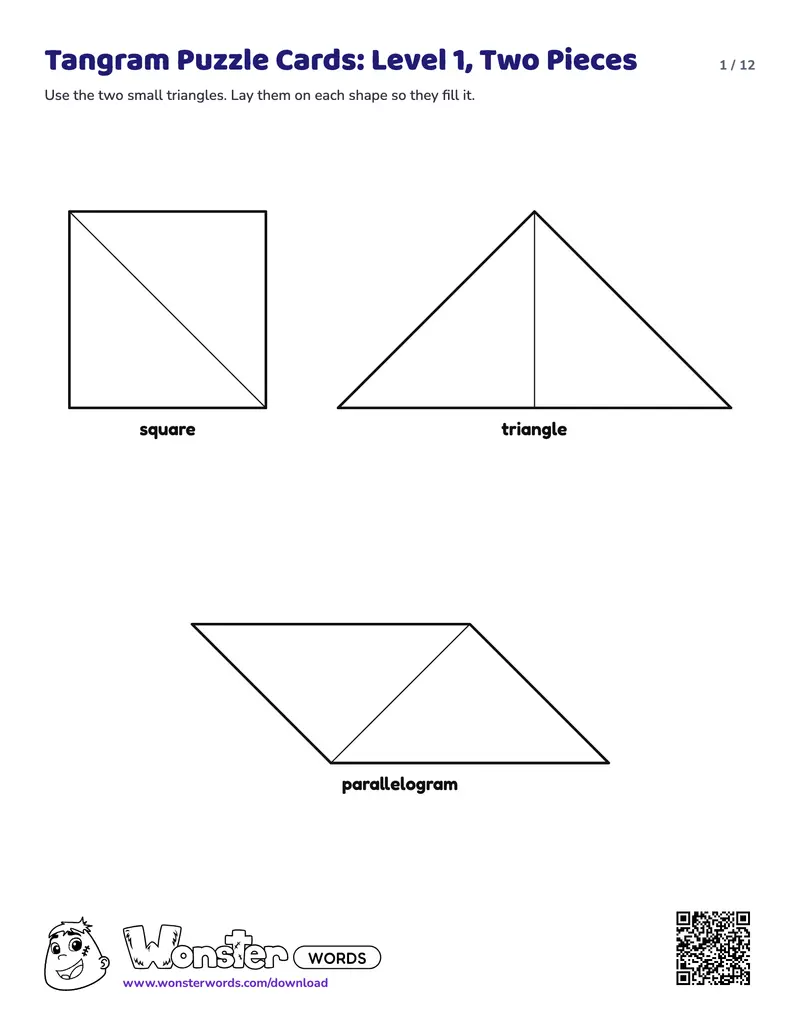
- Tangram Puzzle Cards, from about 5. Four levels, in the order of the how-to: two- and three-piece puzzles, full-size pictures with every piece shown, full-size outlines with no lines, and small silhouettes with some pieces turned. Solutions are at the back.
- Pattern Block Mats, from about 3. A set of paper pattern blocks to cut out, mats with every block drawn, mats with some lines, outline-only mats, and a “make this hexagon 3 ways” page. The mats with some lines and the outline-only mats each have a strip for counting the blocks used, and solutions are at the back.
Print on card at 100 percent so the pieces and the outlines match. An outline puzzle can have more than one right answer, so each solution page is headed “One way to make it”. Tracing, matching, and sorting sheets for other shapes are on the shapes worksheets page.
Free PDF · no sign-up
Free printable tangram puzzles and pattern block mats
Three free PDFs in black and white, with no account and no email: the tangram pieces to cut out, the tangram puzzle cards with solutions, and the pattern block mats with solutions. Each ends with a page for grown-ups.
- Tangram Pieces (PDF)14 pieces · 4 pages
Preview page 1Preview
- Tangram Puzzle Cards (PDF)20 puzzles · answer key included · 12 pages
Preview page 1Preview
- Pattern Block Mats (PDF)8 mats · answer key included · 13 pages
Preview page 1Preview
Going further
Once tangrams are easy, three ideas take joining shapes further:
- Polyominoes. These are shapes made of squares joined edge to edge. Four squares make 5 different shapes, the tetrominoes, when a turned or flipped copy counts as the same shape. Ask your child to find all five with paper squares.
- Flips and turns have grown-up names. The Common Core writing team calls slides, flips, and turns “the informal names” for translations, reflections, and rotations. The flipped parallelogram is a reflection.
- Symmetry. A pattern block design that matches across a line is symmetric. See how to find a line of symmetry.
Fractions with pattern blocks, such as a triangle being one sixth of the hexagon, come in later grades.
Frequently asked questions
What are the different shapes in a tangram?
A tangram has seven pieces: two large triangles, one medium triangle, two small triangles, one square, and one parallelogram. All five triangles are the same shape in three sizes, each with one square corner. Together the seven pieces make a square, and they can also make one large triangle.
What age group benefits most from using pattern blocks?
Pattern blocks suit children from about 3 to 7. Children of 3 and 4 build freely and cover pictures where every block is drawn. Kindergartners and first graders fill bare outlines and join shapes to make new ones, which is the Common Core standard for those grades.
What are pattern blocks used for?
Pattern blocks are used for covering and filling picture outlines, and then for joining shapes to make new shapes, which is a kindergarten and first-grade standard. Children also count and sort the blocks they used. In later grades, teachers use them for fractions, because the smaller blocks fit exactly into the hexagon.
Can I make my own pattern blocks?
Yes. Print the six blocks at actual size on card and cut them out. Paper blocks work on printed pattern block mats, as long as they are printed at 100 percent. They wear out sooner than wood or plastic, so keep them in an envelope.
What age is appropriate to start with tangram puzzles?
Two-piece tangram puzzles, such as two small triangles that make a square, work from about 3 or 4. Full tangrams with all seven pieces usually come between about 5 and 7, starting with pictures that show where each piece goes.
How do homemade tangrams compare to store-bought ones?
A homemade tangram does the same puzzles as a bought one, as long as the pieces are cut accurately from one square. Card lasts longer than paper, and wood or plastic lasts longest. A paper set is a good way to find out whether your child enjoys tangrams before buying one.
How is a tangram different from a jigsaw puzzle?
A jigsaw has one place for every piece, found by matching the picture and the shape of the edge. A tangram has seven plain pieces, and the same seven make every tangram picture, so a child has to work from the shapes alone, turning and flipping pieces. A jigsaw is matching; a tangram is joining shapes.
Wooden vs. plastic pattern blocks for preschoolers: Which should I choose?
Either works. What matters is that the set has the six standard shapes at the standard size, so the blocks fit each other and fit printed mats. Wood is heavier and steadier, plastic is lighter and easy to wash, and foam is quiet but less exact.
Pattern blocks vs. geoboards: Which is better for early ages?
They do different jobs. Pattern blocks fill a flat shape with other shapes, and a geoboard makes the outline of a shape with rubber bands, which is about sides and corners. Pattern blocks usually come first, because a 3-year-old can cover a picture before stretching bands.
Can tangrams be used for art projects?
Yes. Children can build tangram animals or people, trace around them, and color them in, or glue paper pieces down to make a picture. A set of tangram animals can also become the characters in a story your child tells.
Are digital tangrams as good as real ones?
A screen can show a tangram puzzle and check the answer. Building shapes from real materials is what the kindergarten standards describe, so real or paper pieces are the place to start. A screen can add more puzzles once the real pieces are easy.
Related guides
Last updated