
Math
Quadrilaterals for Kids
What a quadrilateral is, the six types and what each must have, why a square is a rectangle, the trapezoid question schools disagree on, and how to teach it at home.
Grades: grade 2 to grade 3 · Common Core: 3.G.A.1 · Texas: 3.6(B) · Related: Common Core 2.G.A.1, 1.G.A.2; Texas K.6(A), 1.6(D), 2.8(C)
A quadrilateral is a flat shape with 4 straight sides and 4 corners, closed all the way around. Every square, rectangle, and diamond shape is a quadrilateral, and so is a lopsided four-sided shape with no special name. The six named types are the square, the rectangle, the rhombus, the parallelogram, the trapezoid, and the kite, each told apart by its sides and corners. One shape can have several names: a square is also a rectangle, because it has 4 square corners, and a rhombus, because it has 4 equal sides.
Children meet the word in second grade and sort the types in third grade (Common Core 3.G.A.1; the Texas standard, 3.6(B), adds parallelograms and trapezoids). This guide draws each type, answers the trapezoid question schools disagree on, and ends with a free quadrilateral chart and sort.
What is a quadrilateral?
A quadrilateral is a flat shape with 4 straight sides and 4 corners, closed all the way around. The test a child can run on any shape takes one question: does it have 4 straight sides that join up with no gap? If it does, it is a quadrilateral, however it is turned or stretched. The word says it: “quadri” means four and “lateral” comes from the Latin word for side, according to the American Heritage Dictionary.
| Shape | Quadrilateral? | Why |
|---|---|---|
| Square | Yes | 4 straight sides, closed |
| Long, thin rectangle | Yes | 4 straight sides, closed |
| Tilted rhombus | Yes | 4 straight sides, closed |
| Lopsided four-sided shape | Yes | 4 straight sides, closed; it just has no special name |
| Dart (an arrowhead shape) | Yes | 4 straight sides, closed, with one corner pointing in |
| Triangle | No | 3 sides |
| Pentagon | No | 5 sides |
| Four-sided shape with a gap | No | Not closed |
| Four-sided shape with a curved side | No | One side is not straight |
A circle is not one either: it has no straight sides at all. A quadrilateral is also flat, the kind of shape that is drawn on paper; a box is a 3D shape, even though its faces are rectangles.
“Vertex” is the math word for a corner, and “vertices” means more than one, so a quadrilateral has 4 vertices. Shapes with 3, 5, 6, or more sides have their own names, and the shapes by number of sides guide lists them up to 12.
Types of quadrilaterals and their properties
There are six named types of quadrilateral: the square, the rectangle, the rhombus, the parallelogram, the trapezoid, and the kite. Each is named by what it must have, and two ideas decide most of them. A square corner is a right angle: the corner of a sheet of paper fits it exactly. Parallel sides are two sides that run the same way and never meet, however long you make them, like train tracks. Children use these words informally in third grade and learn them formally in fourth.
| Type | What it must have | Also called | Learned in |
|---|---|---|---|
| Square | 4 equal sides and 4 square corners | A rectangle, a rhombus, and a parallelogram | Pre-K and kindergarten (the name); grade 3 as a quadrilateral |
| Rectangle | 4 square corners (which makes its opposite sides equal and parallel) | A parallelogram | Pre-K and kindergarten (the name); grade 3 as a quadrilateral |
| Rhombus | 4 equal sides | A parallelogram; a square, if its corners are square | Grade 1 in Texas (1.6(D)); grade 3 in both |
| Parallelogram | 2 pairs of parallel sides | Rectangles, rhombuses, and squares are all parallelograms | Grade 3 in Texas (3.6(B)); in the Common Core, the grade 3 Progressions name it, not a standard |
| Trapezoid | A pair of parallel sides: at least one pair, or exactly one pair, depending on the book | Grade 1 in the Common Core, as a shape to build with (1.G.A.2); grade 3 in Texas (3.6(B)) | |
| Kite | 2 pairs of equal sides, each pair sitting next to each other | Not on either grade 3 list; the usual “other” quadrilateral | |
| Other quadrilaterals | 4 straight sides, nothing more | Just “quadrilateral” | Grade 2 (the word); grade 3 (draw one) |
The corners decide a rectangle, the sides decide a rhombus, and a square has both. A shape takes every name whose row it meets, so a square is also a rectangle and a rhombus. The trapezoid row has two answers because schools use two definitions of a trapezoid. The first shape names, the circle and the triangle among them, are in the 2D shapes guide.
Is a square a rectangle? How the types of quadrilaterals fit together
A square is a rectangle. A rectangle is any quadrilateral with 4 square corners, and a square has 4 square corners, so it qualifies; its sides just happen to be equal too. That is why all squares are rectangles but not all rectangles are squares: a long, thin rectangle has square corners and unequal sides. A square is a special rectangle the way a puppy is a special dog.
A square is also a rhombus, because it has 4 equal sides, and not every rhombus is a square. One level up, rectangles and rhombuses are both parallelograms, because each has 2 pairs of parallel sides.
| Is it also a…? | Quadrilateral | Parallelogram | Rectangle | Rhombus | Square |
|---|---|---|---|---|---|
| Square | Yes | Yes | Yes | Yes | Yes |
| Rectangle that is not a square | Yes | Yes | Yes | No | No |
| Rhombus that is not a square | Yes | Yes | No | Yes | No |
| Parallelogram with no square corners and unequal sides | Yes | Yes | No | No | No |
| Kite that is not a rhombus | Yes | No | No | No | No |
| Other quadrilateral | Yes | No | No | No | No |
Schools teach that a square is a rectangle at different grades. Texas calls squares “special rectangles” from kindergarten (K.6(A), TEKS kindergarten). The Common Core asks for it in third grade, where children learn that shapes “may share attributes (e.g., having four sides), and that the shared attributes can define a larger category (e.g., quadrilaterals)” (3.G.A.1). The Common Core writing team’s Geometry Progressions set grade 3 at “two levels of subcategories (e.g., rectangles are parallelograms and squares are rectangles)”, and leave the whole family tree for grade 5 (2023 edition, p. 116). A third grader is asked for the two levels in the table above. The family tree below is for the grown-up.
In words, the tree runs: every parallelogram, kite, and trapezoid is a quadrilateral; rectangles and rhombuses are parallelograms; and the square sits under both, as the shape that is a rectangle and a rhombus at once. Younger children sort squares and rectangles apart while they learn the names, and the 2D shapes guide answers the question for a kindergartner.
Are all parallelograms trapezoids? Why the answer depends on the book
Whether all parallelograms are trapezoids depends on the definition your child’s school uses. A trapezoid is a quadrilateral with a pair of parallel sides, and schools agree on that. They disagree about whether it can have 2 pairs. The “exactly one pair” definition, often called exclusive, says a parallelogram is not a trapezoid. The “at least one pair” definition, called inclusive, says every parallelogram is a trapezoid, and so is every rectangle, rhombus, and square.
The Common Core does not choose. Its writing team’s Geometry Progressions set out both definitions and say “Both definitions are legitimate”, then quote Zalman Usiskin and colleagues, who found the inclusive one favored by “most college-bound geometry books” (p. 114). The same page adds that while children are naming and describing shapes, “the different definitions are unlikely to affect students or curriculum”. The curricula split:
- “At least one pair”: Illustrative Mathematics (grade 5, unit 7); Eureka Math², whose teacher edition says “Both definitions are acceptable”; and Utah, which adopted it for its standards and tests.
- “Exactly one pair”: Investigations 3, whose authors write that “Most elementary textbooks use the exclusive definition”; and, in Texas, the state test. Its published answer explanations say a trapezoid “has exactly one pair of parallel lines” (STAAR grade 4, 2023), and so does the glossary of Texas’s Education Service Center Region 13. The Texas standards themselves define neither.
The reverse question has one answer. A trapezoid is not always a parallelogram, under either definition, because a trapezoid with only one pair of parallel sides is not a parallelogram.
Neither answer is a mistake: the two books define the word differently, and children usually meet the question head on in fourth or fifth grade. Ask which definition your child’s class uses, and use that one. If a worksheet asks for a trapezoid and the definition is unclear, draw one with exactly one pair of parallel sides: it is a trapezoid by both.
How can you tell the types of quadrilaterals apart quickly?
To tell quadrilaterals apart, ask four questions in order. Each one has a test a child can do with a sheet of paper.
- Does it have 4 straight sides, closed? If not, it is not a quadrilateral.
- How many pairs of parallel sides? Two pairs puts it in the parallelogram family, one pair makes it a trapezoid, and none makes it a kite or another quadrilateral. Test: lay a strip of paper along one side and slide it across. If it lines up with the opposite side, those two sides are parallel.
- Are the corners square? Fit the corner of a sheet of paper into each one. If all four are square, it is a rectangle.
- Are all the sides equal? Fold a strip of paper to the length of one side and check the others against it. If all four match, it is a rhombus. A shape with square corners and equal sides is a square.
Teach your child to say every name that fits, not just one. A square gets a Yes in every column of the “Is it also a…?” table, so it is a quadrilateral, a parallelogram, a rectangle, a rhombus, and a square.
Which quadrilaterals do kids mix up?
Children mix up quadrilaterals when they name a shape by how it looks instead of by what it has, and the four questions fix each mix-up. The Common Core writing team’s Geometry Progressions describe young children naming shapes “often based initially on visual prototypes”, the typical picture of each shape (p. 117).
- “A square on its corner is a diamond.” It is still a square. Turn the page and check the corners with paper: they are square.
- “A square is not a rectangle.” It is, because it has 4 square corners. The section above gives the reason.
- Rhombus and square. Both have 4 equal sides. Only the square has square corners.
- Parallelogram and rectangle. Both have 2 pairs of parallel sides. Only the rectangle has square corners, so a rectangle pushed over into a lean is a parallelogram.
- An upside-down or lopsided trapezoid. It is still a trapezoid if one pair of its sides is parallel. Slide the paper strip to check.
- Trapezoid and parallelogram. A trapezoid with one pair of parallel sides is not a parallelogram, which needs 2. Whether a parallelogram also counts as a trapezoid is the definition question.
- Kite and rhombus. Both have equal sides that sit next to each other. Only the rhombus has all four equal: check with a folded strip of paper.
- “A quadrilateral has to look like a box.” Any 4 straight sides that close make a quadrilateral, including the dart, with its corner pointing in.
What are some quadrilaterals that are not squares, rectangles, or rhombuses?
A quadrilateral that is not a square, rectangle, or rhombus is any four-sided shape without 4 square corners and without 4 equal sides. The easiest to draw are a kite, a trapezoid with one pair of parallel sides, a lopsided quadrilateral with four different sides, and a dart. Third-grade homework asks for this because the Common Core’s third-grade geometry standard asks children to “draw examples of quadrilaterals that do not belong to any of these subcategories”. The lopsided shape is often called “irregular”. Strictly, every quadrilateral except the square is irregular.
A leaning parallelogram also works under the Common Core’s list. The Texas version (3.6(B), TEKS grade 3) also rules out parallelograms and trapezoids, so the kite, the lopsided shape, and the dart are the answers that satisfy both. The Common Core writing team’s Geometry Progressions offer a harder version: “a shape with two long sides of the same length and two short sides of the same length that is not a rectangle” (p. 124). A kite answers it, and so does a leaning parallelogram.
To draw one on dot paper:
- Pick 4 dots, no 3 of them in a straight line.
- Join them in order, around the outside, without any line crossing another.
- Check it with the paper tests: it must not have 4 square corners or 4 equal sides, so it is not a square, a rectangle, or a rhombus.
What grade do kids learn quadrilaterals?
Children learn the word “quadrilateral” in second grade and sort quadrilaterals by type in third grade, under both the Common Core and the Texas standards.
| Grade | What children do | Common Core | Texas (TEKS) |
|---|---|---|---|
| K | Name squares and rectangles | K.G.A.2 | K.6(A): “squares as special rectangles” |
| 1st | Build with trapezoids and rectangles; Texas adds the rhombus | 1.G.A.2 | 1.6(D) |
| 2nd | The word “quadrilateral”: shapes by number of sides | 2.G.A.1 | 2.8(C), polygons with up to 12 sides |
| 3rd | Sort quadrilaterals by type; see squares, rectangles, and rhombuses as quadrilaterals; draw one that is none of them | 3.G.A.1 | 3.6(B), which adds parallelograms and trapezoids |
| 4th | Parallel lines and right angles by name; sort shapes by them | 4.G.A.1–2 | 4.6(A), 4.6(D) |
| 5th | The whole family tree | 5.G.B.3–4 | 5.5 |
The fourth- and fifth-grade rows are what comes next, not what a third grader owes. Utah’s grade 3 Core Guide says third graders are “not expected to master these concepts until fourth grade”, and the hierarchy “is reserved for fifth grade”. In third grade the rectangle also takes on a new job, as the shape behind area and the area model for multiplying. The shapes guide sets out which shapes to expect at every age.
Quadrilaterals in real life
Quadrilaterals are everywhere a child looks, as long as the thing is seen straight on. A door seen from an angle is not a rectangle on paper, so hold each one flat or stand in front of it before naming it.
| Type | Things to find |
|---|---|
| Square | A sticky note, a floor tile, a square cracker |
| Rectangle | A door, a book, a phone |
| Rhombus | A yellow diamond warning sign, which is a square on its point and so a rhombus too; the blue and tan pattern block pieces |
| Parallelogram | A deck of cards pushed into a lean, seen from the side |
| Trapezoid | The red pattern block, a popcorn bucket seen from the side, a lampshade’s outline |
| Kite | A kite |
Yellow diamond warning signs are squares. The Federal Highway Administration’s Manual on Uniform Traffic Control Devices says warning signs “shall be diamond-shaped (square with one diagonal vertical)” (Section 2C.02), with a few exceptions.
Play a quadrilateral hunt around the house: every find scores a point for each column of the “Is it also a…?” table it fits, so a sticky note scores five. The shapes guide’s shape hunt suits younger children.
How to teach quadrilaterals at home
Teach quadrilaterals at home in five steps, from building them with straws to drawing one that has no special name, with a sheet of paper as the test every time. A session takes about 20 minutes with straws, paper, and a pencil.
Build them
Join four straws or craft sticks of the same length with tape or playdough to make a square. Push it over: the sides stay equal but the corners stop being square, and it is a rhombus. Straighten it back into a square and swap two opposite sticks for longer ones: now it is a rectangle. Push that over, and it is a parallelogram.
Test with paper
Use the corner of a sheet of paper to check for square corners, a folded strip of paper to check that sides are equal, and a strip slid across the shape to check whether opposite sides are parallel.
Sort, then sort again
Cut out paper squares, rectangles, rhombuses, parallelograms, trapezoids, and kites. Sort them into shapes with 4 square corners and shapes without. Mix them up and sort by 4 equal sides. The shapes that landed in the yes pile both times are the squares.
Play Mystery Quadrilateral
One person secretly picks a shape. The other asks only yes-or-no questions about its sides and corners, such as "Does it have square corners?", until they can name it. Then swap.
Draw on dot paper
Ask for a rhombus that is not a square, then a quadrilateral that is not a square, a rectangle, or a rhombus. Your child joins four dots and checks the drawing with the paper tests.
Step 1 builds on a first-grade Common Core idea, to “build and draw shapes to possess defining attributes” (1.G.A.1). The child changes one thing and watches which name changes with it. Straws, craft sticks, and paper shapes are among the math manipulatives that cost nothing. The yes-or-no guessing game in step 4 comes from a third-grade lesson of the same name by Illustrative Mathematics.
Folding paper shapes in half shows which ones have a fold where both halves match, which is symmetry: a square, a rectangle, and a kite do, and a leaning parallelogram does not. Triangles are sorted the same way, by sides and corners, and children meet them first.
Free quadrilateral worksheets and chart
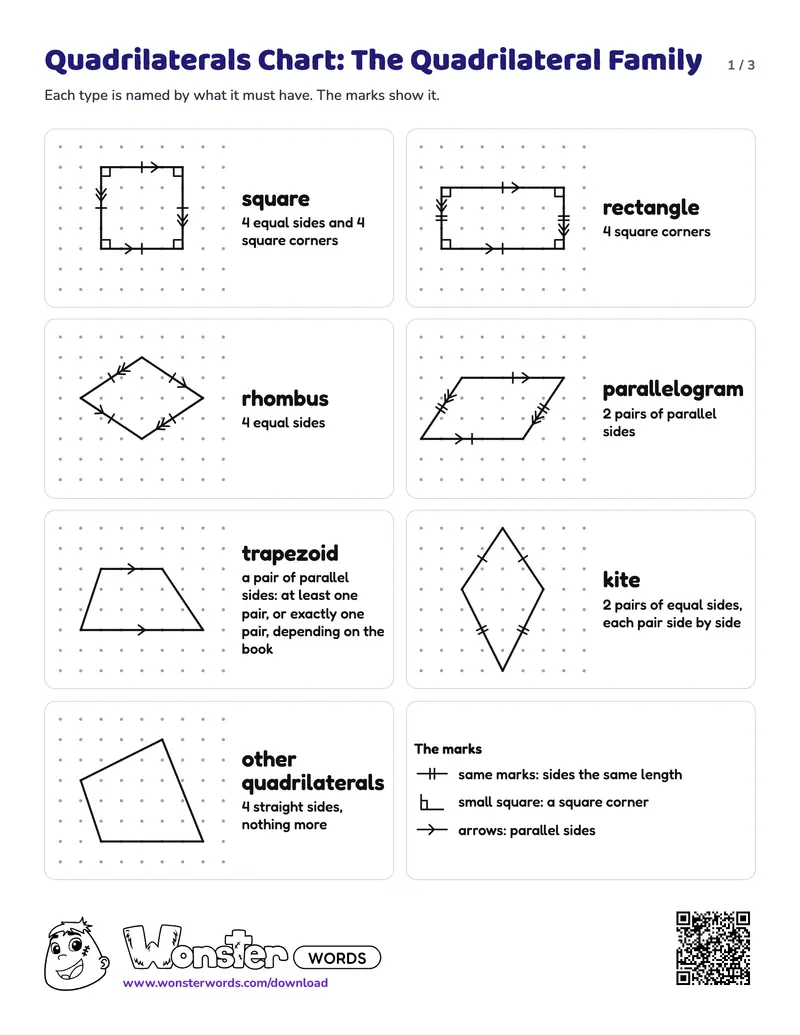
Our free quadrilateral sheets are two PDFs: a chart to keep, and a sort for third grade. The quadrilaterals chart draws the six types and “other” large, each with its tick marks, square-corner marks, and parallel arrows, and a line saying what it must have. Its second page is the family tree, with a dashed line where the trapezoid joins the parallelograms under the “at least one pair” definition, and the four questions for telling the types apart. The chart suits second and third grade and ends with a page for grown-ups.
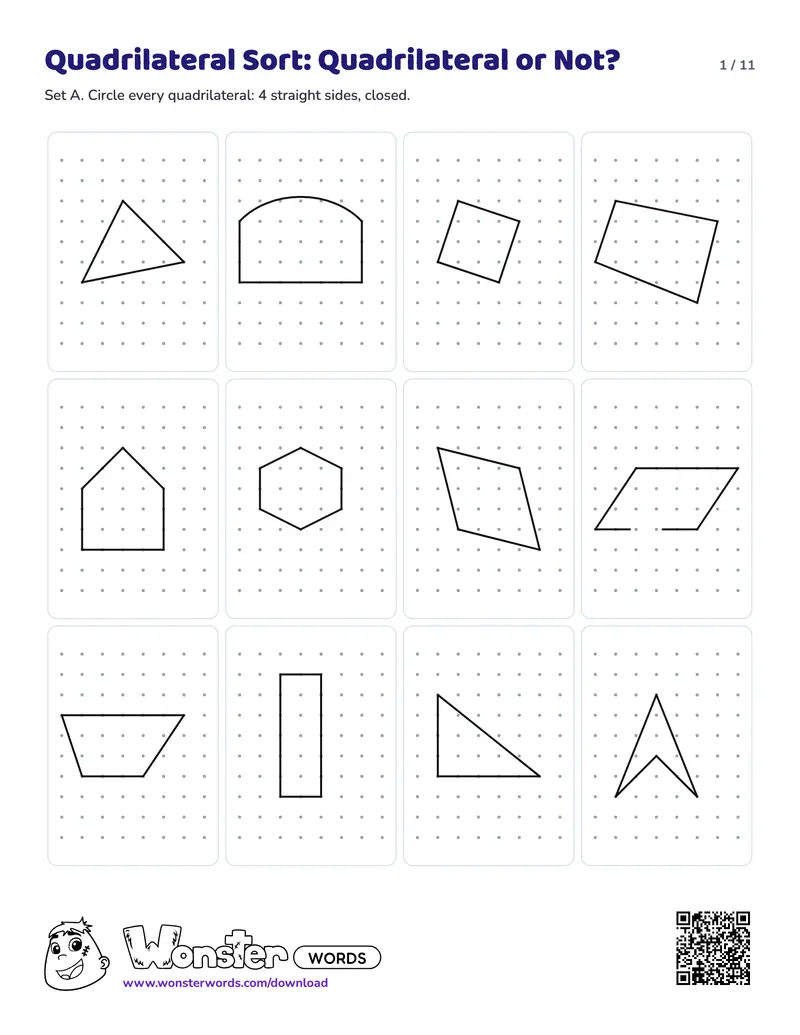
The quadrilateral sort has four activities, and each prints twice, with the same items in a new order:
- Quadrilateral or not? Circle the quadrilaterals among 12 shapes, including a dart, a triangle, and a four-sided shape with a gap.
- Name it. Write the most specific name for each of 8 quadrilaterals, turned and stretched, from a word bank.
- Every name that fits. Mark every name that fits each of 6 shapes: quadrilateral, parallelogram, rectangle, rhombus, square.
- Draw it. Draw a quadrilateral that is not a square, rectangle, or rhombus, a rhombus that is not a square, a shape with two long equal sides and two short equal sides that is not a rectangle, and a trapezoid.
Answer keys follow, then a page for grown-ups. Every trapezoid on both sheets has exactly one pair of parallel sides, so it is right under either definition, and no sheet asks whether a parallelogram is a trapezoid. Every shape is an outline, so the sheets print in black and white. The kindergarten and first-grade shape sheets are in the shapes worksheets.
Free PDF · no sign-up
Free quadrilateral worksheets and chart
Two free PDFs in black and white, with no account and no email: the quadrilaterals chart, and the quadrilateral sort with its answer keys. Each ends with a page for grown-ups.
- Quadrilaterals Chart (PDF)7 shapes · 3 pages
Preview page 1Preview
- Quadrilateral Sort (PDF)30 shapes · answer key included · 11 pages
Preview page 1Preview
Frequently asked questions
What are the 7 types of quadrilaterals?
Six quadrilaterals have their own names in elementary school: the square, the rectangle, the rhombus, the parallelogram, the trapezoid, and the kite. Lists that say seven add either the isosceles trapezoid, a trapezoid whose two slanted sides are equal, or "irregular" for every other four-sided shape. Every four-sided shape is still a quadrilateral.
Is a rhombus a square?
A rhombus is a square only when its corners are square corners. Every square is a rhombus, because it has 4 equal sides, but not every rhombus is a square.
Is a kite a rhombus?
A kite is a rhombus only when all four of its sides are equal. By the usual definition of a kite, two pairs of equal sides that sit next to each other, every rhombus is also a kite.
Is every trapezoid a parallelogram?
No. Schools use two definitions of a trapezoid, and under both, a trapezoid with only one pair of parallel sides is not a parallelogram, because a parallelogram needs 2 pairs.
Are rhombuses and trapezoids introduced in the same grade?
No. The Common Core names the trapezoid in first grade, as a shape to build with, and the rhombus first in third grade. Texas names the rhombus in first grade. In third grade, Texas sorts both as quadrilaterals; the Common Core's third-grade standard names the rhombus, and its Geometry Progressions add the trapezoid.
What is a regular quadrilateral?
A square is the regular quadrilateral. It is the only quadrilateral with all four sides equal and all four corners equal.
Why is it important for kids to learn about quadrilaterals?
Sorting quadrilaterals is where children start reasoning that one shape can belong to several groups at once, such as a square that is also a rectangle. The Common Core places that in third grade. The rectangle is also where area begins, in third grade.
What is a trapezium?
In British English, and in England's national curriculum, a trapezium is the shape American schools call a trapezoid. American dictionaries list a second meaning, a four-sided shape with no parallel sides, which is why a British worksheet and an American one can use the same word for different shapes.
Do quadrilaterals have symmetry?
Some do. A square has 4 lines of symmetry, a rectangle or a rhombus that is not a square has 2, a kite that is not a rhombus has 1, and a parallelogram with no square corners and unequal sides has none.
Related guides
Last updated