
Math
Symmetry for Kids
What a line of symmetry is, how to find one by folding or with a mirror, how many lines each shape and capital letter has, symmetry in nature, activities, what grade learns it, and how to help at home.
Grades: kindergarten to grade 3 · Related: Common Core 1.G.A.3, 2.G.A.3; Texas 1.6(G), 1.6(H), 2.3(A)
Symmetry means one half of a shape or picture is the mirror image of the other half. A line of symmetry is the line you could fold along so the two halves match exactly. A heart has 1 line of symmetry, a square has 4, and the capital letter F has none.
In the US, lines of symmetry are a fourth-grade standard in the Common Core and in Texas. Younger children can find them long before then, by folding paper and holding up a mirror. Symmetry is one of the shape ideas children meet after the shape names. Free draw-the-other-half and lines-of-symmetry worksheets with answer keys, and a lines-of-symmetry chart, come with this guide, all in black and white with no sign-up.
What is symmetry, and what is a line of symmetry?
Symmetry, in the sense children learn first, is line symmetry: a shape is symmetric when one side is the mirror image of the other. It is also called mirror symmetry or reflection symmetry. The line between the two halves is the line of symmetry. Fold along it and the halves land exactly on top of each other. The Common Core defines it the same way, as “a line across the figure such that the figure can be folded along the line into matching parts” (standard 4.G.A.3).
The halves have to be mirror halves, not just equal halves. Cut a rectangle from corner to corner and you get two equal halves, two triangles of exactly the same size. Fold the rectangle along that same diagonal, though, and the triangles do not land on each other: the corners stick out, so the diagonal is not a line of symmetry.
A shape with no line of symmetry is asymmetric: no fold makes its halves match. A line of symmetry can run up and down, across, or on a slant, and a shape can have none, one, or many.
A flip, or reflection, moves a shape across a mirror line to a new place. A line of symmetry is a mirror line where the shape flips onto itself. Young children already flip and turn puzzle pieces to make them fit. The writers of the Common Core call slides, flips, and turns “the informal names for translations, reflections, and rotations” in their Progressions.
The word has other meanings too. Some shapes look the same after a turn, which is rotational symmetry, a later-grade topic. Algebra has an “axis of symmetry”, and biologists call a body with one mirror line “bilateral”. This guide is about lines of symmetry.
Free symmetry worksheets: draw the other half
The free symmetry printables are three PDFs: a draw-the-other-half worksheet, a lines of symmetry worksheet, and a lines of symmetry chart, all in black and white, with no account and no email.
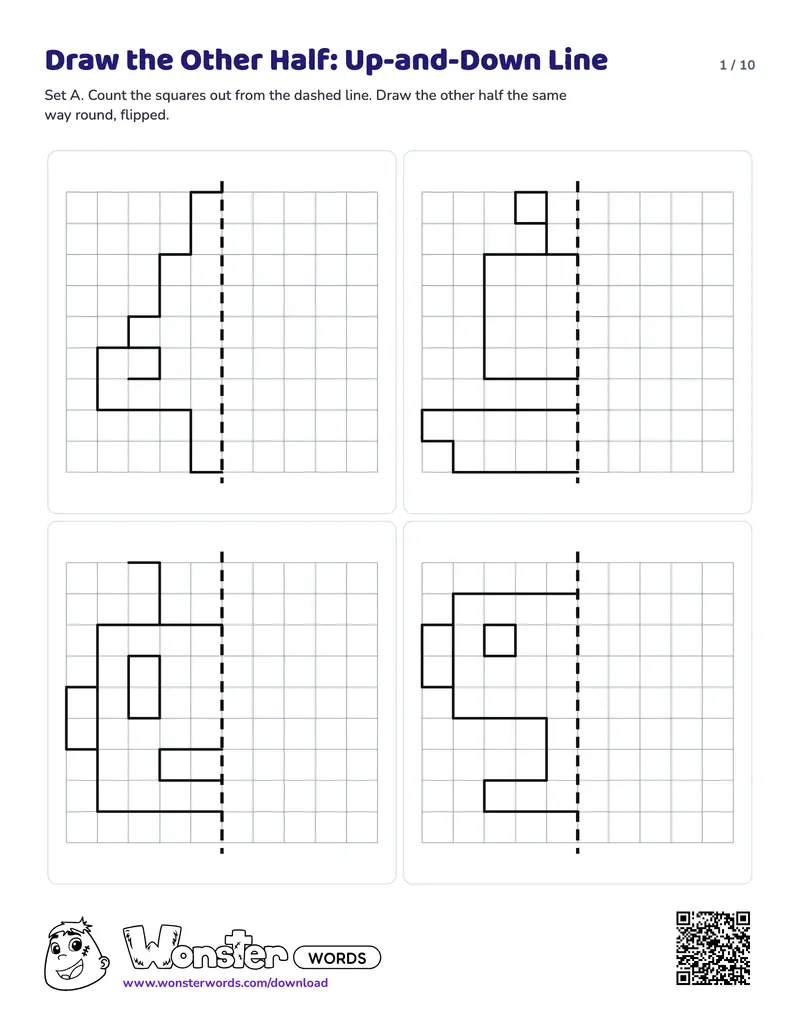
- Draw the Other Half. Print this one first, for any child from kindergarten to third grade who can hold a pencil on a grid. Each picture, such as a house, a rocket, or a fish, is drawn on large squares with half of it missing beside a heavy dashed mirror line. Your child draws the other half. Its three activities move from an up-and-down line, to a line across, to bigger pictures with slanted edges.
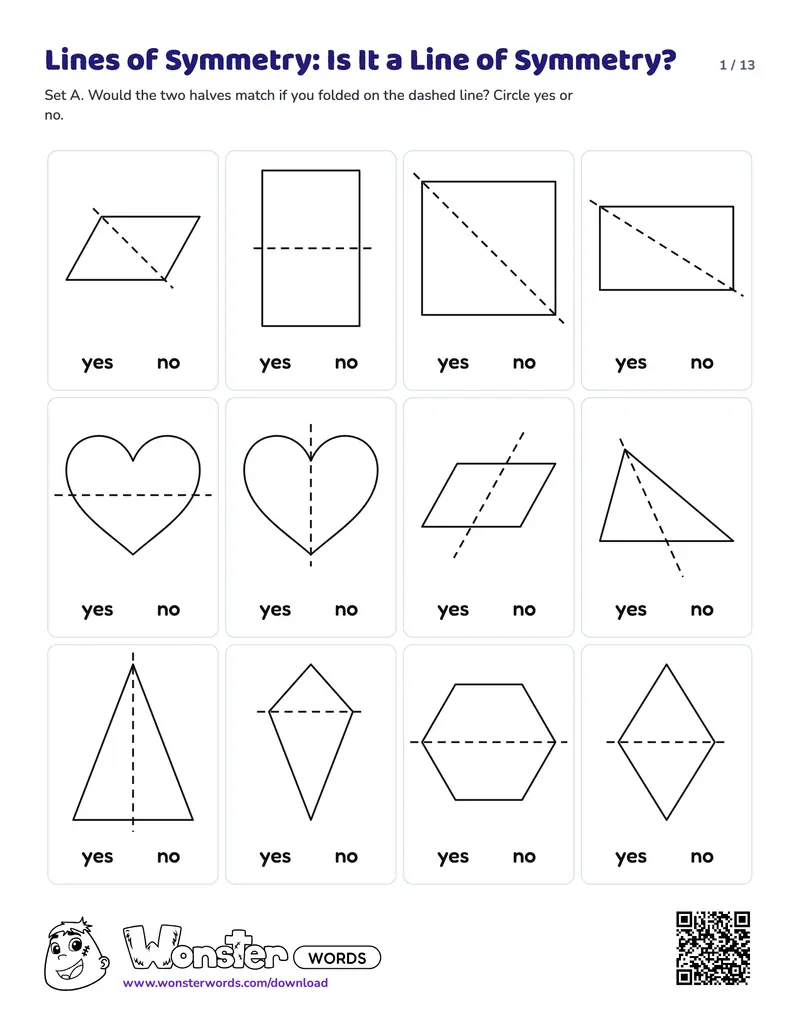
- Lines of Symmetry. Print this one once your child can fold a paper shape to check whether its halves match, from first to third grade. Its four activities ask: is this dashed line a line of symmetry, yes or no; draw the one line of symmetry; draw every line and write how many; and find the lines in twelve capital letters.
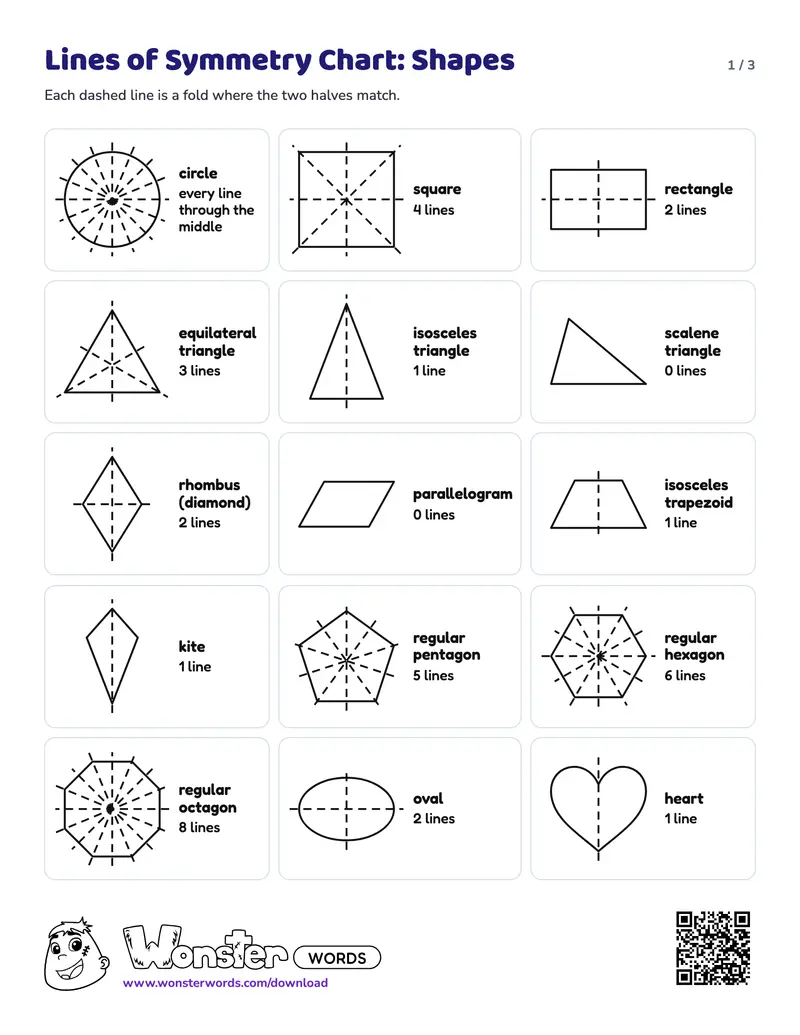
- Lines of Symmetry Chart. A reference for the fridge or the homework folder: 15 shapes, from a circle to a heart, drawn with their lines dashed, then the capital letters with theirs. It has no answers to fill in, so it stays off the table while your child works on the worksheets.
Each worksheet prints every activity twice, with the same items in a new order, and answer keys follow the practice pages. A page for grown-ups closes every PDF, on what the skill is and why folding comes before drawing. A small mirror makes each worksheet self-checking: stand it on the dashed line and the reflection shows whether the drawn half matches. Shape tracing and naming sheets for younger children are on the shapes worksheets page.
Free PDF · no sign-up
Free symmetry worksheets: draw the other half
Print Draw the Other Half first, with a small mirror to check it, then Lines of Symmetry once your child can fold a shape to test it. Keep the chart on the fridge. Both worksheets have answer keys.
- Draw the Other Half (PDF)12 pictures · answer key included · 10 pages
Preview page 1Preview
- Lines of Symmetry (PDF)38 shapes · answer key included · 13 pages
Preview page 1Preview
- Lines of Symmetry Chart (PDF)15 shapes · 3 pages
Preview page 1Preview
How do you find a line of symmetry? Fold it, or hold up a mirror
To find a line of symmetry, fold the shape and look: if the two halves land exactly on top of each other, the fold is a line of symmetry. A mirror shows the same thing without folding. Three tests, in the order to teach them:
- The fold test. Cut the shape out, fold it, and hold it up to a window. If the edges meet all the way around, the fold is a line of symmetry. Unfold it and draw along the crease. Then try another fold.
- The mirror test. Stand a small mirror upright on the line you are testing. If the half in front of the mirror and its reflection make the whole shape, the line is a line of symmetry. A mirror works on things you cannot fold, such as a picture in a book or a leaf. With young children, use a small unbreakable mirror with a straight edge.
- The look test, for older children. For every point on one side of the line, there has to be a matching point the same distance away on the other side. On squared paper, that is counting squares out from the line.
To draw a line of symmetry on a shape you cannot cut out, use the mirror test. Find the place where the shape in the mirror looks whole, mark the two points where the mirror’s edge meets the outline, and join them with a ruler.
Without a mirror, the fold test does the same job.
Fold first, use the mirror second, and draw last. The fold is the definition the Common Core gives in 4.G.A.3, and a child can see for themselves whether the halves match or not. The mirror comes second, because it checks a fold without making one. Drawing comes last, because drawing the other half asks a child to picture the fold in their head. The Common Core’s geometry progression describes first graders “folding paper to make a given two- or three-dimensional shape”, so a fold is already familiar by the time school names symmetry.
How many lines of symmetry does a shape have?
How many lines of symmetry a shape has depends on how many folds make its halves match: a square has 4, a rectangle has 2, and a circle has infinitely many. Count them by trying every fold.
| Shape | Lines of symmetry | Where they are |
|---|---|---|
| Circle | Infinitely many | Every line through the center |
| Square | 4 | Up and down, across, and both corner-to-corner diagonals |
| Rectangle (not a square) | 2 | Up and down, and across, but not the diagonals |
| Equilateral triangle (all sides equal) | 3 | From each corner to the middle of the opposite side |
| Isosceles triangle (two sides equal) | 1 | Down the middle, between the two equal sides |
| Scalene triangle (no sides equal) | 0 | None |
| Rhombus (not a square) | 2 | Its two diagonals |
| Parallelogram (no square corners, sides not all equal) | 0 | None: it looks balanced, but no fold matches |
| Isosceles trapezoid | 1 | Through the middles of the two parallel sides |
| Kite | 1 | The diagonal from the corner where the two short sides meet to the corner where the two long sides meet |
| Regular pentagon | 5 | From each corner to the middle of the opposite side |
| Regular hexagon | 6 | Three corner to corner, three side to side |
| Regular octagon (a stop sign’s shape) | 8 | Four corner to corner, four side to side |
| Oval | 2 | The long way and the short way |
| Heart | 1 | Up and down the middle |
A regular shape, with all its sides and all its corners equal, has as many lines of symmetry as it has sides. The regular pentagon has 5, the regular hexagon 6, and the regular octagon 8. The rule holds only for regular shapes: a rectangle has 4 sides and 2 lines, and a scalene triangle has 3 sides and none. The names of the shapes with more sides are on the shapes by number of sides page. A circle has the most lines of all, because every fold through its middle works.
A square and a rectangle both fold edge to edge, both ways, and only the square also folds corner to corner. A rectangle has 2 lines of symmetry because a fold through the middles of two opposite sides lands every corner on a corner. A corner-to-corner fold does not work on a rectangle, because its long and short sides are different lengths. That holds for every rectangle that is not a square, however long or thin. Fold a sheet of printer paper corner to corner to see the diagonal fail.
A rhombus and a parallelogram both look as if they should fold edge to edge, and neither does. A rhombus folds onto itself along both its diagonals and nowhere else, and a parallelogram that is not a rectangle or a rhombus has no fold where the halves match. The quadrilaterals guide explains what makes each of these four-sided shapes what it is.
Shapes that are not regular can have a line of symmetry too, such as a heart, an arrow, or the outline of a house, and many have none. The fold test decides.
What are the symmetrical letters in the English alphabet?
In plain capital letters like the ones below, 16 of the 26 letters have at least one line of symmetry.
- One up-and-down line: A, M, T, U, V, W, Y
- One line across: B, C, D, E, K
- Two lines, up and down and across: H, I, O, X
- No line: F, G, J, L, N, P, Q, R, S, Z
The style of the letter decides: a fancy B with a smaller top loop has no line across, and a perfectly round O has infinitely many lines, like a circle. The counts are for the simple block capitals a child prints. In plain lowercase print, only c, i, l, o, v, w, and x have a line, so C, I, O, V, W, and X have one in both forms.
Hunting for the symmetrical letters in your child’s name, or on a cereal box, is a symmetry game for a 6-year-old. Some letters, such as N, S, and Z, look the same upside down, but that is a half turn, not a fold.
Symmetry in nature and art: butterflies, leaves, and faces
Symmetry in nature is nearly symmetry, never perfect symmetry, and saying “nearly” is part of the lesson. A butterfly’s wings, most leaves along their middle vein, and a face each have one up-and-down line, nearly. A five-armed starfish has 5, nearly. A snowflake’s six arms come from ice itself. “The six-fold symmetry you see in a snow crystal arises from the arrangement of water molecules in the ice crystal lattice,” writes Caltech physicist Kenneth G. Libbrecht on SnowCrystals.com. An ideal snowflake has 6 lines of symmetry. Biologists call a body with one mirror line “bilateral”, and a child does not need the word.
To see why “nearly” matters, hold a small mirror along the middle of a photo of a face. The face made from one half and its reflection looks different from the real one, because a face is only nearly symmetric. Bobbie Kalman’s picture book What Is Symmetry in Nature? (Crabtree, 2011) looks at the same idea in living things.
A child can test these ten things at home for a line of symmetry with a mirror, and anything handmade is only nearly symmetric:
- A door
- A chair, seen from the front
- A stop sign’s shape (8 lines)
- A spoon
- A plain round plate (a line every way through the middle, like a circle)
- A window
- A table, seen from the front
- A pair of glasses
- A paper heart cut-out
- A book lying open
Artists use symmetry in rangoli patterns, quilt blocks, and the fronts of buildings. They also break it on purpose, which is why a face drawn perfectly symmetric looks odd. A child makes symmetric art by pressing paint between the two halves of a folded sheet, or by cutting half a heart from a folded edge.
Symmetry activities and crafts for kids
Six symmetry activities need only paper, paint, scissors, or a small mirror, and in each one your child sees two halves match.
- Paint-blot butterflies. Fold a sheet of paper in half, open it, and paint on one half only. Press the halves together and open it. The fold makes the other half.
- Fold-and-cut. Fold paper once and cut half a heart, half a tree, or half a person from the folded edge, then open it. Paper folded twice makes a shape with two lines. A paper snowflake shows 6 lines only if a grown-up folds the circle into sixths.
- Mirror drawing. Stand a small unbreakable mirror on half a picture, such as a worksheet picture, a leaf, or a photo. Move it until the picture looks whole, then draw what the mirror shows.
- Build it on both sides. Lay a string or a ruler down the table as the line. You place a block, a button, or a pattern block on one side, and your child places its mirror match on the other. Blocks and buttons are among the math manipulatives most homes already have.
- Symmetry hunt. At home or on a walk, find three things with one line, one with more than one, and one with none.
- Letter hunt. Find the letters in your child’s name that have a line of symmetry, using the symmetrical letters list.
For preschoolers and kindergartners, start with activities 1, 2, and 5, and call the idea “the same on both sides”. Use the word symmetry once the idea lands, and leave drawing lines for later. Activity 4 also works as a turn-taking game: one player builds, the other matches, then swap.
What grade do kids learn lines of symmetry?
Under the Common Core (4.G.A.3) and the Texas standards (TEKS 4.6(B)), children learn lines of symmetry in fourth grade. No standard from kindergarten to third grade in either framework names symmetry.
| Age or grade | What children do | Common Core | Texas (TEKS) |
|---|---|---|---|
| Preschool–3rd grade | Fold paper, build shapes from other shapes, and notice when two sides are the same. No standard names symmetry | None in K.G, 1.G, 2.G, or 3.G | None in §111.2–111.5 |
| 4th grade | Recognize a line of symmetry as a fold into matching parts, and find and draw lines of symmetry | 4.G.A.3 | 4.6(B) |
Texas asks fourth graders to “identify and draw one or more lines of symmetry, if they exist, for a two-dimensional figure” (TEKS 4.6(B)). The Progressions’ fourth-grade example is the draw-the-other-half worksheet on this page: “Given a half of a figure and a line of symmetry, can you accurately draw the other half to create a symmetric figure?”
Younger children meet the idea earlier. The same Progressions say first graders, putting shapes together, build “initial understandings of properties such as congruence and symmetry”. The National Council of Teachers of Mathematics (NCTM) expects children from pre-K to grade 2 to “recognize and create shapes that have symmetry”. NCTM is a professional body, and its recommendations are not a state standard. Schools in England start sooner than US schools do. The national curriculum in England asks Year 2 children, ages 6–7, to describe “line symmetry in a vertical line”, and Year 4 children to “complete a simple symmetric figure with respect to a specific line of symmetry”.
A child of 5–8 who has not met lines of symmetry is on time. Folding, mirrors, and drawing the other half are play that the fourth-grade lesson names later. The shapes a child is expected to know before then, grade by grade, are in the shapes guide.
How can parents help kids understand lines of symmetry?
Parents can teach lines of symmetry at home in five short steps, a few minutes each, with paper, scissors, and a small mirror. It is worth the few minutes for what symmetry connects to. Finding a line of symmetry is a way of describing a shape by its parts, the same habit as counting sides and corners. It is the idea behind two halves that match, it is in the art children make, and it is the fourth-grade lesson met early, as play.
Same on both sides
Fold a paper heart and a paper triangle with uneven sides. Ask your child which one has two halves that match. The heart does, and the uneven triangle does not, whichever way you fold it.
Find the fold
Cut out a paper square and a paper rectangle, such as a sheet of printer paper. Your child tries every fold and keeps the ones where the halves match. The square has 4 and the rectangle has 2.
Check with a mirror
Stand a small mirror upright on each fold line, so the half in front and its reflection make the whole shape. Then try the mirror on a leaf or a toy that cannot be folded.
Draw the other half
On squared paper, draw half a simple picture against a line. Your child counts squares out from the line, point by point, and draws the other half. Check it with the mirror on the line.
Hunt for it
Look for symmetry around you: the capital letters in your child's name, leaves on a walk, the front of your house. Ask whether each one has a line of symmetry, and how many.
Give step 4, drawing the other half, the most time, and go back to the fold whenever the drawing goes wrong.
What are some common mistakes children make when drawing symmetrical pictures?
The symmetry mistake to watch for first is drawing the other half facing the same way, copying the half instead of flipping it. Each of the six below follows from what a line of symmetry is, and each comes with its fix.
- Drawing the other half facing the same way. Drawing the other half asks a child to flip the picture in their head, and a copy is easier. Count squares out from the line, point by point, starting with the points that touch the line. Then stand the mirror on the line to see the flip. If your child is still stuck, go back to a paint blot or a fold-and-cut, where the fold does the flipping.
- Drawing the other half facing the right way, but a different size or a different distance from the line. Use the same counting, one square at a time, and the same mirror check.
- Choosing a line that makes equal halves that do not match, such as a rectangle’s or a parallelogram’s diagonal. Fold it and look.
- Looking only for up-and-down lines. Turn the paper. A line of symmetry can run across or on a slant, like a square’s diagonals.
- Stopping at one line. Ask “Is there another fold?”
- Calling something in nature perfectly symmetric. Say “nearly”, and try the mirror on a photo of a face.
Frequently asked questions
How many lines of symmetry does a square have?
A square has 4 lines of symmetry, not 6. Two run edge to edge, one up and down and one across, and two run corner to corner along the diagonals. Fold a paper square each of those 4 ways and the halves match every time. No other fold makes the two halves of a square match.
What is another name for the line of symmetry?
A line of symmetry is also called a mirror line, because a mirror stood on it shows the whole shape. It is sometimes called an axis of symmetry, which is also the name algebra uses for the line through the middle of a curved graph.
How can I explain symmetry to kids in a simple way?
Tell your child that symmetry means the same on both sides. Then fold a sheet of paper in half, cut half a heart from the folded edge, and open it. The two halves match, and the fold down the middle is the line of symmetry.
What shape has 6 lines of symmetry?
A regular hexagon has 6 lines of symmetry, because its 6 sides are all the same length and its 6 corners are all the same size. Three lines run from corner to opposite corner, and three run from the middle of one side to the middle of the opposite side. An ideal snowflake has 6 lines too.
What are the lines of symmetry in a circle, explained for kids?
A circle has infinitely many lines of symmetry. Every straight line through the center of a circle folds it into two halves that match, so there is always another one to find. That makes the circle the shape with the most lines of symmetry.
What shapes have no lines of symmetry, and why?
A scalene triangle, with no two sides the same length, has no lines of symmetry. Neither does a parallelogram with no square corners and sides that are not all equal, even though it looks balanced. No fold makes the two halves of either shape land on top of each other. The capital letters F, G, J, L, N, P, Q, R, S, and Z have none either.
Why does a rectangle have two lines of symmetry?
A rectangle has 2 lines of symmetry, one up and down and one across, each through the middles of two opposite sides. A fold along either one lands every corner on a corner. A fold from corner to corner does not work, because the long sides and the short sides are different lengths, so the diagonals are not lines of symmetry. Every rectangle that is not a square has 2, and a square has 4.
What is an example of a letter that has two lines of symmetry?
The capital letter H has 2 lines of symmetry, one up and down and one across. In plain capital letters, I, O, and X have 2 as well. A fancy letter style can lose a line, so check the letters your child writes with a mirror.
How can I explain symmetry to my child without a mirror?
Use folded paper. Cut out a shape, fold it along the line you are testing, and hold it up to a window. If the edges meet all the way around, the fold is a line of symmetry. A fold does the same job as a mirror, and it is how the Common Core defines a line of symmetry.
Lines of symmetry vs. lines of reflection: what is the difference?
A line of reflection is a mirror line that flips a shape over to a new place on its other side. A line of symmetry is a mirror line that flips a shape onto itself, so the shape looks exactly the same after the flip. A line of symmetry is a line of reflection that lands the shape on top of itself.
Symmetry vs. Asymmetry for kids: what is the difference?
A symmetric shape has at least one line of symmetry, a fold where the two halves match exactly. An asymmetric shape has none, because no fold makes its halves land on top of each other. A heart is symmetric, and the capital letter F is asymmetric.
At what age do children learn about lines of symmetry?
Under the Common Core and the Texas standards, children learn lines of symmetry in fourth grade, at ages 9–10. Younger children can fold paper, use a mirror, and draw the other half of a picture as play long before then. Schools in England start line symmetry in Year 2, at ages 6–7.
Are lines of symmetry part of the kindergarten curriculum?
No. Neither the Common Core nor the Texas standards name symmetry in kindergarten, or in any grade before fourth. A kindergartner can still fold a paper shape and say whether the two sides are the same, which is the idea the fourth-grade lesson names later.
Why is it important for children to learn about lines of symmetry?
Lines of symmetry are one of the ways children describe a shape by its parts, alongside counting its sides and corners. Symmetry is also the idea behind two halves that match, it is in the art children make, and it is a fourth-grade lesson that a younger child can meet early as play.
What is better for teaching symmetry, paper folding or drawing?
Fold first, then draw. A fold shows a child whether the two halves match, and the Common Core defines a line of symmetry as a fold. Drawing the other half comes after, because it asks a child to picture the fold in their head. A mirror sits between the two, because it checks a fold without making one.
What is rotational symmetry?
Rotational symmetry is a different kind of symmetry, where a shape looks the same after a turn instead of a fold. A square looks the same after a quarter turn, and the capital letter S looks the same after a half turn. It is taught in later grades than lines of symmetry.
Are there children's books about symmetry?
Yes. Seeing Symmetry by Loreen Leedy (Holiday House, 2012) includes activities for making and looking at symmetrical things. What Is Symmetry in Nature? by Bobbie Kalman (Crabtree, 2011) looks at living things, which are nearly symmetric. Let's Fly a Kite by Stuart J. Murphy, illustrated by Brian Floca (HarperCollins, 2000), is a story about two children who learn about symmetry while building a kite. While reading it, pause each time the two children split something into equal parts, and ask whether the halves would match if folded.
Are there apps or online games for learning symmetry?
Yes, several websites and apps offer symmetry games. Folded paper and a small mirror do the same job, and a child holding a real fold can see for themselves whether the two halves match.
Related guides
Last updated