
Math
2D Shapes for Kids
The names of the flat shapes with their sides and corners, why a turned triangle is still a triangle, whether a square is a rectangle, and how to teach shapes at home.
Grades: pre-K to grade 2 · Common Core: K.G.A.2, K.G.B.4, 1.G.A.1 · Texas: K.6(A), K.6(D), K.6(E), 1.6(A), 1.6(B), 1.6(D) · Texas PreK: PK4.V.C.1, PK4.V.C.4 · Related: Common Core K.G.A.3, K.G.B.5, 2.G.A.1, 3.G.A.1; Texas 2.8(C)
A 2D shape is a flat shape, the kind you can draw on paper. Children learn the circle, the square, the triangle, and the rectangle first, then the oval, the rhombus (the “diamond”), the hexagon, the trapezoid, and the pentagon. Each shape is named by its sides and corners: a triangle has 3 straight sides and 3 corners, a square has 4 equal sides and 4 square corners, and a circle has no straight sides and no corners. A shape keeps its name however it is turned or stretched, and a triangle standing on its point is still a triangle. The Common Core asks kindergartners to name shapes “regardless of their orientations or overall size” (K.G.A.2).
Every shape’s sides, corners, and the grade children learn it in are in the shape names table, and a free 2D shapes chart is at the end of this guide.
2D shape names, with pictures
A 2D shape is flat: it has a length and a width but no thickness, so it can be drawn on paper. The Common Core describes 2D shapes as “lying in a plane, ‘flat’”, and asks kindergartners to tell them from solid ones (K.G.A.3). A box or a ball you can hold is a 3D shape. These are the 2D shapes children learn from preschool to second grade, in the order they are taught.
| Shape | Sides | Corners | What makes it that shape | Learned in |
|---|---|---|---|---|
| Circle | None straight (one curved line) | 0 | Round, with every point on the edge the same distance from the middle | Pre-K and kindergarten |
| Square | 4, all the same length | 4 square corners | Four equal sides and four square corners | Pre-K and kindergarten |
| Triangle | 3 | 3 | Three straight sides, closed | Pre-K and kindergarten |
| Rectangle | 4, opposite sides the same length | 4 square corners | Four sides and four square corners | Pre-K and kindergarten |
| Oval | None straight | 0 | A stretched circle; an everyday name, not in the standards | Pre-K and kindergarten, as an everyday word |
| Hexagon | 6 | 6 | Six straight sides | Kindergarten (Common Core); grade 1 (Texas) |
| Rhombus (“diamond”) | 4, all the same length | 4 | Four equal sides; the “diamond” is drawn with corners that are not square | Grade 1 (Texas); grade 3 (Common Core) |
| Trapezoid | 4 | 4 | Four sides, two of them running the same way (parallel) | Grade 1 (Common Core) |
| Pentagon | 5 | 5 | Five straight sides | Grade 2 (Common Core) |
| Heart, star, crescent | Everyday picture names, not geometry names; fine to say | Not in the standards |
“Vertex” is the math word for a corner, and “vertices” means more than one. The kindergarten standard glosses it the same way: “vertices/‘corners’” (K.G.B.4). “Sides” means straight sides, which is why a circle has none.
A square is a rhombus too, the special one with square corners. Math textbooks disagree on whether a shape with two pairs of parallel sides still counts as a trapezoid, and our sheets draw exactly one pair, which counts in all of them. The grades come from the Common Core and the Texas standards (TEKS), and each school follows its own state’s. Our shapes guide covers which shapes to expect at each age, and shapes with 7–12 sides, from the heptagon to the dodecagon, have their own names.
How to explain sides and corners to your child
A 2D shape is named by its sides and corners, not by how it looks at a glance. Five things decide the name: how many straight sides it has, how many corners, whether the sides are the same length, whether the corners are square, and whether the shape is closed all the way around. The Common Core calls these a shape’s defining attributes.
Color, size, and which way the shape is turned do not count. The first-grade standard asks children to “distinguish between defining attributes (e.g., triangles are closed and three-sided) versus non-defining attributes (e.g., color, orientation, overall size)” (1.G.A.1). A big red triangle and a small blue one are both triangles.
To count the corners with your child, put a finger on one corner and count each corner going around, until the finger is back where it started. Count the sides the same way, sliding the finger along each straight edge. The two numbers match on every shape with straight sides: 3 and 3 on a triangle, 4 and 4 on a square, 6 and 6 on a hexagon.
A shape has to be closed, and its sides have to be straight. A triangle with a gap in one side is not a triangle, and neither is a three-cornered shape with one curved side. The Common Core writing team’s Progressions call these “difficult distractors”: shapes “visually similar to examples but lack at least one defining attribute” (2023 edition, p. 117).
Two questions come up once a parent starts counting:
- Sides or corners first? Count them together, since the numbers match. With a 3-year-old, start with the corners: a finger can rest on a corner, and a side is the straight line between two of them.
- Sort by sides, or by color? Color is a fine first sort, but it says nothing about the shape. Sorting by the number of sides or corners teaches shapes, and the shape sort worksheet prints it.
In Texas, first graders tell defining attributes from ones that do not define the shape, as in the Common Core (1.6(B), TEKS grade 1).
Shapes kids mix up
The two shape mix-ups parents ask about most are a turned triangle and whether a square is a rectangle, and both have a test a child can run. Each answer starts from sides and corners.
Is an upside-down triangle still a triangle?
A triangle is still a triangle when it is upside down. A triangle is any closed shape with 3 straight sides and 3 corners. Turning it, stretching it, or making it tall and thin does not change its name.
A child says no because most pictures show a triangle sitting flat on one side with its point up, and a child learns that picture before the rule. The Common Core writing team describes kindergartners naming shapes “often based initially on visual prototypes”, the typical picture of each shape (Progressions, p. 117).
It is normal for a young child to reject a turned triangle. A study by Verdine and colleagues found that children know very few shape names at 25 months. By 30 months, they “are beginning to apply them to some of the less typical instances of the shapes”. Children aged 3–6 in a study by Clements and colleagues still relied mostly on how a shape looks to tell shapes apart.
If your child insists that a turned triangle is not a triangle, do not argue about the name. Run the test together:
- Count. Count the sides and the corners with a finger: 3 and 3.
- Draw it three ways. Draw the same triangle point up, point down, and lying on its side, and count each one.
- Turn it. Cut a triangle from paper and turn it slowly in your hands while your child watches. Ask when it stopped being a triangle.
The Progressions quote a first grader sorting a turned square: “This has to go with the squares, because all four sides are the same, and these are square corners. It doesn’t matter which way it’s turned” (p. 119). A square turned on its corner is still a square, not a diamond, because its corners are still square.
Kindergartners learn to name a shape however it is turned, in the Common Core (K.G.A.2) and in Texas (K.6(E), TEKS kindergarten). The Texas Education Agency asks it of 4-year-olds too: “Child recognizes common shapes, regardless of orientation and size” (PK4.V.C.4, 2022 prekindergarten guidelines).
Is a square a rectangle?
A square is a rectangle. A rectangle is a shape with 4 sides and 4 square corners, and a square has both. A square is a rectangle whose sides are all the same length. Not every rectangle is a square.
Texas teaches this in kindergarten, where the standard names “squares as special rectangles” (K.6(A)), and again in first grade (1.6(D)). The Common Core takes longer. In third grade, children “recognize rhombuses, rectangles, and squares as examples of quadrilaterals” (3.G.A.1), which puts them in one four-sided family. Only in fifth grade does the standard say outright that “squares are rectangles” (5.G.B.3). The Progressions put seeing “that a square is a rectangle because it has all the properties of rectangles” at the last level of children’s geometric thinking (p. 114).
A kindergartner in a Common Core state may sort squares and rectangles into separate piles, which is fine at that age. A worksheet that keeps them apart is teaching the names first, and you can still tell your child that a square is a rectangle.
For a 5-year-old, use the stretch test. Make a square from playdough or paper and pull it longer. It is still a rectangle, with 4 sides and 4 square corners, but it is no longer a square, because its sides are no longer all the same length. In the Common Core, sorting all the four-sided shapes into one family comes in third grade, and how they fit together in fifth.
Three more mix-ups, and their fixes
- Circle and oval. An oval is a stretched circle. Trace around a plate and around an egg, then lay a strip of paper from the middle to the edge in a few directions: on the circle it reaches the edge every time, and on the oval it does not.
- Square and rhombus, the “diamond”. Both have 4 equal sides, and only the square has square corners. Test each corner with the corner of a sheet of paper.
- A shape and a picture of a thing. A heart and a star are fine everyday names, but a worksheet will use the geometry names: circle, triangle, hexagon.
Two habits at home keep a child on the typical picture: always drawing the triangle point up and the rectangle wide and short, and naming shapes without counting them. Turn the drawings, and count every time.
How to teach 2D shapes at home
Teach 2D shapes at home in five steps, from four shapes on real things to building and drawing them, counting sides and corners all the way. Ten minutes with things in the kitchen is enough. Pointing at a shape and counting its corners while you name it is guided play: the grown-up points, counts, and asks. Fisher and colleagues compared it with free play and direct teaching for 4- and 5-year-olds. Children “taught shapes in the guided play condition showed improved shape knowledge compared to” the children in free play and direct teaching, “an effect that was still evident after 1 week”.
Start with four shapes
Name the circle, the square, the triangle, and the rectangle on real things: a plate, a square cracker, a sandwich cut corner to corner, and a door.
Point and count
Every time you name a shape, run a finger around it and count the corners out loud: "One, two, three corners. It is a triangle." Then count the sides the same way.
Turn it and stretch it
Show the same shape upside down, tall and thin, small, and big. Ask "Is it still a triangle? How do you know?" and let your child count to check.
Show what it is not
Draw a triangle with a gap in it and one with a curved side, and ask "Why is this one not a triangle?" Your child should find the gap or the curve.
Build and draw
Make shapes from straws, craft sticks, or playdough, and draw them on paper. Your child chooses how many sides to use, then names the shape that comes out.
Step 5 is the Common Core’s own: kindergartners model shapes “by building shapes from components (e.g., sticks and clay balls) and drawing shapes” (K.G.B.5). Drawing shapes also comes before handwriting. A child who can copy a circle, a cross, and a straight line is ready to start letters, the check our letter formation guide uses.
After the five steps, everyday life supplies the shapes:
- A shape walk. Name the windows, doors, signs, and wheels on a walk, and count the corners of each. Indoors, play it as I spy (“I spy something with 4 corners”) or hunt for 5 things with 4 corners and 5 that are round.
- The table. Plates are circles, napkins are squares, and a sandwich cut corner to corner makes two triangles.
- The stop sign. A stop sign is an octagon, with 8 sides, the one shape past 6 sides a child sees every day.
Shapes are part of the geometry the Common Core sets from kindergarten, and building with blocks goes with early math. In a study of 102 children aged 3, Verdine and colleagues (2014) found that skill at copying block structures “independently predicted” early math scores at the same age. The two go together; the study does not show that block play raises math scores. The shapes guide makes the full case for why shapes matter.
2D shape games, activities, and songs
Four 2D shape games need only paper, tape, or things from the kitchen. End each one by asking your child how they know which shape it is.
- Feely bag. Cut shapes from card and put them in a bag. Your child finds the triangle by touch alone and counts its corners with their fingers before pulling it out.
- Tape shapes on the floor. Make a big triangle and a big square with masking tape. Your child hops along each side counting out loud, then stands in a corner.
- Shape detective. Mix paper triangles with tricky ones, some with a gap and some with a curved side, and sort them into “real triangles” and “not triangles”. The printable shapes practice sheets have a version of this sort.
- Puzzles and pattern blocks. Both help, for different things: puzzles practice matching a shape to its space, and pattern blocks practice building one shape from others. The math manipulatives guide puts pattern blocks at ages 5–7.
Three picture books carry shapes into story time. In The Greedy Triangle by Marilyn Burns, illustrated by Gordon Silveria (Scholastic, 1994), a triangle keeps asking for one more side and one more corner. In Mouse Shapes by Ellen Stoll Walsh (Harcourt, 2007), three mice make things out of shapes as they hide from a cat. In The Shape of Things by Dayle Ann Dodds, illustrated by Julie Lacome (Candlewick Press, 1994), a square becomes a house and a circle a Ferris wheel. Count the sides of each shape as you read.
A 2D shapes song can be a chant you clap to. We wrote this one for this guide: “No sides, no corners, a circle rolls around. / Three sides, three corners, a triangle on the ground. / Four sides the same, four square corners, a square. / Four sides, four square corners, a rectangle, there!”
Shapes with more sides: pentagon, hexagon, and octagon
After the first four shapes, children meet shapes named by their number of sides: the pentagon has 5, the hexagon 6, and the octagon 8. The Common Core lists hexagons from kindergarten and adds pentagons in second grade (2.G.A.1), and Texas second graders sort shapes with up to 12 straight sides (2.8(C), TEKS grade 2).
A hexagon is any shape with 6 straight sides, not only the honeycomb one. A shape with all its sides and corners the same is regular, one without is irregular, and both keep the name. The names from 3 to 12 sides, with a chart, have their own guide.
Free 2D shapes chart
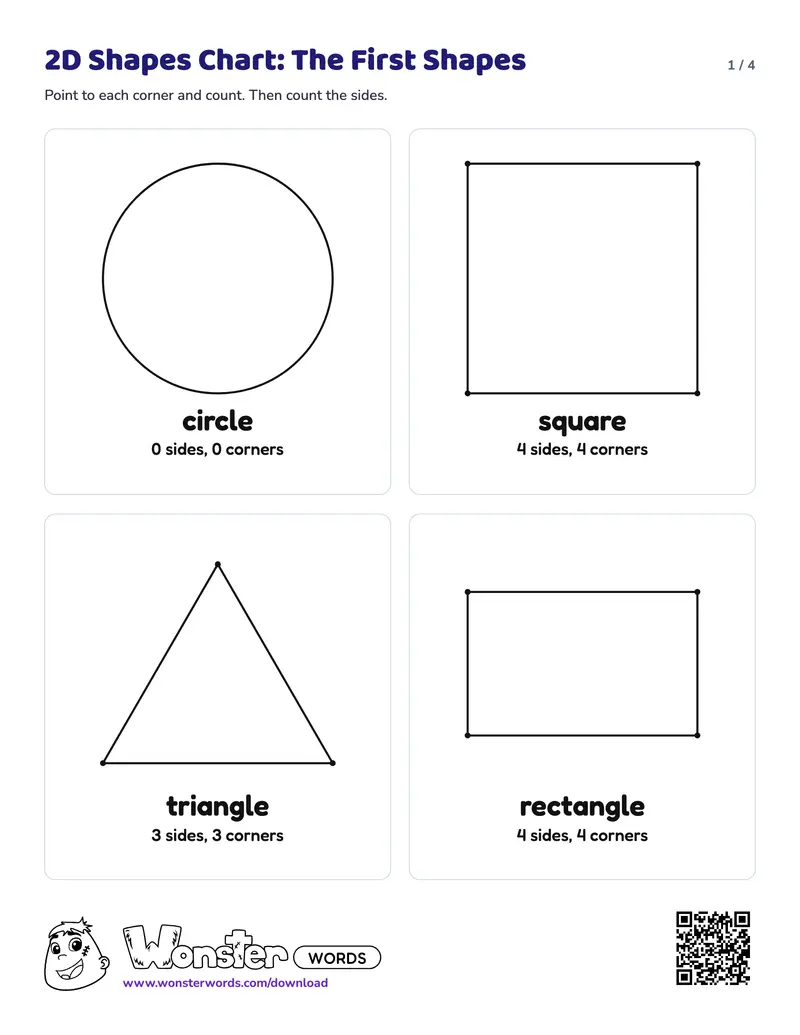
Our free 2D shapes chart is a reference poster for the fridge or a classroom wall, for children aged 3–7. Its first page draws the circle, the square, the triangle, and the rectangle large, each with its sides and corners counted and a dot on every corner. The second adds the oval, the rhombus, the hexagon, the trapezoid, the pentagon, and the octagon. The third draws a triangle, a square, and a rectangle turned, stretched, and small, under “Still a triangle”, “Still a square”, and “Still a rectangle”. A page for grown-ups comes last, 4 pages in all.
Every shape is an outline with no fill, so the chart prints in black and white. The practice sheets (tracing, name cards, sorting, and a shape hunt) are in the shapes worksheets.
Free PDF · no sign-up
Free 2D shapes chart
One free PDF in black and white, with no account and no email: the 2D shapes chart, three pages of shapes with their names, sides, and corners, and a page for grown-ups.
- 2D Shapes Chart (PDF)19 shapes · 4 pages
Preview page 1Preview
Frequently asked questions
What are 2D shapes?
A 2D shape is a flat shape, the kind you can draw on paper, such as a circle, a square, a triangle, or a rectangle. Each one is named by its straight sides and its corners.
What is 2D for kids?
The term 2D is short for two-dimensional, which means flat, with a length and a width but no thickness. A drawing on paper is 2D, and a block you can pick up is not.
What is the difference between 2D and 3D shapes?
A 2D shape is flat, like a square drawn on paper, and a 3D shape is solid, like a cube or a ball you can hold. The Common Core asks kindergartners to tell the two apart.
What shape is a diamond?
A diamond is a rhombus, a shape with 4 sides all the same length, drawn with corners that are not square. A square turned on its corner is still a square, because its corners are still square.
What are the basic shapes?
The basic shapes are the circle, the square, the triangle, and the rectangle, which children learn first. The oval, the rhombus, the hexagon, the trapezoid, and the pentagon come after them.
What shape has 6 sides?
A shape with 6 straight sides and 6 corners is a hexagon, whether or not it looks like a honeycomb cell.
What 2D shapes do preschoolers learn first?
Preschoolers learn the circle, the square, the triangle, and the rectangle first. In kindergarten the hexagon joins them in Common Core states, and children learn to name all of them however they are turned.
What age should children learn about squares and rectangles?
Children learn the names square and rectangle in preschool and kindergarten. Texas teaches that a square is also a rectangle in kindergarten. The Common Core puts squares and rectangles in the same four-sided family in third grade and says that squares are rectangles in fifth.
Related guides
Last updated