
Math
Skip Counting for Kids
What skip counting is, when kids learn it, how to teach it at home, the count for every number from 2 to 10, counting by 100s to 1,000, games, and free charts and worksheets.
Grades: grade 1 to grade 3 · Common Core: 2.NBT.A.2 · Texas: 1.5(B) · Related: Common Core K.CC.A.1, 2.OA.C.3, 2.NBT.B.8; Texas K.5, 1.4(C), 2.7(B), 3.4(E)
Skip counting means counting forward by the same number each time and saying only the numbers you land on: 2, 4, 6, 8, or 5, 10, 15, 20. Children count by 10s in kindergarten, count by 2s, 5s, and 10s in first grade in Texas, and count by 5s, 10s, and 100s in second grade under the Common Core. The 3s, 4s, and up come with the times tables in third grade.
The most useful thing to do is count real groups out loud first, such as pairs of socks or hands of five fingers. Whisper the numbers in between and say each landing number loud. The count then means how many, not a song. Counting by 10s to 100 is kindergarten work, and the counting to 100 guide teaches it. This page goes on from there, with the count for every number from 2 to 10, the 7s included. A free skip counting chart and two worksheets with answer keys are in the skip counting charts and worksheets section.
What is skip counting?
Skip counting means counting by a number other than 1. Counting by 2s is 2, 4, 6, 8, 10, and counting by 5s is 5, 10, 15, 20. Counting by 5s is counting by ones with four of every five numbers left unsaid. Each number you say is a running total of equal groups: one hand of five is 5, two hands are 10, and three hands are 15.
A skip count can start anywhere, such as by 10s from 7 (7, 17, 27), and it can go backward. It is the same thing as counting by intervals, where the interval is the number you count by. Teachers also call it counting by 2s or count-bys. To skip count by 4 means to say 4, 8, 12, 16, adding 4 each time. To explain it to your child, try: “We say only the last number of each group.”
Why is skip counting important?
Skip counting is important because it is faster than counting by ones whenever things come in equal groups. A child who counts socks by 2s says half as many numbers, and one who counts nickels by 5s says a fifth as many. That is the job the Texas first-grade standard gives it: to “skip count by twos, fives, and tens to determine the total number of objects up to 120 in a set” (1.5(B), TEKS grade 1).
Skip counting is also where three later skills start. Counting by 2s from 0 lands only on even numbers, which is one way second graders tell even and odd numbers apart. Counting by 10s and 100s changes one digit and leaves the rest, which is place value heard out loud. And counting by 3s to 30 says the 3 times table in order, which is where multiplication begins. Each count-by also has a pattern in its last digits, and spotting it is a child’s first look at patterns in numbers.
When do kids learn skip counting?
Children usually start skip counting by 10s in kindergarten, add 2s and 5s in first or second grade, and count by 3s, 4s, and up in third grade. The Common Core’s second-grade standard 2.NBT.A.2 reads “Count within 1000; skip-count by 5s, 10s, and 100s” (Common Core grade 2). Counting by 2s appears in the Common Core only inside 2.OA.C.3, as one way to tell whether a group is odd or even, “by pairing objects or counting them by 2s”.
| Grade (age) | What children do | Common Core | Texas (TEKS) |
|---|---|---|---|
| Kindergarten (about 5–6) | Count to 100 by tens | K.CC.A.1 | K.5, by ones and tens from any number |
| 1st grade (about 6–7) | Skip count by 2s, 5s, and 10s to find how many, up to 120; count pennies, nickels, and dimes | None names skip counting (counting to 120 is 1.NBT.A.1) | 1.5(B), 1.4(C) |
| 2nd grade (about 7–8) | Count within 1,000; skip count by 5s, 10s, and 100s; count by 2s to tell even from odd | 2.NBT.A.2, 2.OA.C.3 | No expectation names it; 10 or 100 more or less, up to 1,200, is 2.7(B) |
| 3rd grade (about 8–9) | Count by 3s, 4s, and up as one way to work out a times table fact | None names it (the facts are 3.OA.C.7) | 3.4(E) |
Texas asks first graders to skip count by 2s, 5s, and 10s, a year before the Common Core asks for 5s and 10s, and names skip counting again in third grade as one way to show a multiplication fact. The third-grade standard lists “equal jumps on a number line, and skip counting” among the ways to show a fact (3.4(E), TEKS grade 3).
The order is 10s first, then 2s and 5s, then 100s. Tens come first because they follow the decade names a child already says when counting to 100. Researchers Clements and Sarama of the University of Denver also put the tens early in their counting trajectory. Its “Skip Counter by 10s to 100” level comes before “Counter to 100”, and “Skip Counter” comes two levels after it.
US standards set no order for the numbers past 5. England’s national curriculum does: children count “in steps of 2, 3, and 5 from 0” in Year 2, “in multiples of 4, 8, 50 and 100” in Year 3, and “in multiples of 6, 7, 9, 25 and 1,000” in Year 4. This page lists them in the order the times tables are taught on our times tables page: 3, 4, 6, 8, 9, then 7. A second grader who cannot yet count by 4s is on time.
A child is ready to skip count once they can count to 100 and start counting from any number, both skills on the counting to 100 page. A toddler can learn to chant “2, 4, 6” and enjoy it. Counting things by groups starts later, once counting a set of objects to 20 is steady.
How to teach skip counting at home
To teach skip counting at home, start with real groups counted by ones, then take away the counting in between, one step at a time. Each step below takes a few minutes.
Count real groups by ones, out loud
Lay out pairs of socks, shoes, or mittens, or hold up hands of five fingers. Have your child point to each thing and count every one out loud, by ones.
Whisper the in-between numbers
Count the pairs again, whispering the first number of each pair and saying the second one loud: one, TWO, three, FOUR. Whisper more quietly each time, until only the loud numbers are left. That is counting by 2s.
Let your child see the count
Shade every fifth square on a hundreds chart, or make jumps of the same size on a number line, so your child can see that the gap stays the same. Under rows of things, write the running total: 3, 6, 9, 12, 15 beside five rows of three.
Start somewhere else
Count by 5s from 35, by 10s from 4, or by 2s from 1, which lands on the odd numbers. A child who can only start at 0 has learned a song, and starting in the middle turns it back into counting.
Count how many you counted
Hold up one finger for each number said. Counting by 5s with four fingers up means 20, which is four groups of five. Keeping track of the groups is the step that leads to multiplication.
Something to look at helps because the child can see the gap stay the same. A printable hundreds chart shows the 5s as two straight columns, and a number line shows each count as a jump of the same size. For step 3, the Common Core writing team suggests a running total beside a small array, “written to the right of each row (e.g., 3, 6, 9, 12, 15)”. The arrays page shows how to build one. Fingers are the tool for step 5, and the counting on fingers guide explains why they help.
Practice a few minutes on most days, and stop while it still goes well.
Skip counting by 2s, 5s, and 10s
Counting by 10s comes first, then 2s and 5s. Counting by 2s is easier than counting by 5s, and counting by 5s is easy because two 5s make 10. The Common Core Standards Writing Team, who wrote the standards, call counting by 2s “the easiest count-by”. In their progressions document, how hard a count-by is “depends on how closely related it is to 10”. Counting by 10s comes before both because it reuses the decade names a child already says to 100.
Skip counting by 2s
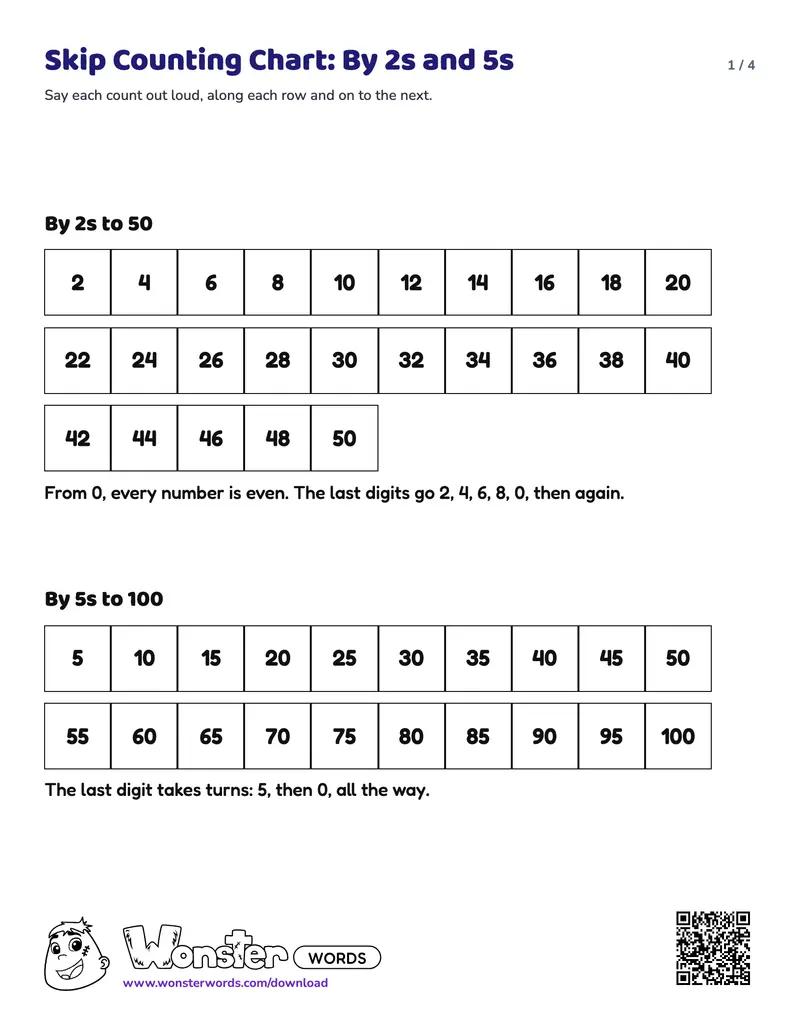
Counting by 2s goes 2, 4, 6, 8, 10, 12, 14, 16, 18, 20. From 0, every number is even, and the last digits go 2, 4, 6, 8, 0 and then repeat: 22, 24, 26, 28, 30. From 1, every number is odd: 1, 3, 5, 7, 9. Things to count at home: socks, shoes, mittens, and eyes around the dinner table.
Skip counting by 5s
Counting by 5s goes 5, 10, 15, 20, 25, 30, 35, 40, 45, 50. The last digit takes turns, 5 and then 0, all the way. Count fingers on hands, nickels in a pile, or the minutes around a clock face, where each number on the clock is 5 more minutes. Texas has first graders count coins by 5s and 10s (1.4(C), “pennies, nickels, and/or dimes”). A second grader can keep going past 100: 95, 100, 105, 110.
Skip counting by 10s
Counting by 10s to 100 is a kindergarten skill, and the counting by 10s section of the counting to 100 guide teaches it with bundles of straws. Two steps come after it. The first is counting by 10s from a number that does not end in 0, such as 7, 17, 27, 37. The last digit stays and the tens digit goes up by one. The second is counting past 100: 90, 100, 110, 120, and on to 200. Count dimes this way.
Counting by 10s is every other number of the 5s. In 5, 10, 15, 20, the 10s are the numbers that end in 0.
Counting by 10s and 100s to 1,000
Second graders count by 10s and 100s to 1,000, the Common Core’s 2.NBT.A.2. When you skip count by 100, only the hundreds digit changes: 100, 200, 300, or from 250, the count goes 350, 450, 550. When you count by 10s, only the tens digit changes until it rolls over to a new hundred: 370, 380, 390, 400, 410.
Counting by 100s is easier to say than counting by 10s past 100. By 100s, a child says one to nine and adds “hundred”. By 10s, the hard spot is each new hundred, such as 190, 200, 210, and that is the place to practice.
- Mark a number line from 0 to 1,000 by hundreds. Jump by 100s, then jump by 10s between two hundreds, such as from 300 to 400. The number line guide has printable lines to start from.
- Bundle ten tens into a hundred, with base ten blocks or ten bundles of ten straws, and count the hundreds and then the tens.
- Count real things. Stack pennies in piles of ten and count the piles by 10s, or flip a thick book to pages 100, 200, and 300.
The common mistake is saying “three hundred” after “two hundred” when the next number by 10s is two hundred ten. Say the hundreds first, then count the tens: two hundred, two hundred ten, two hundred twenty. Counting this way is the place value guide’s hundreds, tens, and ones made audible. Finding 10 more or 100 more than a number in your head comes next (Common Core 2.NBT.B.8, Texas 2.7(B)).
Skip counting by 3s, 4s, and up
To skip count by 3s, 4s, 6s, 7s, 8s, or 9s, add the same number each time and check the count against its pattern. After the 2s and 5s, the 3s and 4s come next, then the 6s and 8s, then the 9s and 7s. The 4s and 8s come easily after the 2s, because the 4s are every other number of the 2s and the 8s are every other number of the 4s.
| Count by | The count to the tenth number | A pattern that helps |
|---|---|---|
| 3s | 3, 6, 9, 12, 15, 18, 21, 24, 27, 30 | The digits of each number add up to 3, 6, or 9 (12: 1 + 2 = 3) |
| 4s | 4, 8, 12, 16, 20, 24, 28, 32, 36, 40 | Every other number of the 2s; the last digits go 4, 8, 2, 6, 0, then again |
| 6s | 6, 12, 18, 24, 30, 36, 42, 48, 54, 60 | Every other number of the 3s; the last digits go 6, 2, 8, 4, 0, then again |
| 8s | 8, 16, 24, 32, 40, 48, 56, 64, 72, 80 | Every other number of the 4s; the last digits go 8, 6, 4, 2, 0, then again |
| 9s | 9, 18, 27, 36, 45, 54, 63, 72, 81, 90 | The tens digit goes up by one and the ones digit goes down by one |
| 7s | 7, 14, 21, 28, 35, 42, 49, 56, 63, 70 | Every last digit from 0 to 9 appears once; cross each ten by making 10 first |
Every pattern in the table can be checked by adding. The 7s are usually the hardest to say. The Common Core writing team’s example is exactly this pair: “the count-by sequence for 5 is easy, but the count-by sequence for 7 is difficult”, because 7 is far from 10. The way past a ten is to make 10 first. Adding 7 to 14 is adding 6 to make 20, then 1 more, which gives 21.
Each count to the tenth number is a times table read in order. Learning the facts, and a strategy for each one, is the job of the times tables guide, which also covers the 11s and 12s.
Skip counting by 4s
Counting by 4s is counting by 2s and saying every other number. Whisper 2, say 4, whisper 6, say 8, and keep going. The last digits check the count: 4, 8, 2, 6, 0, and then the same five again. Only two steps to 40 cross a ten, 8 to 12 and 28 to 32, and each one is easier if your child makes 10 first: 28 and 2 make 30, and 2 more is 32. Count things that come in fours, such as the legs on chairs or the wheels on cars.
The difference between counting by 4s and counting by 2s is that the 4s say half the numbers. In 2, 4, 6, 8, 10, 12, the 4s are 4, 8, and 12.
Skip counting by 7s
When a child loses track counting by 7s, the trouble is the tens. Six of the ten steps in the 7s cross a ten, and the progressions document splits each one so a child can “compose up to and then go over the next decade”:
- From 7 to 14: 3 more makes 10, then 4 more.
- From 14 to 21: 6 more makes 20, then 1 more.
- From 28 to 35: 2 more makes 30, then 5 more.
- From 35 to 42: 5 more makes 40, then 2 more.
- From 49 to 56: 1 more makes 50, then 6 more.
- From 56 to 63: 4 more makes 60, then 3 more.
The last digits check the count: 7, 4, 1, 8, 5, 2, 9, 6, 3, 0, with no digit twice. To stop in the right place, your child holds up a finger for each 7 said, the tracking the progressions document describes. Grouping in twos does not work for 7, which is not two equal groups, so split it as 5 and 2 instead: add a hand, then two fingers.
Can skip counting be taught through songs?
Yes, a song teaches the order of a count-by, because the rhythm is what a child remembers. A song has one limit: it always starts at the beginning. A child who can sing the 5s can still be stuck on “What comes after 35?”, so practice starting in the middle and counting real things too.
Two chants need no music and no screen:
- Whisper and shout. Count by ones, whispering the in-between numbers and shouting each landing number: “one, two, three, four, FIVE”. This is step 2 of the how-to, said as a chant.
- Clap on the landing number. Count by ones and clap on every fifth number, then say only the clapped numbers: 5, 10, 15, 20.
To make your own chant, put a count-by to a tune your child already knows, and stop the tune partway to ask for the next number.
Skip counting games and activities
Each of these five skip counting games needs nothing you would have to buy, and each one practices one count-by.
- Sock pairs. Count the clean laundry by 2s as you pair the socks.
- Coin jar. Sort pennies, nickels, and dimes into three piles, and count the pennies by 1s, the nickels by 5s, and the dimes by 10s.
- Jump the line. Tape or chalk a line on the floor with a mark every step, and jump along it by 5s, saying each number you land on. More floor games are in the number line games.
- Cover the chart. Put a bean on every fourth square of a hundreds chart and look at the pattern the beans make.
- Ball toss. Toss a ball back and forth, and each catch says the next number by 3s. Then start at 30 and count down.
Board games with a straight numbered path are on the math board games page. Games for the times tables are on the multiplication games page.
When skip counting is hard
Skip counting goes wrong in six places, and each one has a fix.
- Stuck at a ten inside the count, such as 28 to 32 or 49 to 56. Make 10 first: 28 and 2 is 30, and 2 more is 32.
- Adding a number or skipping one, such as 5, 10, 15, 25. Count real groups again, or check the last digits against the pattern (5, 0, 5, 0).
- Counting the starting number as the first jump. By 5s from 20, the first jump lands on 25, not 20. Count the jumps, not the numbers, as on a number line.
- Only starting at 0, or only going forward. Start somewhere else (step 4 of the how-to) and count down too.
- Losing how many. Your child counts by 4s to 28 but cannot say it was seven 4s. Use fingers or tally marks, one for each number said (step 5).
- The count is a chant. Your child can sing the 5s but cannot say what comes after 35. Count real things, and start in the middle.
If your child gets frustrated, go back to a count-by that is easy, such as the 10s or the 2s, with real things, and stop while it goes well. If counting by ones to 100 is still hard, go back to counting to 100 first. If you are worried, talk to your child’s teacher.
How to teach skip counting backwards
Skip counting backwards means saying the same count going down: 50, 45, 40, or 100, 90, 80. Counting forward is easier than counting backward, because going back means finding the number before, so teach the forward count first. Count down by 10s and 100s first, where only one digit changes, then by 5s and 2s. Read the hundreds chart or the number line backward, and use everyday countdowns, such as taking pairs of socks out of the basket by 2s.
The common mistake is going down across a ten. By 5s, 35, 30, 25 is fine, but by 2s from 32 a child who slips says 30, 28, then 27. The last digits are the check: by 2s from an even number, every number is even. Counting backward by ones is on the counting to 100 page’s counting backwards section. Later, counting back becomes one of the first ways to subtract.
From skip counting to multiplication
Skip counting gives the total, and multiplication also needs how many groups were counted. The progressions document puts it this way: “The count-bys give the running total. The number of 3s said is tracked with fingers.” A child who counts by 3s and holds up a finger for each 3 is already working out a fact. In the document’s words, “For 8 × 3, you know the number of 3s and count by 3 until you reach 8 of them.”
The difference between skip counting and multiplication is that skip counting finds a total by counting, while a multiplication fact is knowing it without counting. Knowing the facts is third grade. What multiplication is, and how a child gets from counting to the facts, are on the multiplication and times tables pages.
Free skip counting charts and worksheets
The skip counting sheets come as three PDFs: a chart to read from, a worksheet for first and second grade, and a worksheet for the 3s to 9s. Every one prints in black and white.
- Skip Counting Chart. Strips to read from, not a grid: by 2s to 50 and by 5s to 100, by 10s to 200 and by 100s to 1,000, and the 3s, 4s, 6s, 8s, 9s, and 7s to the tenth number, each with its pattern. It is a reference, so it has no answer key. Print it first.
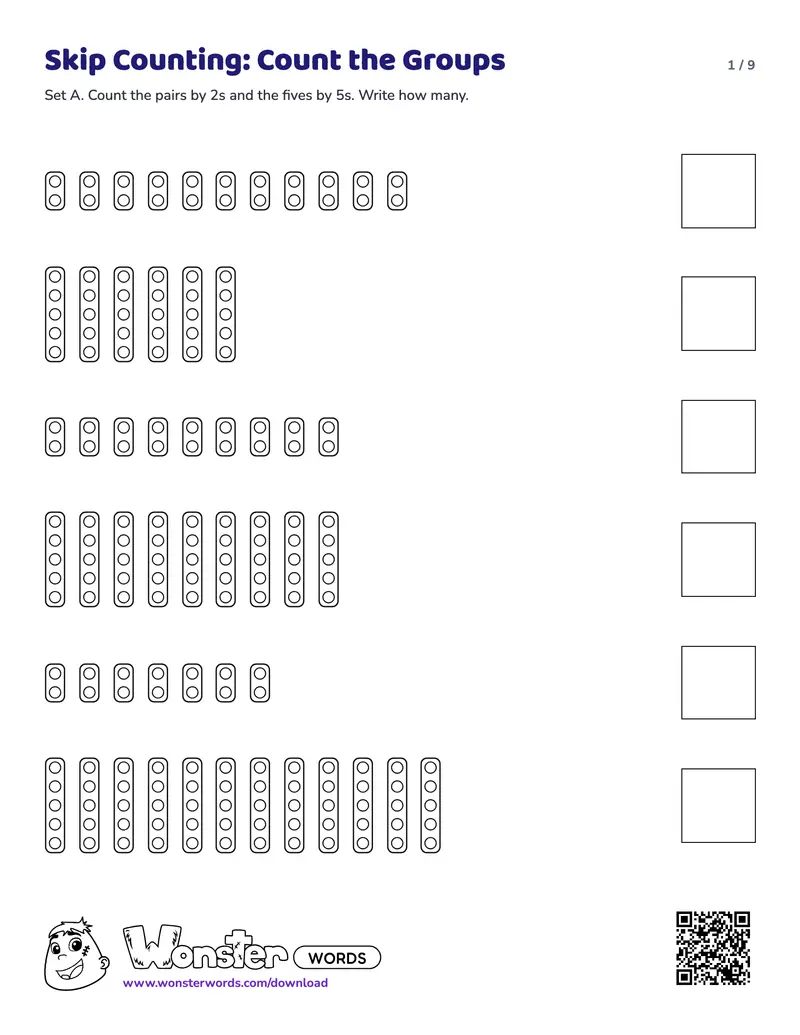
- Skip Counting, for first and second grade. Pictured groups of pairs and fives to count up to 60, then strips with missing numbers by 2s, 5s, and 10s that start off zero, such as by 5s from 65, and cross 100. Two strips count down. Last come strips by 10s and 100s within 1,000.
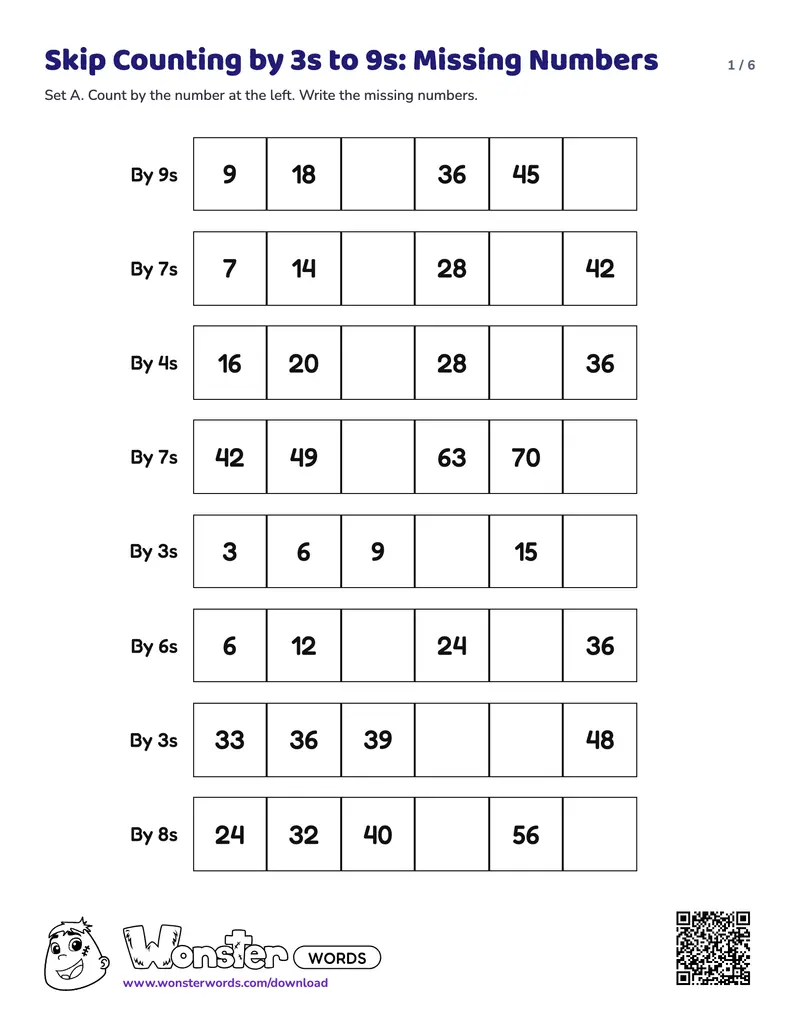
- Skip Counting by 3s to 9s, for second and third grade. Missing numbers by 3s, 4s, 6s, 7s, 8s, and 9s, every strip crossing a ten, and a page of “cross the ten” items with the make-10 split printed under each one.
Both worksheets print each activity twice, with the strips in a new order, and end with answer keys and a page for grown-ups. The blanks sit in the middle of the strips on purpose: a missing number asks for the next number in the count, not a copy of the chant from 0. A 1–100 grid is on the hundreds chart page, and times table worksheets are on the times tables page.
Free PDF · no sign-up
Free skip counting charts and worksheets
Three free PDFs in black and white, with no account and no email: the chart to read from first, then the worksheet for first and second grade, then the 3s to 9s. Each worksheet prints every activity twice, with its answer key and a page for grown-ups at the back.
- Skip Counting Chart (PDF)135 numbers · 4 pages
Preview page 1Preview
- Skip Counting (PDF)68 numbers to write · answer key included · 9 pages
Preview page 1Preview
- Skip Counting by 3s to 9s (PDF)64 numbers to write · answer key included · 6 pages
Preview page 1Preview
Going further
Once the 2s, 5s, 10s, and 100s are easy, the next count-bys are 25s and 50s. England’s curriculum counts in 50s in Year 3 and in 25s in Year 4. A US child meets the 25s with quarters: 25, 50, 75, 100. The 50s go 50, 100, 150, 200. Counting by 10s from any number past 1,000 belongs to later grades.
Frequently asked questions
What does skip count by 4 mean?
To skip count by 4 means to count forward by adding 4 each time and saying only those numbers: 4, 8, 12, 16, 20, 24, 28, 32, 36, 40. Each number is the total of that many groups of four. The 4s are every other number of the 2s, which makes them a good count-by to learn after the 2s.
Skip counting by twos versus fives: which is easier for kids?
Counting by 2s is easier, and the Common Core writing team calls it the easiest count-by. Counting by 5s is close behind, because two 5s make 10 and the last digit only takes turns, 5 and 0. Children usually learn both after counting by 10s, in first grade in Texas and by second grade elsewhere.
What age should children start learning skip counting?
Children start skip counting with counting by 10s in kindergarten, at about 5 or 6. Counting by 2s, 5s, and 10s is a first-grade standard in Texas, and counting by 5s, 10s, and 100s is a second-grade standard in the Common Core, at about 7. Counting by 3s, 4s, and up comes in third grade, with the times tables.
How do I know if my child has mastered skip counting?
A child who has mastered a count-by can start it in the middle, such as by 5s from 35, count down as well as up, cross a ten without stopping, and say how many groups they counted. A child who can only say it from the beginning has learned the order of the words, which is the first step.
What is the difference between skip counting and multiplication?
Skip counting finds a total by counting: 3, 6, 9, 12. Multiplication also keeps track of how many groups were counted, so four 3s make 12. A multiplication fact is knowing that four 3s make 12 without counting at all, which is third-grade work. Skip counting is how many children first work the facts out.
Games vs worksheets: which is better for skip counting?
Both, for different jobs. Games and chants help a child say a count-by out loud and count real things with it. A worksheet with missing numbers checks that your child can start in the middle and find the next number without chanting from the beginning. A few minutes of each, on different days, covers both.
Are skip counting apps a good idea?
A screen can say a count-by and show it in order, which helps with the order of the numbers. It cannot see whether your child is counting real things or reciting, or hear where the count breaks. Use an app for listening, and count socks, coins, or fingers together for the rest.
Related guides
Last updated