
Math
Times Tables for Kids
The order to learn the times tables, why each table comes where it does, and a strategy for every one from the 2s to the 12s, built from a table your child already knows.
Grades: grade 2 to grade 3 · Common Core: 3.OA.C.7, 3.OA.B.5, 3.OA.D.9 · Texas: 3.4(E), 3.4(F) · Related: Common Core 2.NBT.A.2, 2.OA.C.3, 2.OA.C.4, 3.OA.A.1, 3.OA.A.4, 3.OA.B.6; Texas 2.6(A), 3.4(D), 3.5(D)
Kids learn the times tables most easily in an order that builds each new table from one they already know: first the 2s, 5s, and 10s, which they already count by, then the 0s and 1s, which are two rules, then the 3s and 4s, the 6s and 8s, the 9s, and the 7s last. Multiplication has no single strategy that works for every fact, the way making ten does for addition, so each table gets its own. The 4s are the 2s doubled, the 8s are the 4s doubled, and the 9s are ten groups minus one group. By the time a child reaches the 7s, the only new fact left is 7 × 7.
Third graders are expected to know every fact from memory by the end of the year. The US standards go no further than 10 × 10, while many charts and British websites go to 12 × 12. A strategy for every table follows, and each family has its own worksheet with an answer key, described at the end of this guide.
What order should kids learn the times tables in?
The easiest order to learn the times tables puts each table right after the one it is built from: the 2s, 5s, and 10s, then the 0s and 1s, the 3s and 4s, the 6s and 8s, the 9s, and the 7s. The last column counts the different facts from 1 × 1 to 10 × 10, where 3 × 8 and 8 × 3 count as one fact, which leaves 55.
| Step | Tables | Why now | The strategy | New facts it adds (of 55) |
|---|---|---|---|---|
| 1 | 2, 5, 10 | Children already count by 2s, 5s, and 10s | Skip counting; the 2s are the doubles | 27 |
| 2 | 0, 1 | Two rules, once a child knows what “groups of” means | 0 groups of anything is 0; 1 group of 7 is 7 | 7 (the 1s; the 0s are a rule) |
| 3 | 3, 4 | One step from the 2s | 3s: the 2s plus one more group; 4s: double the 2s | 11 |
| 4 | 6, 8 | One step from the 3s, 4s, and 5s | 6s: double the 3s, or the 5s plus one group; 8s: double the 4s | 7 |
| 5 | 9 | One step from the 10s | Ten groups minus one group | 2 |
| 6 | 7 | Almost nothing left | Break it apart into 5 groups and 2 groups | 1 (7 × 7) |
No standard sets the order. The Common Core Standards Writing Team writes in its progressions document that programs teach the tables “in various orders depending on what numbers are seen as or are supported to be easiest”. This guide uses the order above because every table comes after the table it leans on. Eureka Math, for one, teaches third grade a different way: the 2s to 5s and the 10s in Module 1, then the 6s to 9s, and the 0s and 1s last.
Learn one family at a time, then mix. The same progressions document describes fluency as reached “for each number” first, then extended to several, “then all numbers mixed together”. Start with the 2s rather than the 3s, because the 2s are the addition doubles a child already knows. Each worksheet on this page covers one step of the order, and a mixed review of every fact comes after the families. Which facts to practice first, once the order is known, is covered in multiplication fact fluency.
Multiplication strategies: a strategy for each times table
There are four multiplication strategies a child uses for the times tables, and each one turns a new fact into a fact the child already knows. The Common Core Standards Writing Team says there are “no general strategies for multiplying or dividing all single-digit numbers as there are for addition and subtraction. Instead, there are many patterns and strategies dependent upon specific numbers.”
- Skip counting (the 2s, 5s, and 10s): count by the number. For 6 × 5, count by 5s six times: 5, 10, 15, 20, 25, 30.
- Doubling (the 4s from the 2s, the 8s from the 4s, the 6s from the 3s): the fact 4 × 7 is 2 × 7 doubled, and 14 + 14 = 28.
- One more or one less group (the 3s from the 2s, the 6s from the 5s, the 9s from the 10s): 6 × 7 is 5 × 7 and one more 7, 35 + 7 = 42. Going the other way, 9 × 7 is 10 × 7 minus one 7, 70 − 7 = 63.
- Break it apart (the 7s, and any fact not known yet): 7 × 8 is 5 × 8 and 2 × 8, 40 + 16 = 56. Third-grade standard 3.OA.B.5 uses the same fact as its example. Breaking a fact apart is the distributive property, and the area model draws it as one rectangle cut in two.
The turnaround halves the work: 3 × 8 and 8 × 3 are the same fact, which is why the 100 facts from 1 × 1 to 10 × 10 are only 55 different ones, as arrays show with a quarter turn. This table gives the strategy for every table from 0 to 12.
| Table | Strategy | Worked fact |
|---|---|---|
| 0 | Zero groups of anything is zero | 0 × 7 = 0 |
| 1 | One group of a number is that number | 1 × 7 = 7 |
| 2 | The addition doubles | 2 × 7 = 7 + 7 = 14 |
| 3 | The 2s plus one more group | 3 × 7 = 14 + 7 = 21 |
| 4 | Double the 2s | 4 × 7 = 14 + 14 = 28 |
| 5 | Count by 5s, or half of the 10s | 5 × 8 = half of 80 = 40 |
| 6 | The 5s plus one group, or double the 3s | 6 × 7 = 35 + 7 = 42 |
| 7 | Break it apart: 5 groups and 2 groups | 7 × 6 = 30 + 12 = 42 |
| 8 | Double the 4s, or double three times | 8 × 7 = 28 + 28 = 56 |
| 9 | The 10s minus one group | 9 × 7 = 70 − 7 = 63 |
| 10 | That many tens | 10 × 7 = 7 tens = 70 |
| 11 | The digit repeated, to 11 × 9 | 11 × 4 = 44 |
| 12 | Break it apart: 10 groups and 2 groups | 12 × 7 = 70 + 14 = 84 |
A trick works when it comes with a reason. The nines patterns come from 9 being one less than 10, so a child who forgets 9 × 7 can rebuild it from 10 × 7. A rhyme for 7 × 8 has nothing behind it and works only while it is remembered. Mathematics education researcher Arthur Baroody writes that practice “should focus on making reasoning strategies more automatic, not on drilling isolated facts”.
The strategies are the route to memory, not a replacement for it. Common Core standard 3.OA.C.7 ends: “By the end of Grade 3, know from memory all products of two one-digit numbers.” Texas asks third graders to “recall facts to multiply up to 10 by 10 with automaticity” (3.4(F), TEKS grade 3). Flash cards and timed practice are how a worked-out fact becomes a known one. Parents who learned the tables by chanting will find the same answers reached a different way in new math explained for parents.
Before the first table: from skip counting to the times tables
Children move to the times tables in three stages: counting every object in the groups, counting by the number, and working a fact out from one they know. A child counting six plates of 5 grapes one grape at a time is at the first stage. Counting “5, 10, 15, 20, 25, 30” is the second, and the times tables begin there. The strategies on this page are the third. The progressions document describes the same three levels.
Second grade lays the groundwork. Children skip count by 5s, 10s, and 100s (2.NBT.A.2), add the equal rows of an array (2.OA.C.4), and in Texas join equal groups of objects (2.6(A)). Multiplication means equal groups, which is where multiplication for kids starts. Four pictures show the counting:
- An array: rows of dots, one row per group (arrays in math).
- A number line: equal jumps, such as three jumps of 4 landing on 12 (number lines).
- A hundreds chart: shading every fifth square to count by 5s (the hundreds chart).
- A multiplication chart: every table in one grid (the multiplication chart).
A child is ready for the first table when they can count by 2s, 5s, and 10s to 100 without fingers.
The 2, 5, and 10 times tables
The 2, 5, and 10 times tables come first because children already count by 2s, 5s, and 10s. Together they cover 27 of the 55 different facts to 10 × 10. On a chart from 0 × 0 to 10 × 10, they fill 57 of its 121 squares.
The 2 times table: the doubles
The 2 times table is 2, 4, 6, 8, 10, 12, 14, 16, 18, 20. Every 2s fact is an addition double: 2 × 7 is 7 + 7, which is 14. Baroody notes that children who know the doubles can use them “to readily master 2 × n combinations”. Every answer is even, which second graders meet as “a sum of two equal addends” in standard 2.OA.C.3. At home, say a double and ask for the times fact: “8 and 8 is 16, so 2 eights is?”
The 5 times table
The 5 times table is 5, 10, 15, 20, 25, 30, 35, 40, 45, 50. Every answer ends in 5 or 0. A 5s fact is half of the 10s fact: 5 × 8 is half of 80, which is 40. The numbers on a clock face count by 5s for the minutes, so a child can read 5 × 4 as the 4 on the clock, 20 minutes. At home, count by 5s on fingers, one hand at a time.
The 10 times table
The 10 times table is 10, 20, 30, 40, 50, 60, 70, 80, 90, 100. Ten groups of 7 is 7 tens, which is 70. Say “seven tens” rather than “add a zero”, because the zero shortcut stops working with decimals later: 0.3 × 10 is 3, not 0.30. At home, check that your child can say all three count-bys to 10 groups and back.
The 0 and 1 times tables: two rules
The 0 and 1 times tables are two rules: any number times 0 is 0, and any number times 1 is that number. Zero groups of 7 is 0, and 7 groups of 0 is also 0. One group of 7 is 7. The progressions document warns that these rules “need to be differentiated from the patterns for adding 0 and adding 1”: 7 + 0 is 7 but 7 × 0 is 0, and 7 + 1 is 8 but 7 × 1 is 7.
Eureka Math teaches the 0s and 1s last, because “understanding the concept of nothing (zero) is more complex” than the facts look. This guide puts them second because the facts are quick once a child knows what “groups of” means. The rows and columns for 0 and 1 fill 40 of the 121 squares on a chart from 0 × 0 to 10 × 10.
The 1 times table
The 1 times table is 1, 2, 3, 4, 5, 6, 7, 8, 9, 10. One group of any number is that number, so 1 × 9 is 9 and 9 × 1 is 9. Say it as a picture: “one plate with 9 grapes on it”.
The 0 times table
The 0 times table is 0 all the way down: 0 × 1, 0 × 5, and 0 × 10 are all 0. Say it as “seven empty plates” for 7 × 0. A child who answers 7 when asked for 7 × 0 is adding, and the empty plates fix it.
The 3 and 4 times tables: one more group, and double the 2s
The 3 times table is the 2s plus one more group, and the 4 times table is the 2s doubled. Both start from a table the child knows, which is why they come third.
The 3 times table
The 3 times table is 3, 6, 9, 12, 15, 18, 21, 24, 27, 30. Each 3s fact is a 2s fact and one more group: 3 × 7 is 2 × 7 and one more 7, 14 + 7 = 21. Start with real equal groups: three plates of 7 crackers, then two plates and one more. Counting by 3s is harder than counting by 2s because it lands on a ten only at 30, which is why the 3s feel tricky at first.
The 4 times table: double the 2s
The 4 times table is 4, 8, 12, 16, 20, 24, 28, 32, 36, 40. Each 4s fact is the 2s fact doubled: 4 × 7 is 2 × 7 doubled, 14 + 14 = 28. Every answer is even. Third-grade standard 3.OA.D.9 uses this table as its example of a pattern: “observe that 4 times a number is always even, and explain why 4 times a number can be decomposed into two equal addends.” At home, ask for the 2s fact first, then “and double it?”
The 6 and 8 times tables: double again
The 6 times table is the 3s doubled or the 5s plus one group, and the 8 times table is the 4s doubled. By this step only seven facts are new: 6 × 6, 6 × 7, 6 × 8, 6 × 9, 7 × 8, 8 × 8, and 8 × 9. Every other 6s and 8s fact is the turnaround of one the child knows, such as 6 × 4 from 4 × 6.
The 6 times table
The 6 times table is 6, 12, 18, 24, 30, 36, 42, 48, 54, 60. There are two ways to build it, and your child can use whichever comes more easily:
- Double the 3s: 6 × 7 is 3 × 7 doubled, 21 + 21 = 42.
- The 5s plus one group: 5 × 7 is 35, and one more 7 makes 42. The progressions document shows 6, 7, 8, and 9 times a number as 5 + 1, 5 + 2, 5 + 3, and 5 + 4 times it.
Every answer in the 6s is even. At home, work 6 × 8 both ways and ask which felt quicker: 24 + 24 or 40 + 8, both 48.
The 8 times table: double, double, double
The 8 times table is 8, 16, 24, 32, 40, 48, 56, 64, 72, 80. Any 8s fact is the number doubled three times: for 8 × 7, double 7 is 14, double 14 is 28, and double 28 is 56. A child who knows the 4s can double once: 4 × 7 is 28, and 28 + 28 = 56. The last digits run 8, 6, 4, 2, 0 and then repeat, which helps a child check an answer. Counting by 8s is hard because 8 of its 9 steps cross into a new ten; only 40 to 48 stays in the forties.
The 9 times table: ten groups minus one, and the finger trick
The 9 times table is 9, 18, 27, 36, 45, 54, 63, 72, 81, 90, and every 9s fact is the 10s fact minus one group. For 9 × 7, ten 7s is 70, and taking one 7 away leaves 63. By this step only two 9s facts are new, 7 × 9 and 9 × 9.
The patterns in the 9s come from the same place. The progressions document says “9s have particularly rich patterns based on 9 = 10 − 1”:
- The tens digit is one less than the number multiplied. For 9 × 7, the tens digit is 6.
- The two digits add to 9. Six and 3 make 9, so 9 × 7 is 63.
Both patterns hold from 9 × 1 (09) to 9 × 10 (90), because each step adds a ten and takes away a one.
The nines finger trick
The nines finger trick works for 9 × 1 to 9 × 10, in four steps:
- Hold up both hands with your palms facing you, and number the fingers 1 to 10 from left to right, starting with the left thumb.
- For 9 × 7, fold down finger 7.
- Count the fingers to the left of the fold: 6. Those are the tens.
- Count the fingers to the right of the fold: 3. Those are the ones. The answer is 63.
The trick works because folding finger 7 leaves 6 fingers before it, one less than 7, and 3 after it, which is 10 minus 7. Those are the two patterns above. It is a nines trick only and does not work for the 12s or any other table.
Two mistakes are common. A child counts the folded finger as one of the tens; only the standing fingers count. A child numbers the fingers from the wrong side; always start at the left thumb with palms facing you.
The 7 times table: break it apart
The 7 times table is 7, 14, 21, 28, 35, 42, 49, 56, 63, 70, and by the time a child reaches it, only one fact is new: 7 × 7. Every other 7s fact is the turnaround of a fact from an earlier table: 7 × 2 from the 2s, 7 × 8 from the 8s, 7 × 9 from the 9s. A child who “cannot do the 7s” already knows nine of the ten facts under another name.
The 7s come last because counting by 7s is hard. The progressions document says that “the count-by sequence for 5 is easy, but the count-by sequence for 7 is difficult”, and the count lands on a ten only at 70.
Break it apart. Seven is 5 and 2, so any 7s fact is a 5s fact plus a 2s fact:
- For 7 × 6, add 5 × 6 and 2 × 6: 30 + 12 = 42.
- For 7 × 7, add 5 × 7 and 2 × 7: 35 + 14 = 49.
This is the same break-apart move as the Common Core’s 3.OA.B.5 example, 8 × 7 as 40 + 16, and the property it uses is the distributive property of multiplication. The area model draws the split as a rectangle cut into a 5 part and a 2 part.
The 11 and 12 times tables: does your child need them?
The US standards go no further than 10 × 10, so the 11s and 12s are an optional extra after 0 to 10. Common Core standard 3.OA.C.7 asks for “all products of two one-digit numbers”, and Texas asks for facts “up to 10 by 10” (3.4(F)). The National Curriculum in England asks Year 4 to “recall multiplication and division facts for multiplication tables up to 12 × 12”, and many charts, songs, and British websites go that far too.
Learn 0 to 10 first, in the order above. The next step in third grade, multiplying one-digit numbers by multiples of 10 such as 9 × 80 (3.NBT.A.3), uses the facts to 10 × 10. If your child’s school uses a chart to 12 × 12, the same strategies reach that far.
The 11 times table
The 11 times table is 11, 22, 33, 44, 55, 66, 77, 88, 99, 110, 121, 132. From 11 × 1 to 11 × 9 the answer is the digit written twice: 11 × 6 is 66. The pattern stops at 11 × 10 = 110, 11 × 11 = 121, and 11 × 12 = 132, so teach those three as facts of their own.
The 12 times table
The 12 times table is 12, 24, 36, 48, 60, 72, 84, 96, 108, 120, 132, 144. Each 12s fact is a 10s fact plus a 2s fact: 12 × 7 is 10 × 7 and 2 × 7, which is 70 + 14 = 84. A 12 × 12 grid is on the multiplication chart.
What age do kids learn times tables?
Children learn the times tables in third grade, at ages 8–9, and are expected to know every fact to 9 × 9 (Common Core) or 10 × 10 (Texas) from memory by the end of that year. Second grade builds the counting the tables start from.
| Grade | What children do | Common Core | Texas (TEKS) |
|---|---|---|---|
| 2nd grade | Skip count by 5s, 10s, and 100s; add the rows of an array; join equal groups of objects (Texas) | 2.NBT.A.2, 2.OA.C.4 (related) | 2.6(A) (related) |
| 3rd grade | Learn the tables by strategy; every fact to 9 × 9 (Common Core) or 10 × 10 (Texas) from memory by the end of the year | 3.OA.C.7, 3.OA.B.5, 3.OA.D.9 | 3.4(E), 3.4(F) |
Texas lists the ways third graders show a fact: “repeated addition, equal-sized groups, arrays, area models, equal jumps on a number line, and skip counting” (3.4(E), TEKS grade 3). In England, children learn the 2, 5, and 10 tables in Year 2 and reach 12 × 12 in Year 4. A second grader who counts by 5s but does not know the tables yet is on time. When multiplication itself starts is covered in multiplication for kids, and how long it takes to know every fact by heart has its own guide.
Common times table mistakes, and what to do when a table will not stick
Most times table mistakes are a strategy used on the wrong fact or a rule carried over from adding. Each one below has a fix you can make on the spot.
- Treating 0 and 1 like adding. Baroody describes children who “respond to 7 × 0 with ‘7’ and to 7 × 1 with ‘8’”. Say the fact as groups: seven empty plates hold nothing, and one plate of 7 holds 7.
- Losing count while skip counting. Counting by 7s for 4 × 7, a child stops at “7, 14, 21” and answers 21. Track the groups on fingers, one finger per count, or work it from 2 × 7 doubled.
- Mixing up adding and multiplying. A child answers 56 for 8 + 7, the answer to 8 × 7. Read the sign aloud and say the times fact as “8 groups of 7”.
- Learning each table as a separate list. A child who learns 3 × 8 and 8 × 3 as two facts does twice the work. Show the turnaround with an array turned a quarter turn.
- A rhyme with nothing behind it. When a rhyme is forgotten, the fact is gone. Teach the strategy for that table, so the fact can be rebuilt.
When a table will not stick, go back one step to the table it is built from. A child stuck on the 8s needs the 4s to be quicker first. Practice the few new facts in a table rather than the whole table, and play a game for that table. Baroody writes that “relating unknown combinations to previously learned ones can greatly reduce the amount of practice needed to master a family of combinations”. How often and how long to practice has its own guide.
If your child still counts every object in the groups partway through third grade, talk to their teacher.
Going further
The times tables lead on to two things children meet in third grade and after.
- Square numbers and the distributive property. The Beast Academy 3B book, written for ages 8–10, follows its multiplication chapter with chapters on perfect squares and the distributive property. One pattern to notice: 7 × 7 = 49, and 6 × 8 = 48, one less.
- Multiplying by 10s. The fact 3 × 40 is 3 × 4 tens, which is 12 tens, 120. The same move carries into bigger multiplication on the area model.
Free times table worksheets
The times table worksheets come as seven PDFs, one for each step of the order and one for the 11s and 12s.
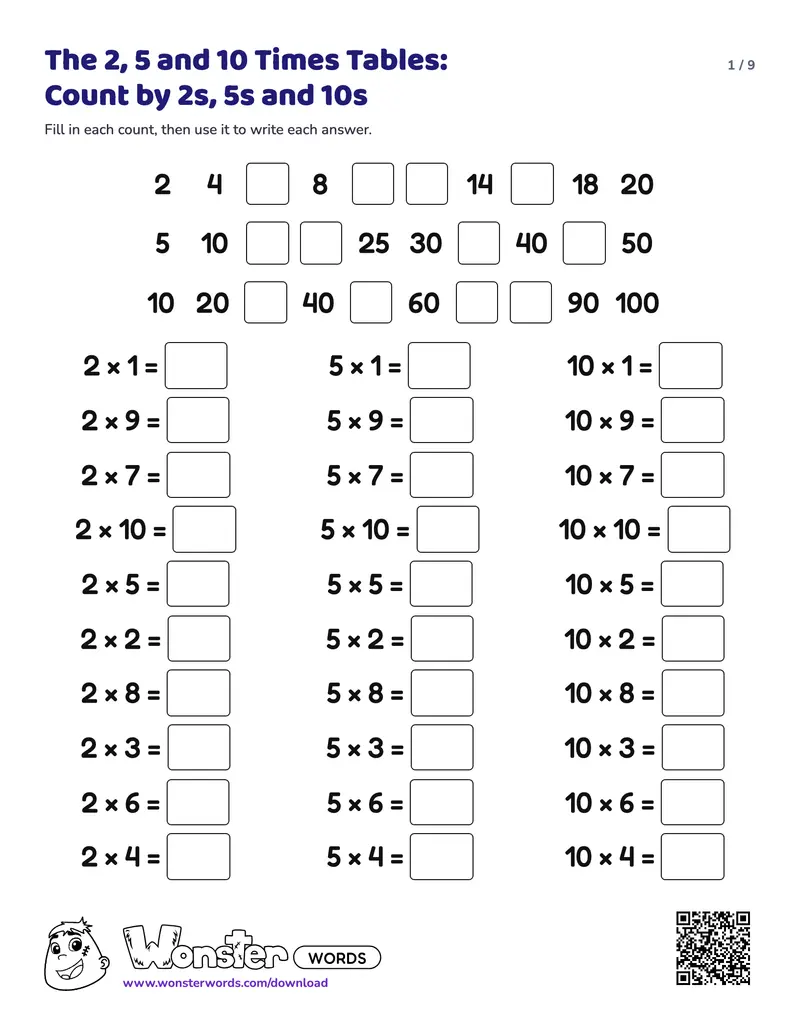
- The 2, 5 and 10 Times Tables, 9 pages, for late second grade and third grade. Count-by lines to fill in, then the three tables, one table to a column.
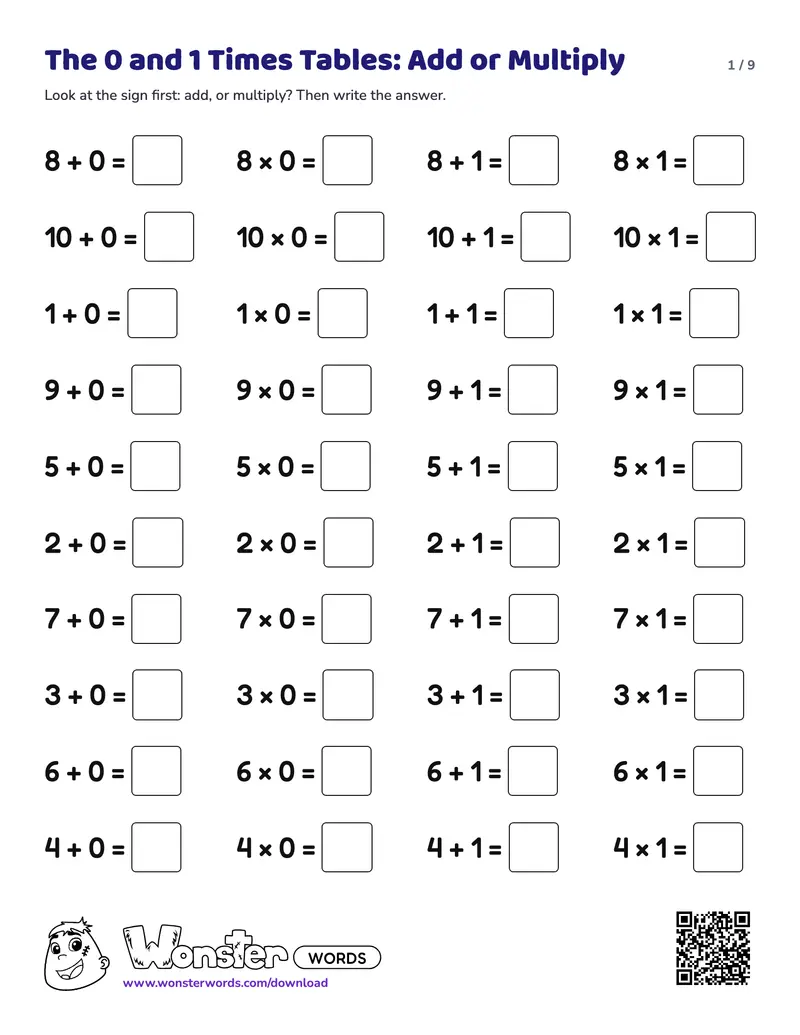
- The 0 and 1 Times Tables, 9 pages. A contrast page sets 7 + 0, 7 × 0, 7 + 1, and 7 × 1 side by side for every number from 1 to 10.
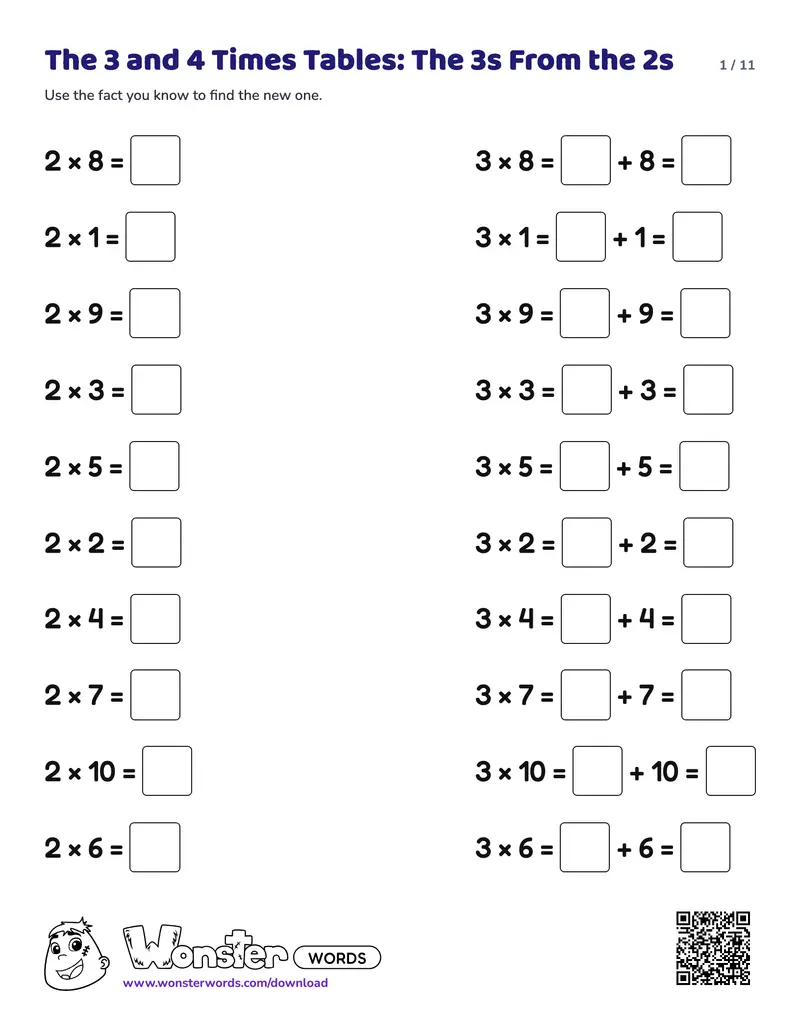
- The 3 and 4 Times Tables, 11 pages. Each fact comes after the 2s fact it is built from: 3 × 7 from 2 × 7 and one more 7, and 4 × 7 from 2 × 7 doubled. The 3s and the 4s each get their own first page.
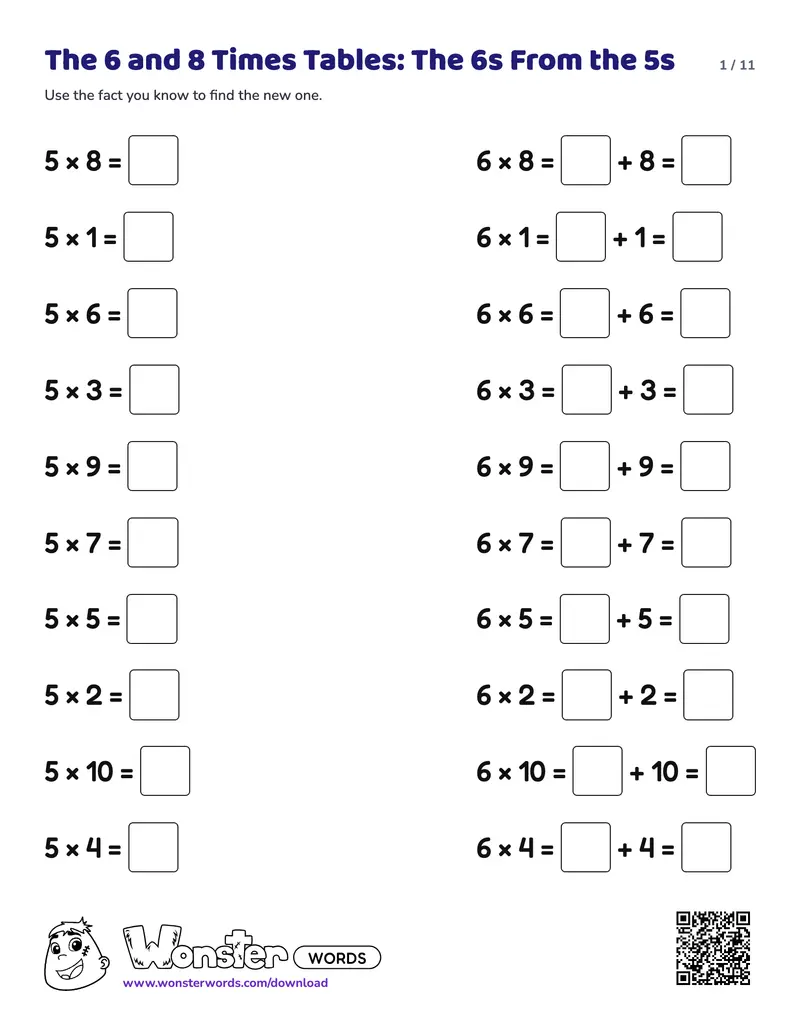
- The 6 and 8 Times Tables, 11 pages. The 6s from the 5s plus one group, and the 8s from the 4s doubled, each on its own first page.
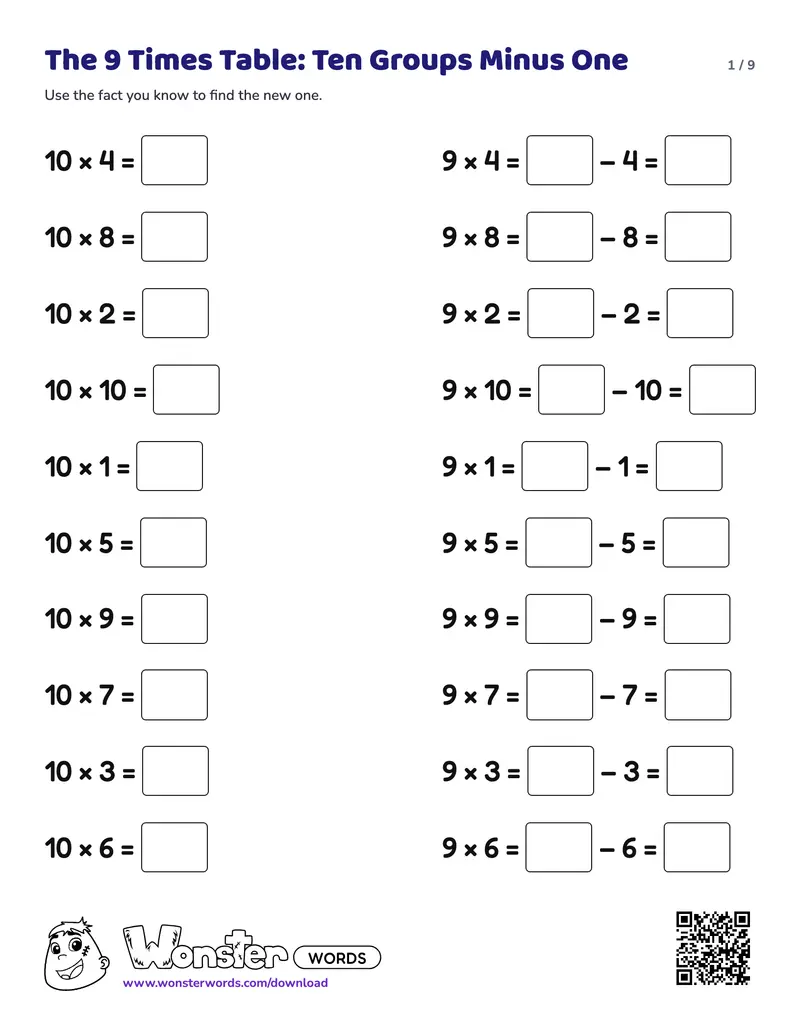
- The 9 Times Table, 9 pages. Each fact from the 10s fact minus one group.
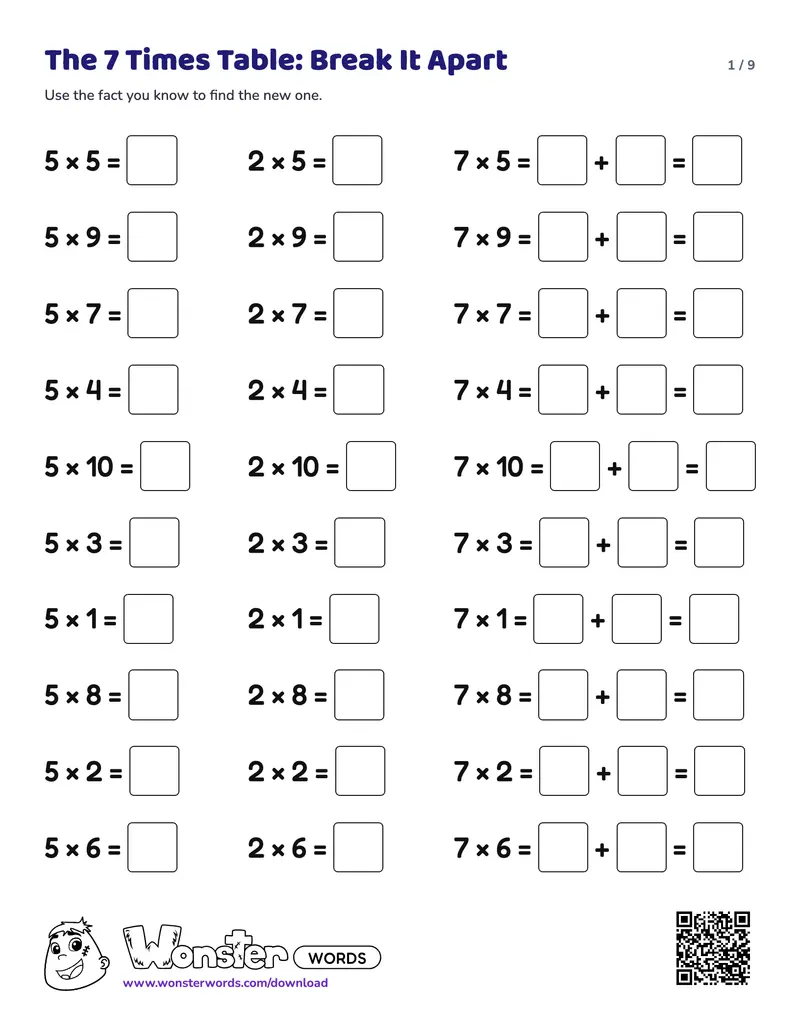
- The 7 Times Table, 9 pages. Each fact broken into a 5s fact and a 2s fact.
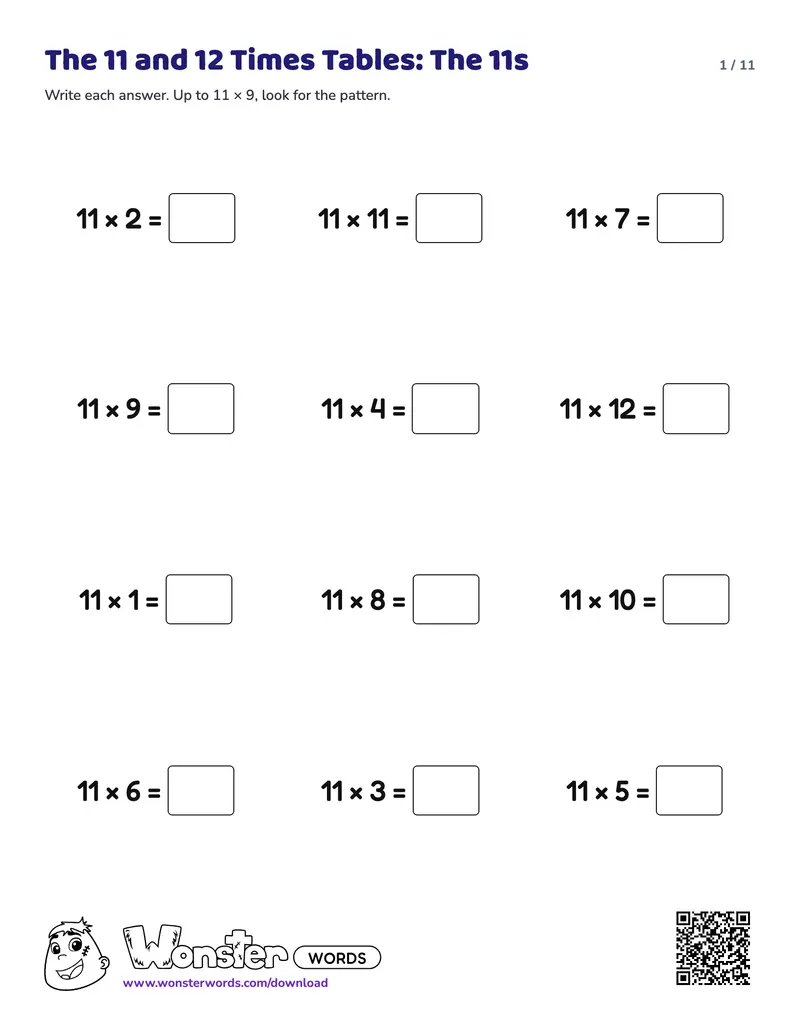
- The 11 and 12 Times Tables, 11 pages. The 11s to 11 × 12, with 11 × 10, 11 × 11, and 11 × 12 as facts of their own, and the 12s from the 10s and the 2s.
Every sheet has the same three activities, each printed twice. No page runs in order: the facts are mixed on the first copy and mixed again on the second. The first activity writes the helper fact in. The second mixes the facts with no helper, in both orders, such as 9 × 7 and 7 × 9. The third asks for the missing number, as in 9 × ☐ = 63, which is the division fact in disguise. An answer key and a page for grown-ups follow. Nothing on a sheet is timed.
Once the families are done, the mixed review covers every fact to 10 × 10. For the picture step, the array worksheets draw facts as rows of dots, and every table sits in one grid on the multiplication chart. More practice is in the multiplication worksheets, and times table games turn one table into a game.
Free PDF · no sign-up
Free printable times table worksheets
Seven free PDFs in black and white, with no account and no email: one for each step of the order and one for the 11s and 12s, each with an answer key and a page for grown-ups on how to use it.
- The 2, 5 and 10 Times Tables (PDF)180 facts · answer key included · 9 pages
Preview page 1Preview
- The 0 and 1 Times Tables (PDF)100 facts · answer key included · 9 pages
Preview page 1Preview
- The 3 and 4 Times Tables (PDF)120 facts · answer key included · 11 pages
Preview page 1Preview
- The 6 and 8 Times Tables (PDF)120 facts · answer key included · 11 pages
Preview page 1Preview
- The 9 Times Table (PDF)100 facts · answer key included · 9 pages
Preview page 1Preview
- The 7 Times Table (PDF)100 facts · answer key included · 9 pages
Preview page 1Preview
- The 11 and 12 Times Tables (PDF)144 facts · answer key included · 11 pages
Preview page 1Preview
Frequently asked questions
Which times table should be taught first and why?
Start with the 2s, then the 5s and 10s. Children already count by 2s, 5s, and 10s, and the 2s are the addition doubles they know from first grade: 2 × 7 is 7 + 7, 14. Those three tables cover 27 of the 55 different facts from 1 × 1 to 10 × 10, so a child who knows them already has about half the chart.
Should times tables be taught in sequence or random order?
Both, in that order. Learn one table or family at a time, with its strategy, until it is quick. Then mix it with the tables already learned, so your child has to recognize which fact is which. The Common Core writing team describes fluency the same way: one number at a time, then several, then all of them mixed together.
Is there a research-based order for teaching multiplication facts?
No standard or study fixes one order, and programs differ. Eureka Math, for example, teaches the 2s to 5s and the 10s first and saves the 0s and 1s for last. Mathematics education researcher Arthur Baroody writes that relating a new fact to one already known greatly reduces the practice a table needs. Any order that puts a table after the one it is built from uses that idea.
Is the 9 times table easier to learn compared to the 8 times table?
Yes. Every 9s fact is the 10s fact minus one group, such as 9 × 7 = 70 − 7 = 63, and the answers follow a pattern a child can check: the two digits always add up to 9. The 8s have no pattern that strong, and counting by 8s crosses a ten at almost every step. Doubling the 4s twice is the strategy for the 8s.
Is there a trick for multiplying by 9?
Yes, two. Take ten groups and subtract one: 9 × 6 is 60 − 6 = 54. Or use the finger trick: hold up ten fingers, fold down the sixth from the left, and read 5 fingers before the fold as tens and 4 after it as ones, 54. Both work because 9 is one less than 10.
Can finger multiplication tricks help in learning the twelve times table too?
No. The nines finger trick works only for 9 × 1 to 9 × 10, because it depends on 9 being one less than 10. For the 12s, split the 12 into 10 and 2: 12 × 7 is 70 + 14, which is 84. That uses the 10s and 2s, which your child already knows.
Are 11 and 12 times tables necessary for future math skills?
They are useful, not required. The Common Core stops at 9 × 9 and the Texas standards at 10 × 10, and the next step in third grade, multiplying by 10s, uses the facts to 10 × 10. England's curriculum goes to 12 × 12, and many charts do too. Learn 0 to 10 first, then the 11s and 12s if your child's school or chart uses them.
Is learning the 7 times table harder than other multiplication tables?
Counting by 7s is harder, because it lands on a ten only at 70. The facts are not, once the other tables are known. A child who already knows the 2s, 5s, 10s, 0s, 1s, 3s, 4s, 6s, 8s, and 9s knows every 7s fact as a turnaround except 7 × 7, and 7 × 7 is 5 × 7 and 2 × 7, 35 + 14 = 49.
Are multiplication tricks really effective?
A trick with a reason behind it works. The nines patterns come from 9 being 10 minus 1, so a child who forgets 9 × 7 can rebuild it from 10 × 7. A trick with no reason, such as a rhyme for one fact, works only as long as it is remembered. Practice should make the reasoning quick until the fact is simply known.
What age should children master their times tables?
By the end of third grade, at about age 8 or 9. The Common Core asks third graders to know from memory all products of two one-digit numbers, and Texas asks for facts up to 10 by 10 with automaticity. Second graders skip count by 5s, 10s, and 100s, so a second grader who counts by 5s but does not yet know the tables is on time.
Are there any songs that help memorize the 9 times table?
Yes, many count-by songs run through the 9s, and they help a child say 9, 18, 27 in order. A song does not help with a fact your child has forgotten in the middle of a page. For that, teach the strategy: 9 × 7 is 10 × 7 minus 7, which is 63.
What are the four multiplication strategies?
For the times tables they are skip counting (the 2s, 5s, and 10s), doubling (the 4s from the 2s, the 8s from the 4s), one more or one less group (the 3s from the 2s, the 9s from the 10s), and breaking a fact apart into two easier ones (7 × 8 is 5 × 8 plus 2 × 8, 40 + 16 = 56).
Related guides
Last updated