
Math
Division for Kids
What division means, its two meanings (sharing and grouping), how it connects to multiplication, what grade learns it, the division facts and the division chart, with free sheets.
Grades: grade 2 to grade 3 · Common Core: 3.OA.A.2, 3.OA.B.6, 3.OA.C.7 · Texas: 2.6(B), 3.4(H), 3.4(J), 3.4(K) · Related: Common Core 3.OA.A.1, 3.OA.A.3, 3.OA.A.4, 3.OA.B.5, 2.OA.C.4; Texas 2.6(A), 3.4(F), 3.5(B), 3.5(D)
Division splits a total into equal groups, and it answers one of two questions: how many are in each group, or how many groups there are. Twelve strawberries shared onto 3 plates put 4 on each plate (sharing). Twelve strawberries put 3 to a bag fill 4 bags (grouping). Both are written 12 ÷ 3 = 4. Every division is a multiplication with a missing number, 3 × ? = 12, and that is how third graders learn the facts.
The most useful move at home is to act out 12 ÷ 3 with 12 small objects both ways, then ask which question you answered. Children learn division in third grade under the Common Core, and Texas second graders already act out division with objects. The free division sheets are a division chart (10 × 10 and 12 × 12), sharing mats, division fact practice with answer keys, and division flash cards with the answer on the back, described in this guide.
What is division?
Division splits a total into equal groups. The total is fixed, the groups must all be the same size, and division finds either the size of each group or the number of groups. Those are the two meanings of division, sharing and grouping.
Each number in a division has a name. In 12 ÷ 3 = 4:
- 12 is the dividend, the total being split.
- 3 is the divisor, the number it is divided by.
- 4 is the quotient, the answer to a division problem.
The sign ÷ is read “divided by”, so 12 ÷ 3 = 4 is “12 divided by 3 is 4”. The same division can be written 12/3, and later with the long division bracket.
Division undoes multiplication. Three groups of 4 make 12, so 12 split into 3 equal groups gives 4 in each. A child who knows the multiplication fact already holds the division fact.
Equal is the whole point. Twelve crackers split into a pile of 5 and a pile of 7 have been split, but not divided, because the piles are different sizes. Division always means every group gets the same number.
Sharing and grouping: the two meanings of division
Division has two meanings: sharing finds how many are in each group, and grouping finds how many groups there are. Twelve strawberries and the number 3 can make either problem, and the table shows the difference.
| 12 ÷ 3 = 4 | Sharing | Grouping |
|---|---|---|
| The question | How many in each group? | How many groups? |
| You know | The number of groups (3 plates) | The size of each group (3 in a bag) |
| Act it out | Deal the 12 one at a time onto 3 plates | Scoop out 3 at a time until none are left |
| The answer counts | Strawberries on a plate: 4 | Bags: 4 |
| Common Core 3.OA.A.2 | ”the number of objects in each share" | "a number of shares” |
The Common Core’s third-grade standard 3.OA.A.2 names both meanings in one example: interpret 56 ÷ 8 “as the number of objects in each share when 56 objects are partitioned equally into 8 shares, or as a number of shares when 56 objects are partitioned into equal shares of 8 objects each.” The standard’s progressions document says “there are two kinds of division situations depending on which factor is the unknown”, and calls them “Group Size Unknown” and “Number of Groups Unknown”.
Teachers have their own names. The Utah State Board of Education third-grade guide calls sharing “partitive (fair sharing)” and grouping “quotative (measurement)”, and adds that children are not expected to know the terms. Sharing and grouping are the words a child needs.
Texas names sharing alone in third grade. Its second-grade standard has children separate “a set of concrete objects” into “equivalent sets” (2.6(B)), and its third-grade standard names only the number in each group when a set “is shared equally” (3.4(H), TEKS grade 3).
Grouping written down is repeated subtraction: 12 − 3 − 3 − 3 − 3 = 0 takes away four 3s, so 12 ÷ 3 = 4. On a number line, grouping is equal jumps of 3 from 12 back to 0, and the number of jumps is the answer.
How is division related to multiplication?
Multiplication and division are one fact read two ways: every division is a multiplication with a missing number. The division 12 ÷ 3 asks “3 times what makes 12?”, and a child who knows 3 × 4 = 12 has the answer. The Common Core says it in 3.OA.B.6: “Understand division as an unknown-factor problem. For example, find 32 ÷ 8 by finding the number that makes 32 when multiplied by 8.” Texas third graders “determine a quotient using the relationship between multiplication and division” (3.4(J)).
The two meanings are the two factors. Sharing is the missing group size, 3 × ? = 12 with 3 groups. Grouping is the missing number of groups, ? × 3 = 12 with groups of 3.
An array shows all of it at once. Twelve dots in 3 rows of 4 read 3 × 4 = 12, 4 × 3 = 12, 12 ÷ 3 = 4, and 12 ÷ 4 = 3. A tape diagram shows the same split as one bar cut into 3 equal parts.
Those four facts are a multiplication and division fact family: the numbers 3, 4, and 12. It is the same idea first graders meet with addition and subtraction. The family’s two multiplications turn around, and its two divisions do not: 12 ÷ 3 is not 3 ÷ 12, and the total always comes first.
Schools teach multiplication and division together in third grade, not one after the other. The progressions document says “Multiplications and divisions can be learned at the same time and can reinforce each other.” It also notes that when a child counts by 3s to reach 24, “dividing can be easier than multiplying”, because listening for 24 is easier than keeping track of eight 3s. A child does need the meaning of multiplication as equal groups before division makes sense. Practice for the pair is the Multiplication and Division Facts sheet in the free division worksheets.
What grade do kids learn division?
Children learn division in third grade under both the Common Core and the Texas standards, and Texas second graders already act out division with objects. Division with remainders comes in fourth grade, and Texas teaches long division then too.
| Grade | What children do | Common Core | Texas (TEKS) |
|---|---|---|---|
| 2nd grade | Equal groups and small arrays by adding; in Texas, separate a set of objects into equal sets | 2.OA.C.4 (related; no division standard) | 2.6(A), 2.6(B) |
| 3rd grade | Both meanings within 100; division as a missing factor; word problems with equal groups and arrays; multiply and divide fluently within 100 | 3.OA.A.2, 3.OA.A.3, 3.OA.B.6, 3.OA.C.7 | 3.4(F), 3.4(H), 3.4(J), 3.4(K) |
| 4th grade | Divide up to four digits by one digit, with remainders; in Texas, with the standard algorithm (long division) | 4.NBT.B.6 | 4.4(E), 4.4(F), 4.4(H) |
Texas starts earlier. Its second graders “model, create, and describe contextual division situations in which a set of concrete objects is separated into equivalent sets” (2.6(B)). Its third graders recall the multiplication facts to 10 × 10 and “recall the corresponding division facts” (3.4(F)). No Common Core second-grade standard mentions division. Its third graders “fluently multiply and divide within 100” (3.OA.C.7).
A child who can make equal groups and count by 2s, 5s, and 10s is ready to share and group. A younger child who shares snacks fairly between friends is doing the second-grade work, with no worksheet needed. Long division, the method many searches for “how to do division” mean, builds on the division facts this guide covers. Texas teaches it in fourth grade (4.4(F)), and the Common Core expects it by sixth grade (6.NS.B.2).
How to teach division at home
Teach division at home with objects first, then a drawing, then numbers alone, and act out every division both ways. The What Works Clearinghouse practice guide Assisting Students Struggling with Mathematics (2021) is written for intervention teachers, and it rates objects and drawings, connected step by step to the written numbers, as strongly supported, on 28 studies. These five steps adapt that advice for a kitchen table, about 10 minutes at a time.
Share with objects
Put 12 crackers and 3 plates on the table. Deal the crackers one to each plate, round and round, until none are left. Count one plate: 4. Say "12 shared into 3 groups is 4 each."
Group with objects
Gather the same 12 crackers. Scoop out 3 at a time into cups until none are left, then count the cups: 4. Say "12 in groups of 3 makes 4 groups." The numbers are the same, and the question is different.
Draw it
Draw 3 circles with 4 dots in each, or 3 rows of 4 dots. The drawing is the step between the crackers and the numbers.
Write the division and its multiplication
Write 12 ÷ 3 = 4, and under it 3 × 4 = 12. Read both aloud: "12 divided by 3 is 4" and "3 groups of 4 is 12."
Ask the missing-number question
Ask "3 times what makes 12?" Your child answers 4. Every division fact can be found this way, and it is how third graders learn them.
Everyday life is full of division. Share the slices of a pizza, deal the cards for a game, and put the socks in pairs, which is grouping by 2. Then swap stories: you tell a sharing story (“15 grapes for 3 friends”), and your child tells a grouping story with the same numbers (“15 grapes, 3 in each bowl”). Start with totals to 20 and 2, 3, 4, or 5 groups. Beans, buttons, and blocks all work as counters, and math manipulatives covers which suit which age.
On a homework night, use three moves. Before any answer, ask “is this sharing or grouping?” and act out one problem. For a fact, ask the multiplication question, “3 times what makes 12?”, before reaching for a chart. Keep the sitting short, and stop when your child is guessing rather than working. A child who can act out both meanings for 12 and write the matching ÷ sentence understands division.
How kids learn division facts
A division fact is a multiplication fact read backwards, so children learn the two together, one family at a time. The order this site recommends starts with the 2s, 5s, and 10s, then the 1s and 0, then the 3s and 4s, the 6s and 8s, the 9s, and the 7s, as in the times tables. For each family the multiplication fact finds the division: 56 ÷ 8 asks “8 times what is 56?”
Three quick division strategies:
- Count up by the divisor. For 24 ÷ 3, count 3, 6, 9, 12, 15, 18, 21, 24 and keep track of the counts: eight 3s, so 24 ÷ 3 = 8.
- Think of the multiplication fact. For 35 ÷ 5, a child who knows 5 × 7 = 35 answers 7.
- Halve. Dividing by 2 is halving, and dividing by 4 is halving twice: 24 ÷ 4 is half of 12, which is 6.
The 1s and 0 follow three rules. Any number divided by 1 is itself (6 ÷ 1 = 6). A number divided by itself is 1 (8 ÷ 8 = 1). Zero divided by any number is 0 (0 ÷ 6 = 0). No number can be divided by 0, because no number times 0 makes anything but 0.
Memorizing and understanding are not a choice between two things. By the end of third grade, the Common Core asks children to divide fluently within 100 “using strategies such as the relationship between multiplication and division”. The same standard asks them to “know from memory all products of two one-digit numbers” (3.OA.C.7). The memory work is on the products, and the divisions come from them. The progressions document says fluency “isn’t a matter of instilling facts divorced from their meanings, but rather the outcome of a carefully designed learning process that heavily involves the interplay of practice and reasoning.” Practice without a timer first, and add a short beat-your-own-score round only once the answers are accurate. Multiplication fact fluency covers timed practice and flash card routines, and the division flash cards on this page follow the same family order as the multiplication cards there.
What is a division chart and how do you use it?
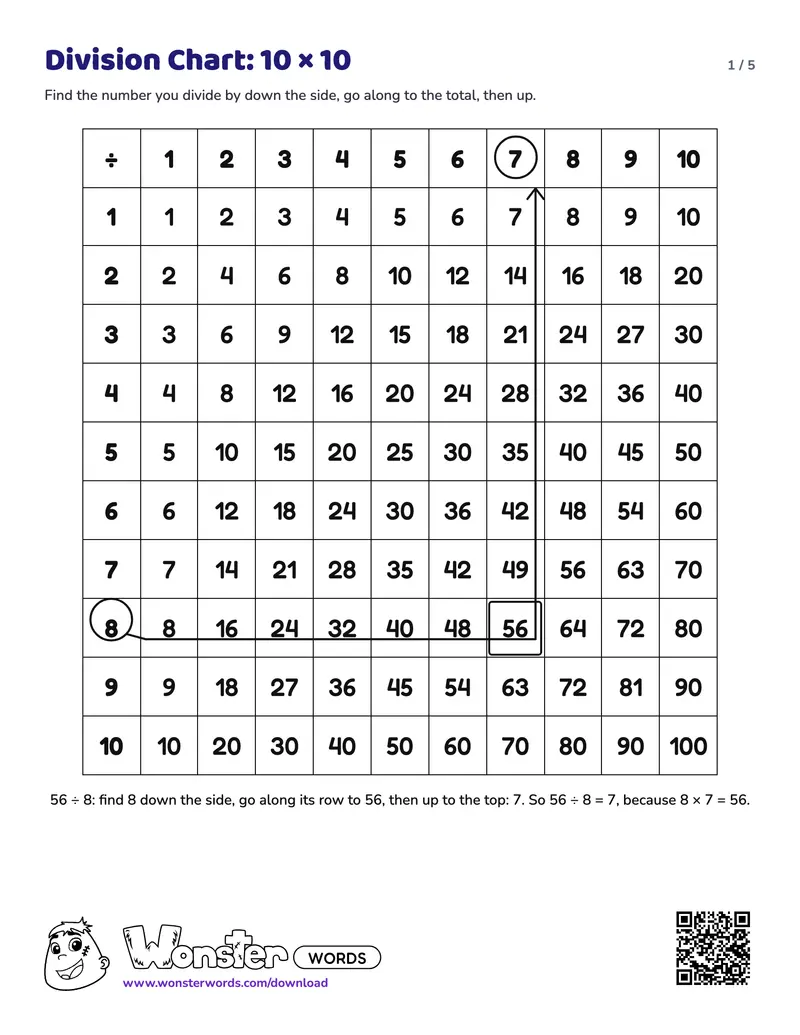
A division chart is a multiplication chart read backwards. The grid of products is the same. To divide, find the divisor’s row, move along it to the total, and go up to the top of that column for the answer.
To find 56 ÷ 8 on the chart:
- Find the 8 row on the left side.
- Move along the 8 row until you reach 56.
- Go up to the top of that column. It says 7, so 56 ÷ 8 = 7.
- Check it with the multiplication: 8 × 7 = 56.
| ÷ | 1 | 2 | 3 | 4 | 5 | 6 | 7 | 8 | 9 | 10 |
|---|---|---|---|---|---|---|---|---|---|---|
| 7 | 7 | 14 | 21 | 28 | 35 | 42 | 49 | 56 | 63 | 70 |
| 8 | 8 | 16 | 24 | 32 | 40 | 48 | 56 | 64 | 72 | 80 |
| 9 | 9 | 18 | 27 | 36 | 45 | 54 | 63 | 72 | 81 | 90 |
Our division chart sheet has two forms. The grid comes in 10 × 10 and 12 × 12. The division facts tables list every fact from ÷1 to ÷12, such as 2 ÷ 2 = 1 to 20 ÷ 2 = 10. Many division charts take that form. Common Core’s facts stop at 9 × 9 (3.OA.C.7’s “two one-digit numbers”), and Texas’s at 10 × 10 (“up to 10 by 10”). Many charts and classrooms use 12 × 12, so the sheet has both.
At home, look up a fact and then say the multiplication that checks it. Cover a column number with a finger and ask for the hidden answer. Use the chart less as the facts become known. A division chart and a multiplication table are the same table, and that is the point: reading it both ways is the relationship third graders learn. The multiplication chart guide has the blank and missing-number charts and how to read one.
Division games for kids
Each of these five division games needs counters, cups, a die, a deck of cards, or the division chart, and each ends with your child saying a division fact aloud.
- Fair share (sharing). Deal a pile of 12, 18, or 24 counters among 2 to 6 cups. Your child says the division before anyone counts (“18 shared by 3 is 6 each”), then checks.
- Bag it (grouping). Roll a die for the group size, and your child bags a pile of 12, 18, or 24 into groups that size and says how many bags. A leftover means the pile does not divide evenly, so pick a new pile.
- Missing factor flip. Remove the picture cards from a deck. Flip one card for the divisor, and you name a product from that family. The first to say the quotient keeps the card: flip a 6, say “42”, and the answer is 7.
- Chart cover. On the division chart, cover a number in the top row with a counter. Your child reads the row and the total below it and names the hidden quotient.
- Division war. Each player flips two cards and multiplies. The partner says both divisions of the product: a 4 and a 6 make 24, so 24 ÷ 4 = 6 and 24 ÷ 6 = 4.
None of the games is timed. Flash cards and games are both practice, and a game keeps it social so it does not feel like a test. Card, dice, and bingo games for the multiplication facts are on the multiplication games page.
Common division mistakes, and what to do when division is hard
The commonest division mistake is mixing up what the answer counts. In a grouping problem the child answers with the group size, or in a sharing problem with the number of groups. “Twelve crackers, 3 in each cup: how many cups?” gets “3”. Ask “is this sharing or grouping?” before any answer, and have your child say the unit with it: “4 cups”, or “4 on each plate”.
Four more mistakes show on the homework sheet, and each has a fix.
- Turning the division around. The child writes 3 ÷ 12 for 12 ÷ 3. The total comes first. Ask “can you share 3 crackers among 12 people and give each a whole one?”
- Unequal groups. Twelve split into 5 and 7 is called division. Every group must be the same size, so count each one.
- Mixing up 1 and 0. The child answers 6 ÷ 1 with 1, or 0 ÷ 6 with 6. Act it out: 6 crackers on 1 plate, and no crackers on 6 plates.
- Counting everything every time. A child still dealing out 56 counters in the spring needs the next step: the drawing, then the multiplication question, with the chart while the facts are learned.
When division is hard, go back to objects and totals to 20, learn one family a week, and use the sharing mats. When a child is afraid of division, keep sessions short, use objects and stories before symbols, leave out the timer until the answers are accurate, and stay calm yourself. If division within 20 with objects is still guesswork by the end of third grade, talk to your child’s teacher.
Going further: remainders and long division
When a total does not split evenly, the part left over is the remainder. Thirteen crackers shared onto 4 plates give 3 on each plate with 1 left over. The Common Core teaches remainders in fourth grade (4.NBT.B.6), and Texas asks fourth graders to interpret remainders (4.4(H), TEKS grade 4). Long division, the written method, is fourth grade in Texas (4.4(F)) and sixth grade in the Common Core (6.NS.B.2). Dimensions Math, a Singapore-method program from Singapore Math Inc., meets remainders sooner, in its first third-grade book, 3A. All of them rest on the division facts this guide covers.
Free division worksheets: chart, sharing mats, facts, and flash cards
The free division worksheets come as five PDFs, in teaching order: objects, a look-up chart, facts by family, a mixed review, and flash cards.
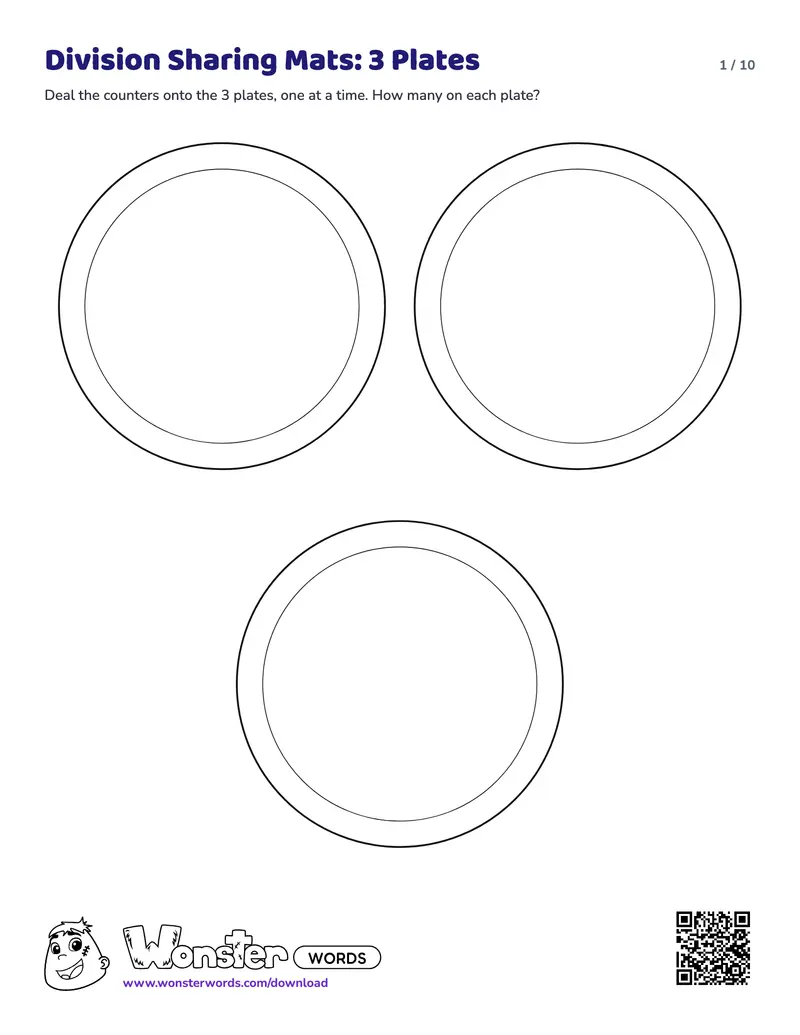
- Division Sharing Mats, 10 pages, from second grade. Mats of 3, 4, and 5 plates, a grouping mat of ten bags, and 40 counters to cut out, for the first two steps above on paper. Two “Share or group?” pages of eight stories ask your child to circle share or group for each one and write the ÷ sentence, with an answer key.
- Division Chart, 5 pages, for third grade. The 10 × 10 and 12 × 12 grids, each with an arrow showing how to read 56 ÷ 8, and division facts tables from ÷1 to ÷12.
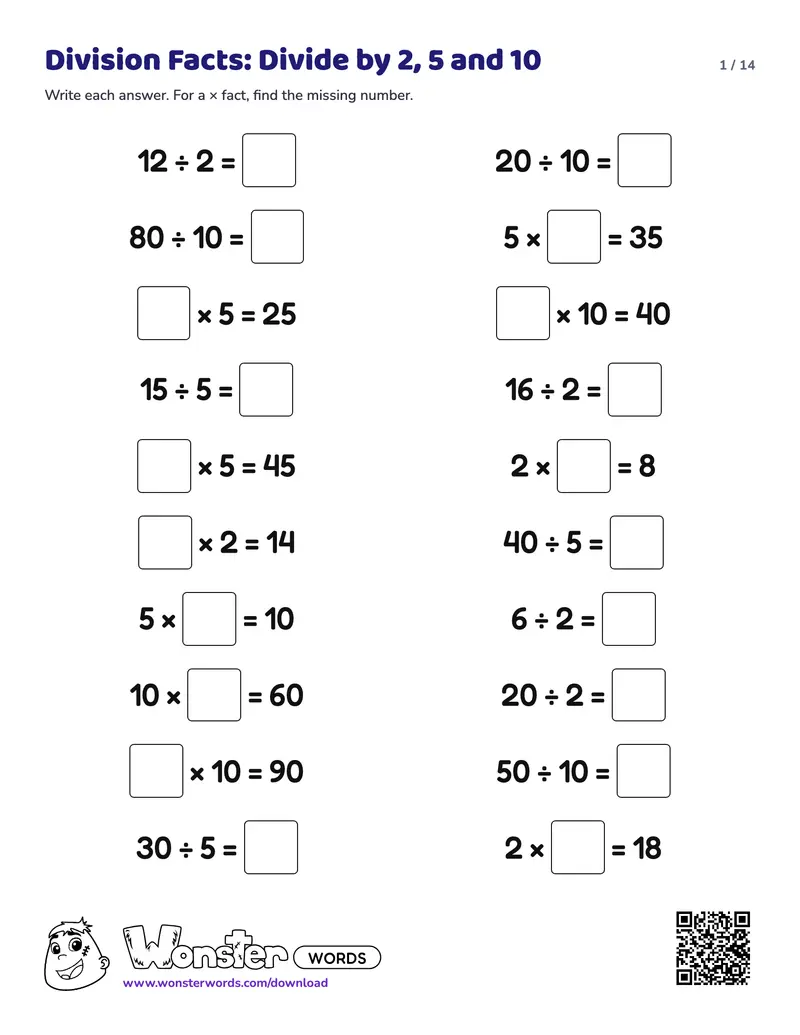
- Division Facts, 14 pages, once your child can act out both meanings. One page for each family, in the order above, half as 18 ÷ 2 = ☐ and half as 2 × ☐ = 18, with answer keys.
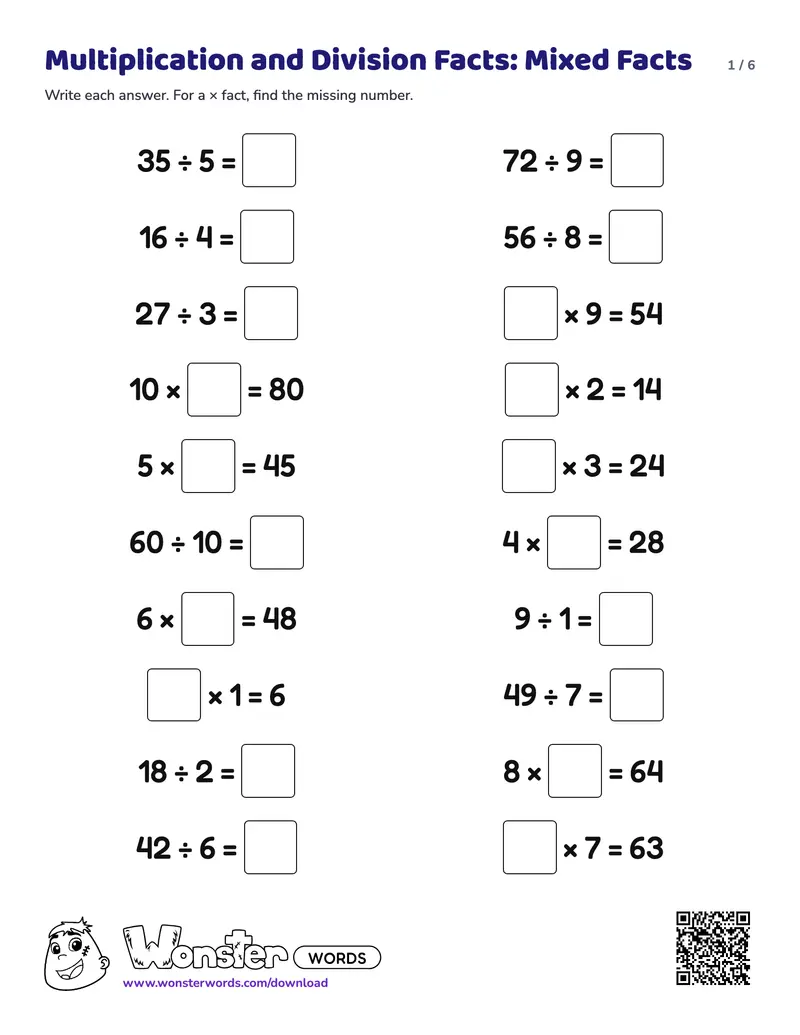
- Multiplication and Division Facts, 6 pages, once the families are done. A mixed review of every family to 10 × 10, and a fact family page where three numbers, such as 3, 4, and 12, make two multiplications and two divisions, with an answer key.
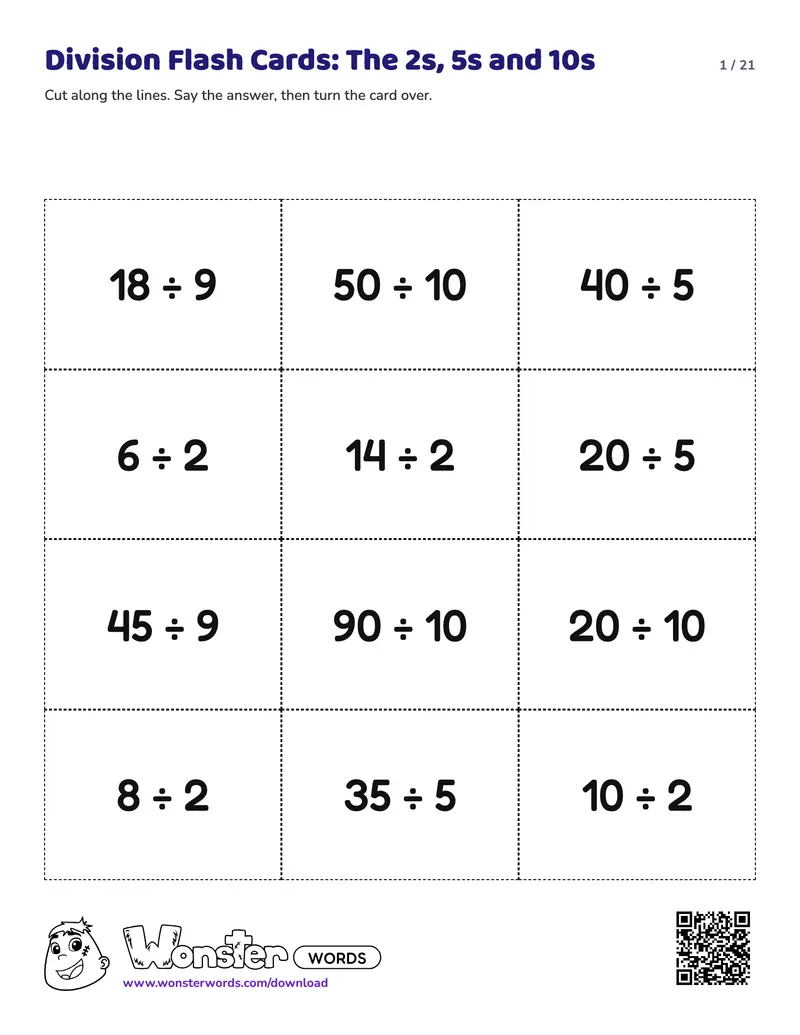
- Division Flash Cards, 21 pages, for facts your child can already work out. It has 100 cards, both division facts of every pair from 1 × 1 to 10 × 10, a family a page and mixed within it, printed double-sided so each answer is on the back.
Every practice page prints twice, with the items in a mixed order that is different each time. The answer keys let you check a page without working every problem. Each PDF ends with a page for grown-ups on what the sheet practices, why schools teach it this way, and how to use it. Every page prints in black and white.
Free PDF · no sign-up
Free printable division worksheets
Five free PDFs in black and white, with no account and no email: the sharing mats, the division chart, the division facts, the mixed multiplication and division facts, and the division flash cards. Print the flash cards double-sided, flipping on the long edge, so each answer lands on the back of its card.
- Division Sharing Mats (PDF)4 mats · answer key included · 10 pages
Preview page 1Preview
- Division Chart (PDF)144 facts · 5 pages
Preview page 1Preview
- Division Facts (PDF)200 facts · answer key included · 14 pages
Preview page 1Preview
- Multiplication and Division Facts (PDF)88 facts · answer key included · 6 pages
Preview page 1Preview
- Division Flash Cards (PDF)100 cards · answer key included · 21 pages
Preview page 1Preview
For the picture step, the array worksheets draw multiplication facts as rows of dots, and each one reads as a division too. For more multiplication practice, see the multiplication worksheets.
Frequently asked questions
What are the two meanings of division?
Division has two meanings, sharing and grouping. Sharing asks how many are in each group, as when 12 strawberries are shared onto 3 plates and each plate gets 4. Grouping asks how many groups there are, as when 12 strawberries are put 3 to a bag and fill 4 bags. Both are written 12 ÷ 3 = 4, and the Common Core asks third graders to understand both.
What is the answer to a division problem called?
The answer to a division problem is called the quotient. In 12 ÷ 3 = 4, the quotient is 4. The number being divided, 12, is the dividend, and the number it is divided by, 3, is the divisor. The answer to a multiplication problem is the product, and a division turns a product back into one of its factors.
Why is division considered the opposite of multiplication?
Division undoes multiplication. Multiplication puts equal groups together, so 3 groups of 4 make 12. Division starts from the 12 and splits it back into 3 groups of 4. That is why every division fact matches a multiplication fact, and why 12 ÷ 3 can be found by asking what number times 3 makes 12.
What age should children start learning division?
Children learn division in third grade, at about 8, in both the Common Core and the Texas standards. Texas second graders already separate a set of objects into equal groups. A younger child who shares snacks fairly between friends is doing the same work with no worksheet at all.
Should I teach division with equal groups or through repeated subtraction?
Teach both, because they are the same idea. Repeated subtraction is grouping written down. Taking 3 away from 12 again and again, 12 − 3 − 3 − 3 − 3 = 0, uses four 3s, so 12 ÷ 3 = 4. Start with equal groups of real objects, then show the subtraction as a record of the scooping.
Is it more effective to teach multiplication before division or vice versa?
Schools teach them together in third grade, once a child understands multiplication as equal groups. The Common Core progressions document says multiplication and division can be learned at the same time and reinforce each other. A child who knows 3 × 4 = 12 also knows 12 ÷ 3 = 4 and 12 ÷ 4 = 3.
What are examples of division in real life?
Sharing 8 slices of pizza among 4 people is division, 2 slices each. Dealing 20 cards to 4 players is division, 5 cards each. Putting 10 socks into pairs is division too, and it makes 5 pairs. Every time a total is split into equal groups, or packed a fixed number to a group, someone is dividing.
How does dividing a number by zero affect the result?
Zero divided by a number is 0, so 0 ÷ 5 = 0, because 0 shared among 5 plates leaves each plate empty. A number divided by zero has no answer. The fact 5 ÷ 0 would need a number that makes 5 when multiplied by 0, and every number times 0 is 0, so no such number exists.
Is a division chart the same as a multiplication chart?
Yes. A division chart is a multiplication chart read backwards. To find 56 ÷ 8, find the 8 row, move along it to 56, and go up to the top of that column, which says 7. Some division charts list the facts as tables instead, such as 2 ÷ 2 = 1 to 20 ÷ 2 = 10, but the facts are the same.
Are printable division games suitable for homeschooling?
Yes. Division games that use counters, cups, a deck of cards, or a printed division chart work at a kitchen table with one child or several. Start with sharing and grouping games that use real objects, then move to card games that ask for a division fact once your child can act out both meanings.
How can I check my child's understanding of division?
Ask your child to act out 12 ÷ 3 both ways with 12 small objects, sharing them onto 3 plates and then putting them 3 to a cup, and to write the matching division sentence. A child who can do both, and say what the 4 counts each time, understands division.
Related guides
Last updated