
Math
Multiplication Games for Kids
Card games, dice and paper games, and multiplication bingo for second and third grade, which game fits which times table, how to keep practice fun, and whether games beat worksheets.
Grades: grade 2 to grade 3 · Common Core: 3.OA.C.7 · Texas: 3.4(F) · Related: Common Core 2.NBT.A.2, 3.OA.A.1, 3.OA.B.5; Texas 3.4(E)
The best multiplication games for kids are quick ones you can play with a deck of cards, two dice, or a printed bingo board, and each works the same way: your child says the whole fact aloud, “six times seven is forty-two”, on facts they can already work out. Four to start with are Multiplication War, Salute, Circles and Stars, and multiplication bingo, with free multiplication bingo sheets described on this page.
A game makes a known fact quicker; it does not teach a fact your child cannot yet work out. The What Works Clearinghouse practice guide for teachers rates short, regular fact practice (timed activities of 1–5 minutes) as strongly supported, as long as it comes after a child has a strategy, and a game is a good way to deliver that practice. Start with the 2s, 5s, and 10s.
How do you play multiplication games with regular playing cards?
Take the jacks, queens, and kings out of a deck to leave 40 cards, ace to 10, and count an ace as 1. The 10s stay in for the 10s facts. Each of these four games ends with a fact said aloud.
- Multiplication War (two players). Shuffle and deal each player 20 cards face down. Each turns over two cards and says the fact: “4 times 7 is 28”, not just “28”. The bigger product takes all four cards. If the products are equal, each turns over two more and the bigger product takes all eight. When the piles run out, the player with more cards wins.
- Salute (three players). Two players each take a card and hold it to their forehead without looking at it. The third player sees both and says the product. Each card holder works out their own card from the product and the card they can see, and the first to say it correctly keeps both cards. A product of 24 and a 6 means 4, so Salute is division practice in disguise; the division page has games that are division on purpose.
- One-table War (two players, for one times table). Put one card from the table your child is learning face up in the middle, such as a 7. Each player turns over one card and says the fact with the 7: “7 times 8 is 56”. The bigger product takes both cards, but only if the fact was said correctly.
- Biggest product (two or more players). Deal each player three cards. Each chooses two to multiply, says the fact, and the biggest product scores a point. Then play a round for the smallest product. The first to 5 points wins. Choosing makes a child compare facts, which is reasoning, not only recall.
Addition war and salute, with a plus sign, are the addition versions of the first two games. For a child still building the meaning of multiplication, Array War on the arrays page draws each pair of cards as an array before saying the fact.
Low-prep multiplication games with dice, paper, and pencil
Multiplication games need no board or app: two dice, squared paper, or a hallway floor make four of them. Each one has your child say the fact.
- Circles and Stars. Roll a die and draw that many large circles. Roll again and draw that many stars in each circle, then write the multiplication: four circles of three stars is 4 × 3 = 12. Take turns for six rounds, add up your stars, and the most stars wins. The circles make the equal groups visible, so it suits a second grader starting out. youcubed, Stanford’s math education site, publishes the rules.
- Roll and multiply. Each player rolls two dice and says the fact, and the bigger product wins the round. The first to win 5 rounds wins. Two ordinary dice stop at 6 × 6, so for the 7s to 10s swap one die for a 10-sided die, or for a card from the 40-card deck above.
- Array capture. Draw a 10 by 10 square on squared paper. Players take turns rolling two dice, drawing a rectangle that many squares long and wide anywhere it fits (a 3 and a 5 can go either way), and writing the fact inside it, such as 3 × 5 = 15. If a rectangle does not fit, that turn is lost. When neither player can fit one, each adds up their products, and the most squares wins. The rectangle is the start of the area model, the next step for bigger numbers, and a cousin of the array games.
- Skip-count jumps. Your child jumps along the hallway counting by 2s, 5s, or 10s out loud. Call “stop”, and your child says the fact for the jumps so far: “five jumps of 5 is 25”. It suits a second grader, since skip counting by 5s and 10s is a second-grade Common Core standard.
Any race board game played with two dice becomes fact practice on a family game night: the player says the multiplication fact for the roll before moving. Board games for younger brothers and sisters, aged 3–8, are on our math board games page.
Free printable multiplication bingo
Multiplication bingo is played with boards of answers and a caller deck of facts. The caller reads a fact, such as 6 × 7. Each player works out the answer, says the whole fact aloud, and covers 42 if it is on their board. The first to cover a full row, column, or diagonal wins.
Choose the facts
Pick the range your child can already work out: the 2s, 5s and 10s first, then the 3s, 4s, 6s and 8s, then every fact from 2 × 2 to 10 × 10.
Give each player a board of answers
Each board is a grid of different products from that range, 16 squares on a 4 × 4 board or 25 on a 5 × 5. Give each player a different board and a pile of covers, such as coins or buttons.
Shuffle the caller cards
Use one card for each fact in the range, such as 6 × 7, and shuffle them face down. Either order of the factors is fine.
Call a fact and say it whole
The caller reads the top card. Every player works out the answer and says the whole fact aloud, "six times seven is forty-two", then covers 42 if it is on their board.
Say the fact even when the answer is covered
Two facts can share an answer: 3 × 4 and 2 × 6 are both 12. If your answer is already covered or not on your board, say the fact anyway and wait for the next card.
Win with a full line
The first player to cover a full row, column or diagonal calls "Bingo" and reads back the facts for each square. Clear the covers and play again, with your child as the caller.
The free multiplication bingo comes as three sheets, one for each stage of the times tables, in the order children learn them:
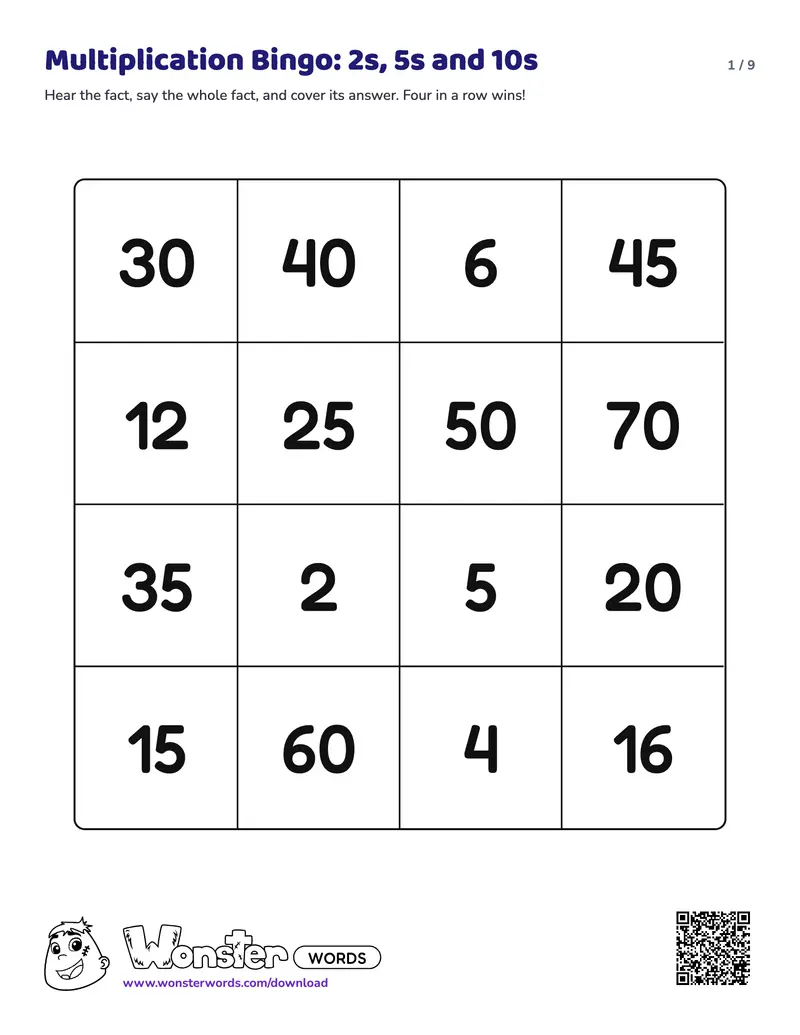
- Multiplication Bingo: 2s, 5s and 10s, for second and third grade, 9 pages. A caller card for each of the 27 facts from the 2s, 5s, and 10s, times 1 to 10, and 4 × 4 boards drawn from their 23 different answers.
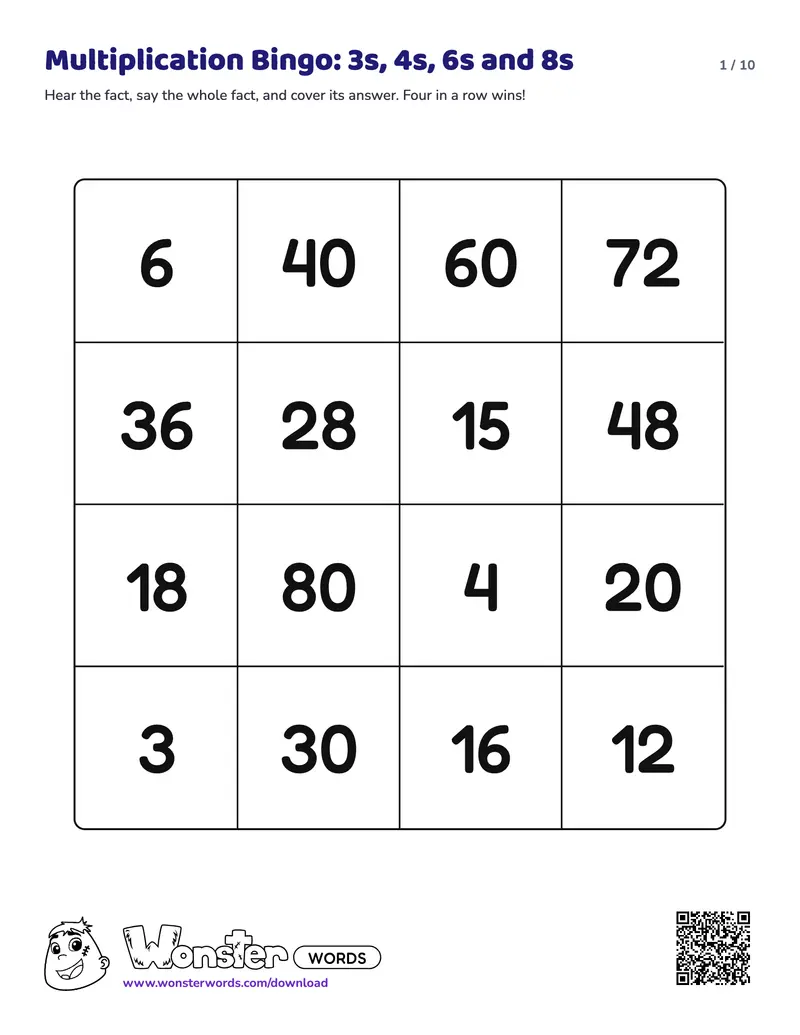
- Multiplication Bingo: 3s, 4s, 6s and 8s, for third grade, 10 pages. It has 34 facts and 4 × 4 boards drawn from 26 different answers.
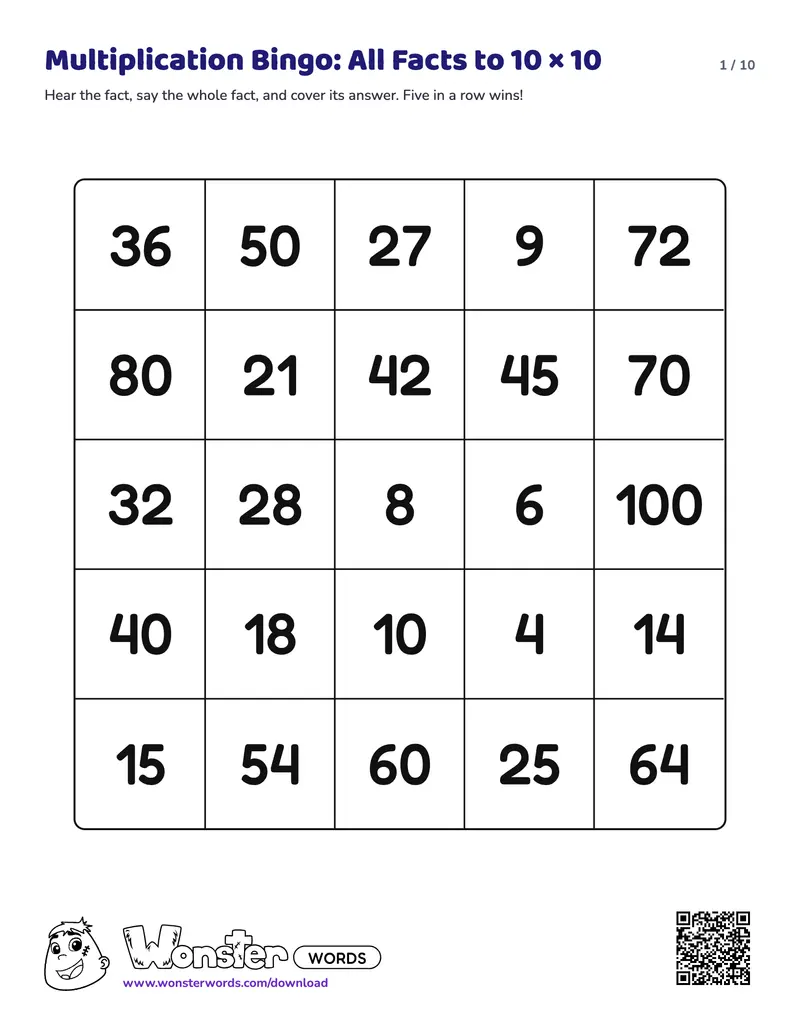
- Multiplication Bingo: All Facts to 10 × 10, for third grade, 10 pages. It has every fact from 2 × 2 to 10 × 10, 45 in all, and 5 × 5 boards drawn from 37 different answers.
Each sheet has three different boards, a page of covers for each board, caller cards that print the fact large and its answer small so the caller can check, how to play, and a last page for grown-ups. There is no 0 square: every times-0 fact has the same answer. The boards use covers, not crosses, so they can be played again; coins or buttons work too. All three print in black and white.
Two facts can share an answer. The facts 3 × 4 and 2 × 6 are both 12, and in the all-facts set 8 of the 37 answers have two facts. The second call covers nothing new, but the player still says the fact.
To adapt bingo, start a younger child or a reluctant one on the 2s, 5s, and 10s, and let them be the caller, reading the answer on the card to check everyone. A quicker child plays the all-facts boards. Bingo has no timer.
To make your own, draw a 4 by 4 grid and fill it with 16 different answers from the 2s, 5s, and 10s, then call the 27 facts from a list, crossing each off as you go. For one table, use a 3 by 3 grid of 9 of its 10 answers.
Free PDF · no sign-up
Free printable multiplication bingo
Three free bingo PDFs in black and white, with no account and no email, in the order children learn the tables: the 2s, 5s, and 10s, then the 3s, 4s, 6s, and 8s, then every fact to 10 × 10. Each has three boards of answers, a page of covers for each board, caller cards with the fact large and its answer small, how to play, and a page for grown-ups.
- Multiplication Bingo: 2s, 5s and 10s (PDF)27 facts · 9 pages
Preview page 1Preview
- Multiplication Bingo: 3s, 4s, 6s and 8s (PDF)34 facts · 10 pages
Preview page 1Preview
- Multiplication Bingo: All Facts to 10 × 10 (PDF)45 facts · 10 pages
Preview page 1Preview
What games help with one times table, such as the 7s?
Play games on the times tables in the order children learn them: the 2s, 5s, and 10s, then the 0s and 1s, the 3s and 4s, the 6s and 8s, the 9s, and the 7s last. The times tables page explains the order and teaches the strategy for each table. The game fits the stage:
| Stage | The strategy | Games that fit |
|---|---|---|
| 2s, 5s, and 10s | Skip counting | Skip-count jumps, bingo sheet 1, One-table War with a 2, 5, or 10 |
| 0s and 1s | Two rules | A round of One-table War with an ace |
| 3s and 4s | One more group; double the 2s | Bingo sheet 2, One-table War with a 3 or 4 |
| 6s and 8s | Double again | Bingo sheet 2, One-table War with a 6 or 8 |
| 9s | Ten groups minus one | One-table War with a 9, bingo sheet 3 |
| 7s | Break it apart: 5s plus 2s | One-table War with a 7, bingo sheet 3 |
The 7s come last, and that makes them easier than they look. By the time a child reaches them, every 7s fact but one is already known from another table, because 7 × 3 is the same as 3 × 7, the turnaround rule on the properties of multiplication page. Only 7 × 7 is new. For One-table War on the 7s, take the aces, 2s, 5s, and 10s out of the deck, so most flips are the facts that are still slow.
The 11s and 12s come after the facts to 10 × 10, which is as far as the US standards go. One-table War works for them with a jack as 11 and a queen as 12, and the times table worksheets include a sheet for the 11s and 12s. The bingo sheets stop at 10 × 10.
Play a game on a table only once your child can work out its facts, however slowly. Before that, the table needs its strategy, not a game.
How can parents make multiplication practice fun at home?
Five habits keep multiplication practice short, winnable, and fun at home:
- A few minutes, most days. The What Works Clearinghouse guide’s fact activities last “between 1 and 5 minutes”. One game is enough, not an hour.
- Known facts, plus a few new ones. The fun comes from winning, and a game full of facts your child cannot work out is a test.
- Say the whole fact aloud, every turn. It is how you hear a wrong one.
- Beat your own score, never someone else’s. The guide suggests a score to “meet or beat”. When a brother or sister plays, keep one team score, since working toward a goal as a group “can reduce the pressure on individual students”.
- Let your child run it. Your child can be the caller in bingo or the dealer in War. Songs and skip-count chants count too.
For a child who dislikes math, make the first games wins. Start with the 2s, 5s, and 10s, and play cooperatively: beat the deck together, scoring a point for each fact said right and a point to the deck for each one missed. The WWC guide’s advice for an anxious child is to begin with “flashcards or other activities that do not present many problems at the onset”, so use a short game of a few facts and stop while it is still fun. The game is the reward; a chart of your child’s own scores is enough. More on a child who dislikes multiplication is in when multiplication is hard, and if your child still cannot work out the facts by the end of third grade, talk to your child’s teacher.
Multiplication games or worksheets: which is more effective for kids?
Multiplication games work best as practice for facts a child already understands, and so do worksheets: neither teaches a fact on its own. A child learns a fact by counting, then reasoning from facts they know, then knowing it, and Arthur Baroody argues that “practice should focus on making reasoning strategies more automatic, not on drilling isolated facts”.
The evidence is for the practice, and a game delivers it well. The What Works Clearinghouse rates short, regular fact practice, in its case timed activities of 1–5 minutes, as strongly supported, on 27 studies. It sets three conditions a game meets easily: the facts are already learned, the child has an efficient strategy to fall back on, and there is a score to meet or beat. It suggests “game-like features, such as keeping score”. The studies behind it tested fact practice, not a home card game or bingo, so a game is one good way to deliver the practice they describe. The guide was written for teachers working with children who struggle, and this page adapts it for home.
Each tool has a job:
- A game gets a reluctant child to do the practice, and lets you hear every fact.
- A worksheet leaves a written record, and is how school will ask. The multiplication worksheets page covers when one helps.
- Flash cards pick out the few facts that are still slow, as the multiplication facts page explains.
Use games for most practice at home, in the short sessions above, and a short worksheet or a minute of flash cards to check which facts are still slow. Games count as real practice, and the goal is in reach: Common Core asks that by the end of third grade children “know from memory all products of two one-digit numbers” (3.OA.C.7), and Texas asks third graders to recall facts up to 10 by 10 with automaticity (TEKS 3.4(F)).
Frequently asked questions
What age group benefits most from multiplication games?
Second and third graders, at different games. A second grader is building the idea of equal groups, so games that show the groups, such as Circles and Stars and skip-count jumps on the 2s, 5s and 10s, fit best. A third grader is learning the times tables, so card games and multiplication bingo fit best. Older children who are still slow on some facts can play the same games to review them.
Is it faster to learn multiplication through games or flashcards?
Neither teaches a fact a child cannot yet work out; a child learns that from a strategy first. For practice afterwards, the faster method is whichever your child will do for a few minutes on most days. Flash cards are good for picking out the few facts that are still slow, and games are good for practicing many facts without a fight.
How often should kids play math card games to see improvement?
A few minutes on most days, one or two short games, works better than one long game once a week. The What Works Clearinghouse's practice guide for teachers recommends brief, regular fact practice on facts a child has already learned. There is no set number of weeks before improvement shows, so watch for facts your child answers without counting, and add a few new facts as old ones become quick.
What are the best grade levels for color by number multiplication worksheets?
Third grade, once the times tables are being practiced, since each region of the picture is a fact to work out before it can be colored. A second grader can do one that uses only the 2s, 5s and 10s. For a younger child, the coloring takes the time and the facts get little attention, so choose a sheet with only facts your child already knows.
Multiplication worksheets vs. online math games for kids: which is better?
Neither is better for every child. Judge a screen game by the same three things as any practice: it uses facts your child has already learned, your child has a strategy to fall back on, and the score to beat is your child's own last one. A worksheet leaves a written record, and a game at the table lets a parent hear every fact said aloud and catch a wrong one.
How do you create your own multiplication bingo cards?
Draw a 4 by 4 grid for each player and fill it with 16 different answers from the 2s, 5s and 10s, which have 23 different answers to choose from, so every board is different. Write each fact on a slip of paper for the caller, 27 in all. For one times table, use a 3 by 3 grid, since a single table from times 1 to times 10 has only 10 answers.
What about division games?
Salute is a multiplication game that is really division practice: a player sees a product and one card and works out the missing card. Division games such as sharing counters into cups and division war are on the division page. Play them once your child knows the multiplication facts they come from, since every division fact has a multiplication fact behind it.
Related guides
Last updated