
Math
Multiplication Facts for Kids
What the multiplication facts are, when children should know them, how they get from skip counting to just knowing 7 × 8, where flash cards and timing fit, and a free deck of flash cards.
Grades: grade 2 to grade 3 · Common Core: 3.OA.C.7 · Texas: 3.4(F) · Related: Common Core 3.OA.B.5, 3.OA.B.6, 2.OA.C.4, 2.NBT.A.2; Texas 3.4(E), 3.4(J), 2.6(A)
Multiplication facts are the products of two one-digit numbers, from 0 × 0 to 9 × 9, and children are expected to know them from memory by the end of third grade. Texas includes the 10s, up to 10 × 10. Fluency means answering a fact quickly and correctly. A child gets there in three stages: skip counting the fact (for 4 × 7: 7, 14, 21, 28), then working it out from facts already known (4 × 5 is 20, and 4 × 2 is 8 more, so 28), then simply knowing it. Speed comes last.
The most useful move at home is to practice the facts your child can already work out, one family at a time, for a few minutes on most days, and to time a round only against your child’s own last score. Free multiplication flash cards from 0 to 10, sorted in the order on our times tables page, with each answer on the back of its card, are described at the end of this guide.
What are multiplication facts?
Multiplication facts are the products of two one-digit numbers, such as 6 × 8 = 48. They run from 0 × 0 to 9 × 9, which makes 100 facts. Counting a turnaround pair such as 3 × 8 and 8 × 3 once, there are 55 to learn. Counted from 1 × 1 to 10 × 10 instead, as on many charts, there are also 100 facts and 55 pairs. Texas adds the 10s: from 0 × 0 to 10 × 10 there are 121 facts, or 66 with each turnaround pair counted once. Teachers also call them basic facts or the times tables.
Many charts and boxed card decks go to 12 × 12, but neither the Common Core nor the Texas standards ask for the 11s and 12s. The times tables guide explains when the 11s and 12s are worth learning.
Multiplication fact fluency means answering a fact quickly and correctly. Common Core standard 3.OA.C.7 asks third graders to “fluently multiply and divide within 100, using strategies”. The Association for Psychological Science’s summary of a 2025 review by McNeil, Jordan, Viegut, and Ansari defines arithmetic fluency as “not only the automatic recall of facts, such as 6 × 8 = 48, but also noticing and using number relationships to solve problems”.
A multiplication fact is one answer to know, and a concept is the idea that lets a child find it. The fact is 6 × 8 = 48. The concept is that 6 eights are 5 eights and one more eight, 40 + 8, which is how a forgotten fact gets found again. Multiplication for kids explains the meaning itself.
Multiplication facts are learned table by table, where addition facts share a few big strategies. The Common Core writing team notes in its progressions document that multiplication has no general strategy that works for every fact, the way making ten does for the addition facts (p. 22). The facts turn up at the shop all the same: 4 packs of 6 juice boxes is 4 × 6, which is 24 boxes.
When should kids know their multiplication facts?
Children are expected to know every multiplication fact from memory by the end of third grade, at about 8 or 9. Second graders get ready by skip counting and adding equal groups, and fourth graders use the facts to multiply bigger numbers.
| Grade | What children do | Common Core | Texas (TEKS) |
|---|---|---|---|
| 2nd grade | Skip count by 5s, 10s, and 100s; add the rows of arrays up to 5 by 5; join equal groups of objects. No multiplication facts yet | 2.NBT.A.2, 2.OA.C.4 | 2.6(A): join equal sets of objects |
| 3rd grade | Multiply and divide within 100 fluently, using strategies; know all products of two one-digit numbers from memory by the end of the year | 3.OA.C.7 | 3.4(F): “recall facts to multiply up to 10 by 10 with automaticity and recall the corresponding division facts” |
| 4th grade | The facts are used, not learned: multiplying multi-digit numbers | 4.NBT.B.5 | 4.4(D): multiply up to a four-digit number by a one-digit number |
Texas asks for a little more than the Common Core. Its third graders recall every fact up to 10 × 10, the 10s included, and the division facts that go with them, both “with automaticity” (3.4(F)). The Common Core asks for the products “from memory” and for division “fluently”, using the relationship between multiplication and division.
Learning the facts takes most of a school year, and some children need longer. The progressions document warns that reaching fluency “may be quite time consuming because there are no general strategies for multiplying or dividing all single-digit numbers”, and says “it is imperative that extra time and support be provided if needed” (p. 22). Arthur Baroody describes a class given one day per table and writes that “mastering such combinations typically takes children considerably more time than ten days” (Teaching Children Mathematics, 2006, p. 23).
Why do multiplication facts matter?
A fact a child knows takes no effort to recall, so the child’s attention is free for the new step in a harder problem. The What Works Clearinghouse guide Assisting Students Struggling with Mathematics (2021) says quick recall “gives students more mental energy to understand relatively complex mathematical tasks and execute multi-step mathematical procedures” (p. 51).
The facts come back in every later year of school math. The progressions document says students “will rely on them for years to come as they learn to multiply and divide with multi-digit whole number and to add, subtract, multiply and divide with fractions and with decimals” (p. 22). In fourth grade, 4 × 30 is 4 × 3 tens, 12 tens, 120, and every tens box of an area model depends on a fact like it. A child who knows 4 × 3 at once can think about the tens; a child still counting by 3s has two jobs at once.
Memorizing multiplication facts or understanding them? Strategies first, then memory
Children need both, in that order: a strategy first, then practice that turns it into memory. McNeil and colleagues’ 2025 review presents the two “not as opposing methods but as complementary forces”, and the third-grade standard asks for both in one sentence: multiply “using strategies”, and by the end of the year “know from memory”.
Children learn a multiplication fact in three stages: counting, reasoning, and knowing. Baroody names the three phases for “the single-digit addition and multiplication combinations” (2006, p. 22), and the progressions document describes the same three levels (pp. 25–26). Take 4 × 7:
- Counting. The child draws 4 groups of 7 and counts them, or counts by 7s: 7, 14, 21, 28.
- Reasoning. The child works it out from facts already known: 4 × 5 is 20 and 4 × 2 is 8, so 4 × 7 is 20 + 8, which is 28.
- Knowing. The child says 28 at once.
Reasoning cuts the number of facts a child has to memorize. Baroody writes that the turnaround property “enables children to learn all basic multiplication combinations by practicing only half of them” (p. 26), which takes the 100 facts to 55. He adds that “relating unknown combinations to previously learned ones can greatly reduce the amount of practice needed” (p. 29). The arithmetic shows how much: of the 66 facts from 0 × 0 to 10 × 10, the 2s, 5s, 10s, 0s, and 1s cover all but 21. By the time a child reaches the 7s, the only new fact is 7 × 7.
Then practice makes the strategy automatic. Baroody’s rule is that “practice should focus on making reasoning strategies more automatic, not on drilling isolated facts” (p. 29). A study of 58 fourth graders by Woodward (2006) compared strategy teaching plus timed drills with timed drills alone. According to its abstract, both groups built automaticity, and the strategy group did better at applying the facts.
The strategies, in the order on our times tables page:
- 2s are the doubles: 2 × 7 is 7 + 7, 14.
- 5s are half the 10s: 5 × 8 is half of 80, 40.
- 10s are that many tens: 10 × 6 is 6 tens, 60.
- 0s and 1s are two rules: 0 groups of anything is 0, and 1 group of 9 is 9.
- 3s are the 2s and one more group: 3 × 7 is 14 + 7, 21.
- 4s double the 2s: 4 × 6 is double 12, 24.
- 6s are 5 groups and one more: 6 × 7 is 35 + 7, 42.
- 8s double the 4s: 8 × 6 is double 24, 48.
- 9s are 10 groups minus one: 9 × 7 is 70 − 7, 63.
- 7s are what is left, and 7 × 7 is 5 × 7 and 2 × 7, 35 + 14, which is 49.
Each is taught with worked examples in a strategy for each times table. The reasoning step has a picture behind it. An array shows 6 × 7 as 6 rows of 7, with 5 rows and one more row inside it. An area model draws the same split as one rectangle cut in two.
Songs and tricks help with one stage each. A count-by song practices the counting stage (“one times three is three, two times three is six”, in the progressions document’s words, p. 25), which is quick for the 2s, 5s, and 10s and slow for 7 × 8. The digits of a 9s answer add to 9 (63 is 6 + 3), a pattern that checks an answer but does not replace knowing 9 × 7 (p. 26).
Memorizing and understanding are two halves of one job. Jo Boaler of Stanford makes the point with 7 × 8 in Fluency Without Fear: a child with number sense may have memorized 56, and can also rebuild it as 7 × 7, 49, plus one more 7.
Which multiplication facts should kids learn first?
This order builds each family from one already known: the 2s, 5s, and 10s, then the 0s and 1s, the 3s and 4s, the 6s and 8s, the 9s, and the 7s. Learn the facts in order first, then mix them. The progressions document describes fluency as built “for each number (e.g., the 2s, the 5s, etc.)” and then extended “to several, then all numbers mixed together” (p. 27).
Programs differ on where the 0s and 1s go. The WWC guide says to “focus on zeroes and ones first. Then integrate the tens and fives” (p. 52), and the progressions document notes that approaches teach the facts “in various orders” (p. 26). The flash cards on this page follow the order above. What order kids learn the times tables in explains why each family comes where it does.
What is the best way to use multiplication flash cards?
Multiplication flash cards work when a child can already work the fact out. A flash card is retrieval practice: the child pulls the answer from memory, which turns a worked-out fact into a known one. The APS summary of McNeil and colleagues’ review recommends “well-structured retrieval practice in which children recall arithmetic combinations and their sums or products”. Boaler’s objection is to how the cards are usually used: they “usually include 2 unhelpful practices – memorization without understanding and time pressure”. Five rules remove both.
- Only facts your child can already work out, one family at a time. Before the cards, a child needs to know what 4 × 7 means and that family’s strategy. The progressions document says practice should focus “most heavily on understood but not yet fluent products” (p. 27).
- A small pile. Use the new family and a few facts that are already quick, never all 66. Our cards come twelve to a page so that one page makes one pile.
- When a card is slow, say the strategy, not the answer. “6 × 7: 5 sevens is 35, and one more seven.” Then slide the card back a few cards down. The WWC guide says to correct errors “using an efficient strategy” (p. 54).
- Two piles, quick and slow. A card joins the quick pile when your child answers it at once on two different days.
- A few minutes, most days. The next family joins when the slow pile is small, and the old families stay in the mix. The WWC: “As you move on to harder facts, include easier facts” (p. 52).
Three habits undo the rules: all 66 cards every night, racing the slow cards, and cards before the strategy, which leave a child only guessing or skip counting from the start.
A chart and a deck of cards do different jobs, so a child uses both. The chart is for seeing the patterns and checking an answer, and the cards are for recall. Multiplication chart or flash cards compares the two in full.
Flash cards suit children with learning disabilities too: the WWC guide, written for children who struggle with math, lists flash cards among the materials for its recommended timed fluency practice, on its conditions.
Our cards print in black and white, so they work on any printer, and they come sorted by difficulty: each page holds one family or a run of families, in the order above. A child who wants color can color the edge of each page as a family is finished. Printed double-sided, each answer is on the back of its card, so your child says the answer and turns the card over to check.
How often should kids practice multiplication facts, and for how long?
Practice multiplication facts for a few minutes on most days, one family at a time, starting from the facts your child already knows. The WWC guide’s advice on timed practice is written for intervention teachers, and these six steps adapt it for a kitchen table.
Find what is already quick
Go through the flash cards for the families your child has learned, with no timer, and sort them into two piles: the cards your child answers at once, and the ones that take a while. Or tick the facts your child knows on a blank multiplication chart.
Pick the next family
Take the families in order: the 2s, 5s, and 10s, then the 0s and 1s, the 3s and 4s, the 6s and 8s, the 9s, and the 7s. Before practicing a family, check that your child can work out its facts with that family's strategy.
Practice for about five minutes
Mix a few cards from the new family with cards that are already quick, and have your child say each fact aloud, the answer included. A card game or a dice game counts as practice too.
Most days, not one long session
Keep each session to a few minutes and come back on most days of the week, rather than practicing for an hour once a week. A longer session is fine when it is a game. Stop while it is still going well.
Move a fact to the quick pile
A card moves to the quick pile when your child answers it at once on two different days. Add the next family when the slow pile is small, and keep the old families in the mix.
Mix the families, then time it once it is accurate
Once two or three families are quick, shuffle them together. When your child gets a pile right every time, set a timer for one minute and count the cards answered. Write the score down, and next time the goal is to meet or beat it, never another child's score.
No source sets a daily number of minutes for home practice. Practice guides recommend brief, regular practice, and the WWC’s fluency activities last “between 1 and 5 minutes” (p. 51), so 15 or 20 minutes a day is more than enough. For step 1, a blank chart shows what is left: how to use a blank multiplication chart. For step 2, each family’s strategy is in the times tables guide. For step 3, a game with cards or dice counts as practice.
Praise the strategy and the improvement. “You used the 5s” tells your child what worked. The WWC guide suggests charting scores, because students “may feel more excited and motivated” when they see their progress (p. 53), and a score that climbs is a reward your child can see.
Are timed multiplication tests bad? Speed, worksheets, and math anxiety
A long timed sheet on facts still being worked out does not build fluency, and a one-minute round against your child’s own score on facts already accurate does.
Math anxiety is real in young children. Ramirez, Gunderson, Levine, and Beilock (2013) measured it in 154 first and second graders. Sian Beilock and Daniel Willingham describe the study in American Educator (2014): “nearly 50 percent of the students reported medium to high levels of math anxiety”, and the link between anxiety and lower scores was strongest in the children with the most working memory.
Jo Boaler argues that timed tests cause math anxiety and should not be used. Her essay Fluency Without Fear (YouCubed, 2015) calls memorizing facts “through times table repetition, practice and timed testing” “unnecessary and damaging”.
Timed worksheets on their own do not build fluency. The WWC panel writes that “giving timed worksheets alone does not support fluency” (p. 55).
Brief timed practice does help, under conditions. The WWC guide rates brief timed activities as having strong evidence for children who struggle with math, from 27 studies. Each activity lasts “between 1 and 5 minutes”, covers facts already learned, never introduces a new idea, and comes with a strategy to fall back on. The child aims to “meet or beat” their own last score, and the guide says: “Remind students that accuracy is the goal; not how many problems were attempted” (p. 55). The APS summary of McNeil and colleagues’ review says timed practice “should be used only after children demonstrate high accuracy with the facts being practiced”.
The two positions describe different activities. Boaler’s target is a sheet of many facts against the clock. The WWC’s is a one-minute personal best on facts a child already gets right. The WWC’s own advice for an anxious child: “Instead of presenting a large list of problems to solve, use flashcards or other activities that do not present many problems at the onset” (p. 55).
A beat-your-own-score round at home takes one minute. Take a pile of quick cards, set a timer, and count the right answers. Write the number where only the two of you see it, and next time try to meet or beat it. No standard sets an age for timed drills: timing fits once the facts are accurate.
The alternatives to a timed test are untimed practice of facts already known, a few cards at a time rather than a full sheet, the quick and slow piles, and the private score.
A timed test shows how many facts a child recalled fast on one day. That is fluency, the last stage. A child who works facts out correctly but slowly knows more than the score shows, and the quick and slow piles show that knowledge.
When school sends home a timed test, practice those facts untimed first, then do a one-minute round at home with a small pile. If the test is causing tears, tell the teacher and ask about an untimed version. The same debate for the addition facts is in are timed math tests bad.
How can you tell if your child knows their multiplication facts?
A known fact comes back at once, with no counting, no lips moving, and no fingers tapping. A fact your child works out takes a few seconds and a strategy. That is fine, and it marks the fact as the next one to practice. Three home checks show which is which:
- The quick and slow piles. Step 1 of the routine sorts every card into one or the other.
- A blank chart. Tick the facts your child knows on a blank multiplication chart, and the empty squares are what is left.
- The one-minute score. A private score that climbs over weeks shows the quick pile growing.
A child who understands a fact can rebuild it when it is forgotten. Ask how they know 6 × 7. A child who says “5 sevens is 35, and 7 more is 42” understands it. A child who can only say 42 or nothing has memorized it without the strategy, and the fix is that family’s reasoning step from the three stages above.
A school test reports a level, and the piles at home show which facts are next.
What if my child is struggling to memorize multiplication facts?
When a child cannot remember the multiplication facts, go back one stage: to the strategy, or to counting and pictures. Baroody gives two reasons many children struggle with the facts (2006, p. 28): they “lack adequate informal knowledge”, and “the conventional approach makes learning the basic number combinations unduly difficult and anxiety provoking”. Five patterns, and the way back from each:
- Still skip counting every fact from the start. Go back to the reasoning step for that family: 6 × 7 from 5 × 7 and one more 7. Counters or coins laid out in equal groups make the extra group visible.
- Mixing up times 0 and times 1 with adding. Both the progressions document (p. 26) and Baroody (p. 27) describe children answering 7 × 0 with 7 and 7 × 1 with 8. Say it with groups: 7 groups of nothing is nothing, and 1 group of 7 is 7.
- Answering with a neighbor’s product. Baroody calls these associative confusions, such as 56 for 8 + 7 (p. 27). Mix families only once each is quick on its own.
- Known on Monday and gone by Friday. The pile is too big. Make it smaller and spread it over more days.
- Right at home and wrong on the school sheet. Speed pressure is the likely cause. Practice untimed, and time only against your child’s own score.
Children learn the facts at different speeds, and that is normal. The progressions document asks for “extra time and support” where a child needs it (p. 22). A third grader who still counts every fact by ones near the end of the year, despite steady practice, is worth raising with the teacher.
Do division facts come with the multiplication facts?
Yes. Every division fact is a multiplication fact read backwards. Standard 3.OA.C.7 gives its own example: “knowing that 8 × 5 = 40, one knows 40 ÷ 5 = 8”. The progressions document says “multiplications and divisions can be learned at the same time and can reinforce each other” (p. 26). Texas asks for the division facts by recall too (3.4(F)).
In practice, once a family’s cards are quick, its division partners join: 40 ÷ 5 asks “5 times what is 40?”. Sharing, grouping, and a deck of division flash cards with the answers on the back are in division for kids.
Free multiplication flash cards
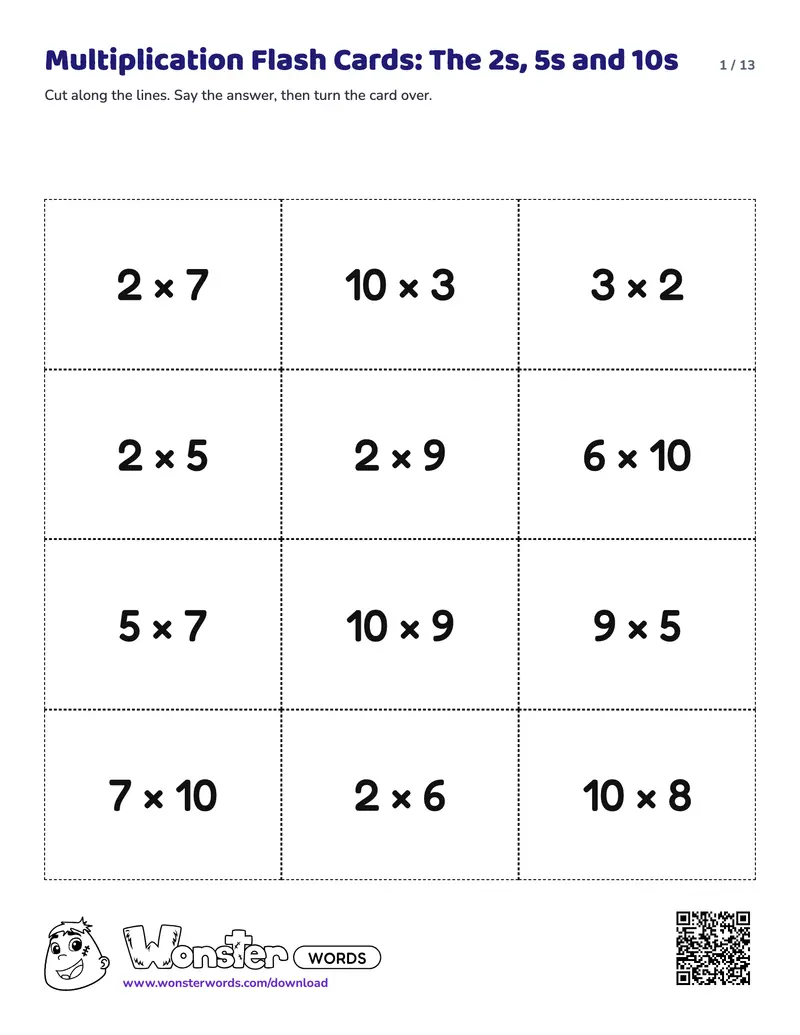
The multiplication flash cards are 66 cards, one for each turnaround pair from 0 × 0 to 10 × 10, twelve to a page, in the order on our times tables page. Each page holds one family, named at the top:
- The 2s, 5s, and 10s, two pages, 24 cards, such as 5 × 7.
- Times 0 and times 1, two pages, 21 cards, such as 8 × 0 and 1 × 9.
- The 3s and 4s, one page, 11 cards, such as 4 × 6.
- The 6s, 8s, 9s, and 7s, one page, 10 cards, such as 9 × 7 and 7 × 7.
The deck is for third grade, and the first two pages suit a second grader who already skip counts by 2s, 5s, and 10s. Within a family the cards come in a mixed order, never in table order, and the factors come in both orders across the deck. The PDF is 13 pages: every card page is followed by its answer page, and a page for grown-ups on how to use the deck comes last. Print double-sided and flip on the long edge, the usual setting for a portrait page, and each answer lands on the back of its card. Printed one-sided, the answer pages work as a key, with each row read from the right.
Free PDF · no sign-up
Free printable multiplication flash cards
One free PDF in black and white, with no account and no email: 66 multiplication flash cards from 0 × 0 to 10 × 10, a family a page, with the answers on the back. Print it double-sided, flipping on the long edge. Below it is a written practice sheet from our array page.
- Multiplication Flash Cards (PDF)66 cards · answer key included · 13 pages
Preview page 1Preview
- Arrays: Write the Multiplication (PDF)16 arrays · answer key included · 6 pages
Preview page 1Preview
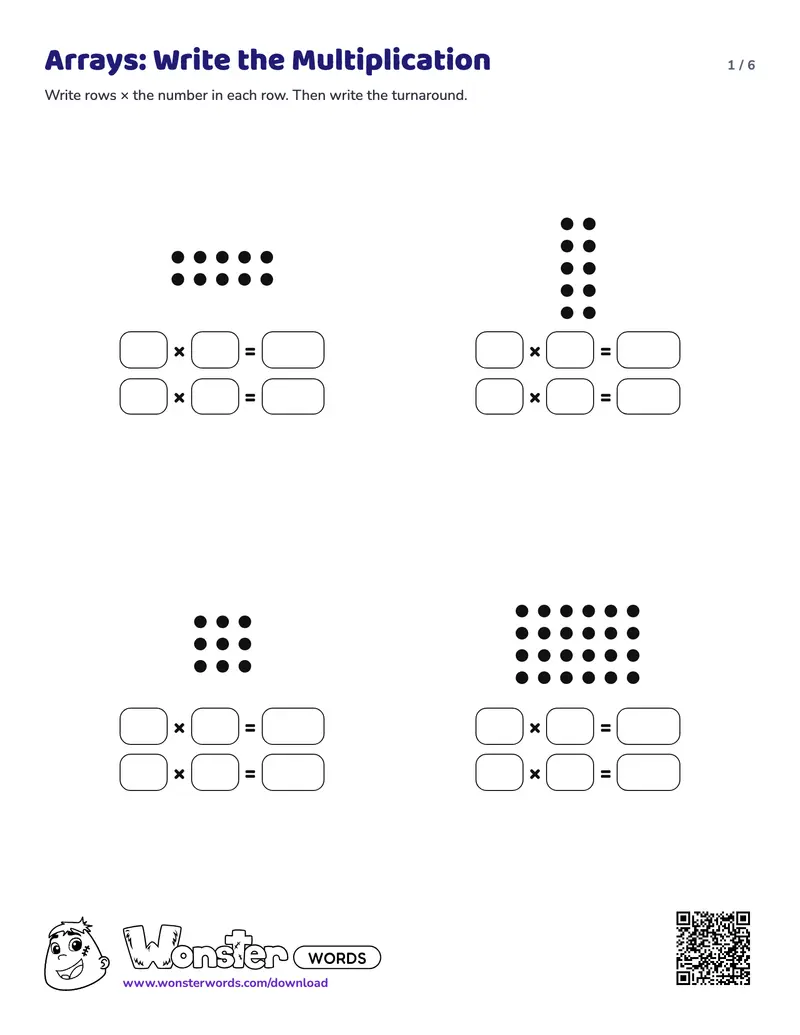
For the rest of the multiplication practice, the multiplication chart puts every fact in one grid, the multiplication worksheets give written practice by family and mixed, and the division flash cards are on the division page. For the reasoning step, the Arrays: Write the Multiplication sheet on the array worksheets page draws facts up to 10 by 10 as rows of dots.
Frequently asked questions
What age do children typically master multiplication facts?
By the end of third grade, at about 8 or 9. The Common Core asks third graders to know from memory all products of two one-digit numbers, and Texas asks for every fact up to 10 × 10 with automaticity. Second graders skip count and add equal groups, so a second grader who does not know the facts yet is on time.
How long does it typically take for children to memorize multiplication facts?
Most of a school year, and longer for some children. The facts are learned one family at a time, and each family needs its own strategy before practice makes it quick. No standard or study gives a number of weeks, and the Common Core gives the whole of third grade.
Is memorizing times tables better than understanding the concept?
Children need both, in that order. A strategy, such as 6 × 7 being 5 sevens and one more seven, comes first, and short practice turns that worked-out fact into a known one. The standards ask for both: third graders multiply using strategies and, by the end of the year, know the products from memory.
What multiplication facts should be taught first and why?
Start with the 2s, 5s, and 10s, because children already count by them, then the 0s and 1s, the 3s and 4s, the 6s and 8s, the 9s, and the 7s last. Each family leans on one already known: the 4s are the 2s doubled, and the 9s are ten groups minus one group.
Do kids need to learn the 11 and 12 times tables?
Neither the Common Core nor the Texas standards ask for them. Both stop at 10 × 10 or below, and the next steps in school use the facts to 10 × 10. Many charts and boxed card decks go to 12 × 12, so learn 0 to 10 first, then the 11s and 12s if your child's school or chart uses them.
As a parent, should I be worried about timed multiplication tests for my child?
Not about short timing on facts your child already knows. A practice guide from the What Works Clearinghouse rates brief timed practice as having strong evidence for children who struggle, when it lasts 1 to 5 minutes and a child beats their own last score. A long sheet against the clock on facts still being worked out is worth raising with the teacher.
How often should I practice with multiplication flash cards?
A few minutes on most days. Use a small pile from one family mixed with cards your child already knows, and stop while it is still going well. Treat a card as known when your child answers it at once on two different days, and add the next family when the slow pile is small.
Is 15 minutes a day enough for kids to master their multiplication tables?
Yes, and less is fine. No source sets a daily number, and practice guides recommend brief, regular practice: timed fact activities in one guide last 1 to 5 minutes. Five minutes of flash cards on most days, plus a game when your child wants one, is enough to move one family at a time.
Should kids review multiplication flash cards daily or weekly?
On most days, briefly, rather than once a week for a long session. Keep the families already learned in the pile as new ones join, so the older facts keep coming back. A card that is slow again goes back to the slow pile.
Are flash cards or written practice more effective for multiplication?
They do different jobs, so use both. Flash cards practice recall: saying a fact your child can already work out until it comes at once. Written practice, such as drawing an array or writing the helper fact, practices working a fact out. A child needs the second before the first is useful.
What age should kids start timed multiplication drills?
No standard sets an age. Timing fits only once a child answers a set of facts correctly every time, and then as a one-minute round against their own last score, not against other children. A child who is still working facts out needs untimed practice with the strategies first.
Can I use multiplication flash cards with my child who has learning disabilities?
Yes. A practice guide written for children who struggle with math, including children with learning disabilities, recommends brief fluency practice with flash cards, on facts already taught and with a strategy to fall back on. Use a small pile, give more days to each family, and ask the teacher about any accommodation at school.
Related guides
Last updated