
Math
Properties of Multiplication: Commutative, Associative, Distributive, Identity, and Zero
What each property says, with examples, how the commutative and associative properties differ, what grade uses them, why they cut the facts to learn, and how to show them at home.
Grade 3 · Common Core: 3.OA.B.5 · Texas: 3.4(G), 3.4(K) · Related: Common Core 2.OA.C.4, 3.OA.A.1, 3.OA.C.7, 3.OA.D.9, 3.MD.C.7c, 1.OA.B.3; Texas 2.6(A), 3.4(E), 3.4(F)
The properties of multiplication are rules that hold for every product. The commutative property says that changing the order does not change the product: 6 × 4 = 4 × 6. The associative property says that changing the grouping does not change the product: (3 × 5) × 2 = 3 × (5 × 2). The distributive property says that you can break one number into parts and multiply each part: 8 × 7 = 8 × 5 + 8 × 2. The identity property says that multiplying by 1 leaves a number the same. And multiplying by 0 always makes 0.
Third graders use these rules to learn their facts before they learn the names, and the Common Core says they “need not use formal terms for these properties.” The most useful move at home is one question: “If 6 × 4 is 24, what is 4 × 6?” A child who answers at once, without working it out again, is using the commutative property. A practice sheet with an answer key, for turnarounds, breaking apart, the easy pair first, and times one and times zero, is described at the end of this guide.
What are the properties of multiplication?
The properties of multiplication are the commutative, associative, distributive, and identity properties, plus the rule that any number times 0 is 0. The Common Core glossary writes the first four with letters in its Table 3, where “a, b and c stand for arbitrary numbers.” Sixth graders use the letters, and third graders meet the same rules with numbers.
| Property | What it says | Example | What a third grader might call it |
|---|---|---|---|
| Commutative | The order of the factors does not change the product: a × b = b × a | 6 × 4 = 24 and 4 × 6 = 24 | Turnaround facts; “flip it” |
| Associative | The grouping of three factors does not change the product: (a × b) × c = a × (b × c) | (3 × 5) × 2 = 15 × 2 = 30 and 3 × (5 × 2) = 3 × 10 = 30 | ”Do the easy pair first” |
| Distributive | Multiplying a sum is the same as multiplying each part and adding: a × (b + c) = a × b + a × c | 8 × 7 = 8 × (5 + 2) = 40 + 16 = 56 | Break apart; “split it” |
| Identity | Multiplying by 1 leaves a number the same: a × 1 = 1 × a = a | 9 × 1 = 9 | Times one |
| Zero | Multiplying by 0 makes 0 | 9 × 0 = 0 | Times zero |
What is the commutative property of multiplication?
The commutative property of multiplication says that two numbers can be multiplied in either order and the product stays the same. Six groups of 4 and 4 groups of 6 are different pictures, and both make 24. An array turned a quarter turn shows it: 3 rows of 4 become 4 rows of 3. In the United States, 3 × 6 is read as “3 groups of 6,” while many other countries read it as 6 groups of 3, the Common Core Standards Writing Team notes. Both readings give 18, which is the commutative property at work.
What is the associative property of multiplication?
The associative property of multiplication says that when three numbers are multiplied, the product is the same whichever two are multiplied first. The parentheses show which pair goes first. The Common Core’s third-grade example is 3 × 5 × 2: either 3 × 5 = 15, then 15 × 2 = 30, or 5 × 2 = 10, then 3 × 10 = 30. The numbers stay in the same order, and only the grouping moves. A homework line such as (2 × 3) × 4 = 2 × (3 × 4) is the associative property: 6 × 4 and 2 × 12 are both 24.
What is the distributive property of multiplication?
The distributive property of multiplication says that you can break one factor into two parts, multiply each part, and add the two products. For 8 × 7, break the 7 into 5 and 2: 8 × 5 = 40, 8 × 2 = 16, and 40 + 16 = 56. It is the property that joins multiplying to adding, and the one an area model draws: third-grade standard 3.MD.C.7c asks children to “use area models to represent the distributive property.” Break apart, the name many third-grade worksheets use, is this property used on a fact.
What is the identity property of multiplication?
The identity property of multiplication says that multiplying a number by 1 leaves the number the same: 9 × 1 = 9, and 1 × 9 = 9. One group of 9 is 9, and 9 groups of 1 are 9 too. The number 1 is called the identity for multiplication because it leaves a number’s identity unchanged. The Common Core glossary calls the rule the “multiplicative identity property of 1.” For addition, the identity is 0 instead.
What is the zero property of multiplication?
The zero property of multiplication says that any number times 0 is 0: 9 × 0 = 0, and 0 × 9 = 0. Nine groups of nothing are nothing, and zero groups of 9 are nothing too. Children learn it as a rule in third grade, alongside the 0s and 1s in the times tables. It is a rule, not one of the properties in the Common Core glossary’s list, which is why the table above gives it no letter form.
How does the commutative property differ from the associative property?
The commutative property is about order, and the associative property is about grouping. The commutative property swaps two factors, and the associative property keeps three factors in order and moves the parentheses. To tell the three named properties apart, ask what changed in a step:
- Did two numbers swap places? Then the step was commutative: 7 × 3 = 3 × 7.
- Did only the parentheses move? Then it was associative: (2 × 3) × 4 = 2 × (3 × 4).
- Was a number split into a sum? Then it was distributive: 6 × 8 = 6 × (5 + 3) = 30 + 18 = 48.
Doing the easy pair first often takes both. For 5 × 7 × 2, a child first swaps the 7 and the 2 to get 5 × 2 × 7, which is the commutative property. Then they multiply the 5 and the 2 first, (5 × 2) × 7 = 10 × 7 = 70, which is the associative property.
Addition shares two of the names. The commutative and associative properties hold for adding too, and addition’s identity is 0 where multiplication’s is 1. The distributive property and the rule for 0 belong to multiplication alone. Children slip on the zeros: multiplying by 0 makes 0, while adding 0 and multiplying by 1 both keep the number.
What grade learns the properties of multiplication?
Children use the properties of multiplication in third grade, at about age 8 or 9, and the Common Core does not ask for the names. Each grade puts the same rules to work:
| Grade | What children do | Common Core | Texas (TEKS) |
|---|---|---|---|
| 2nd grade | Add the rows of an array, up to 5 rows and 5 columns, as a sum of equal numbers; no × sign yet | 2.OA.C.4 | 2.6(A), joining equal sets of objects |
| 3rd grade | Use the commutative, associative, and distributive properties as strategies to multiply and to learn every fact, without the names; draw area models for the distributive property; know all products of two one-digit numbers from memory by the end of the year | 3.OA.B.5 (footnote: “need not use formal terms”), 3.OA.C.7, 3.MD.C.7c | 3.4(K), “properties of operations” within 100; 3.4(G), which names “the commutative, associative, and distributive properties” for multiplying a two-digit number by a one-digit number; 3.4(F), facts to 10 by 10 |
| 4th grade | Use the same properties to multiply bigger numbers | 4.NBT.B.5 | |
| 5th grade | Show the associative property as the volume of a box | 5.MD.C.5a | |
| 6th grade | Write the properties as rules with letters and use them to rewrite expressions | 6.EE.A.3 |
The Common Core asks third graders to “apply properties of operations as strategies to multiply and divide,” and says “Students need not use formal terms for these properties.” The Common Core Standards Writing Team adds in its progressions document that students “may not use the properties explicitly,” but “classroom discussion can identify and record properties in student reasoning.” Texas differs: it names the three properties in third grade, as ways to multiply a two-digit number by a one-digit number (3.4(G)).
A third grader who knows 4 × 6 because they know 6 × 4 is doing exactly what the standard asks. A worksheet that says “distributive” reflects the school’s program, or the Texas standards. A child who does not use the word yet is not behind.
Second graders can already see the turnaround with equal rows: 3 rows of 4 hold the same 12 as 4 rows of 3, as the arrays guide shows. Kindergartners do not learn multiplication properties. The turnaround first appears with adding, in first grade (standard 1.OA.B.3). The multiplication guide shows where the properties fit among the other steps.
Why the properties of multiplication matter: fewer facts to learn, and easier ones
The properties of multiplication matter because they cut the facts a child has to learn and turn the hard facts into easy ones. A third grader uses them three ways:
- Fewer facts. By the end of third grade, children are asked to “know from memory all products of two one-digit numbers” (standard 3.OA.C.7). That is 100 facts, from 0 × 0 to 9 × 9. The commutative property makes them only 55 different facts, because 6 × 8 and 8 × 6 are one fact: the 45 pairs of two different numbers, plus the 10 facts with a number times itself, such as 4 × 4. The 10 facts with a 0 follow one rule, which leaves 45. The 9 with a 1, from 1 × 1 to 1 × 9, follow the identity property, which leaves 36 facts to learn. (Counted from 1 × 1 to 10 × 10, as the arrays page does, there are no zeros, and the same steps leave 45.) The multiplication facts guide covers practicing the 36.
- Hard facts from easy ones. For 7 × 8, a child adds 7 × 5 and 7 × 3: 35 + 21 = 56. The Common Core’s Standards for Mathematical Practice use this very example: students “will see 7 × 8 equals the well remembered 7 × 5 + 7 × 3, in preparation for learning about the distributive property.” The 9s are ten groups minus one group: 9 × 6 = 60 − 6 = 54. The times tables guide gives the order to learn the tables in and the strategy for each one.
- Doubling and easy pairs. The progressions document shows 4 × 6 as 4 × (2 × 3) = (4 × 2) × 3 = 8 × 3, which is the associative property. That is why doubling the 3s gives the 6s. For 5 × 7 × 2, multiplying 5 × 2 first turns the problem into 10 × 7.
Breaking apart and regrouping are most of multiplying in your head, and the area model writes the same steps on paper: 4 × 23 is 4 × 20 plus 4 × 3, which is 80 + 12 = 92. The progressions document calls the associative and distributive properties “at the heart of Grades 3 to 5,” because later multiplying, dividing, and fractions rest on them.
How to teach the properties of multiplication at home
Teach the commutative property, the distributive property, and the other properties at home with objects first, then pictures, then numbers. The What Works Clearinghouse 2021 guide Assisting Students Struggling with Mathematics rates objects and drawings, connected step by step to the written numbers, as strongly supported. The guide is written for intervention teachers, and these five steps adapt it for home, a few minutes at a time.
Make equal groups both ways
Put 4 grapes in each of 3 bowls, then 3 grapes in each of 4 bowls. The two pictures look different, and both make 12. Then line the grapes up in rows on a tray, 3 rows of 4, and turn the tray a quarter turn: now it is 4 rows of 3, and nothing was added or taken away.
Ask before your child counts
Say: 6 × 4 is 24, so what is 4 × 6? A child who answers at once is using the turnaround. A child who works it out again has not yet seen that the order does not matter, which is normal at first. Go back to the bowls and make the groups both ways again.
Break a hard fact into two easy ones
For 7 × 6, lay out 7 rows of 6 coins or cereal pieces. Slide a ruler under the fifth row. The top part is 5 rows of 6, which is 30, and the bottom part is 2 rows of 6, which is 12. Together they make 42. Call it five and two more.
Three numbers: find the easy pair
Write 3 × 5 × 2 on cards, or roll three dice. Ask which two make ten. Multiply 5 × 2 first to get 10, then 3 × 10 is 30. The answer is the same as 3 × 5 = 15 and 15 × 2 = 30, and the easy pair gets there faster.
Times one, times zero
Put one cracker on each of 4 plates: 4 × 1 = 4. Then clear the plates and show 4 empty plates: 4 × 0 = 0. Write 4 + 0 = 4 beside them, and ask why adding zero keeps the 4 while multiplying by zero leaves nothing.
Step 1’s turned tray is the array turn, and step 3 is the strategy for the 7s.
Everyday life is full of equal groups both ways. An egg carton is 2 rows of 6 or 6 columns of 2. A 12-cup muffin tin is 3 rows of 4; cover one column, and it is 3 × 3 plus 3 × 1, which is 9 + 3 = 12. Three packs of 2 juice boxes and 2 packs of 3 are the same 6 boxes. In a story, 4 friends with 3 stickers each have 12 stickers, and so do 3 friends with 4 each.
One game practices the turnaround with a deck of cards. In flip it, take out the picture cards and count aces as 1. Your child draws two cards, says the product, flips the order, and says it again: 7 × 4 = 28, then 4 × 7 = 28. Add a joker as a 0, which always makes 0. More card and dice games are on the multiplication games page, and things to build groups with are listed by age in the math manipulatives guide.
How do arrays show the distributive property?
An array cut in two is two smaller arrays, which is the distributive property drawn as a picture. An array of 8 rows of 7, cut after the fifth column, becomes 8 rows of 5 and 8 rows of 2: 40 + 16 = 56, the same as 8 × 7. The same array turned a quarter turn is 7 rows of 8, which is the commutative property.
To show it at home, draw the array on squared paper, cut it with scissors after the fifth column, and count the two pieces. When the squares touch edge to edge, the drawing is the area model, which third-grade standard 3.MD.C.7c names, and it works for 4 × 23 too. Building and reading arrays, with array worksheets, has its own guide.
Common mistakes with the properties of multiplication
Mistakes with the properties of multiplication come in three kinds: using a rule where it does not work, using it on only part of a problem, and not yet trusting it. Each has a fix.
- Turning a division around. The fact 12 ÷ 3 = 4 does not turn around: 3 ÷ 12 is not 4. The turnaround works for multiplying only, and it does not work for subtraction either. Fix: share 12 crackers among 3 plates, then try sharing 3 crackers among 12 plates. The division guide shows how division is related to multiplication.
- Mixing up times 0, plus 0, and times 1. Your child writes 7 × 0 = 7, or 7 × 1 = 8. The progressions document notes that “students often confuse these three patterns”: adding 0 leaves a number the same, multiplying by 0 makes 0, and multiplying by 1 is the one that leaves the number unchanged. Fix: the plates in step 5, with 4 + 0 written beside 4 × 0.
- Multiplying only one part. Your child writes 7 × (5 + 2) as 7 × 5 + 2 = 37, where the answer is 35 + 14 = 49. Fix: draw the two pieces of the array, and show that both pieces have 7 rows.
- Splitting both numbers. Your child writes 7 × 8 as 5 × 5 + 2 × 3 = 31, where the answer is 56. Fix: split one number only, and keep the other whole in both pieces: 7 × 5 + 7 × 3.
- Working out a turnaround again every time. A child who has just found 6 × 4 = 24 works out 4 × 6 from the start. That is not wrong, only slow. Fix: ask “So what is 4 × 6?” before the counting starts.
Reading 3 × 6 as 6 groups of 3 is not a mistake. Many countries read it that way, and both readings give 18.
Free properties of multiplication worksheets
The printable multiplication properties worksheets for grade 3 come as one PDF of 11 pages, Properties of Multiplication, with four activities, one for each way third graders use the properties. Each activity prints twice, the second page with the same items in a new order.
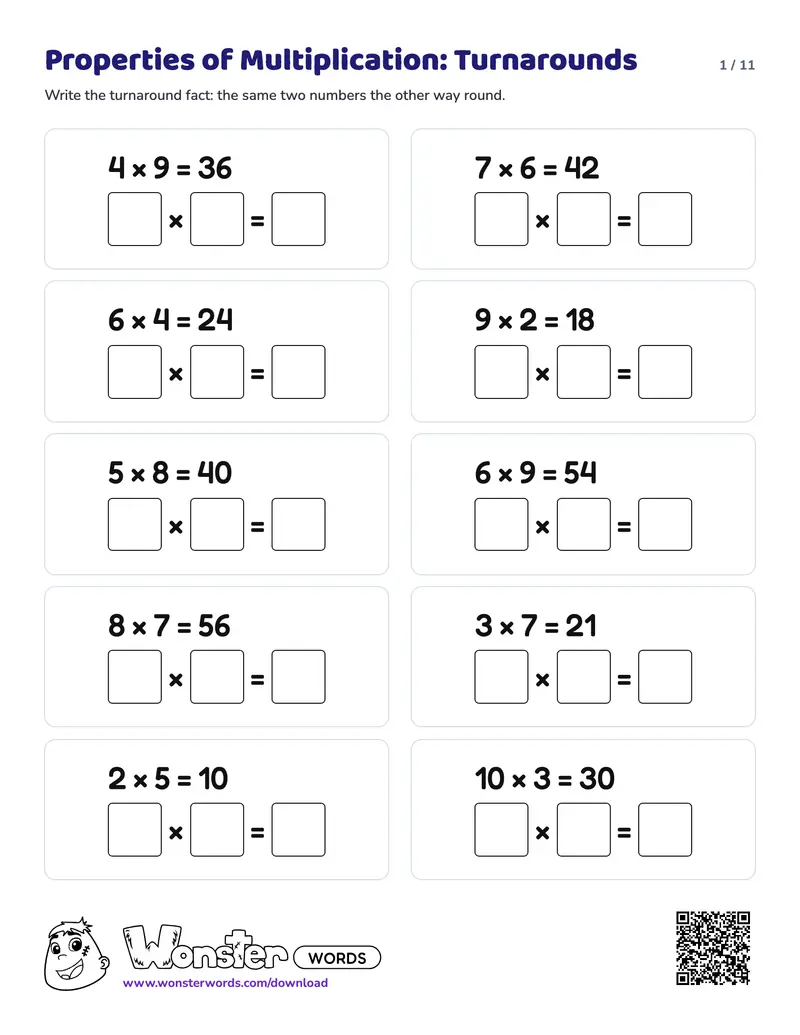
- Turnarounds. A fact such as 6 × 4 = 24 over three empty boxes, where your child writes the turnaround. No fact is a number times itself, because 4 × 4 has no separate turnaround.
- Break apart. A fact with one factor from 6 to 9, printed with the split already made, such as 7 × 8 = 7 × 5 + 7 × _. Your child fills in the missing part and the two products, then adds them.
- Easy pair first. Three factors, half of them with a pair that makes 10, such as 3 × 5 × 2, printed both ways: (3 × 5) × 2 and 3 × (5 × 2). Your child works out each grouping and sees that they give the same product.
- Times one, times zero. Quick facts such as 7 × 1, 0 × 6, and 5 × 0, with a few additions such as 9 + 0 mixed in. The instruction says “Look at the sign.”
The sheet suits third graders learning their facts, and a second grader can do the turnaround pages with an array drawn beside each fact. The answer key shows each answer in red where your child writes it, and a last page for grown-ups says what the sheet builds, why schools teach it, and how to use it. For mixed practice, use the multiplication worksheets. The multiplication chart is a mirror image across its diagonal, which is the commutative property again. Turnaround facts for adding, for younger children, are on the properties of addition page.
Free PDF · no sign-up
Free printable properties of multiplication worksheets
One free PDF of 11 pages in black and white, with no account and no email: turnarounds, break apart, easy pair first, and times one and times zero, each printed twice with the same facts in a new order. Two answer key pages show every answer where your child writes it, and the last page is for grown-ups on why, what for, and how to use it.
- Properties of Multiplication (PDF)80 facts · answer key included · 11 pages
Preview page 1Preview
Frequently asked questions
What is the difference between commutative and associative property?
The commutative property is about order, and the associative property is about grouping. The commutative property swaps two factors, as in 6 × 4 = 4 × 6. The associative property keeps three factors in the same order and changes which two are multiplied first, as in (3 × 5) × 2 = 3 × (5 × 2). Both leave the product the same.
What are examples of commutative property?
Examples of the commutative property of multiplication are 6 × 4 = 4 × 6, where both products are 24, and 3 × 8 = 8 × 3, where both are 24 as well. Addition has the same property, as in 3 + 5 = 5 + 3. Subtraction and division do not: 12 ÷ 3 is 4, but 3 ÷ 12 is not.
What is an example of a distributive property?
An example of the distributive property is 8 × 7 = 8 × (5 + 2) = 8 × 5 + 8 × 2 = 40 + 16 = 56. The 7 is broken into 5 and 2, each part is multiplied by 8, and the two products are added. Third graders use it to find a fact they do not know from two they do.
What property is (2 × 3) × 4 = 2 × (3 × 4)?
That is the associative property of multiplication. The three numbers stay in the same order, and only the grouping changes: (2 × 3) × 4 is 6 × 4, and 2 × (3 × 4) is 2 × 12. Both are 24.
Why is the distributive property useful?
The distributive property lets a child find a hard fact from two easy ones. For 7 × 8, a child who knows 7 × 5 = 35 and 7 × 3 = 21 adds them to get 56. The same idea is how people multiply bigger numbers in their heads, such as 4 × 23 as 4 × 20 plus 4 × 3, which is 80 + 12 = 92.
What is the identity property of multiplication?
The identity property of multiplication says that multiplying a number by 1 leaves it the same: 9 × 1 = 9 and 1 × 9 = 9. One group of 9 is just 9, so 1 is called the identity for multiplication.
At what grade do students first learn multiplication properties?
Students first use the properties of multiplication in third grade, at about age 8 or 9, to learn their multiplication facts. The Common Core does not ask third graders to know the names. Texas names the commutative, associative, and distributive properties in third grade, as ways to multiply a two-digit number by a one-digit number. Students write the properties with letters in sixth grade.
How do the properties of multiplication differ from those of addition?
Addition and multiplication share the commutative and associative properties, and each has an identity: 0 for addition and 1 for multiplication. Two rules belong to multiplication alone. The distributive property joins multiplying to adding, as in 8 × 7 = 8 × 5 + 8 × 2, and multiplying by 0 always makes 0, where adding 0 leaves a number the same.
Is breaking apart numbers in math the same as using the distributive property?
Yes. Breaking apart a fact, such as 8 × 7 into 8 × 5 and 8 × 2, is the distributive property used on a multiplication fact. Break apart is the name many third-grade worksheets use, and the distributive property is the name of the rule behind it.
Related guides
Last updated