
Math
Properties of Addition: Commutative, Associative, and Identity
What each property says, with examples, how the commutative and associative properties differ, what grade uses them, and how to show them at home, with free turnaround facts worksheets.
Grades: grade 1 to grade 3 · Common Core: 1.OA.B.3, 1.OA.D.7 · Texas: 1.5(G) · Related: Common Core 1.OA.A.2, 1.OA.C.6, 2.OA.B.2, 2.NBT.B.6, 2.NBT.B.9, 3.OA.B.5; Texas 2.4(B), 3.4(G)
The properties of addition are three rules that hold for every sum. The commutative property says that changing the order does not change the sum: 3 + 5 = 5 + 3. The associative property says that changing the grouping does not change the sum: (2 + 6) + 4 = 2 + (6 + 4). The identity property says that adding 0 leaves a number the same: 7 + 0 = 7.
First graders use all three before they learn the names, and the Common Core says they “need not use formal terms for these properties.” The most useful move at home is one question: “If you know 8 + 3 = 11, what is 3 + 8?” A child who answers at once, without counting again, is using the commutative property. Our free turnaround facts worksheets, with an answer key, practice exactly that.
What are the properties of addition?
The properties of addition are the commutative, associative, and identity properties: rules about order, grouping, and zero that are true of every sum. The Common Core glossary writes them with letters in its Table 3, where “a, b and c stand for arbitrary numbers.” Sixth graders use the letters. First graders meet the same rules with numbers.
| Property | What it says | Example | What a first grader might call it |
|---|---|---|---|
| Commutative | The order of the numbers does not change the sum: a + b = b + a | 3 + 5 = 8 and 5 + 3 = 8 | Turnaround facts; “flip it” |
| Associative | The grouping of three numbers does not change the sum: (a + b) + c = a + (b + c) | (2 + 6) + 4 = 8 + 4 = 12 and 2 + (6 + 4) = 2 + 10 = 12 | Adding three numbers; “make a ten first” |
| Identity (zero) | Adding 0 to a number leaves it the same: a + 0 = 0 + a = a | 7 + 0 = 7 | Plus zero |
What is the commutative property of addition?
The commutative property of addition says that two numbers can be added in either order and the sum stays the same. Both 3 + 5 and 5 + 3 make 8: the numbers move, and the sum stays. First-grade standard 1.OA.B.3 gives the Common Core’s own example: “If 8 + 3 = 11 is known, then 3 + 8 = 11 is also known.” The rule holds for any two numbers, however big, so 47 + 25 = 25 + 47, and it holds in addition with regrouping too.
The commutative property: 3 dots and 5 dots, then the same dots turned around. Nothing was added or taken away, so the sum is 8 both ways.
What is the associative property of addition?
The associative property of addition says that when three numbers are added, the sum is the same whichever two are added first. The parentheses show which pair goes first. In (2 + 6) + 4, the 2 and the 6 are added first, giving 8 + 4 = 12. In 2 + (6 + 4), the 6 and the 4 go first, giving 2 + 10 = 12. The numbers stay in the same order, and only the grouping moves. Standard 1.OA.B.3 uses this sum as its example, written 2 + 6 + 4 = 2 + 10 = 12: the second two numbers make a ten, so a child adds them first.
What is the identity property of addition?
The identity property of addition says that adding 0 to a number leaves the number the same: 7 + 0 = 7, and 0 + 7 = 7. Zero is called the identity for addition because it leaves a number’s identity unchanged, and it is the only number that does. The Common Core glossary calls the rule the “additive identity property of 0.”
What are turnaround facts in math?
Turnaround facts are the same addition fact with its two numbers swapped, such as 6 + 8 = 14 and 8 + 6 = 14. They are the commutative property under the name many first-grade programs use. Everyday Mathematics, the University of Chicago’s curriculum, calls it the turn-around rule. A double such as 4 + 4 = 8 is its own turnaround, because swapping its numbers changes nothing, which is why turnaround practice leaves the doubles out.
What is the difference between the commutative and associative properties?
The commutative property is about order, and the associative property is about grouping. The commutative property swaps two numbers: 4 + 9 = 9 + 4. The associative property keeps three numbers in the same order and moves the parentheses: (4 + 6) + 3 = 4 + (6 + 3). To tell which one a step used, ask whether the numbers changed places. If they did, the step was commutative. If only the parentheses moved, it was associative.
Making ten with three numbers takes both when the two that make ten are not side by side. For 6 + 3 + 4, a child first swaps the 3 and the 4 to get 6 + 4 + 3, which is the commutative property. Then they add the 6 and the 4 first, (6 + 4) + 3 = 10 + 3 = 13, which is the associative property. The Common Core’s own example, 2 + 6 + 4 = 2 + 10 = 12, needs only the grouping, because its 6 and 4 already sit together.
The other two names fit beside these. The identity property is about one number and 0, not about order or grouping. Turnaround facts are the commutative property under its classroom name.
What grade learns the properties of addition?
Children use the properties of addition in first grade, without the names, and the Common Core does not ask for the names in first, second, or third grade. Each grade puts the same rules to work:
| Grade | What children do | Common Core | Texas (TEKS) |
|---|---|---|---|
| Kindergarten | Notice that adding 0 gives the same number, while adding and taking apart small numbers with objects | None names a property; the progressions document describes the zero pattern | None |
| 1st grade | Use turnaround facts, count on from the bigger number, and add three numbers by making a ten first, without the names; decide whether 5 + 2 = 2 + 5 is true | 1.OA.B.3 (with its footnote), 1.OA.D.7, 1.OA.A.2 | 1.5(G) |
| 2nd grade | Use the same properties to add two-digit numbers, up to four at once, and explain why a strategy works | 2.NBT.B.5, 2.NBT.B.6, 2.NBT.B.9 | 2.4(B) |
| 3rd grade | Use the same properties to multiply, plus the distributive property, still without the names in the Common Core; add within 1,000 | 3.OA.B.5 (footnote: “need not use formal terms”), 3.MD.C.7c, 3.NBT.A.2 | 3.4(A); 3.4(G), which names “the commutative, associative, and distributive properties” for multiplying |
| 6th grade | Write the properties as rules with letters and use them to rewrite expressions | 6.EE.A.3 |
The Common Core asks first graders to apply the properties “as strategies to add and subtract.” The Common Core Standards Writing Team adds in its progressions document that first graders “can begin to learn to recognize these properties in action and discuss their use after solving.” Texas asks the same thing in its own words: first graders “apply properties of operations to add and subtract two or three numbers.”
A first grader who knows 3 + 8 because they know 8 + 3 is doing exactly what the standard asks. A homework sheet that uses the word “commutative” reflects the school’s program. A child who does not use the word yet is not behind.
For older students, the names arrive later and in different places. The Common Core’s third-grade standard 3.OA.B.5 repeats first grade’s footnote for multiplication: children “need not use formal terms for these properties.” In multiplying, turning an array shows 3 × 4 = 4 × 3. Texas names the commutative and associative properties in third grade, beside the distributive property, as ways to multiply (3.4(G)). Sixth-grade standard 6.EE.A.3 asks students to “apply the properties of operations to generate equivalent expressions,” which is where the rules are written with letters.
Why the properties of addition matter: fewer facts to learn, and easier sums
Turnaround facts and the other two properties matter because they cut the facts a child has to learn and make sums easier to work out. A first grader uses them three ways:
- Half the facts. By the end of second grade, children are asked to “know from memory all sums of two one-digit numbers” (standard 2.OA.B.2). That is 100 facts, from 0 + 0 to 9 + 9, and only 55 different facts once a child knows that 8 + 5 and 5 + 8 are the same (the 10 doubles, such as 4 + 4, have no separate turnaround). Once a child knows that adding 0 changes nothing, 45 are left. On an addition chart, the two halves mirror each other across the doubles.
- Start from the bigger number. For 2 + 9, a child turns the fact around and counts on from 9: “ten, eleven.” The progressions document says students “use the commutative property to shorten tasks, by counting on from the larger addend even if it is second.” The guide to counting on fingers uses the same example.
- Make a ten first. With 8 + 7 + 2, a child adds the 8 and the 2 first, and 10 + 7 = 17. The progressions document says that the make ten methods “implicitly use the associative property.”
Underneath all three is one idea: a sum depends on its numbers, not on the order or grouping they are written in. Canobi, Reeve, and Pattison studied 48 children aged 6 to 8 in 1998. In their study, understanding how one sum relates to another went with starting from either number, breaking numbers apart, and knowing facts outright. That understanding, which included changing the order and the grouping, also went with speed and accuracy on other sums.
How to teach the properties of addition at home
Teach the commutative property, turnaround facts, and the other two properties at home with objects first, then pictures, then numbers. The What Works Clearinghouse recommends objects and pictures tied to the numbers, set aside only once a child is accurate without them, in its 2021 guide Assisting Students Struggling with Mathematics. The guide is written for intervention teachers, and these five steps adapt it for home, a few minutes at a time.
Make a train and turn it around
Snap 3 cubes of one color to 5 of another, or line up 3 spoons and 5 forks. Read it as 3 and 5 is 8. Then walk to the other side and read 5 and 3 is 8. Nothing was added or taken away, so the total cannot change.
Ask before your child counts
Say: you know 8 + 3 is 11, so what is 3 + 8? A child who answers at once is using the turnaround. A child who counts again has not yet seen that the order does not matter, which is normal at first. Go back to the train and turn it around again.
Start from the bigger number
For 2 + 9, turn the fact around and count on from 9: ten, eleven. Counting on from the 9 takes two counts, where counting on from the 2 takes nine.
Three numbers: find the ten
Roll three dice, or put out three piles of 4, 3, and 6 things. Ask which two make ten, add those first, and then add the third: 4 + 6 is 10, and 10 + 3 is 13.
Add nothing
Put 7 crackers on a plate and an empty plate beside it, then tip the empty plate onto the full one: still 7. Write 7 + 0 = 7 and 0 + 7 = 7. On a number line, adding 0 is a jump of no length: start on 7 and stay on 7.
Kindergartners do not start out assuming that the order does not matter. In a study of 36 kindergartners, Baroody and Gannon found that the children did not assume that the order of addition does not matter, and appeared to discover it (1984). Step 3 is how children count on with their fingers, and step 5 is drawn as a jump on a number line.
Everyday life is full of turnarounds. On a shelf, 3 shoes on the left and 5 on the right make 8, and so do 5 on the left and 3 on the right. A snack poured in two goes, 4 crackers and then 2, fills the bowl the same as 2 and then 4. Coins or stickers in a row give the same total counted from either end.
Some things care about order, and addition does not. Socks then shoes is not the same as shoes then socks. But 3 apples and then 5 apples is the same 8 apples as 5 and then 3.
Two games practice the properties with dominoes and dice:
- Domino flip. Read a domino as an addition, such as 2 + 5 = 7. Turn it upside down and read it again: 5 + 2 = 7. Seeing the dots without counting them is subitizing, and the subitizing guide has more domino games.
- Three-dice ten. Roll three dice. Look for two that make ten, or else add the two biggest first, and say the sum. A roll of 4, 5, and 6 is 4 + 6 = 10, and 10 + 5 = 15.
Cubes, counters, and other things to build trains with are listed by age in the math manipulatives guide. Adding in the easiest order and grouping is a large part of mental math, done in the head instead of on paper.
Common mistakes with the properties of addition
Mistakes with the properties of addition come in two kinds: using a turnaround where it does not work, and not yet trusting one where it does. Each has a fix.
- Turning a subtraction around. The fact 8 − 3 = 5 does not turn around: 3 − 8 is not 5. The turnaround works only for adding, and so does changing the grouping: (9 − 4) − 2 is 3, but 9 − (4 − 2) is 7. Fix: act out 8 − 3 with 8 spoons, then try taking 8 away from 3 of them. A subtraction has its partner in a fact family instead: 8 − 3 = 5 and 8 − 5 = 3. Taking away 0 also leaves a number the same (7 − 0 = 7), but 0 − 7 is not 7, so only adding 0 works in both orders.
- Counting the turnaround again. A child who has just worked out 8 + 3 = 11 counts from the start for 3 + 8. That is not wrong, only slow. Fix: ask “So what is 3 + 8?” before the counting starts.
- Thinking 5 + 2 = 2 + 5 is wrong, because the answer “should” come after the equal sign. First-grade standard 1.OA.D.7 lists 5 + 2 = 2 + 5 among the equations children decide are true or false, and it is true. Fix: read the equal sign as “is the same as.” The progressions document says that = always means “is the same number as.”
- Thinking adding 0 makes 0, or changes the number. Fix: the empty plate from step 5. Third graders later meet multiplying by 0, which does make 0, and the progressions document notes that “students often confuse these three patterns”: adding 0, multiplying by 0, and multiplying by 1.
- Adding three numbers strictly left to right when two of them make ten. For 7 + 5 + 3, a child adds 7 + 5 = 12 and then 12 + 3 = 15. The answer is right, and the shortcut is missed: 7 + 3 is 10, and 10 + 5 = 15. Fix: ask “Which two make ten?” before adding.
Turning a subtraction around shows up again in column subtraction. A child who takes the smaller digit from the bigger one in every column writes 82 − 45 = 43, where the right answer is 37. The Common Core Standards Writing Team gives that example in its progressions document for place value, and the fix is in the subtraction with regrouping mistakes. When the properties are hard, go back to objects and to sums within 10.
Free turnaround facts worksheets
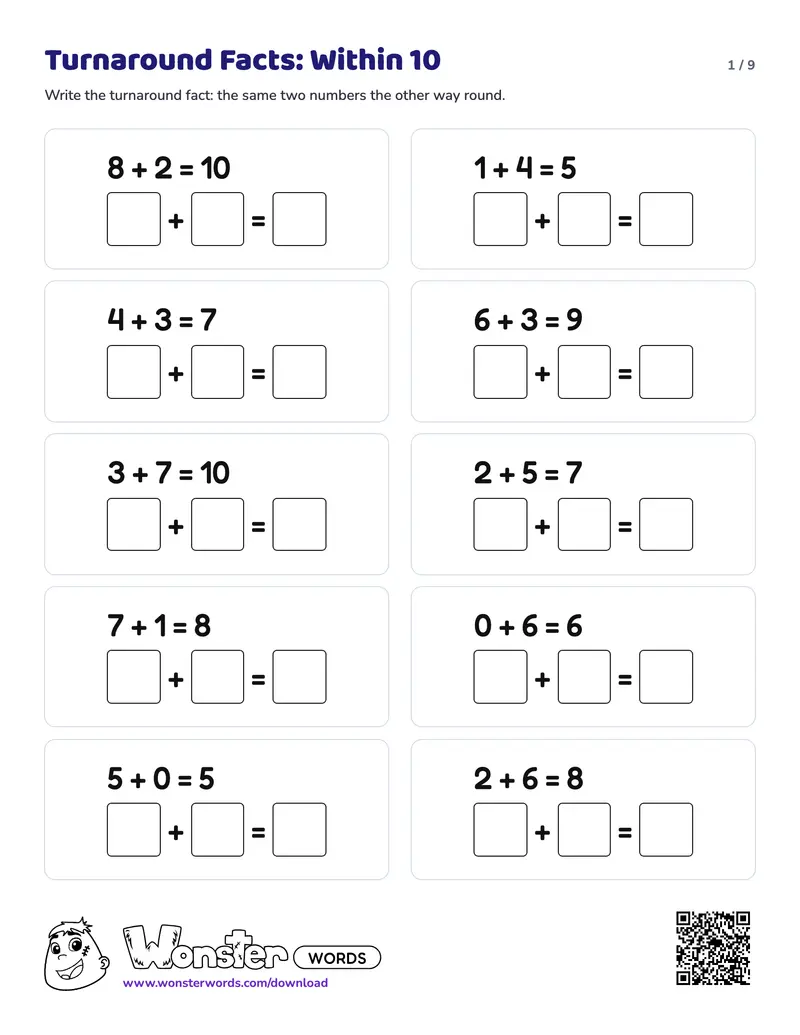
Our free printable commutative property of addition worksheets come as one PDF of 9 pages, Turnaround Facts. On every fact, your child writes the turnaround: the same two numbers the other way around, with the same sum. The sheet suits first grade, and second graders still building the facts within 20.
- Pages 1–2, Within 10. Ten facts a page, such as 6 + 3 = 9, each with three empty boxes under it for the turnaround. Two facts have a 0, 0 + 6 and 5 + 0, and half start with the bigger number.
- Pages 3–4, Within 20. Ten facts a page with one-digit numbers and sums from 11 to 17, such as 8 + 5 = 13, the facts second graders are expected to know from memory. The sum boxes are wide enough for two digits.
- Pages 5–6, Domino Facts. Eight dominoes a page, with 0 to 6 dots on each half and one domino with a blank half. Your child writes each domino both ways around in two rows of boxes. A child who is not yet reading sums easily can start from the dots.
Each activity prints twice, the second page with the same facts in a new order. No page has a double, because a double has no turnaround. Two answer key pages show every page in miniature, with each answer in red where your child writes it. On the domino pages the key writes the left half first and notes that a domino may be written either way around first. A last page for grown-ups says what the sheet builds, why schools teach it, and how to use it.
Three numbers with a ten among them are on the Make Ten Facts sheet, on the doubles and make ten page. For mixed practice by range, use the addition and subtraction worksheets. The addition and subtraction guide sets out every strategy in the order kids learn them.
Free PDF · no sign-up
Free printable turnaround facts worksheets
One free PDF of 9 pages in black and white, with no account and no email: turnaround facts within 10, within 20, and from dominoes, each printed twice with the same facts in a new order. Two answer key pages show every answer where your child writes it, and the last page is for grown-ups on why, what for, and how to use it.
- Turnaround Facts (PDF)56 facts · answer key included · 9 pages
Preview page 1Preview
Frequently asked questions
What is the difference between commutative and associative addition?
The commutative property is about order, and the associative property is about grouping. Commutative addition swaps two numbers, as in 4 + 9 = 9 + 4. Associative addition keeps three numbers in the same order and changes which two are added first, as in (4 + 6) + 3 = 4 + (6 + 3). Both leave the sum the same.
What is an example of a commutative property?
An example of the commutative property of addition is 3 + 5 = 5 + 3, where both sums are 8. The Common Core's first-grade example is that if 8 + 3 = 11 is known, then 3 + 8 = 11 is also known. Multiplication has the same property, as in 3 × 4 = 4 × 3. Subtraction and division do not.
What are two examples of associative property?
Two examples of the associative property of addition are (2 + 6) + 4 = 2 + (6 + 4), where both sides make 12, and (5 + 3) + 7 = 5 + (3 + 7), where both make 15. In each, the numbers stay in the same order and only the parentheses move. First graders use it to make a ten first: 2 + 6 + 4 = 2 + 10 = 12.
How do you know if it is commutative or associative?
Look at what moved. If two numbers changed places, as in 4 + 9 = 9 + 4, it is the commutative property. If the numbers stayed in the same order and only the parentheses moved, as in (4 + 6) + 3 = 4 + (6 + 3), it is the associative property. Rewriting 6 + 3 + 4 as 6 + 4 + 3 swaps two numbers, so that step is commutative.
Is the commutative property applicable to subtraction?
No. The commutative property works for addition and multiplication, not for subtraction. The fact 8 − 3 = 5 does not turn around, because 3 − 8 is not 5. Grouping does not work either: (9 − 4) − 2 is 3, but 9 − (4 − 2) is 7. A subtraction fact has a related fact in its fact family instead: 8 − 3 = 5 and 8 − 5 = 3.
What age group is best suited to introduce the commutative property of addition?
First grade, at about age 6 or 7, is when the Common Core asks children to use the commutative property, without its name. A kindergartner can see it earlier with objects, by turning a row of 3 spoons and 5 forks around and finding the total is still 8. The name can wait: the standards say first graders need not use formal terms for these properties.
What is the identity property of addition and its formula?
The identity property of addition says that adding 0 to a number leaves the number the same. Its formula is a + 0 = 0 + a = a, where a is any number, so 7 + 0 = 7 and 0 + 7 = 7. Zero is called the identity for addition because it is the one number that leaves every number unchanged when added.
Are turnaround facts similar to mathematical properties?
Turnaround facts are the commutative property of addition under the name many first-grade programs use. A turnaround fact is the same fact with its two numbers swapped, such as 6 + 8 = 14 and 8 + 6 = 14. A double such as 4 + 4 has no separate turnaround, because swapping its numbers changes nothing.
What grade level is typically taught the associative property of addition?
Children use the associative property in first grade, when they add three numbers by making a ten first, as in 2 + 6 + 4 = 2 + 10 = 12. The Common Core does not ask for the name in first, second, or third grade. Texas names it in third grade as a way to multiply, and sixth graders write it with letters: (a + b) + c = a + (b + c).
In what grade do students typically learn turnaround facts?
Students learn turnaround facts in first grade, when the Common Core and the Texas standards ask them to apply properties of operations to add. A first grader who knows 8 + 3 = 11 is expected to know 3 + 8 = 11 as well. In second grade, turnaround facts help children know all sums of two one-digit numbers from memory.
Related guides
Last updated