
Math
Even and Odd Numbers for Kids
What even and odd mean, the last-digit rule and why it works, why zero is even, the even and odd numbers from 1 to 100, what grade learns them, and how to teach them at home.
Grades: grade 1 to grade 3 · Common Core: 2.OA.C.3 · Texas: 2.7(A), 3.4(I) · Related: Common Core 3.OA.D.9; Texas 1.5(B)
An even number is a number of things that splits into pairs with none left over: 8 is four pairs. An odd number always has one left over: 7 is three pairs and one extra. To tell from the digits, look at the last digit, the ones digit. Numbers ending in 0, 2, 4, 6, or 8 are even, and numbers ending in 1, 3, 5, 7, or 9 are odd, however big the number is. Zero is even, because zero things make zero pairs with nothing left over.
Children learn even and odd numbers in second grade by pairing real objects: groups of up to 20 under the Common Core, and numbers up to 40 in Texas. The last-digit rule is the shortcut that comes after the pairs. A free 1 to 100 chart and even and odd worksheets are at the end of this guide.
What are even and odd numbers?
An even number is a number that splits into pairs with none left over, and an odd number is one that always leaves one without a partner. Six socks make three pairs, so 6 is even. Seven socks make three pairs and one sock on its own, so 7 is odd. A child can test any small number this way with real things. The Common Core asks second graders to decide the same way, “by pairing objects or counting them by 2s” (2.OA.C.3).
Counting by 2s is the second way. If the count 2, 4, 6, 8 lands on a number, the number is even. The count lands on 8 and jumps over 7, so 8 is even and 7 is odd.
| Number | Pairs | Left over | Even or odd |
|---|---|---|---|
| 5 | 2 | 1 | Odd |
| 6 | 3 | 0 | Even |
| 7 | 3 | 1 | Odd |
| 8 | 4 | 0 | Even |
| 9 | 4 | 1 | Odd |
| 10 | 5 | 0 | Even |
Every whole number is exactly one of the two, and they take turns. The numbers run odd, even, odd, even without a break: 1 is odd, 2 is even, 3 is odd. The smallest odd whole number is 1. The word “even” means the same thing in everyday speech: a snack that splits evenly between two children, or even teams, where every player has someone to match. That everyday meaning is a good place to start with a child.
How do you tell if a number is even or odd?
To tell if a number is even or odd, look at its last digit. Every even number ends in 0, 2, 4, 6, or 8, and every odd number ends in 1, 3, 5, 7, or 9. The rest of the number makes no difference, however many digits it has.
The rule works because tens always pair up. A ten is five pairs, so 30 is 15 pairs and 300 is 150 pairs, with nothing left over. Only the ones can leave one without a partner. In 38, the 3 tens pair up and the 8 ones make four pairs, so 38 is even. This is place value at work: the tens digit says how many tens there are, and any number of tens pairs up.
| Number | Last digit | Even or odd | Why |
|---|---|---|---|
| 38 | 8 | Even | 3 tens pair up, and 8 ones make 4 pairs |
| 51 | 1 | Odd | 5 tens pair up, and 1 one is left over |
| 140 | 0 | Even | 14 tens pair up, and there are no ones |
| 21 | 1 | Odd | 2 tens pair up, and 1 one is left over, although 21 starts with a 2 |
| 346 | 6 | Even | 34 tens pair up, and 6 ones make 3 pairs |
| 347 | 7 | Odd | 34 tens pair up, and 7 ones make 3 pairs and 1 over |
| 348 | 8 | Even | 34 tens pair up, and 8 ones make 4 pairs |
The last-digit rule is a shortcut, and pairing is the test underneath it. Texas names “divisibility rules” for even and odd in third grade (3.4(I), TEKS grade 3). Dividing by 2 is the same test as pairing: a number that splits into two equal groups with none left over also splits into pairs with none left over.
Is zero an even number?
Zero is an even number. It is not odd, and it is not “neither”. A child can check it three ways:
- Pairs. Zero things make zero pairs, with none left over. Nothing is left without a partner.
- Taking turns. On a number line, odd and even numbers take turns. The number 1 is odd, so the number just before it, 0, is even, the same way 2 sits between 1 and 3.
- Two equal parts. Zero is 0 + 0, two equal parts. The Common Core asks second graders to write an even number “as a sum of two equal addends” (2.OA.C.3), and 0 + 0 is one.
The grown-up version takes one line. Wolfram MathWorld, a reference work for mathematics, defines an even number as “an integer of the form n=2k, where k is an integer”. That means 2 times a whole number, and 0 = 2 × 0. Its list of even numbers runs ”…, -4, -2, 0, 2, 4, 6, 8, 10, …”, with 0 in it.
Zero feels wrong because it means “nothing”, and “nothing” sounds as if it should be neither even nor odd. Many adults hesitate over it too, but mathematicians do not disagree: by the definition, zero is even. If a classmate or a worksheet says otherwise, the definition is on your child’s side.
Even and odd numbers from 1 to 100
The even numbers from 1 to 100 are the 50 numbers ending in 0, 2, 4, 6, or 8, and the odd numbers are the other 50, ending in 1, 3, 5, 7, or 9.
Even numbers from 1 to 100: 2, 4, 6, 8, 10, 12, 14, 16, 18, 20, 22, 24, 26, 28, 30, 32, 34, 36, 38, 40, 42, 44, 46, 48, 50, 52, 54, 56, 58, 60, 62, 64, 66, 68, 70, 72, 74, 76, 78, 80, 82, 84, 86, 88, 90, 92, 94, 96, 98, 100.
Odd numbers from 1 to 100: 1, 3, 5, 7, 9, 11, 13, 15, 17, 19, 21, 23, 25, 27, 29, 31, 33, 35, 37, 39, 41, 43, 45, 47, 49, 51, 53, 55, 57, 59, 61, 63, 65, 67, 69, 71, 73, 75, 77, 79, 81, 83, 85, 87, 89, 91, 93, 95, 97, 99.
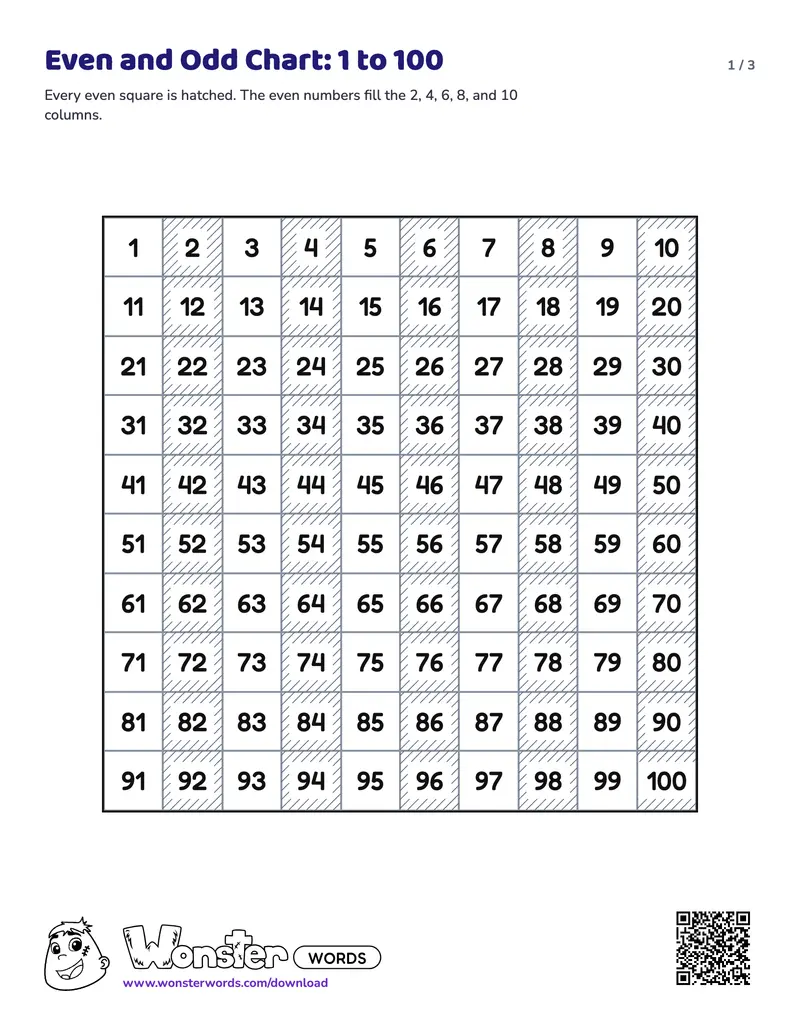
On a hundreds chart with 1 to 10 in the top row, the even numbers fill five whole columns: the ones headed 2, 4, 6, 8, and 10. The odd numbers fill the other five. A child who colors every even square sees the stripes appear, which is the last-digit rule drawn as a picture.
What grade do kids learn even and odd numbers?
Children learn even and odd numbers in second grade, by pairing objects or counting by 2s, under both the Common Core and the Texas standards. Schools follow their own state’s standards, so the grade and the range of numbers can differ from one state to another.
| Grade | What children do | Common Core | Texas (TEKS) |
|---|---|---|---|
| Pre-K and K | Pairs come up in play (socks, shoes, partners) and in counting; no standard names even and odd | None | None |
| 1st grade | Skip count by 2s, the count that lands on the even numbers | None for even and odd | 1.5(B), skip count by twos, fives, and tens |
| 2nd grade | Decide even or odd by pairing objects or counting by 2s, and write an even number as two equal parts (8 = 4 + 4) | 2.OA.C.3, groups up to 20 | 2.7(A), numbers up to 40, by pairing objects |
| 3rd grade | Even and odd by rule; “4 times a number is always even” | 3.OA.D.9 | 3.4(I), “using divisibility rules” |
In Texas, second graders decide even or odd for numbers up to 40 rather than 20, and third graders use divisibility rules. The second-grade standard reads “determine whether a number up to 40 is even or odd using pairings of objects to represent the number” (2.7(A), TEKS grade 2). Texas first graders already skip count by twos (1.5(B), TEKS grade 1).
A preschooler who pairs socks is doing the right thing for their age, and a kindergartner who does not know the word “odd” yet is on time. The pairs matter later. The Common Core files even and odd under “Work with equal groups of objects to gain foundations for multiplication”, and a pair is the first equal group a child meets, the start of multiplication. The place value guide covers the tens and ones the last-digit rule rests on. Beast Academy, a math curriculum for advanced learners, comes to odds and evens earlier, in the Categories chapter of its first-grade book 1B, beside squares and primes.
How can parents help children learn even and odd numbers at home?
Teach even and odd at home in the order the standards set: pairs of real things first, then counting by 2s and doubles, and the last-digit rule last. Ten minutes with things already in the kitchen is enough for a session. The writers of the Common Core’s progressions document tie pairs, 2s, and doubles together. The second-grade standard, they write, “relates doubles additions up to 20 to the concept of odd and even numbers and to counting by 2s” (page 25).
Make pairs with real things
Count out up to 20 crackers, coins, or blocks and line them up two by two, in two rows. If every one has a partner, the number is even. If one is left without a partner, the number is odd.
Say both words every time
Say the whole sentence: nine is odd, four pairs and one left over. Keep saying "left over" until your child can say the sentence alone.
Count by 2s
Touch the pairs and count 2, 4, 6, 8. If the count lands on the number, it is even. If the count jumps over it, it is odd.
Write the double
Write an even number as two equal parts: 10 = 5 + 5 and 8 = 4 + 4. An odd number cannot be split into two equal parts: 9 is 4 + 5, one more on one side.
Then use the last digit
Once pairing is easy, show that 10 and 20 always pair up, with nothing left over, so only the ones can leave one without a partner. Then try big numbers, such as 58, 73, and 346, by their last digit alone.
Counting by 2s in step 3 is its own skill, and the skip counting guide shows how to practice it. The double in step 4 is the same idea as the doubles facts children learn for adding, such as 6 + 6 = 12. Any small objects work for step 1, and math manipulatives such as counters or linking cubes make the two rows easy to line up.
After the five steps, everyday life supplies the questions:
- Snacks. Can the crackers split evenly between two children, with none left over?
- Partners. Are there enough children at the party for everyone to have a partner?
- Shoes and socks. Count the shoes by the door. A pair means the count is even, and an odd count means a shoe is missing.
- House numbers. On many streets, the even house numbers are on one side and the odd ones on the other. Read them on a walk and check.
Common mistakes with even and odd numbers
The first even and odd mistake to watch for is judging a number by its first digit, and each of these five mistakes has a fix at the table.
- Judging by the first digit. Your child says 21 is even because it starts with a 2. Count out 21 things in pairs: ten pairs and one left over, so 21 is odd. Then show the last-digit rule, and why the tens never matter: every ten pairs up.
- Thinking zero is neither. Your child says zero cannot be even because it is nothing. Use the three checks in the zero section above: zero pairs with none left over, 0 comes just before the odd number 1, and 0 + 0 is two equal parts.
- Mixing up the everyday words. “Odd” also means strange, and “even” also means flat or level. Say the math meaning each time: odd means one left over.
- Losing count while pairing. A child pairing a scattered pile counts a cracker twice or skips one. Line the pairs up in two rows, so the extra one sticks out at the end.
- Thinking the rule stops at 20. A child who has only worked with numbers up to 20 can think the rule stops there. Try 58, 103, and 346 together, using the last digit.
Even and odd number games
These five even and odd games need only cards, dice, or the kitchen, and each one ends with your child saying why a number is even or odd.
- Roll it. Roll a die and call out even or odd, then say why: “5 is odd: two pairs and one left over.” For bigger numbers, roll two dice and add them.
- Evens win. Use cards from ace (1) to 10. Each player flips a card. If only one card is even, that player scores a point. Two evens or two odds is a tie, and both players flip again.
- Pair up. Grab a handful of beans or buttons, guess even or odd, then pair them up to check.
- Hop the number line. Start at 1 and hop by 2s along a number line, saying the odd numbers. Start at 0 and do it again for the even ones.
- Read the story. Even Steven and Odd Todd by Kathryn Cristaldi (Scholastic, 1996) is an early reader in the Hello Math Reader series. After reading it, sort a handful of number cards into an Even Steven pile and an Odd Todd pile.
A rhyme carries the rule in one line: “Even numbers pair and share, odd numbers have one to spare.” For more games with a board and dice, see math board games.
Free even and odd worksheets
Our free even and odd sheets are two PDFs: a 1 to 100 chart to keep, and a set of worksheets for second and third grade. The even and odd chart is a hundreds chart with every even square hatched and every odd square plain, so the five even columns show without color. It also prints the two lists from this guide and a page for grown-ups. It suits first to third grade as a reference.
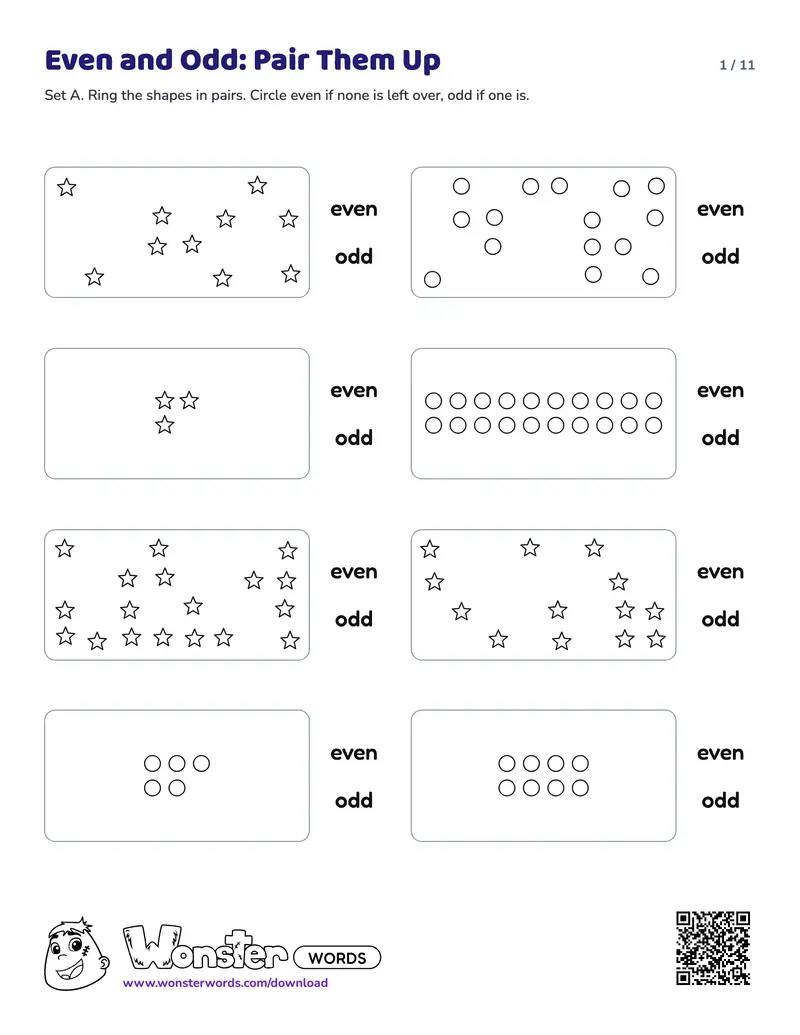
The even and odd worksheets have four activities, and each prints twice, with the same items in a new order:
- Pair them up, groups of 1 to 20 shapes to ring in pairs, then circle even or odd. This activity suits a second grader starting out.
- Two equal parts, even numbers to 20 to write as a double, such as 8 = 4 + 4, with odd numbers mixed in to cross out. Zero appears once, as 0 + 0.
- Even or odd to 40, numbers from 0 to 40 to circle E or O, including numbers such as 21 and 32 where the first digit misleads. This one covers the Texas range.
- Sort by the last digit, two-digit and three-digit numbers, such as 74 and 347, to write in Even and Odd columns.
Answer keys follow the activities, and a page for grown-ups at the end explains why schools teach even and odd by pairing. Every page prints in black and white, with no account and no email.
Free PDF · no sign-up
Free even and odd worksheets
Two free PDFs in black and white, with no account and no email: the even and odd chart to keep first, then the worksheets, which print every activity twice, with answer keys and a page for grown-ups at the back.
- Even and Odd Chart (PDF)100 numbers · 3 pages
Preview page 1Preview
- Even and Odd Numbers (PDF)96 even or odd questions · answer key included · 11 pages
Preview page 1Preview
Frequently asked questions
Is zero even or odd?
Zero is even. Zero objects make zero pairs with none left over, and 0 = 0 + 0 is a number written as two equal parts, which is what makes a number even. Zero is not odd, and it is not "neither".
Are all integers either even or odd?
Yes. Every integer, negative numbers included, is either even or odd and never both. Negative numbers follow the same rule as positive ones, so −4 is even and −7 is odd. Children meet negative numbers long after second grade.
Can a number be both even and odd?
No. A number of things either splits into pairs with none left over, which makes it even, or leaves exactly one without a partner, which makes it odd. Every whole number does one of the two, and none does both.
Are even numbers always divisible by 2?
Yes. Divisible by 2 means a number splits into two equal groups with none left over, which is the same test as splitting it into pairs. Every even number is divisible by 2, and no odd number is.
Which is taught first, even or odd numbers?
Children learn even and odd numbers together, because each is defined against the other. A group of objects either pairs up with none left over or has one left over, and the Common Core's second-grade standard asks a child to decide which.
What happens if you add or subtract an odd number from an even number?
The answer is always odd. The odd number brings one left over that has no partner, so 8 + 3 = 11 and 8 − 3 = 5 are both odd. Adding two odd numbers makes an even number, because their two leftovers pair up, as in 3 + 5 = 8.
Related guides
Last updated