
Sentence Writing Worksheets
Kindergarten Sentence Writing Worksheets
Sentence writing worksheets for kindergarten and the start of 1st grade, in the order to print them: trace a sentence, build one from word cards, fix its capital and period, then write one about a picture. Every word on the sentence sheets made on this page is a short vowel word or a sight word we name.
- cat
- sat
- pig
- big
- hen
- red
- pup
- sun
- hot
- jog
- bug
- dog
- dig
- hug
- hop
- rug
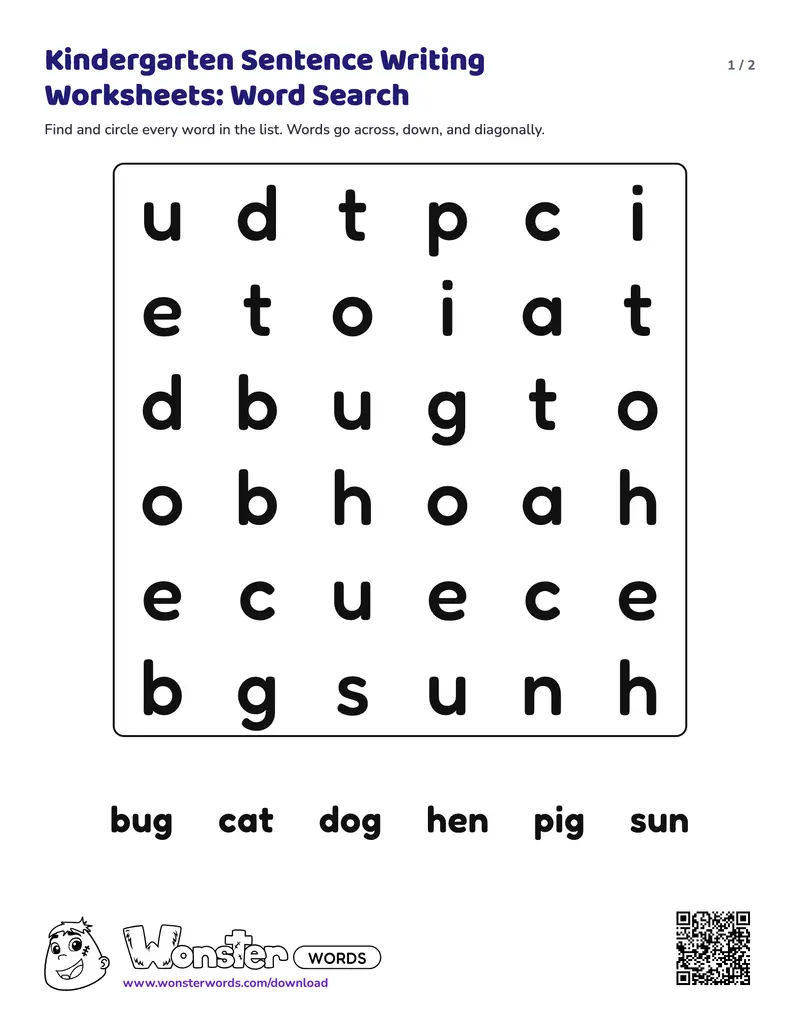
Sentence writing at ages 5 and 6 is four steps a parent can print in order: trace a sentence, build it from word cards, fix its capital and period, then write one about a picture. Every word in the sentences below is a short vowel word, like cat and hen, or a sight word, like the, I, and you, so your child can read each sentence before writing it. Start with the tracing sheet, then the word card sheet, the fix the sentence sheet, and the picture sheet. At the foot of the page, a word tracing sheet and a word search review the words from the sentences. About 10 minutes a day is enough, and every sheet is free to print. For sentences to read rather than write, see our kindergarten sentences to read.
Which sentence writing worksheet does my child need?
Pick the sheet by what your child can already do, not by their grade. Each row below names one thing your child can do, the sheet that comes next, and the Common Core standard it practices.
| Your child can already | Start with | What the sheet asks | Common Core standard |
|---|---|---|---|
| Form most letters, but has not written a sentence | Sentence tracing | Trace a sentence, then write it on the line below | ”Understand that words are separated by spaces in print” (RF.K.1c) |
| Copy a sentence, but runs the words together or mixes up their order | Sentence scramble | Cut out the word cards, put them in order, then glue or write the sentence | ”Recognize the distinguishing features of a sentence (e.g., first word, capitalization, ending punctuation)” (RF.1.1a) |
| Write a sentence, but forgets the capital or the period | Fix the sentence | Write each sentence again with its capital and end mark | ”Capitalize the first word in a sentence and the pronoun I” (L.K.2a) |
| Write a sentence with its capital and period | Write a sentence | Write a sentence of their own about a picture | ”Produce and expand complete sentences in shared language activities” (L.K.1f) |
Kindergarten and first grade sentence worksheets practice the same four steps; what changes is the words and where a child starts. First grade asks children to “use end punctuation for sentences” and to write sentences “in response to prompts” (L.1.2b and L.1.1j), so a first grader can start at the word cards or the fix sheet. The sentences here are written in kindergarten words, with no sh, ch, or blends, so they also suit the start of first grade.
Why trace, then build, then fix, then write?
Each sheet takes away one kind of help, so by the last one your child writes a whole sentence alone. Tracing gives the letters, the spaces, and the order. The word cards give the words but not the order. The fix sheet gives the words in order but leaves out the capital or the period. The picture gives only the idea and a box of words.
The order follows how writing is taught at school. The Institute of Education Sciences, the research arm of the US Department of Education, recommends teaching children “to become fluent with handwriting, spelling, sentence construction, typing, and word processing.” Its writing guide adds that “beginning in kindergarten, students should develop an understanding of what sentences are and should learn the basic principles of capitalization and punctuation.” The word cards come early because a sentence is made of separate words: the Institute’s foundational reading guide recommends “first demonstrating that sentences can be broken into words.” Both guides are written for teachers, and the sheets here are the same steps at a kitchen table.
What makes a good sentence writing worksheet?
A good sentence writing worksheet has four things: words your child can read, a capital and a period on every sentence, one right order on a scramble, and a line to write on.
- Every word is readable. A child who cannot read a sentence can still trace it, or glue its cards in order by matching their shapes. The sheet then practices copying rather than writing.
- Every sentence starts with a capital and ends with an end mark. Our scramble cards keep both, so the capital shows which card comes first and the period which comes last.
- A scramble has one right order. The cat sat on the mat also reads The mat sat on the cat, and a key that prints one of them marks the other wrong. Each sentence on our scramble sheet was checked by a person for a second order that makes sense.
- There is a line to write on. On every sheet here, the sentence your child copies, builds, or fixes has a writing line under it.
These sentences are decodable for a kindergartner who knows the short vowel sounds. Every word on the tracing, scramble, fix, and write a sentence sheets is either a short vowel word your child can sound out, like pig, hen, and rug, or a sight word. The sight words come from our kindergarten sight words list, like the, is, I, and you, and our VC words list, like my, we, and me. Each sentence is checked against those lists when the site is built, and a sentence with any other word in it is refused before it is printed.
Sentence writing worksheets
Each sentence writing worksheet below has its own section, in the order to print them: what your child does on it, the words to read first, and the worksheets to download.
Sentence tracing worksheets: trace the sentence, then write it
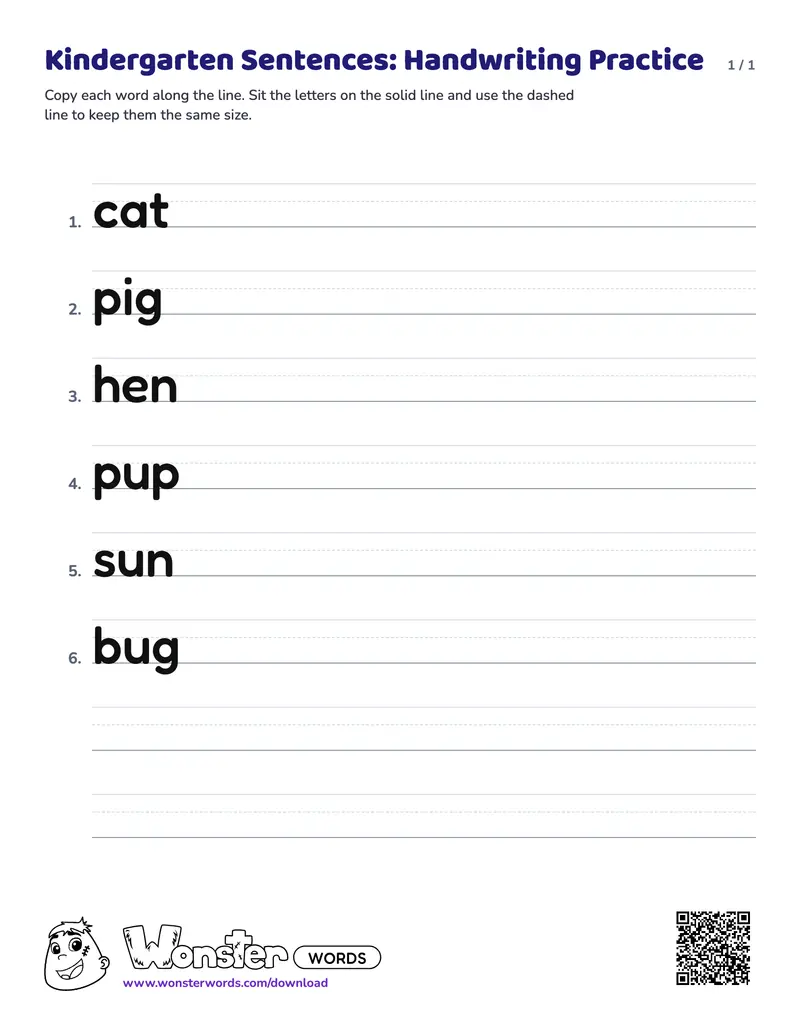
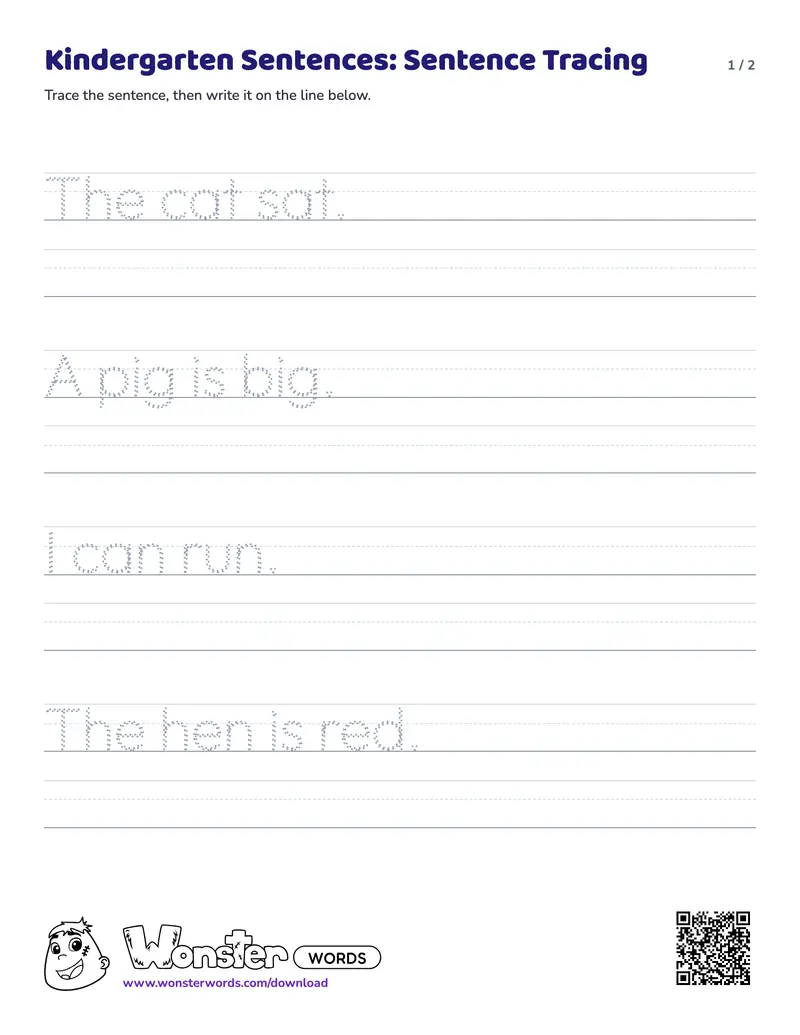
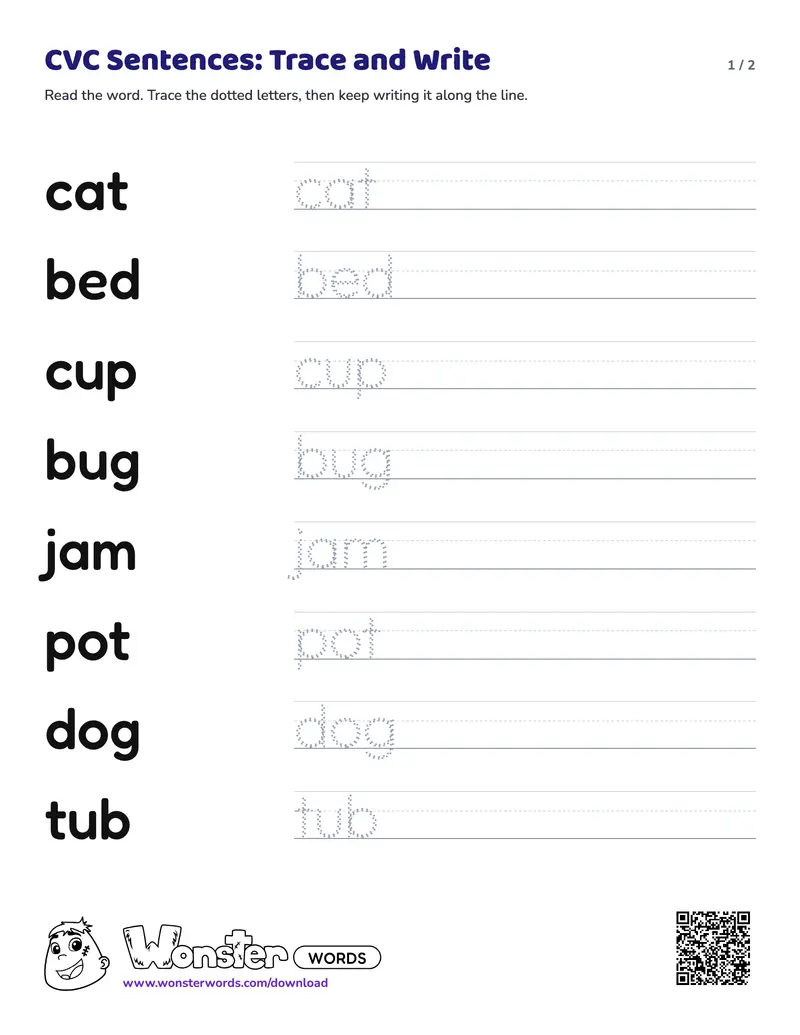
On the sentence tracing sheet your child traces each sentence, then writes it again on the line below it. The capital, the spaces between the words, and the period are traced too. Common Core asks kindergartners to “understand that words are separated by spaces in print” (RF.K.1c), and tracing a gap after each word is how that habit starts. The 8 sentences run from The cat sat. to It is a big bug. If a letter is still hard to form, practice it on its own first with our letter formation guide. The handwriting sheet has your child copy 6 words from these sentences, from cat to bug, and the tracing sheet from our simple sentences for kindergarten page has 12 short vowel words to trace.
- cat
- pig
- hen
- pup
- sun
- bug
Free PDF · no sign-up
Feedback?Printables for Kindergarten Sentences
Some come from the Kindergarten Sentences to Read page.
- Kindergarten Sentences: Handwriting Practice (PDF)6 words · 1 page
Preview page 1Preview
- Kindergarten Sentences: Sentence Tracing (PDF)8 sentences · 2 pages
Preview page 1Preview
- CVC Sentences: Trace and Write (PDF)12 words · 2 pages
Preview page 1Preview
Sentence building and sentence scramble worksheets: cut, order, glue
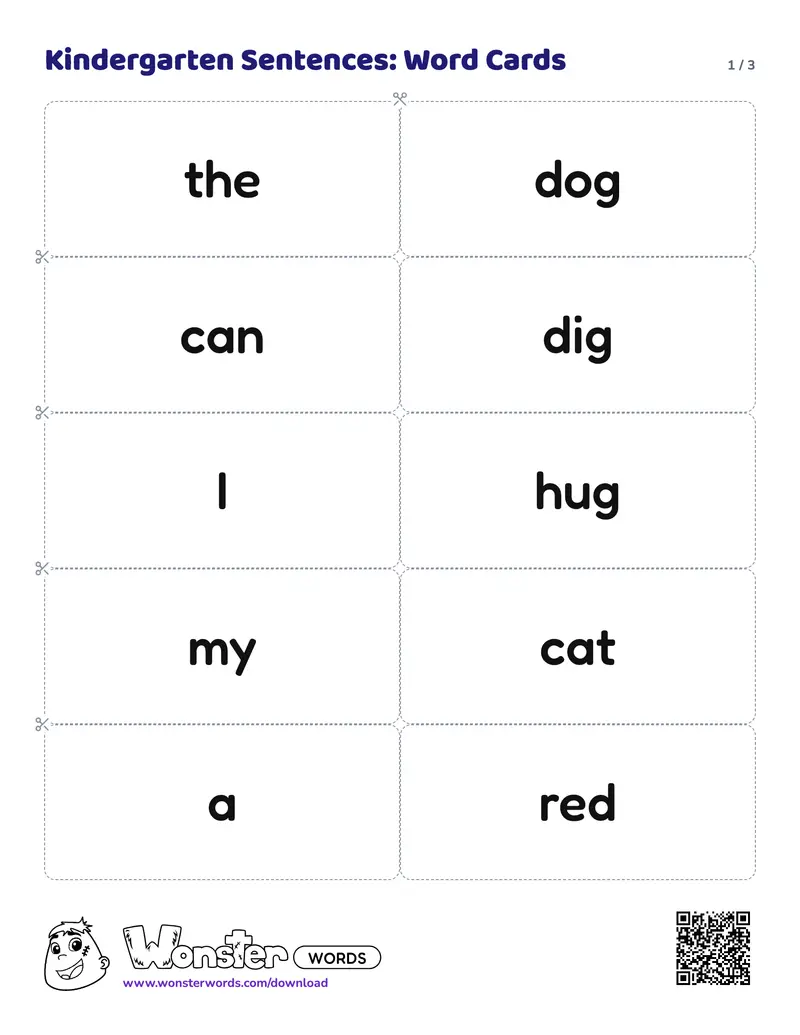
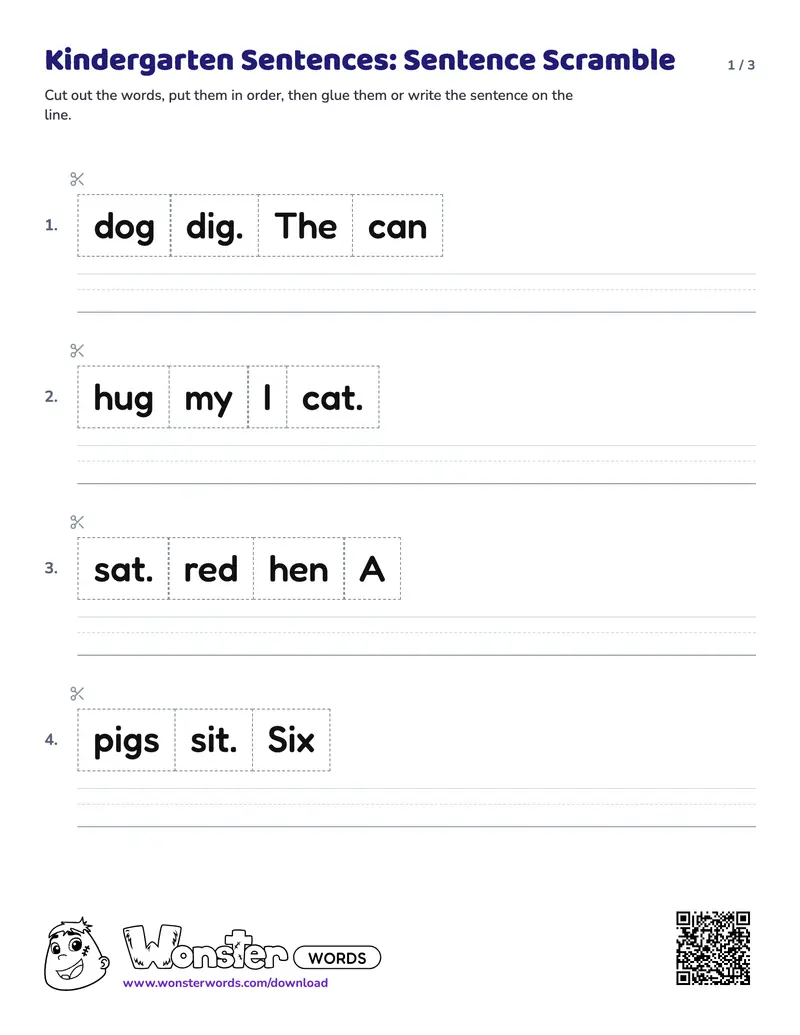
On the sentence scramble sheet your child cuts out each row’s word cards, puts them in order, and glues them down or writes the sentence on the line. The capital shows which card comes first and the period shows which comes last: the “first word, capitalization, ending punctuation” that Common Core asks first graders to recognize (RF.1.1a). A scramble is the opposite of a fill-in-the-blank sheet, which gives the sentence and asks for one word: a scramble gives every word and asks for the order. Keep the cut cards in an envelope for a sentence game. The word cards hold all 24 different words in the 8 sentences, so your child can read each word on its own first, and the sentence sheet from our kindergarten sentences page has a word to choose for each blank.
- the
- dog
- can
- dig
- I
- hug
- my
- cat
- a
- red
- hen
- sat
- six
- pigs
- sit
- we
- get
- pup
- hop
- big
- ran
- you
- on
- rug
Free PDF · no sign-up
Feedback?Printables for Kindergarten Sentences
Some come from the Kindergarten Sentences to Read page.
- Kindergarten Sentences: Word Cards (PDF)24 cards · 3 pages
Preview page 1Preview
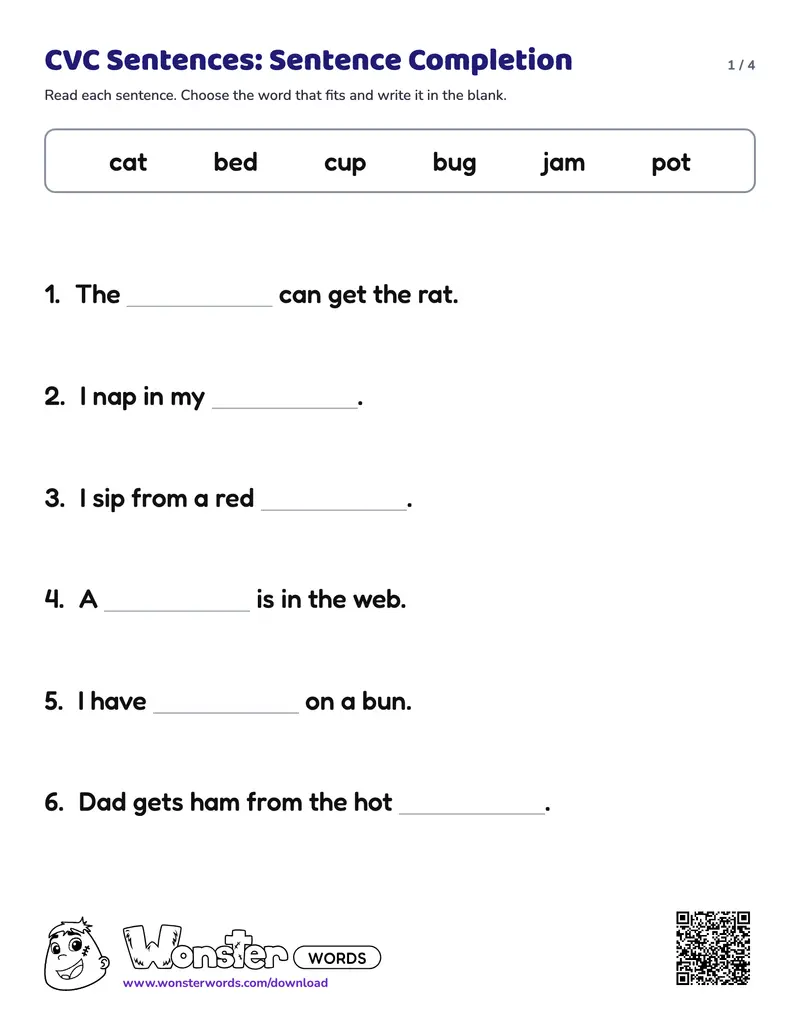
- CVC Sentences: Sentence Completion (PDF)12 sentences · answer key included · 4 pages
Preview page 1Preview
Capitals and periods: fix the sentence worksheets
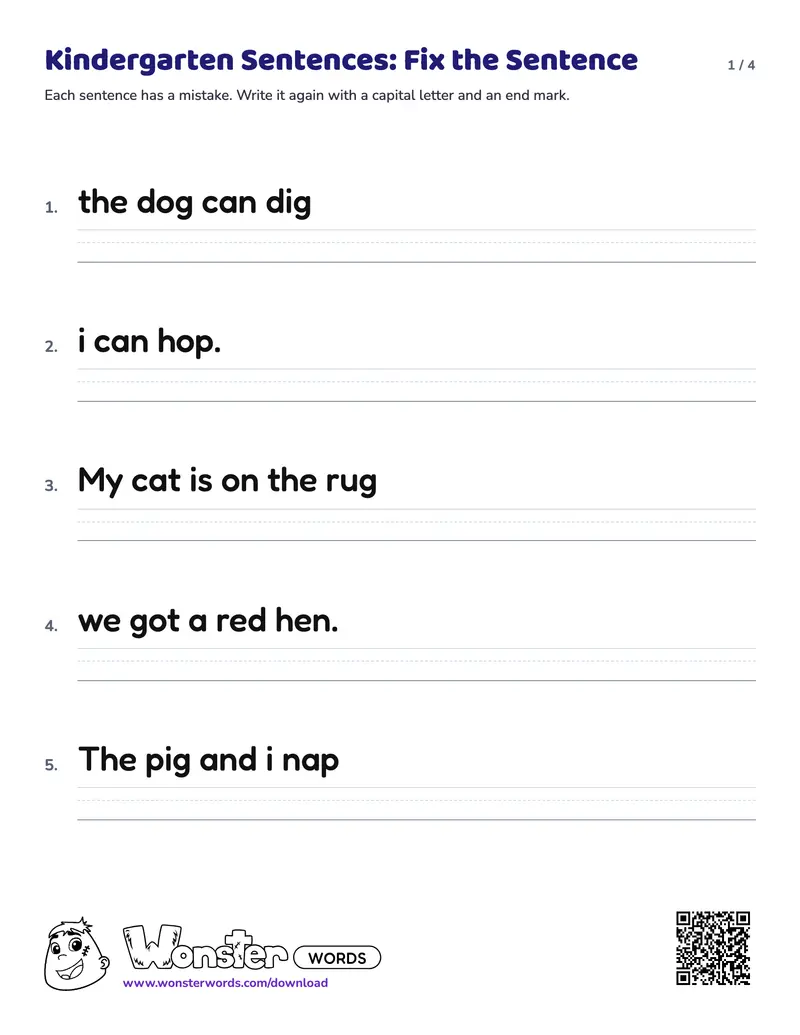
On the fix the sentence sheet your child writes each sentence again correctly, with its capital and its end mark. Each one is printed with a small first letter, a small i for I, or no end mark. Those are two of the kindergarten rules in Common Core: “Capitalize the first word in a sentence and the pronoun I” and “Recognize and name end punctuation” (L.K.2). The period matters because it tells a reader where one idea stops. Without it, two sentences run into one. The answer key at the back shows each sentence written the right way. If capital letters are still new, print the uppercase tracing sheet from our letter tracing worksheets page first: it practices all 26.
- dog
- cat
- rug
- hen
- pig
- pup
- sun
- bug
- log
- van
Free PDF · no sign-up
Feedback?Printables for Kindergarten Sentences
Some come from the Letter Tracing Worksheets page.
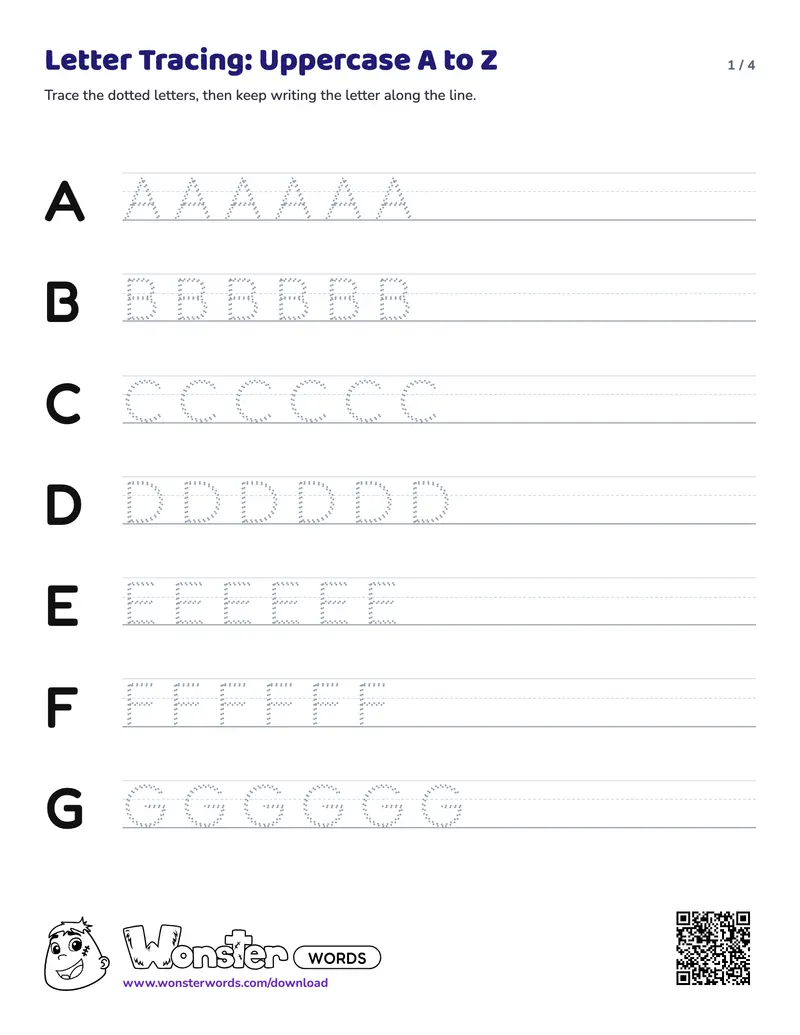
- Letter Tracing: Uppercase (PDF)26 letters · 4 pages
Preview page 1Preview
Write a sentence about a picture
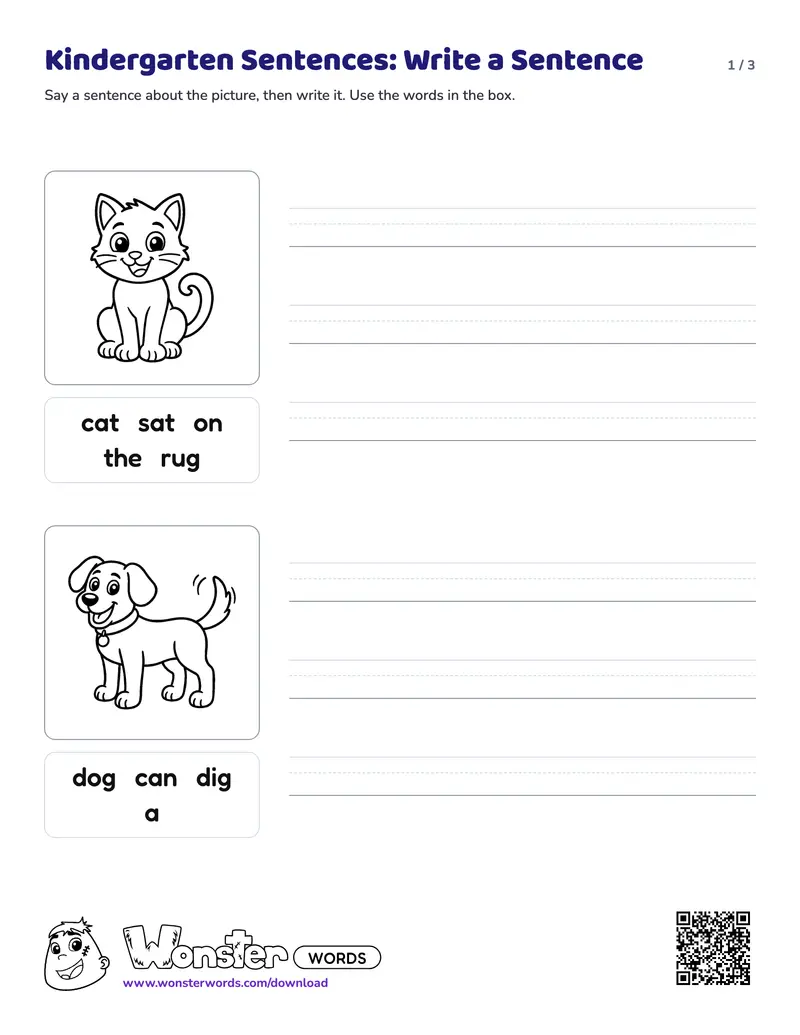
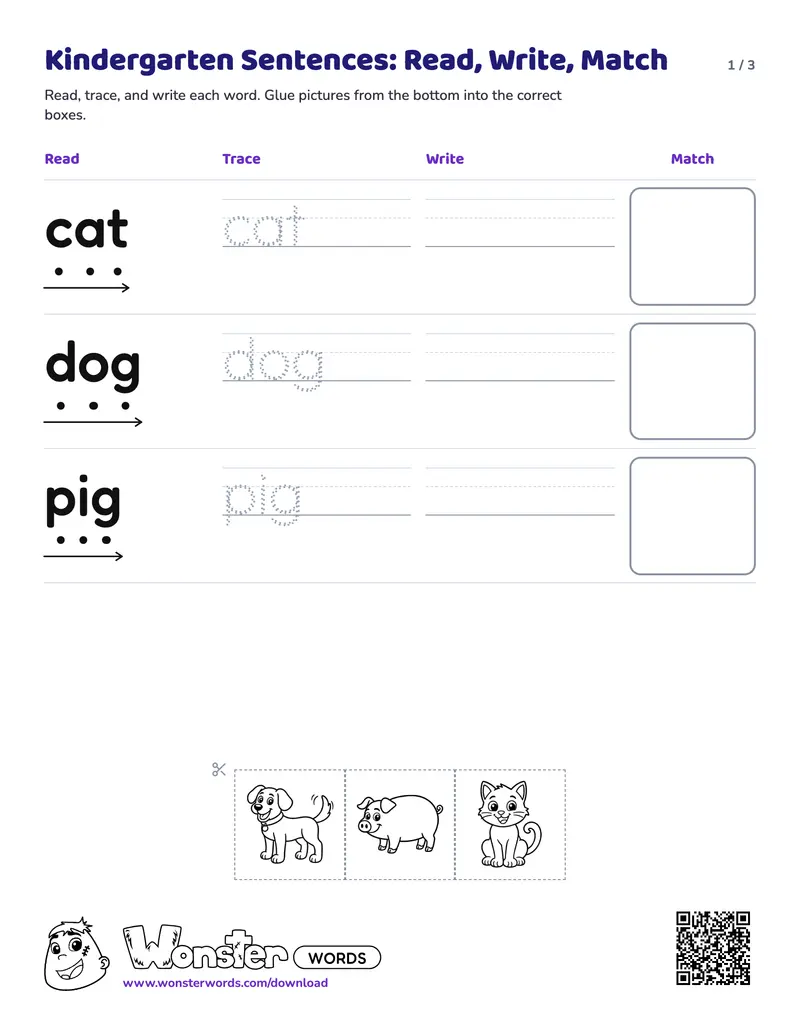
On the write a sentence sheet your child looks at the picture, says a sentence about it, and writes it on the lines, using the words in the box. The writing guide from the Institute of Education Sciences puts talking first: children say their ideas aloud, and then they “can independently practice writing their ideas in complete sentences, using invented spelling if necessary.” Our guide to how to teach your child to write a sentence walks through that say-it-first step. There is no answer key, because any sentence about the picture that starts with a capital and ends with a period is right. The 6 pictures are a cat, a dog, a pig, a hen, a bug, and the sun. On the read, write, match sheet your child reads, traces, and writes the same 6 words, then glues each picture beside its word. The kindergarten prompt pages from our writing prompts for kindergarten to 2nd grade come next: 12 prompts, one to a page, with a box to draw in and lines to write on. For scenes with more going on than one animal, try our picture writing prompts.
- cat
- dog
- pig
- hen
- bug
- sun
Free PDF · no sign-up
Feedback?Printables for Kindergarten Sentences
Some come from the Writing Prompts for Kindergarten, 1st and 2nd Grade page.
- Kindergarten Sentences: Write a Sentence (PDF)6 pictures · 3 pages
Preview page 1Preview
- Writing Prompts: Kindergarten (PDF)12 prompts · 13 pages
Preview page 1Preview
Free PDF · no sign-up
Feedback?Mixed review: printables for the whole list
Every sheet below is built from the Kindergarten Sentence Writing Worksheets above. No account, no email, no watermark. Start at the top and print one at a time. The sheets are in teaching order, and ten minutes on a single sheet is more valuable than working through a stack on autopilot.
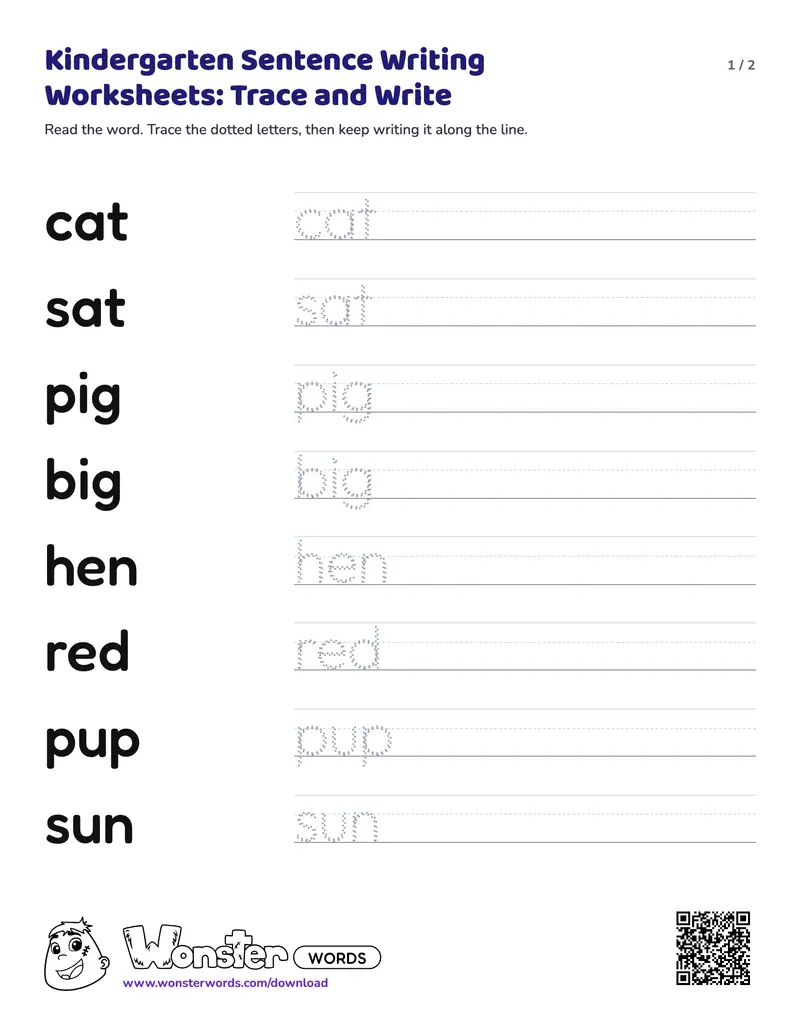
- Kindergarten Sentence Writing Worksheets: Trace and Write (PDF)16 words · 2 pages
Preview page 1Preview
How to use sentence writing worksheets at home
About 10 minutes a sitting is enough: one sheet, or a few rows of one, then stop while your child still wants to do one more. Print the sheets in order, and move on when your child finishes a sheet without help. A few habits make each one work:
- Read each sentence together first. Your child reads it aloud, pointing to each word, before writing anything.
- Say it before writing it. On the picture sheet, your child says the whole sentence twice the same way before the pencil moves.
- Praise the capital and the period. Name them when they are right, then fix one thing at most.
- Let spelling by sound stand on the picture sheet. Dg for dog is a good sign, and our guide to how kids learn to spell explains why.
The word cards make a sentence game. Mix two sentences’ cards together and race to build both. Or build a sentence in a silly order, read it aloud (“Dig can dog the.”), and let your child put it right.
Paper and an app practice different parts of a sentence. On paper your child forms the letters and leaves the spaces by hand, and an app can practice spelling the words that go in it. A child still learning their letters can start with their name on our name tracing worksheets. For the next words to write, our kindergarten spelling words have sheets of their own, and the kindergarten worksheets page has every kindergarten skill. When your child writes a sentence about a picture without help, a writing prompt is the next step: our writing prompts by grade each come with the first words of the answer.
Frequently asked questions
What are the differences between kindergarten and first grade short sentence writing worksheets?
The steps are the same: trace a sentence, build it, fix its capital and period, and write one of your own. What changes is the words and where a child starts. A kindergarten sheet uses short vowel words like cat and hen and sight words like the and I. A first grade sheet can add words with sh, ch, and blends, and a first grader can start at building or fixing a sentence rather than tracing it. The sheets on this page are written in kindergarten words, so they also suit the start of first grade.
How often should children practice with short sentence writing worksheets?
One sheet, or a few rows of one, for about 10 minutes, on most days of the week. Stop while your child still wants to do one more. No Common Core standard sets a number of sentences for kindergarten or first grade. A short session your child finishes is worth more than a long one they rush.
Why is punctuation important in sentence writing worksheets?
The capital and the period show a reader where a sentence starts and stops. Without them, two ideas run together and the reader has to guess where one ends. Common Core asks kindergartners to capitalize the first word in a sentence and to recognize and name end punctuation. First graders use end punctuation in their own sentences. A worksheet that puts a capital and a period on every sentence practices both every time.
Sentence scramble worksheets vs. fill-in-the-blank worksheets: which is better for kids?
They practice different things, so use both. A sentence scramble gives every word of the sentence on a card and asks for the order. That practices how a sentence is built: the capital first, the period last, and the words in an order that makes sense. A fill-in-the-blank sheet gives the sentence and asks for one missing word, which practices reading and choosing the word that fits. For a child learning to write sentences, the scramble comes first.
What age groups benefit most from cut and paste sentence building worksheets?
Children aged 5–7, in kindergarten and first grade. A child is ready once they can read short words like cat and dog, because the cards only work as a sentence if each one can be read. Cutting is part of the activity. A 5-year-old who cannot cut neatly yet can tear the cards along the lines, or you can cut them out for your child.
What should I do when my child cannot read a word on the sheet?
Ask them to sound it out letter by letter, then blend the sounds. Every word on this page's sentence sheets is a short vowel word or a named sight word, so sounding out works on every word except the sight words. If the word is a sight word such as the or you, tell them the word and point to it once more in the next sentence. If many words stop your child, go back to reading short words on their own before writing them in sentences.
Looking for something else?
Looking for something else?