
Writing
Writing Prompts for Kindergarten, 1st and 2nd Grade
Journal prompts and story starters for young writers, each with the first words of the answer to start on.
A good writing prompt for a child of 5, 6, or 7 asks about their own life or a simple “what if”, and gives them the first words of the answer. In kindergarten your child says the answer, draws it, and writes a word or finishes a sentence with your help. In 1st grade they write a few sentences that tell what happened in order. By 2nd grade they write a short story or an opinion with a reason and some details. Every prompt on this page comes with a sentence starter, the first words of the answer. A beginning writer usually has the idea and stalls on how to begin.
The prompt gives the idea and the sentence starter gives the first words. The starter shrinks as your child grows: a whole sentence missing its last word in kindergarten, the opening of a sentence in 1st grade, and only a linking word such as “because” by 2nd grade.
How do writing prompts change from kindergarten to 2nd grade?
Writing prompts change from kindergarten to 2nd grade in how much of the answer the child writes alone. The Common Core writing standards set out what a child is asked to do by the end of each grade:
| Grade | What your child does with a prompt | The Common Core standard, in its own words | The sentence starter | A finished page |
|---|---|---|---|---|
| Kindergarten | Says the answer, draws it, writes a word or a sentence with help | ”Use a combination of drawing, dictating, and writing” (W.K.3) | A whole sentence with the last word missing: “My favorite animal is a …” | A picture, a label or a word, and sometimes one sentence |
| 1st grade | Writes a few sentences that tell what happened in order | ”recount two or more appropriately sequenced events” and “use temporal words to signal event order” (W.1.3) | The opening of the first sentence: “First, I …” | A few sentences joined by words like first, next, and then |
| 2nd grade | Writes a short story, or an opinion with reasons | ”include details to describe actions, thoughts, and feelings” (W.2.3); opinions use “linking words (e.g., because, and, also)” (W.2.1) | A first line, or only the linking word: ”… because …” | A short paragraph with a detail and a feeling |
Pick the list by what your child can do, not by their school grade. A 2nd grader who still stalls on the first sentence will write more from a 1st grade prompt with its longer starter. A kindergartner who already writes sentences can take a 1st grade prompt.
Kindergarten writing prompts
Kindergarten writing prompts work best when your child says the answer, draws it, and then writes. The starter below each prompt is a whole sentence with the last word or two left for your child. Writing that word, or a label on the picture, is a complete answer. If your child cannot write it yet, write down what they say and let them copy one word.
| Prompt | Sentence starter |
|---|---|
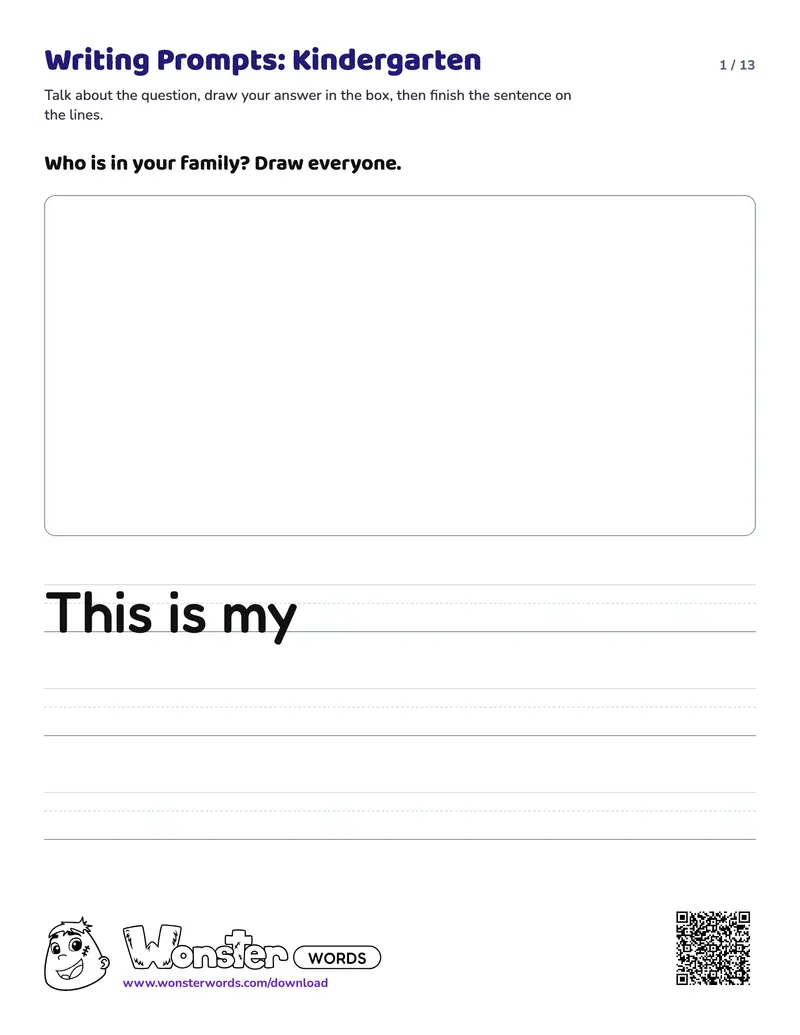
| Who is in your family? Draw everyone. | ”This is my …” |
| What do you like to do with your family? | ”I like to … with my …” |
| What makes you happy? | ”I am happy when …” |
| What can you do now that you could not do when you were little? | ”Now I can …” |
| What is your favorite animal? | ”My favorite animal is a …” |
| What is your favorite food? | ”I like to eat …” |
| What do you like to play outside? | ”I like to play …” |
| What is your favorite toy? | ”My best toy is …” |
| If you had a pet dragon, what would it eat? | ”My dragon eats …” |
| If you could fly, where would you go? | ”I would fly to …” |
| If you were as small as a mouse, where would you hide? | ”I would hide in …” |
| A dog can talk. What does it say to you? | ”The dog said …” |
The first four are about the child, the next four about things they like, and the last four are “what if” prompts. A child who has nothing to say about a family prompt often has plenty to say about a dragon.
1st grade writing prompts
Writing prompts for 1st grade ask for a few sentences that tell what happened in order. The starter gives only the opening of the first sentence. Five of the starters open with a time word, such as first, one day, or yesterday, which leads into the next sentence. Ask “and then what happened?” when your child stops.
| Prompt | Sentence starter |
|---|---|
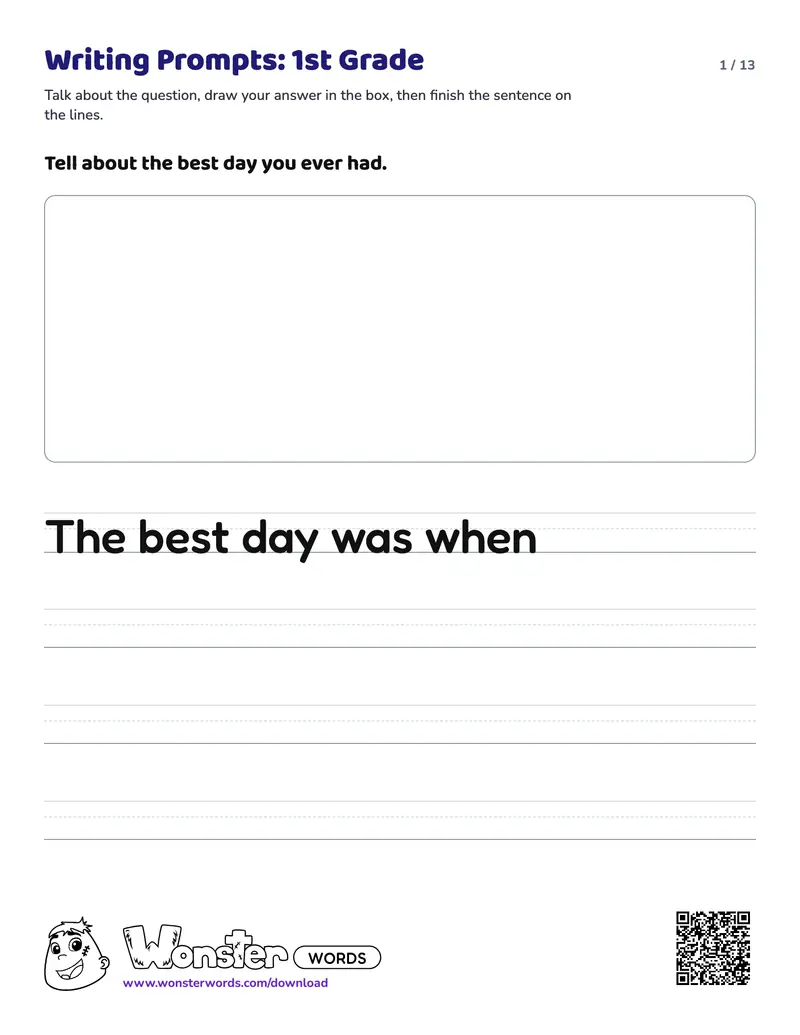
| Tell about the best day you ever had. | ”The best day was when …” |
| How do you make your favorite snack? | ”First, I get … Next, I …” |
| Tell about a time you were brave. | ”I was brave when …” |
| What do you do when you get home from school? | ”When I get home, I …” |
| Tell about a time you lost something. | ”One day I lost my …” |
| What is the best animal to have as a pet? Why? | ”The best pet is a … because …” |
| Who is your best friend? What do you like to do together? | ”My friend … and I like to …” |
| What do you want to learn to do? | ”I want to learn to … because …” |
| You wake up and you are a cat. What do you do first? | ”When I woke up, I had a tail! First, I …” |
| Tell about a time you helped someone. | ”I helped … when …” |
| What is something you are good at? | ”I am good at …” |
| Tell about a trip to the park, the store, or a friend’s house. | ”Yesterday we went to …“ |
2nd grade writing prompts
Writing prompts for 2nd grade ask for a short story with a beginning, a middle, and an end, or an opinion with reasons. The starter is shorter again: a first line to carry on from, or a “because” that asks for the reason. Ask your child how they felt, or what they saw, to add the detail.
| Prompt | Sentence starter |
|---|---|
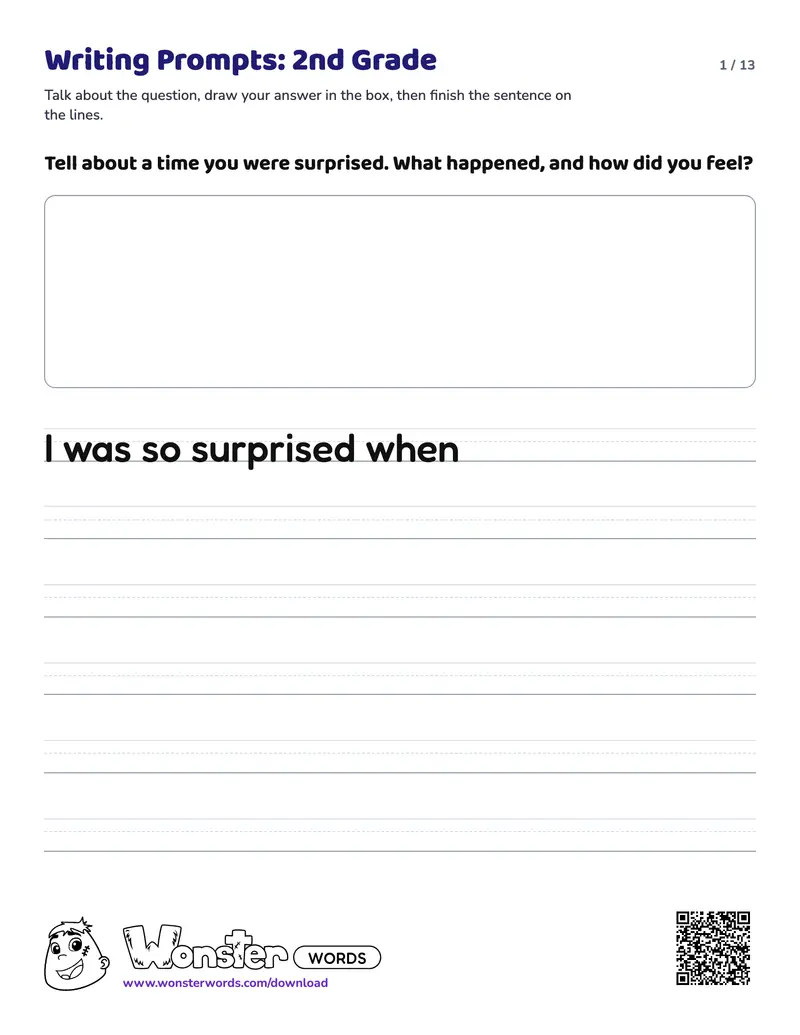
| Tell about a time you were surprised. What happened, and how did you feel? | ”I was so surprised when …” |
| Which is better, summer or winter? Give two reasons. | ”I think … is better because … Also, …” |
| Tell about a time something went wrong and how you fixed it. | ”One time, … went wrong. At first, …” |
| Should kids have homework? Why or why not? | ”I think kids should … because …” |
| Describe your bedroom so a friend could draw it. | ”When you walk into my room, you see …” |
| You find a map in an old box. Where does it lead? | ”I followed the map to …” |
| Teach someone how to play your favorite game. | ”To play …, first you …” |
| What is the best book you have read? Why should a friend read it? | ”The best book I have read is … You should read it because …” |
| Tell about your first day of something new: school, a sport, or a new house. | ”On my first day of …, I felt …” |
| You can invent a new holiday. What is it, and what do people do? | ”My holiday is called … On that day, everyone …” |
| Write a letter to someone you miss. | ”Dear …, I miss you because …” |
| What would happen if animals could talk for one day? | ”On the day the animals talked, my dog said …” |
Journal prompts for kids: daily journal ideas
A journal at home is a notebook with one page per entry: a box to draw in at the top and lines to write on underneath. Your child writes the date, draws, and writes from a prompt, or about anything they choose. The prompts below suit every grade from kindergarten to 2nd grade; cut the starter shorter as your child writes more. Several come from a practice guide on elementary writing by the Institute of Education Sciences, the US Department of Education’s research arm. It suggests children keep a notebook of topics to write about: “memories, pets, vacations, ‘firsts’ … and favorite holidays”.
| Journal prompt | Sentence starter |
|---|---|
| How did you feel today, and why? | ”Today I felt … because …” |
| What was the best part of today? | ”The best part of today was …” |
| Tell about a first: the first time you rode a bike, lost a tooth, or slept away from home. | ”The first time I …” |
| Tell about a pet, or an animal you know. | ”My pet …” |
| Tell about something you remember doing with a grandparent or a friend. | ”I remember when …” |
| Tell about a trip you took. | ”When we went to …” |
| What does your family do on your favorite holiday? | ”On … we always …” |
| What do you want to do tomorrow? | ”Tomorrow I want to …” |
Story starters for kindergarteners and young writers
A story starter is the first line of a story, and your child writes what happens next. It differs from a sentence starter, which is the first few words of any sentence. Read the line aloud, ask what happens next, and let your child tell the whole story before writing any of it. In kindergarten the story can be one drawing and one sentence; by 2nd grade it can have a middle and an end.
- “The box on our doorstep was moving. I opened the lid and …”
- “My shoes started to talk. They said …”
- “It rained jelly beans all day. Everyone …”
- “A dinosaur came to my school. It sat next to me and …”
- “The moon fell into our garden. I picked it up and …”
- “My teddy bear woke up in the night and …”
- “I found a tiny door in a tree. I knocked, and …”
Writing prompts by theme: animals, seasons, and silly ones
Animals, the seasons, and silly “what ifs” give a young writer something they already know or can picture. Pick a theme your child is already talking about: a prompt about the snow outside the window needs no warm-up.
| Theme | Prompt | Sentence starter |
|---|---|---|
| Animals | If you could be any animal for a day, which would you be? | ”I would be a … so I could …” |
| Animals | What does a pet do all day while everyone is at school? | ”While I am at school, my …” |
| Animals | An animal moves into your house. What happens? | ”A … moved into my house, and …” |
| Fall | What do you see, hear, and smell on a fall walk? | ”On my fall walk, I saw …” |
| Winter | What would you build in the snow? | ”In the snow, I would build …” |
| Spring | You plant a seed. What grows? | ”I planted a seed, and up came …” |
| Summer | What is the best thing to do on a hot day? | ”On a hot day, the best thing to do is …” |
| Silly | Your sock ran away. Where did it go? | ”My sock ran to …” |
| Silly | You have a pet cloud. What tricks can it do? | ”My cloud can …” |
| Silly | Your teacher turns into a frog for a day. What happens? | ”When my teacher turned into a frog, …” |
How to use a writing prompt at home: talk first, draw, then write
Using a writing prompt at home takes four steps: your child talks about it, draws it, finishes the sentence starter you write for them, and reads it back. Talking comes first because a child who has said a sentence aloud knows what to write. The practice guide on elementary writing from the Institute of Education Sciences describes the same move at school. In its words, “As students convey their ideas orally, the teacher can put those ideas in writing while explaining sentences”. Our guide to teaching your child to write a sentence takes that first sentence step by step, from saying it aloud to adding the capital and the period.
Talk about it first
Read the prompt aloud and let your child answer it out loud before anything is written. Ask one question back, such as what happened next or how it felt. A child who has said the sentence knows what to write.
Draw it
Your child draws the answer in a box at the top of the page. The picture holds the idea while the words come, and in kindergarten the drawing is part of the writing, not a warm-up.
Write the sentence starter for them
Write the starter on the top line in your own hand, saying each word as you write it. Your child finishes the sentence underneath. In kindergarten you can write down the words your child says and let them write one word themselves.
Let them spell it the way it sounds, then read it back
Spell a word when your child asks, and otherwise let them write the sounds they hear. When the page is done, your child reads it to you. Praise the idea first, then point out one thing to fix, at most.
Let your child spell words the way they sound. Beginning in kindergarten, the same guide advises encouraging children “to invent spellings for words they do not know, or to spell a word phonetically (e.g., wuz for was)”. By 2nd grade, it expects them to start checking whether their spelling looks right. A spelling like “nite” for “night” shows your child hearing every sound. That is the step before the correct spelling, as the guide to how kids learn to spell explains.
The words your child keeps asking how to spell are a ready-made spelling list. The kindergarten, 1st grade, and 2nd grade spelling lists show the words children practice at each grade. The guide to teaching spelling at home sets out a short plan for practicing them.
One prompt and one page is a session at home. The Institute of Education Sciences guide recommends at least 30 minutes of writing a day in kindergarten and at least an hour a day from 1st grade. Those are school figures, and the guide rates the evidence for daily writing time as minimal, its lowest level. A prompt at home comes on top of school. Stop while your child still wants to write.
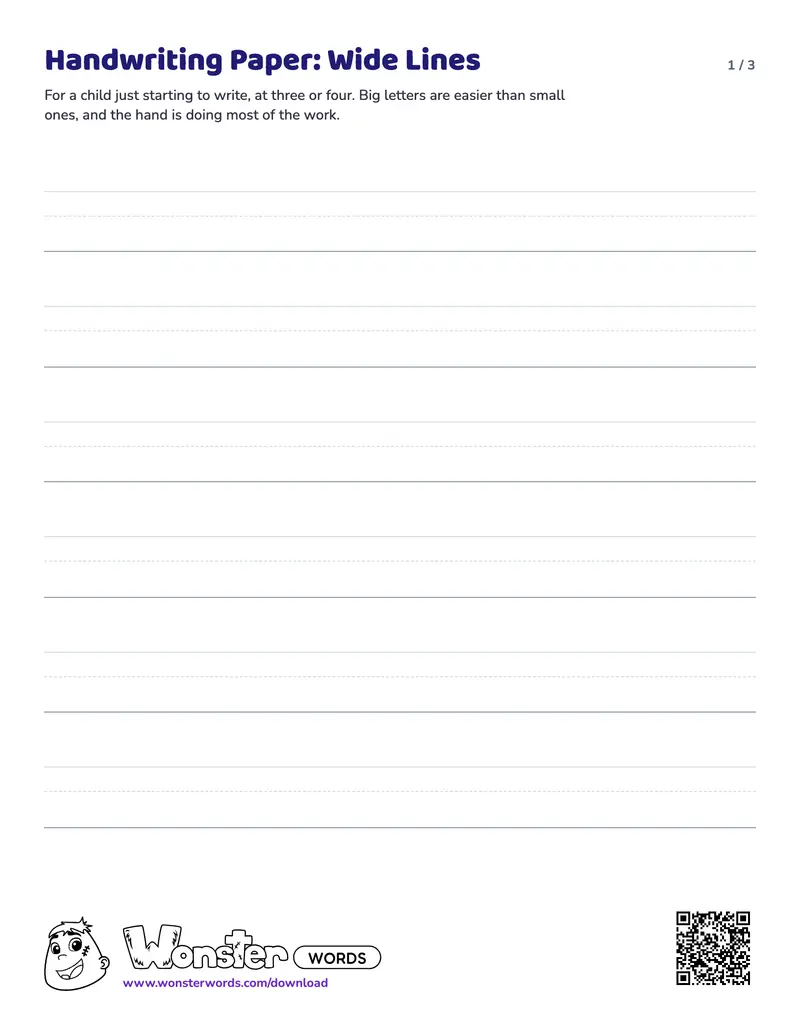
The prompt pages below print the grade tables on this page, one prompt to a page: the prompt at the top, a box to draw in, and handwriting lines with the sentence starter already on the first one. The kindergarten pages have the biggest box and three wide lines. The 2nd grade pages have a small box and six lines. The last page of each is a cover, so the pages can be stapled into a journal. For the journal, story, and theme prompts, or to write the starter in your own hand, print the handwriting paper. Its third page has a model line at the top of each group for you to write on, with lines underneath for your child.
Free PDF · no sign-up
Feedback?Free printable writing prompt pages and handwriting paper
One PDF for each grade, with the 12 prompts from that grade's list, one to a page: a box to draw the answer in, then lines with the sentence starter printed at the start, and a journal cover last. The handwriting paper is 3 pages of primary ruling for any prompt, the last with model lines for you to write on. No account, no email, no watermark.
- Writing Prompts: Kindergarten (PDF)12 prompts · 13 pages
Preview page 1Preview
- Writing Prompts: 1st Grade (PDF)12 prompts · 13 pages
Preview page 1Preview
- Writing Prompts: 2nd Grade (PDF)12 prompts · 13 pages
Preview page 1Preview
- Handwriting Paper (PDF)23 ruled lines · 3 pages
Preview page 1Preview
For a child still learning to write one sentence alone, the sentence writing worksheets go one step at a time: trace a sentence, build it from word cards, fix its capital and period, then write one about a picture.
Writing prompts for kids who do not like writing
A child who does not like writing has two ways in: choosing the topic, and saying the answer instead of writing all of it. The practice guide on elementary writing from the Institute of Education Sciences says teachers should “include opportunities for students to choose their own topics and/or modify teacher-selected prompts”. Children who choose, it adds, “may become more engaged and motivated to write”. At home, offer two prompts and let your child pick, or let them change a prompt into one they like better.
Four things help a reluctant writer at home:
- Let them say it while you write it. The same guide counts “students dictating ideas to an adult” as writing. Write down what your child says, then have them copy one sentence of it.
- Start silly, or start from a picture. The silly prompts above, the sock that ran away and the pet cloud, take the pressure off getting it right. Our picture writing prompts give a child who will not start something to look at and describe.
- Make the page smaller. One sentence and a picture is a finished page. A child who stops after one good sentence has done the job.
- Use their words. If your child wants to write about a video game or a show, that is the prompt.
A child who avoids writing because holding the pencil hurts, or because forming the letters is still slow, needs help with the letters first. The guide to letter formation covers how letters are taught, and the name tracing worksheets are a short, familiar place to start. If writing stays very hard after weeks of practice, talk to your child’s teacher.
Frequently asked questions
What are effective kindergarten writing prompts for beginners?
The best kindergarten writing prompts ask about your child's own life, such as their favorite animal, who is in their family, or what makes them happy. Each gives the first words of the answer. Your child says the answer, draws it, and then writes a word or finishes the sentence. The Common Core expects kindergartners to use a mix of drawing, dictating, and writing, so a picture with one word under it is a finished kindergarten page.
Sentence starters vs. prompts: What are the differences in helping kids write?
A writing prompt gives the idea, such as tell about the best day you ever had. A sentence starter gives the first words of the answer, such as The best day was when. A beginning writer often has an idea and stalls on how to begin. The two work together: the prompt says what to write about, and the starter gets the first sentence on the page. The starter gets shorter from kindergarten to 2nd grade and then disappears.
How can parents assist first graders with journal prompts?
Talk about the prompt first and let your child say the answer aloud. Then have them draw it, and write the sentence starter on the top line for them to finish underneath. Spell a word when they ask, and let them write the sounds they hear for the rest. First graders are expected to tell two or more events in order, so asking what happened first and what happened next is the most useful help.
How long should morning journals be for 2nd graders?
There is no set length. By the end of 2nd grade, the Common Core asks for a short story or event told in order, with details about actions, thoughts, and feelings. For most children that is a short paragraph. A few careful sentences with one detail and one feeling are a better entry than a long one written in a hurry.
How often should first graders write in their journals?
At school, the Institute of Education Sciences practice guide on elementary writing recommends at least an hour of writing a day from 1st grade. In kindergarten it recommends at least 30 minutes. A journal at home adds to that, so a prompt on the days your child wants one is plenty. Several short entries a week build more than one long one.
Does my child need to spell every word correctly in a journal?
No. The Institute of Education Sciences practice guide on elementary writing advises letting children invent spellings from kindergarten, writing a word the way it sounds, such as wuz for was. By 2nd grade children start checking whether their spelling looks right. Correct one word at most, and keep the rest of the page about the idea.
Related guides
Last updated
Looking for something else?
Looking for something else?