
Writing
How to Teach Your Child to Write a Sentence
The steps from saying it to writing it, kindergarten to 2nd grade: say it, count the words, write the sounds, add the capital and the period, and read it back.
To teach your child to write a sentence, have them say it out loud, count the words, write each word one sound at a time, add a capital letter and a period, and read it back. In kindergarten, your child draws first and you can write some of the words for them. Writing a sentence is two jobs at once: deciding what to say, and getting each word onto the paper. For a child of 5, 6, or 7 the second job takes the bigger share of the effort, because every word has to be spelled and every letter formed. The steps keep the two jobs apart, so your child finishes saying the sentence before writing a single letter.
Two kinds of help split the same way. A sentence frame, such as “I like ___.”, helps with what to say. Dictation, where you say a sentence and your child writes it, practices getting the words down.
How do you teach a child to write a sentence, step by step?
Teaching a child to write a sentence takes five steps: say it, count the words, write each word sound by sound, add the capital and the end mark, and read it back. The Institute of Education Sciences, the research arm of the US Department of Education, publishes a practice guide on elementary writing. It starts from the spoken sentence: “As students convey their ideas orally, the teacher can put those ideas in writing while explaining sentences and demonstrating how to write them.” The guide is written for teachers; these are the same moves at a kitchen table.
Say the sentence out loud
Your child says the whole sentence before writing anything, then says it again the same way. In kindergarten, they draw it first and tell you about the picture. If the sentence changes each time, keep talking until it stays the same twice in a row.
Count the words
Say the sentence slowly together and hold up one finger for each word. Then draw one short line on the paper for each word, with a gap between the lines. The lines show your child where each word goes and that a space comes after it.
Write each word one sound at a time
Your child says the first word slowly, writes a letter for each sound they hear, and moves to the next line. Accept a spelling that matches the sounds, such as dg for dog. If they ask how to spell a word like the or said, tell them.
Add the capital letter and the end mark
Check that the first word starts with a capital letter and that the sentence ends with a period, a question mark, or an exclamation mark. In kindergarten, point to where each one goes and let your child add it.
Read it back
Your child reads the sentence aloud, pointing to each word. A missing word shows up here, because the finger runs out of words before the voice does. Praise the sentence first, then fix one thing at most.
Counting the words keeps the end of the sentence from getting lost. A child who has counted five words and drawn five lines knows the sentence is not finished until the fifth line has a word on it. The Institute’s practice guide on foundational reading skills recommends “first demonstrating that sentences can be broken into words”, with a teacher saying a sentence and the children counting its words. The Common Core asks kindergartners to “understand that words are separated by spaces in print” (RF.K.1c), and the lines on the paper are those spaces.
Writing each word one sound at a time is where spelling comes in. Your child says the word slowly and writes a letter for each sound they hear. It is the same move as an Elkonin box mat, with one line for the whole word in place of a box for each sound. A child who cannot yet pick out the sounds in a word needs practice hearing the sounds in words before writing them. The writing guide advises encouraging children, beginning in kindergarten, “to invent spellings for words they do not know, or to spell a word phonetically (e.g., wuz for was)”.
Here is one sentence worked through the steps. Your child says “My dog can run fast.” and counts five words on five fingers. You draw five lines. Your child writes, sound by sound, “My dg cn rn fst.” That is a finished kindergarten sentence: every word has the sounds your child heard, a capital starts it, and a period ends it. Why “dg” for “dog” is a good sign, and what comes next, is in the guide to how kids learn to spell.
What is a sentence? How to explain it to a 5-year-old
A sentence tells who or what, and what they do. “The big dog” names something but does not say what it does, so it is not a sentence yet. “The big dog ran.” is. Explain it to a 5-year-old in three parts: a sentence has a who and a doing part, it starts with a capital letter, and it ends with a period, a question mark, or an exclamation mark.
| Words | A sentence? | Why |
|---|---|---|
| the big dog | Not yet | It says who, but not what the dog did |
| The big dog ran. | Yes | Who: the big dog. What it did: ran |
| ran to the park | Not yet | It says what happened, but not who did it |
| Mom ran to the park. | Yes | Who: Mom. What she did: ran to the park |
| Can you see the cat? | Yes | A question is a sentence, and it ends with a question mark |
Understanding what a sentence is comes before the rules for writing one. The IES writing guide says children should develop “an understanding of what sentences are” beginning in kindergarten. It puts the rules second: “Once students understand the concept of a sentence, they then need instruction in how to apply standard conventions”, such as the capital letter and the period. For a kindergartner, the order is the same at home: first a sentence that says who and what, then the capital and the end mark. Hearing “who did it?” and “what did they do?” after every sentence your child says builds the idea before any writing does.
When do kids start writing sentences, and what is normal at 5, 6, and 7?
Kindergartners are expected to write a short sentence about something that happened by the end of the year, with its words spelled the way they sound. The Common Core standards set out the end-of-year goal for each grade. A kindergartner who labels a picture with one word in the fall is at the start of that year, not behind it.
| Grade | What the Common Core asks by the end of the year, in its own words | An example sentence |
|---|---|---|
| Kindergarten (age 5–6) | “Use a combination of drawing, dictating, and writing” (W.K.3); “Capitalize the first word in a sentence and the pronoun I”; “Recognize and name end punctuation”; “Spell simple words phonetically” (L.K.2) | A drawing with “I lik my dog.” under it |
| 1st grade (age 6–7) | Write sentences “in response to prompts” (L.1.1j); “Use end punctuation for sentences” (L.1.2b); “recount two or more appropriately sequenced events” (W.1.3) | “We went to the park. Then I went on the swing.” |
| 2nd grade (age 7–8) | “Produce, expand, and rearrange complete simple and compound sentences” (L.2.1f); “include details to describe actions, thoughts, and feelings” (W.2.3) | “I made a boat, and it can float. I felt proud.” |
No standard sets a number of sentences. None of the kindergarten, 1st grade, or 2nd grade writing and language standards gives a count. They describe what a sentence contains at each grade. In kindergarten, a grown-up writing down part of the child’s sentence is part of the standard itself: “dictating” sits in the kindergarten writing standards beside drawing and writing.
One thing is worth raising with the teacher near the end of kindergarten: a child who cannot yet write a letter for most of the sounds in a short word. The kindergarten standard asks for “a letter or letters for most consonant and short-vowel sounds” (L.K.2c).
For reading more broadly, the guide to whether your child is on track in reading sets out what each age usually does. The kindergarten readiness check covers what school assumes on the first day.
What are some easy sentences for kindergarteners to write? Examples by stage
Simple sentences for kindergarten are ones your child can say in one breath and spell mostly by sound. The table moves from a single label to sentences with two ideas. Pick the row that matches what your child can already sound out, not their grade. The words not spelled by sound, such as the, a, and said, are sight words: tell your child how to spell them, or practice them on their own.
| Stage | What your child spells by sound | Example sentences |
|---|---|---|
| A label, start of kindergarten | The first sound, or every sound they hear | cat · Mom · sun |
| A frame with one word to add | Only the last word; the frame gives the rest | I can hop. · I see a cat. · I like red. |
| Short-vowel sentences, mid to late kindergarten | Every word except the, a, and is | The cat sat on a mat. · A big dog ran. · Is the pig in the mud? |
| Digraphs and blends, 1st grade | Words with sh, ch, th, and ck, and blends such as sw and mp | The fish is in the dish. · I can jump and swim. · The duck sat on a log. |
| Two ideas in one sentence, 2nd grade | Silent e and vowel teams, joined with and or because | I made a boat, and it can float. · The snake hid under a rock because it was cold. |
Every word in the short-vowel row is either a short-vowel word, such as cat, on, and mud, or one of the three sight words named. A child who can sound out consonant-vowel-consonant (CVC) words can spell the whole sentence. The guide to teaching CVC words covers the step before: reading and spelling those words on their own. For sentences to read rather than write, the kindergarten sentences to read are built from the same short vowel words and sight words.
What are the best sentence starters and sentence frames for kids?
A sentence frame gives your child the first words of a sentence and a blank to finish. It takes care of the first job, deciding how to begin, so your child’s attention goes to the words they add. The IES writing guide lists sentence framing among its activities for building sentences, with frames such as “I like ___.” and “I like to ___ and ___.” It ends on taking the frame away: “Slowly fade the use of the sentence frame during instruction until students can write sentences independently.”
Frames in three steps, from the most help to the least:
| Step | Frames | What your child adds |
|---|---|---|
| One word | ”I see a ___.” · “I can ___.” · “I like ___.” | One word |
| Two words | ”My ___ is ___.” · “I like to ___ and ___.” | Two words in two places |
| A second half | ”When I ___, I ___.” · “I like ___ because ___.” | Half a sentence, with its own who and doing part |
To fade a frame, write it in full the first time, then only “I like” the next time, then nothing. Once your child writes sentences without a frame, expanding is the next move for 1st and 2nd grade. Start from a short sentence and add one detail at a time. The IES guide’s own example runs from “The dog napped.” to “The brown dog napped.” and then “The brown dog napped on the couch.” The 2nd grade language standard asks children to “produce, expand, and rearrange” sentences in exactly this way.
A writing prompt and a frame help at different moments: the prompt gives your child the idea, and the frame gives the first words. The writing prompts for kindergarten to 2nd grade pair each prompt with a sentence starter, grade by grade.
How do you use dictation sentences with a beginning writer?
Dictation means you say a short sentence and your child writes it without seeing it. It practices the second job on its own: spelling each word, leaving the spaces, and adding the capital and the period. It does not practice deciding what to say. The IES writing guide makes that distinction in its glossary: writing from dictation does not count as “authentic writing, because students are not generating the content themselves”. Do both: a dictated sentence for the spelling, and a sentence of your child’s own for the writing.
How to run a dictation, three sentences a session:
- Say the sentence once, at normal speed.
- Your child says it back to you, word for word.
- Count the words together on fingers, and your child draws a line for each.
- Your child writes it, saying each word slowly as they go.
- Show them the sentence written correctly and check it together, one word at a time.
Build every dictation sentence from phonics patterns your child has already learned. A sentence with a pattern they have not met turns spelling into guessing. The IES guide to foundational reading skills uses the same move for single words: the teacher says each word and the children write it. These sentences follow the usual order of phonics; skip a row your child has not reached.
| Phonics stage | Dictation sentences |
|---|---|
| Short vowels (CVC) | Dad has a red hat. · The fox is in a box. · Can you get the big bag? |
| Digraphs and blends | Seth got a fish and a crab. · The frog sat on a log. · Shut the shed! |
| Silent e and vowel teams | We will bake a cake. · The goat ate the green weeds. · Kate rode a bike home. |
Dictation is also the center of spelling practice at home. The guide to teaching spelling at home explains why writing a word unseen does more than copying it. For a child who balks at a straight dictation, the spelling games for 1st and 2nd grade include a silly sentence version.
What are some fun games to teach sentence writing at home?
These seven sentence games each practice part of writing a sentence, so pick by the step your child finds hardest. The step and the age each game suits are in italics after it.
- Silly sentences. Fill three cups with slips of paper: a “who” cup (a pig, my teacher, a cat), a “did what” cup (sat on, ate, kicked), and a “where” cup (in the mud, on a bus, at school). Your child pulls one from each, says the sentence, writes it, and draws it. Saying it and writing it; kindergarten and up.
- Stretch a sentence. Start with “The cat ran.” and take turns adding one word or detail: “The fat cat ran.” “The fat cat ran up a tree.” Say each one, then write the longest. Expanding; 1st and 2nd grade.
- Mixed-up sentence. Say the words of a sentence out of order, “ran dog the,” and your child says it the right way round, then writes it. Word order and what a sentence is; kindergarten and up.
- Caption a photo. Your child picks a family photo and writes one sentence to go under it. Saying it first, with a real reader; any age.
- A note with a job. A sentence on a shopping list, a note in a lunch box, or a card for a grandparent. A sentence with a reader is worth getting right. Every step; any age.
- Fix my sentence. You write a sentence with one thing wrong, such as no capital, no period, or a missing word. Your child finds it and fixes it. The capital, the end mark, and reading it back; kindergarten and up.
- A sentence a day on the fridge. One sentence, every day, about anything, read aloud at dinner. All five steps; kindergarten and up.
What can you do when your child will not write a sentence?
When a child will not write a sentence, take one of the two jobs away first. Let them say the sentence while you write it, then have them write one word of it themselves. The IES writing guide counts “students dictating ideas to an adult or peer for transcription” as writing, so this is not letting them off. It keeps the sentence their own while the spelling load drops to one word.
Then find which job is stalling:
| What you see | Which job is stalling | What helps |
|---|---|---|
| Says there is nothing to write about | Deciding what to say | Talk about it, draw it first, or give a frame such as “I like ___.” |
| Says the sentence but writes one letter and stops | Hearing the sounds in each word | Practice hearing the sounds in words out loud, with no pencil |
| Forms each letter slowly, or says writing hurts | Forming the letters | Short practice on how letters are formed, with the sentence kept to three or four words |
| Refuses unless every word is spelled for them | Spelling, and worry about getting it wrong | Accept spellings by sound, and spell only the sight words |
| Starts well and loses the end of the sentence | Holding the sentence in mind | Count the words and draw the lines before writing |
For a child who says there is nothing to write about, a picture gives them something to say. Each of the picture writing prompts comes with a question to ask and the first words of the answer.
Keep the session to one sentence, and let your child choose the subject. Talk to the teacher if writing a sentence is still very hard after several weeks of short practice. The same goes for a child near the end of 1st grade who cannot yet write a simple sentence by sound.
Free printable sentence writing worksheets and paper
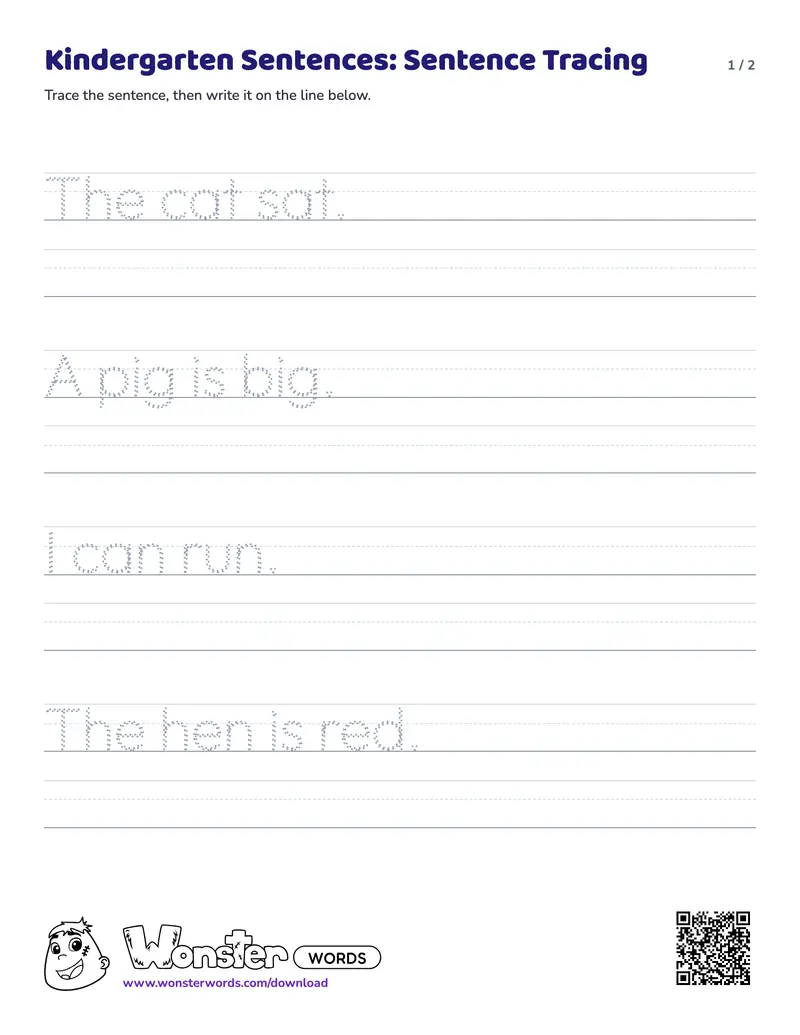
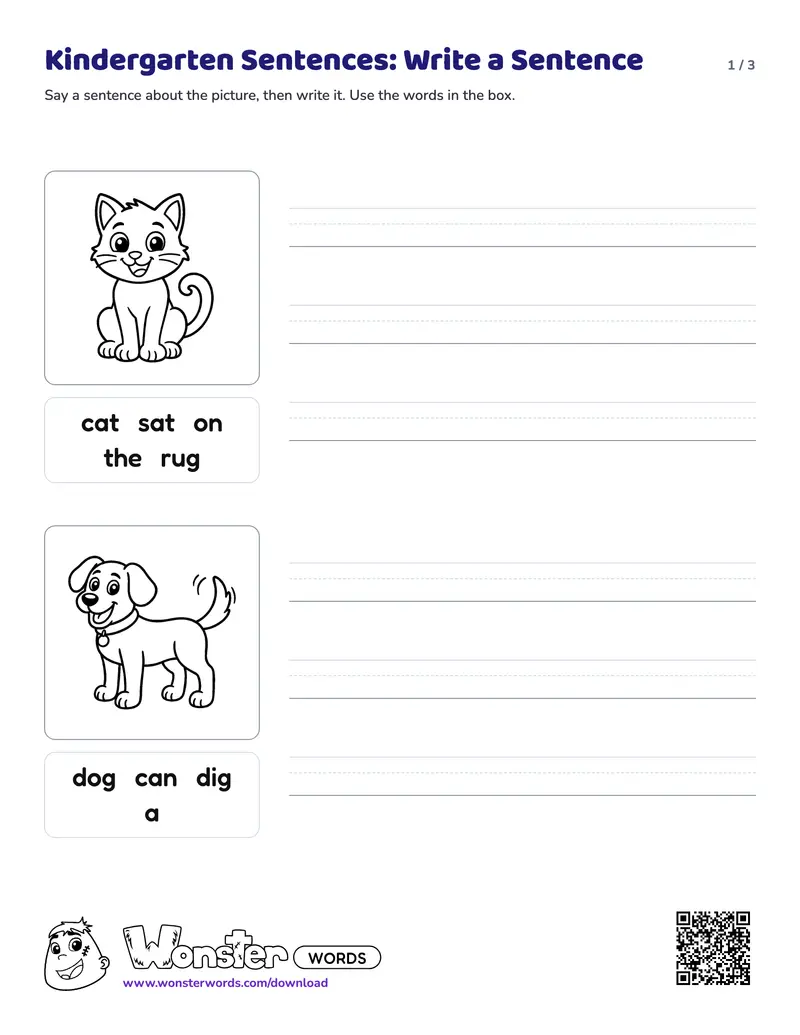
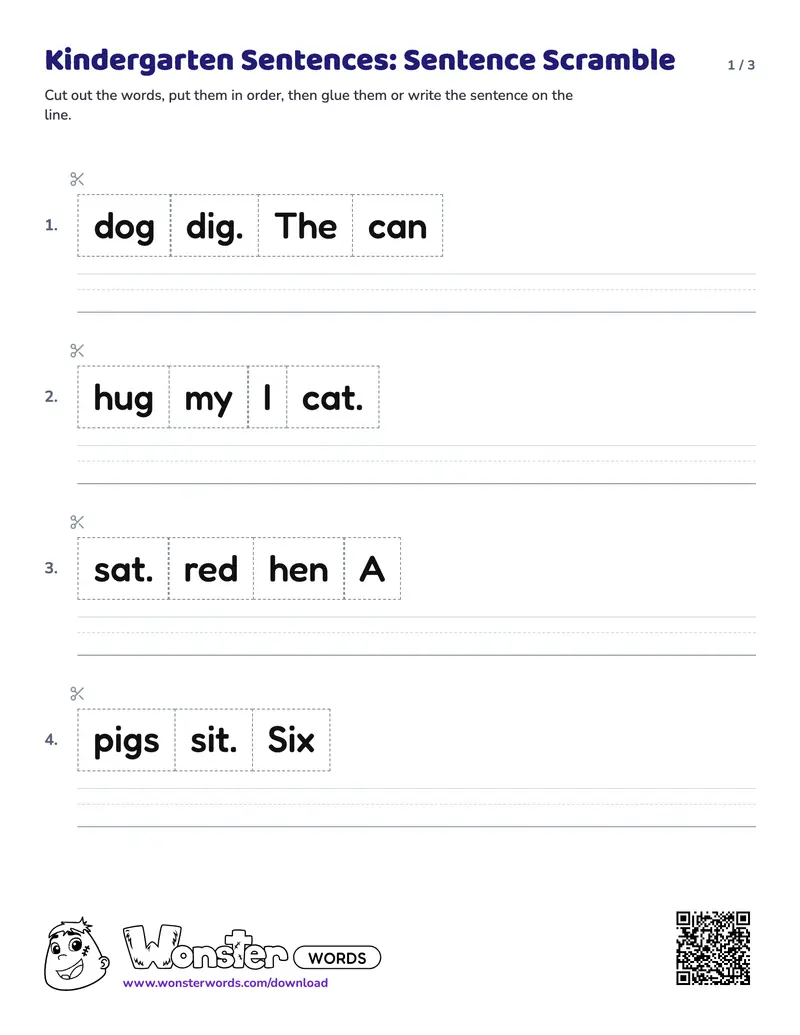
Three sentence writing worksheets practice the steps on paper, and the handwriting paper is for a sentence of your child’s own. On the sentence tracing sheet your child traces a short sentence, with its capital, spaces, and period, then writes it on the line below. On the sentence scramble sheet they cut out word cards and put them in order, the printed version of the mixed-up sentence game. On the write a sentence sheet they say a sentence about a picture and write it, using a box of words. Every word in the sentences is a short vowel word or a sight word. All three come from the kindergarten sentence writing worksheets, which also have a fix-the-sentence sheet for the capital and the period.
The handwriting paper has three pages. The third has a model line at the top of each group for you, with lines underneath for your child. Write the sentence frame or the dictated sentence on the model line, and your child writes their own underneath.
Free PDF · no sign-up
Feedback?Free printable sentence writing worksheets and handwriting paper
Three sentence writing worksheets for kindergarten and the start of first grade, in the order to use them: trace a sentence, build one from word cards, then write one about a picture. Then three pages of primary-ruled handwriting paper, the last with model lines for you to write a sentence frame or a dictated sentence on, with lines under each for your child. No account, no email, no watermark.
- Kindergarten Sentences: Sentence Tracing (PDF)8 sentences · 2 pages
Preview page 1Preview
- Kindergarten Sentences: Write a Sentence (PDF)6 pictures · 3 pages
Preview page 1Preview
- Handwriting Paper (PDF)23 ruled lines · 3 pages
Preview page 1Preview
Frequently asked questions
How to teach kindergarteners to write a sentence?
Have your kindergartner draw a picture and say one sentence about it. Then count the words on your fingers together, draw a line for each word, and let them write each word the way it sounds. Add a capital letter at the start and a period at the end, and have them read it back while pointing to each word. Write any word they cannot manage yet, and let them write the rest.
Is it normal for a 5 year old to write sentences?
Yes, and it is also normal for a 5-year-old not to write sentences yet. The Common Core standards describe the end of kindergarten, not the start. By then, a child draws, dictates, and writes about an event, capitalizes the first word, and spells simple words by their sounds. Early in kindergarten, a picture with a word or two under it is where writing starts. A sentence such as I lik my dog, written by sound, is what the end of the year looks like.
Should my kindergartener be able to write sentences?
By the end of kindergarten, the Common Core expects a child to write about an event using a mix of drawing, dictating, and writing. It also expects a capital at the start of a sentence and simple words spelled by their sounds. That adds up to a short sentence with some words spelled the way they sound. Earlier in the year, a picture with a label is on track. If you are worried, the child's teacher can tell you how they compare with the class.
Teaching sentence structure vs. teaching punctuation in kindergarten: Which is more critical?
Sentence structure comes first. The Institute of Education Sciences practice guide on elementary writing says children should first understand what a sentence is. Then they learn conventions such as the capital letter and the period. At home, check that your child's sentence says who and what they did before checking the capital and the end mark. Both belong in kindergarten: the Common Core asks kindergartners to capitalize the first word and to recognize end punctuation.
How many simple sentences should kindergarteners write?
No standard sets a number. The Common Core kindergarten standards describe what a child writes and give no count. What they describe is a sentence about an event, with a capital at the start and words spelled by their sounds. At home, one sentence written with care, said first and read back afterwards, is a complete session.
How can dictation improve spelling skills for new writers?
Dictation asks a child to hear a word inside a sentence and spell it from memory, with no copy to look at. That is the same work as spelling a word in their own sentence, practiced with words you chose. Use sentences built from the phonics patterns your child has learned, such as The fox is in a box for short vowels, and check each one together straight away.
Why do young children struggle with writing complete sentences?
A child writing a sentence is doing two jobs at once: deciding what to say, and spelling and forming each word. At 5–7, the spelling and the letters take so much attention that the end of the sentence is easy to lose. Saying the whole sentence first, and counting its words before writing, keeps the sentence in mind while the words go down.
Related guides
Last updated
Looking for something else?
Looking for something else?