
Sentences to Read
Kindergarten Sentences to Read
Simple sentences for kindergarten to read: 28 example sentences in three stages, from CVC words alone to two sentences together, then free printable sentence worksheets and short reading passages. Every word in our kindergarten sentences is a short vowel word or a sight word we name.
Simple sentences for kindergarten are 3–8 words long, built from CVC words your child can sound out, like cat, dog, and sun, and a few sight words, like the, is, and I. Start with sentences of only CVC words and a or the, add the sight words one at a time, then put two sentences together, which is the step to a short story. The examples below follow that order, and the CVC sentence worksheet and the reading passages come after them. Every word in our kindergarten sentences is checked against our kindergarten word lists. For writing sentences rather than reading them, see how to teach your child to write a sentence.
Why reading a word inside a sentence is the real test
A child can read a list of words by guessing from the first letter, and a sentence catches the guess. Read The dog digs as The dog dips and the sentence stops making sense. Common Core asks first graders to “use context to confirm or self-correct word recognition and understanding, rereading as necessary” (RF.1.4c), and the habit starts here. The Institute of Education Sciences gives the prompt for it: “Check it! Does it make sense?”, then reread the sentence.
Reading sentences is also the step between words and books. Common Core’s kindergarten goal is to “read emergent-reader texts with purpose and understanding” (RF.K.4). The same IES guide lists the practice that gets a child there: “word lists, decodable sentences, short decodable texts”, in that order. If your child is not yet reading CVC words on their own, start with how to teach CVC words and come back.
Simple sentences for kindergarten to read, by stage
Stage 1: CVC words, plus a and the. For a child who has just started blending:
- The cat naps.
- A dog digs.
- The pup hops.
- The bug hums.
- A red hen sits.
- The kid sips.
- The man naps on a mat.
- A pig digs in a pit.
- A rat sits on a rug.
- Get the hat.
Stage 2: CVC words with the kindergarten sight words. Each sentence adds one to three sight words, such as is, I, have, you, they, or was:
- The cat is on the bed.
- I have a red cap.
- He can hop.
- You can sit with me.
- They are in the van.
- This is my pet.
- That bug is big.
- We have a pup.
- The dog was in the tub.
- Is it hot?
- His hat is red.
- He sips from a cup.
Stage 3: two sentences together. The second sentence says more about the first, which is how a story works:
- The pup is wet. He wants a rug.
- I have a big bag. It is red.
- The cat is on the mat. It naps in the sun.
- Dad gets the van. We go to the vet.
- The hen is in the pen. It sits on ten eggs.
- A bug is on my leg. I can not get it off.
Every sight word in these sentences is on our kindergarten sight words list or our VC words list, which has go, me, my, and we. The one exception is want, a primer word on our Dolch sight words list. Common Core asks kindergartners to “read common high-frequency words by sight (e.g., the, of, to, you, she, my, is, are, do, does)” (RF.K.3c).
What makes a sentence decodable?
A decodable sentence is one your child can read using the letter sounds and the sight words they have already learned. That is the IES definition of decodable text, “text that is written so that students can read it using the letter sounds and high-frequency sight words they have learned.” It depends on the child: a sentence decodable in May may not be in September.
| Sentence | Decodable for a kindergartner who knows the short vowels? |
|---|---|
| The dog can dig. | Yes. dog, can, and dig are CVC words, and the is a sight word. |
| The puppy likes to play. | No. puppy has two syllables, likes needs silent e, and play has a blend and a vowel team. |
Every word on our kindergarten sentence sheets and reading passages is a short vowel word or a sight word named in its section, and that is what we mean when we call them decodable. The passages are checked word by word against our kindergarten word lists when the site is built, and the sentences against the same lists before they are printed. “Decodable or sight words?” is not a real choice: a decodable sentence needs both.
How to use these sentences at home
A few minutes and a few sentences a day is enough. One way to run it:
- Read the sentence to your child, pointing to each word.
- Your child reads it, sounding out each CVC word.
- Find the sight words together and read them on their own.
- Your child reads the sentence again, a little faster.
- Ask one question about it: Where is the cat?
Reading the same short text again is the practice. The National Reading Panel found that guided repeated oral reading, with guidance from teachers, peers, or parents, “had a significant and positive impact on word recognition, fluency, and comprehension.” First grade asks for reading “on successive readings” (RF.1.4b), and the reading passages below have three circles to fill in, one for each read.
Storytime and favorite books still count. Most picture books have words your child cannot sound out yet, so you read them aloud. While you read, point to a CVC word your child knows and let them read it. When they stop on a word they cannot read, do not ask them to guess from the picture. IES advises modeling sounding the word out instead, because relying on illustrations is “a habit that will not be effective with more-difficult texts and may become difficult to break.”
Sentence strips and picture sentences
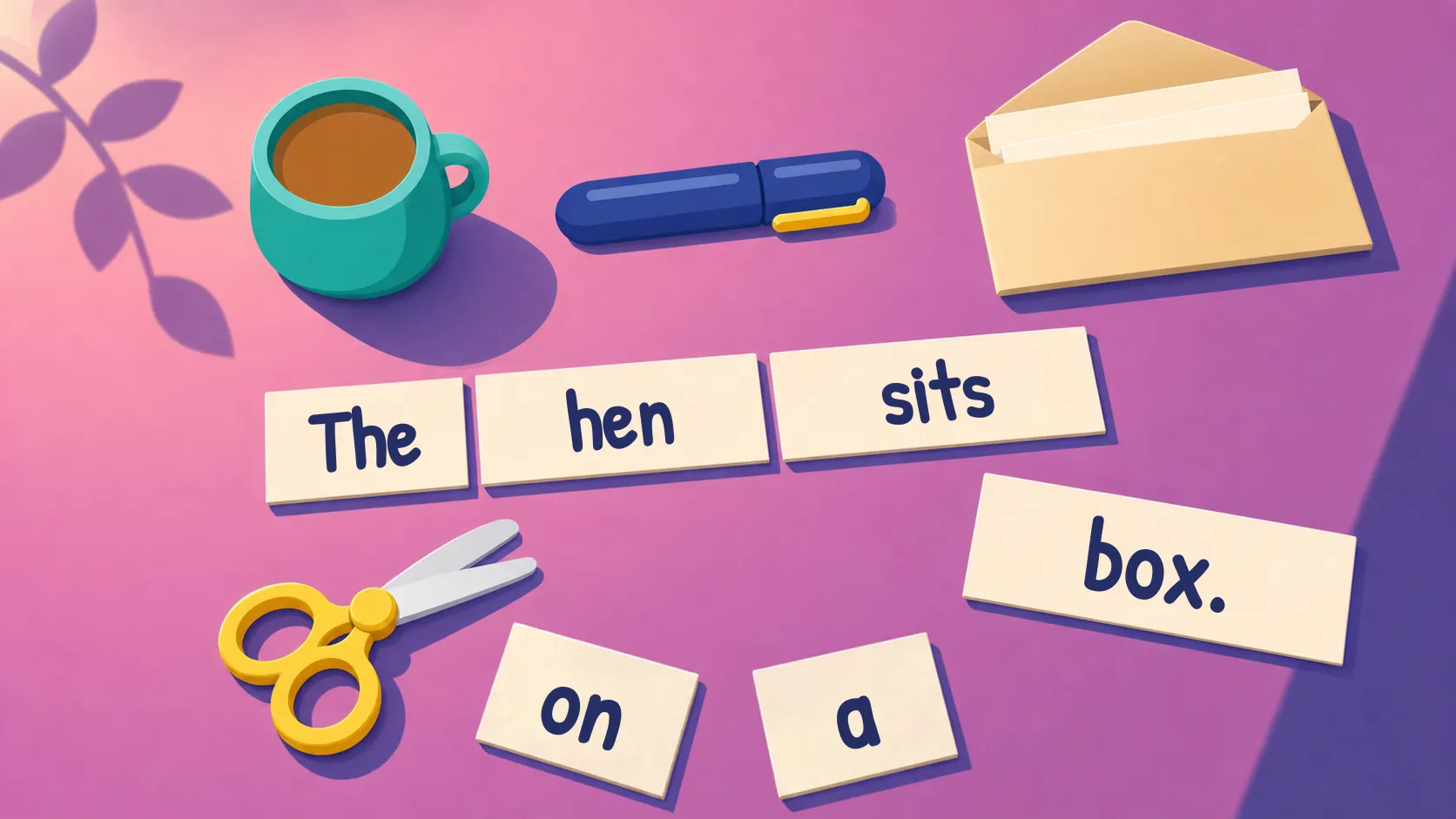
A sentence strip is a sentence written on a strip of paper and cut into words. Write one of the sentences above, read it together, cut it apart, and let your child put it back in order and read it. It shows that a sentence is made of separate words, which Common Core lists for kindergarten as “understand that words are separated by spaces in print” (RF.K.1c). Keep the strips in an envelope and add one a day. To write sentences rather than read them, the sentence scramble on our sentence writing worksheets page has the word cards ready to cut out.
A picture sentence is one your child reads first and then draws. The cat is on the bed becomes a drawing of a cat on a bed. Drawing after reading shows whether your child understood the sentence, while a picture printed beside the sentence lets them guess the words without reading them. That is why our sentence sheets for reading have no pictures.
Sentence worksheets
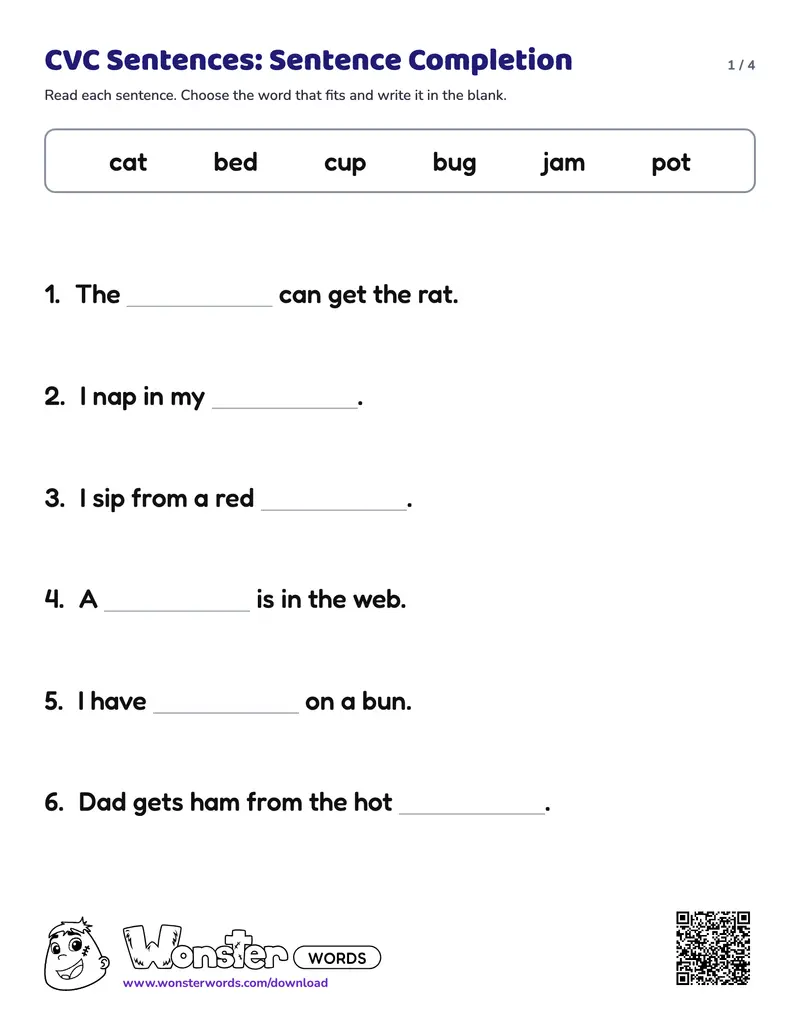
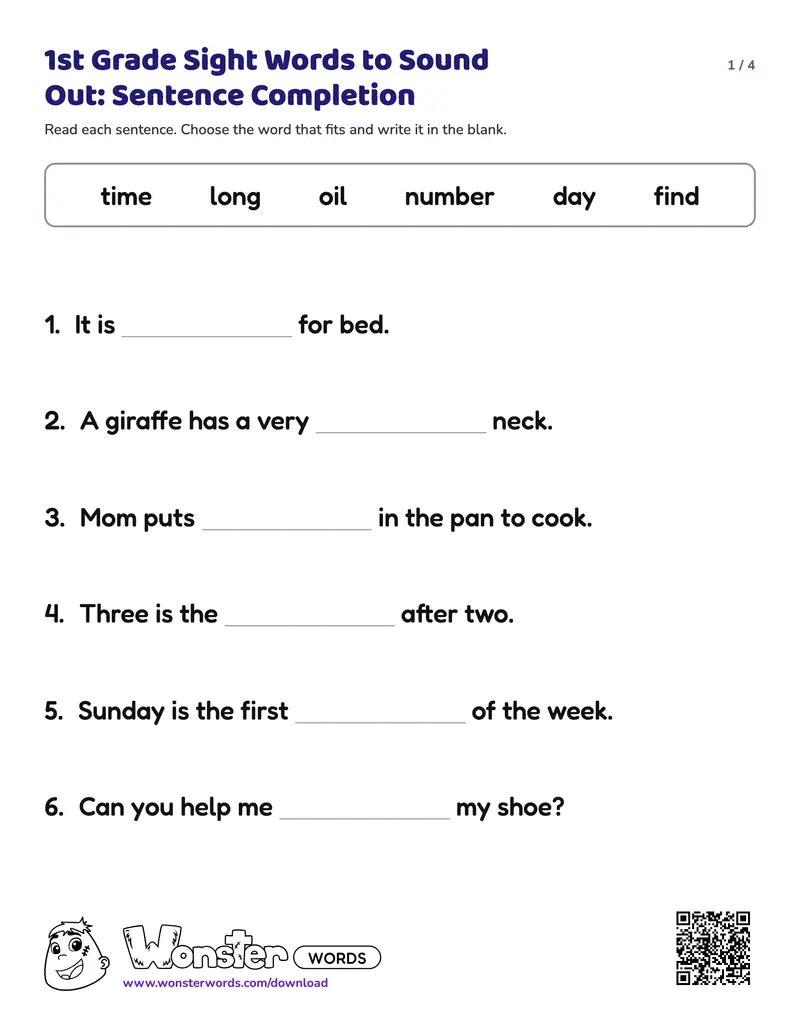
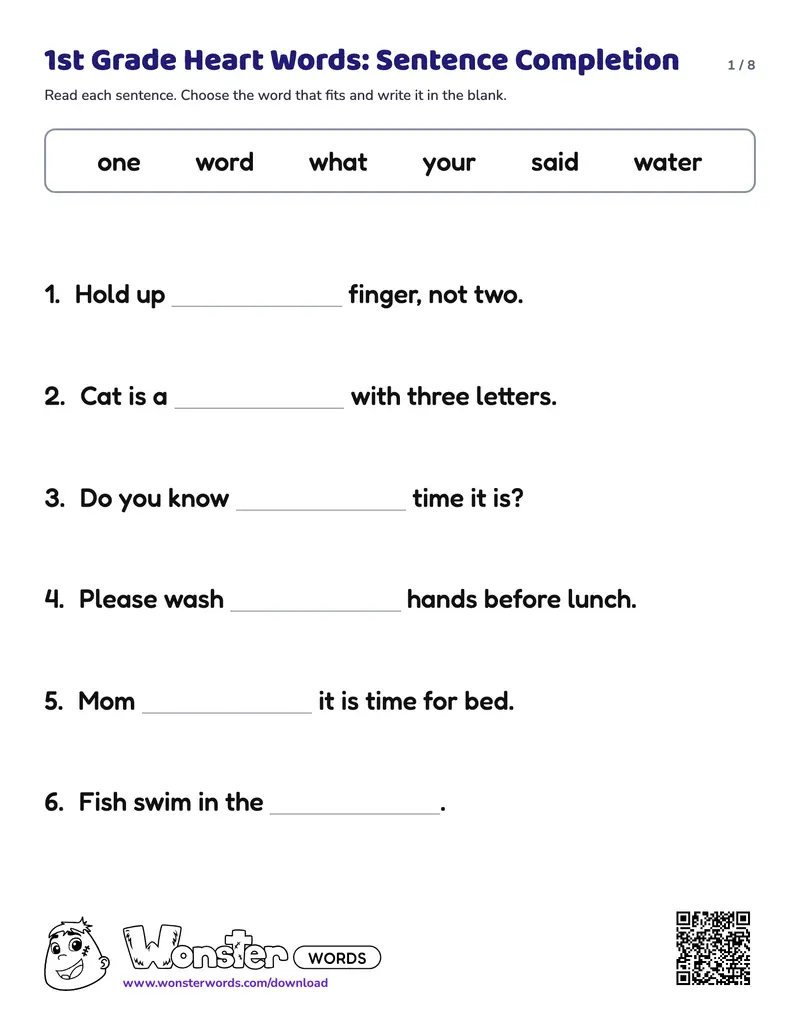
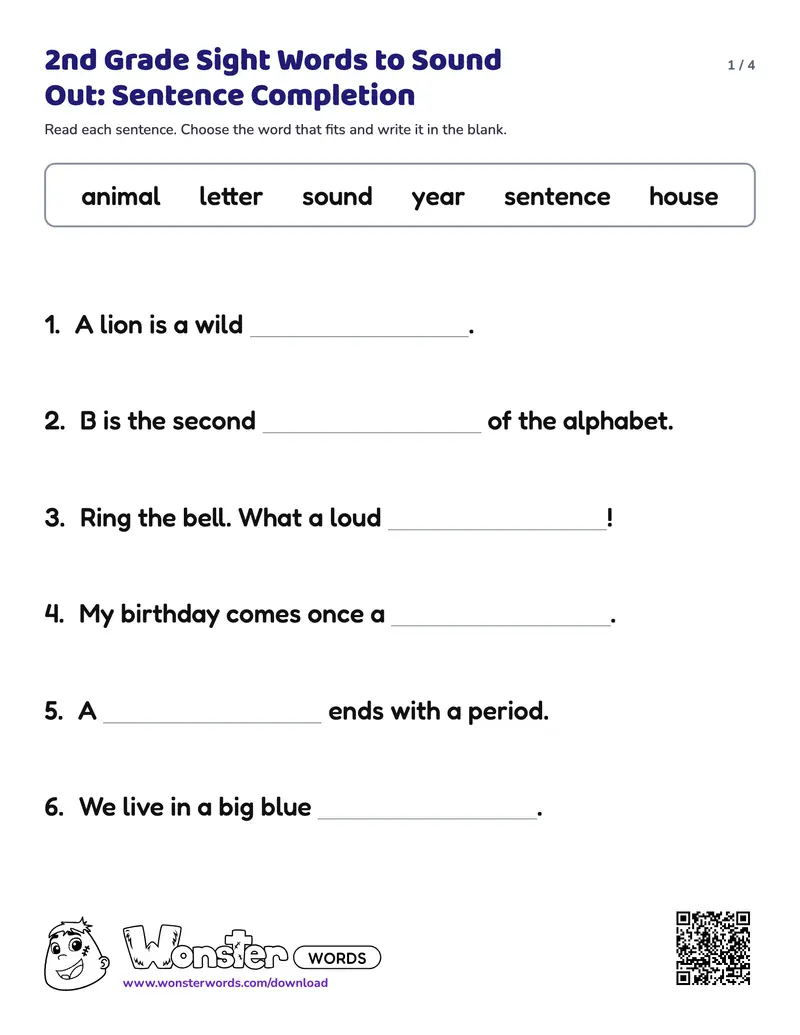
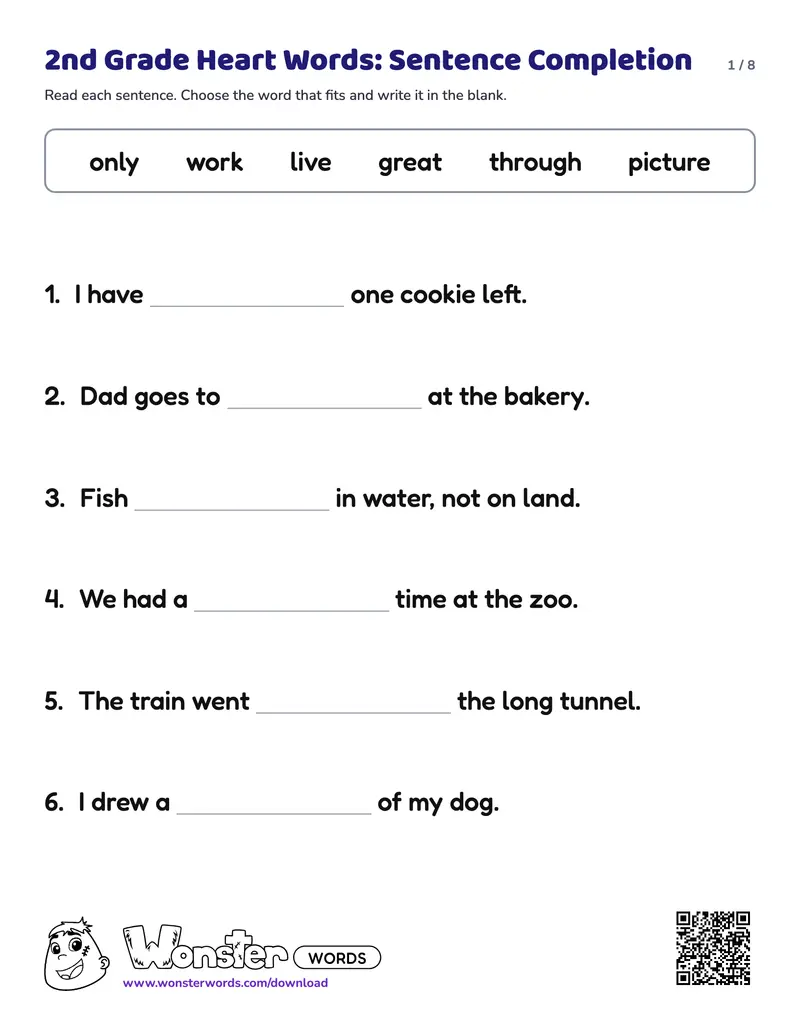
One worksheet of CVC sentences for kindergarten, and the sight word sentence sheets for 1st and 2nd grade. On each sentence sheet your child reads the sentence, chooses the word from the box that fits, and writes it in the blank.
CVC sentences worksheet: 12 sentences with all five short vowels
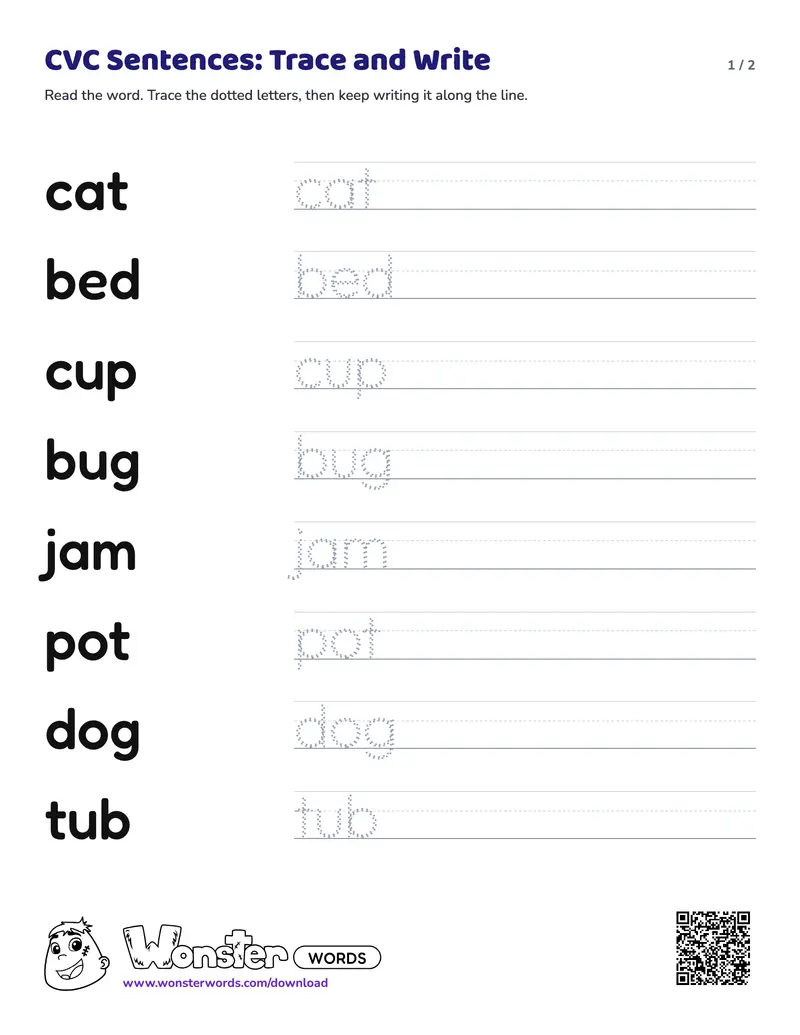
These 12 CVC sentences are decodable for a kindergartner who knows the five short vowels. Every word in them is a short vowel word, like cat, in, and pot, or one of these sight words: a, an, the, and, I, is, my, he, his, have, from, to, and go. Read the 12 words below with your child first. The tracing sheet practices writing them, and the sentence sheet puts each one in a sentence. For more CVC words, one word family at a time, see our CVC words page.
- cat
- bed
- cup
- bug
- jam
- pot
- dog
- tub
- egg
- hug
- six
- van
Free PDF · no sign-up
Feedback?Printables for CVC Sentences
- CVC Sentences: Trace and Write (PDF)12 words · 2 pages
Preview page 1Preview
- CVC Sentences: Sentence Completion (PDF)12 sentences · answer key included · 4 pages
Preview page 1Preview
Sight word sentences for kindergarten, 1st, and 2nd grade
In kindergarten, the sight words are the small words that hold a sentence together. The sentences above and the stories below use the, a, is, I, have, and the other words on our kindergarten sight words list, so your child reads them in every line rather than on a sentence sheet of their own. From first grade, each sight word gets its own sentence. These four sheets come from our 1st grade sight words and 2nd grade sight words pages: the words your child can sound out, then the heart words, which have a part to learn by heart.
Free PDF · no sign-up
Feedback?Printables for Sight Word Sentences
From the 1st Grade Sight Words, 1st Grade Sight Words, 2nd Grade Sight Words and 2nd Grade Sight Words pages.
Short reading passages for kindergarten
Each passage is ten short sentences or fewer, one to a line, written only in short vowel words and kindergarten sight words, so your child can read every word. Read it together first, then let your child read it alone, once a day across the week, and fill in a circle each time. Then read the three questions out loud and let your child find each answer in the story. For longer stories with blends, digraphs, and silent e, see our 1st grade reading passages.
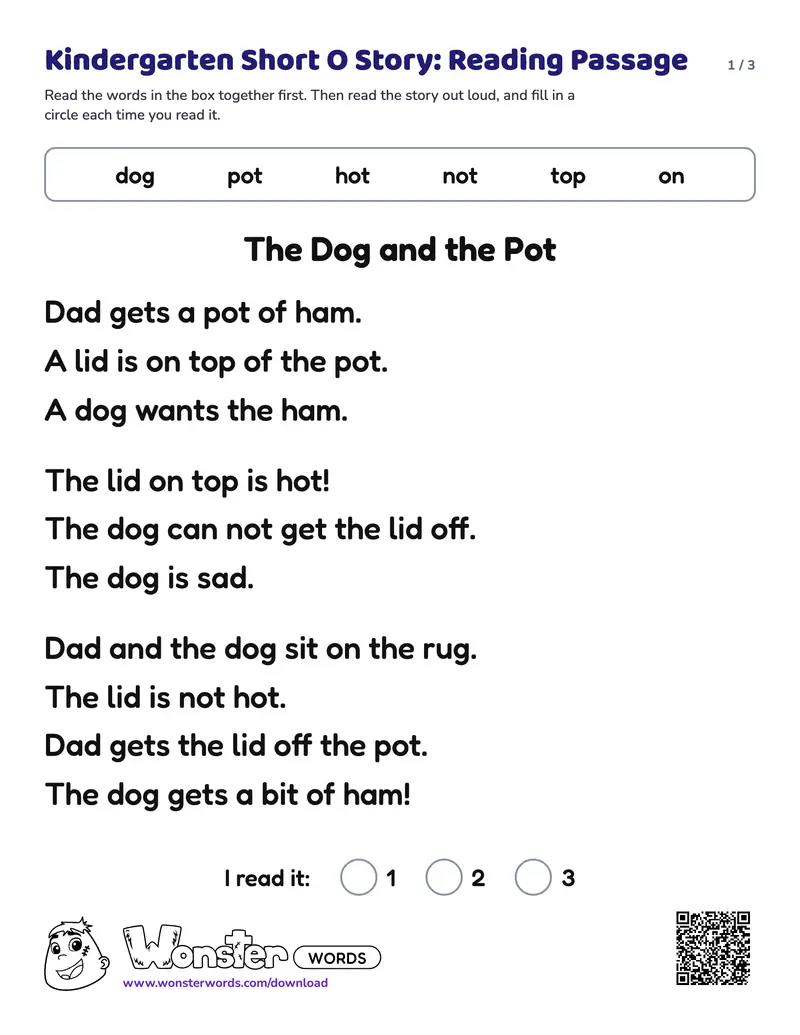
Short o story (dog, pot, hot): The Dog and the Pot
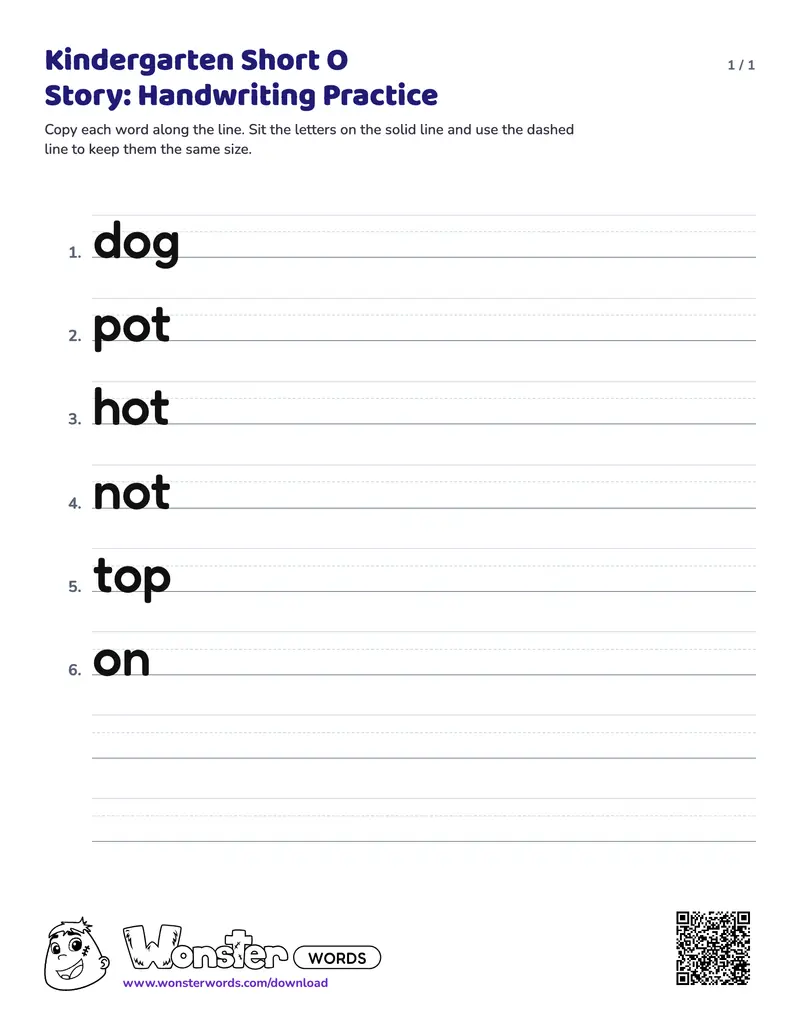
The Dog and the Pot practices short o, the sound in the middle of dog. Read the six words below with your child before the story: dog, pot, hot, not, top, and on. Each one comes up at least twice. Every other word is a short vowel word or one of the sight words a, the, of, is, and, and wants.
- dog
- pot
- hot
- not
- top
- on
Free PDF · no sign-up
Feedback?Printables for Kindergarten Short O Story
- Kindergarten Short O Story: Handwriting Practice (PDF)6 words · 1 page
Preview page 1Preview
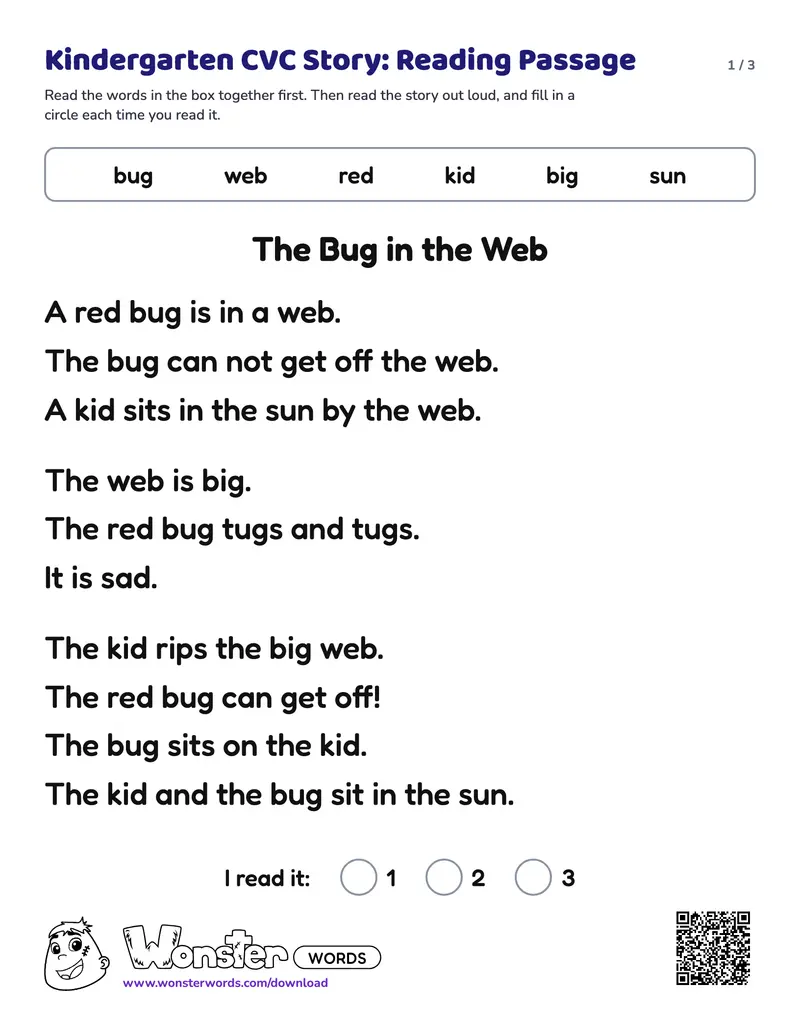
Mixed short vowels story (bug, web, kid): The Bug in the Web
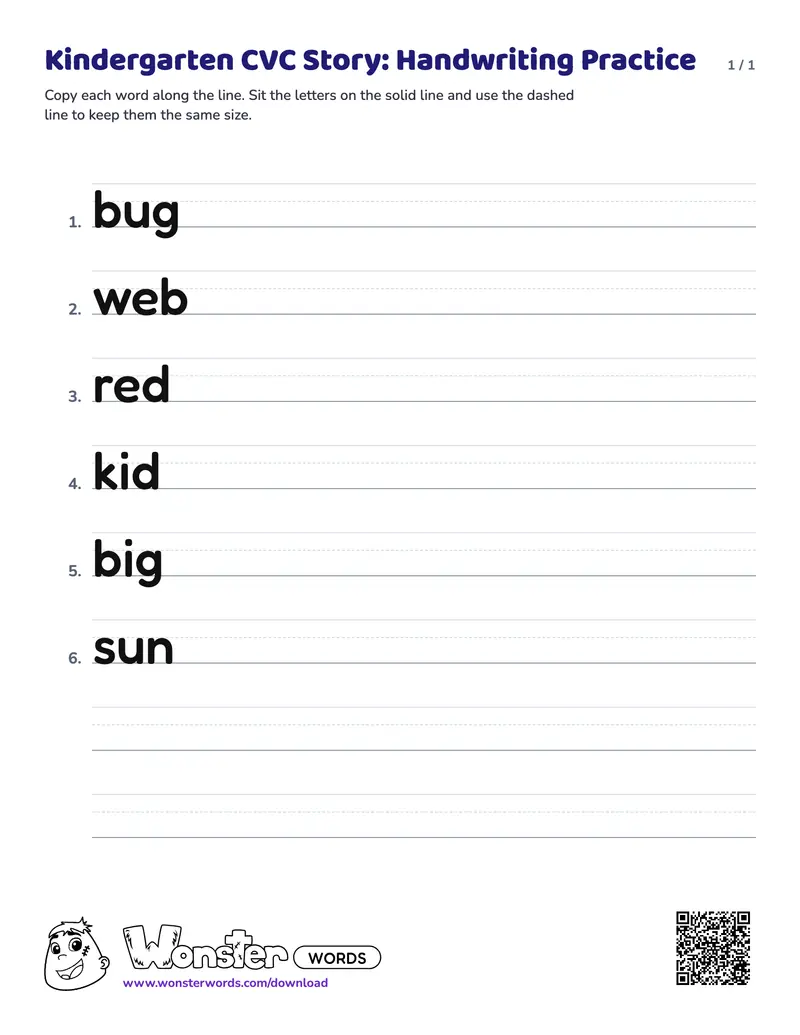
The Bug in the Web mixes three short vowels: short u in bug and sun, short e in web and red, and short i in kid and big. Every other word is a short vowel word or one of the sight words a, the, is, and and. Read the six words below with your child before the story. A child who reads this one has the short vowels in hand and is ready for the reading passages on our 1st grade reading worksheets page.
- bug
- web
- red
- kid
- big
- sun
Free PDF · no sign-up
Feedback?Printables for Kindergarten CVC Story
- Kindergarten CVC Story: Handwriting Practice (PDF)6 words · 1 page
Preview page 1Preview
Four more kindergarten passages: short a, i, e, and o with u
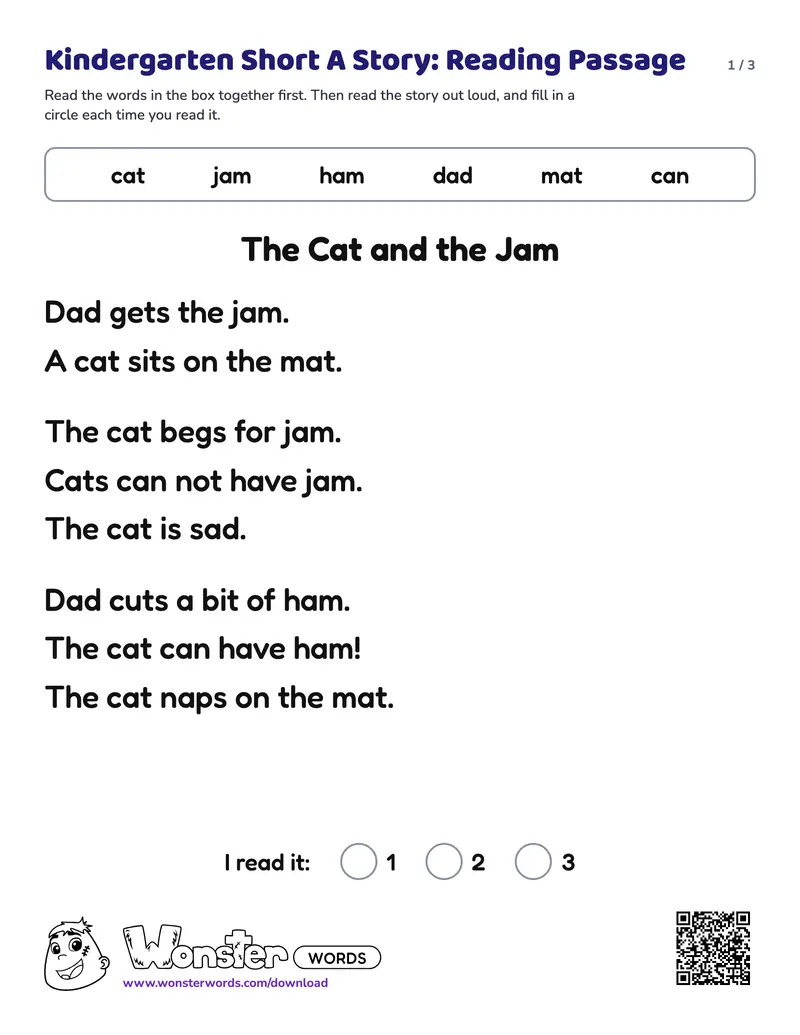
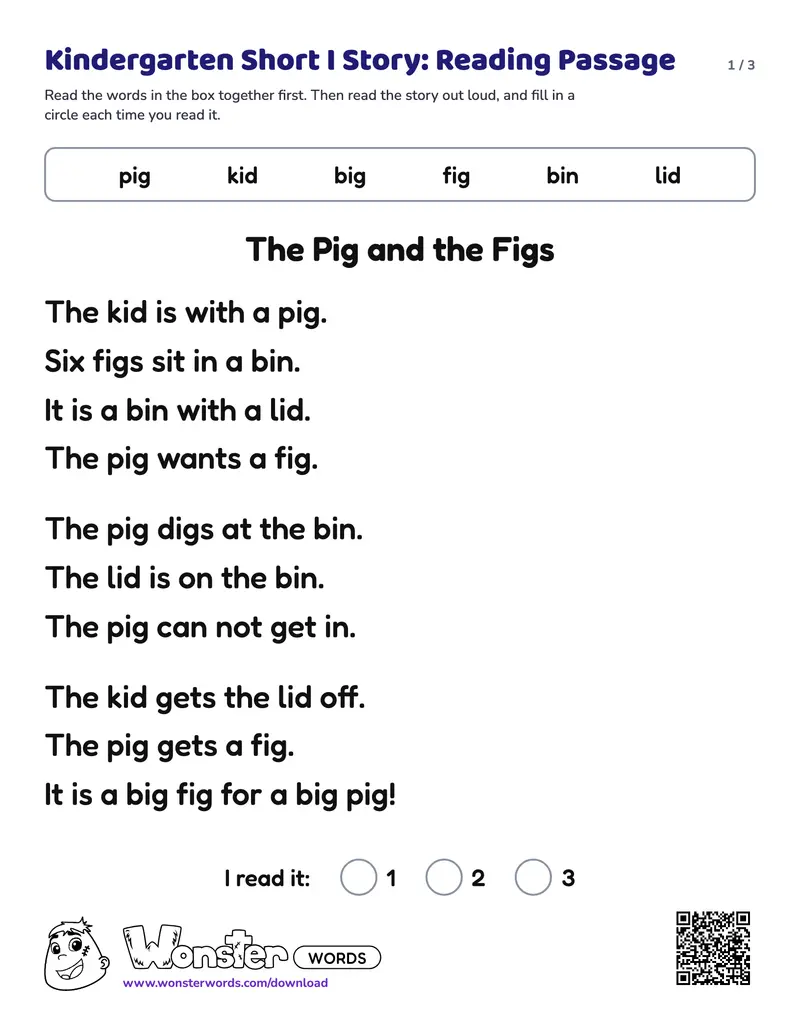
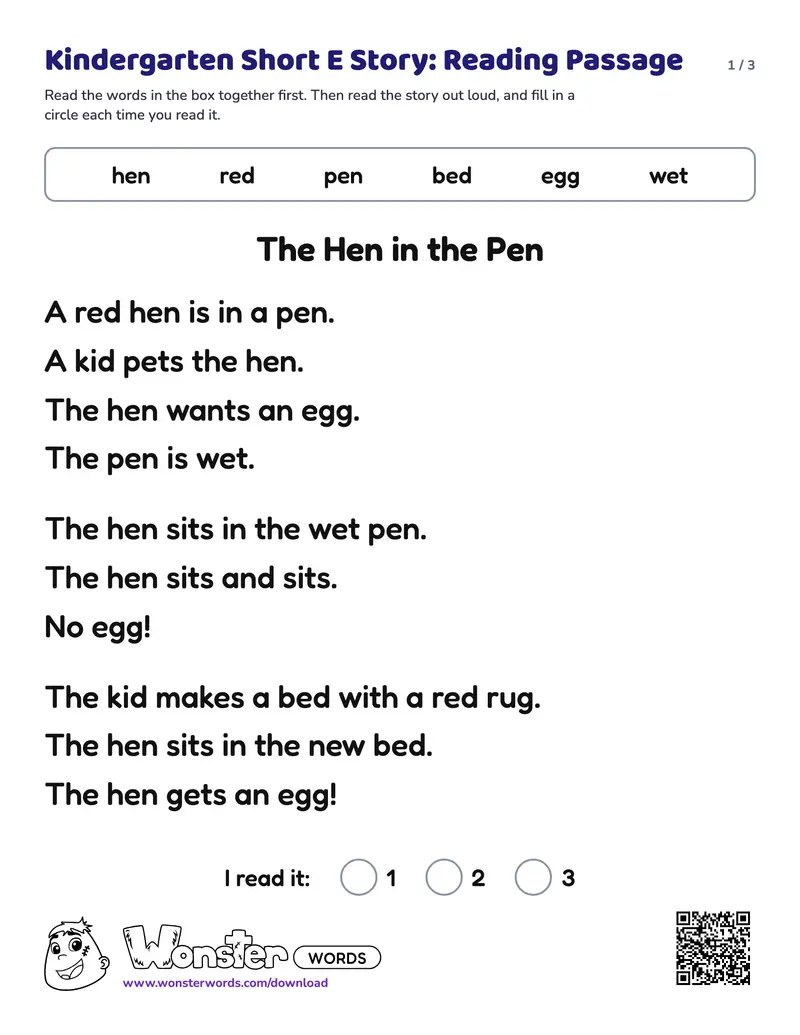
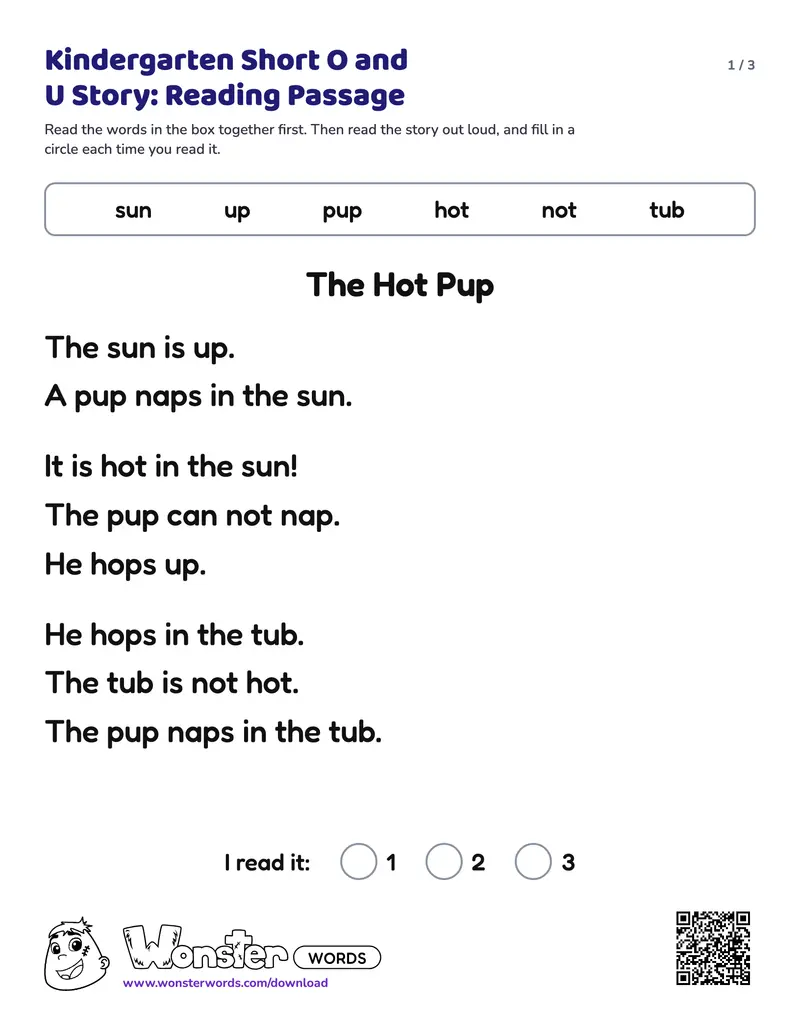
Four more stories at the same level come from our kindergarten worksheets page: The Cat and the Jam (short a), The Pig and the Figs (short i), The Hen in the Pen (short e), and The Hot Pup (short o and u). Each one works the same way: read the six words first, read the story once a day, then answer the three questions.
Free PDF · no sign-up
Feedback?Printables for More Kindergarten Reading Passages
From the Kindergarten Worksheets, Kindergarten Worksheets, Kindergarten Worksheets and Kindergarten Worksheets pages.
Free printable sentence worksheets, and what comes next
Every sheet on this page is free to print. The CVC sentence worksheet and its tracing sheet, and the two new reading passages, are hosted here. The 1st and 2nd grade sight word sentence sheets and four of the passages come from the pages linked beside them, so each one prints the same file wherever you find it.
For more sentences on one word family at a time, each family on our CVC words page has a sentence sheet of its own. For the week’s school word list, type it into our spelling worksheet generator and print sheets on exactly those words. When the short vowel stories are easy, the 1st grade reading worksheets have six longer passages, one for each first grade spelling pattern.
Frequently asked questions
What are examples of decodable sentences for early readers?
For a kindergartner who knows the short vowels: The cat naps. A dog digs. The cat is on the bed. I have a red cap. Every word is either a CVC word your child can sound out, like cat and bed, or a sight word they have learned, like the and is. A sentence is decodable for your child when every word in it is one of those two kinds.
Decodable sentences vs. sight words: which is better for beginners?
It is not a choice between the two. A decodable sentence is made of both: words your child can sound out, held together by a few sight words such as the, a, and is. Teach the sight words a few at a time, and read them in decodable sentences, so your child practices both at once.
Why are pictures important in CVC sentence worksheets?
A picture helps most after the sentence is read, not before. If a picture shows the answer, a beginning reader can guess the word from it without sounding it out, and that habit stops working in harder books. Let your child read the sentence first, then draw it: the drawing shows whether they understood it.
How many sight words should kindergarteners learn?
Common Core names examples rather than a number: the, of, to, you, she, my, is, are, do, and does. Our kindergarten list has 25. A few at a time is enough, as long as each one is then read in sentences, not only on a card.
How do I assess a child's understanding of CVC sentences?
Ask one question after each sentence, such as Where is the cat? If your child can answer from the sentence, they understood it, not just read it. On the reading passages below, the three questions do the same job, and how smoothly your child reads by the third read shows the fluency.
Looking for something else?
Looking for something else?