
Math
Free Printable Place Value Chart (Ones to Thousands)
Tens and ones, hundreds, and thousands charts, filled and blank, place value worksheets for first and second grade with answer keys, and how to use a chart with your child.
Grades: grade 1 to grade 3 · Common Core: 1.NBT.B.2, 2.NBT.A.1, 2.NBT.A.3 · Texas: 1.2(B), 2.2(A) · Related: Common Core K.NBT.A.1, 2.NBT.A.4, 3.NBT.A.2; Texas 1.2(C), 2.2(B), 3.2(A)
Free printable place value charts are on this page, filled and blank in three ranges (tens and ones, hundreds, and thousands), with place value worksheets for first and second grade that have answer keys. Every sheet is designed to print in black and white, with no sign-up. A chart from ones to thousands to read on screen is below the downloads.
A place value chart is a row of labeled columns (Thousands, Hundreds, Tens, Ones) with one digit in each, so a child can see what each digit in a number is worth. In 347, the 4 sits under Tens, so it is worth 40. Each column is worth ten of the column to its right: ten ones make a ten, and ten tens make a hundred.
The most useful move at home is to have your child say the number in its columns (“3 hundreds, 4 tens, 7 ones”) before saying it the usual way. Print the tens and ones chart for first grade and the hundreds chart for second grade. The thousands chart is for 1,000 and, in Texas, for second-grade numbers up to 1,200.
Free printable place value charts and worksheets
The place value charts and worksheets are four PDFs, one for each job: reading a number in its columns, building one, and practicing at two grade levels.
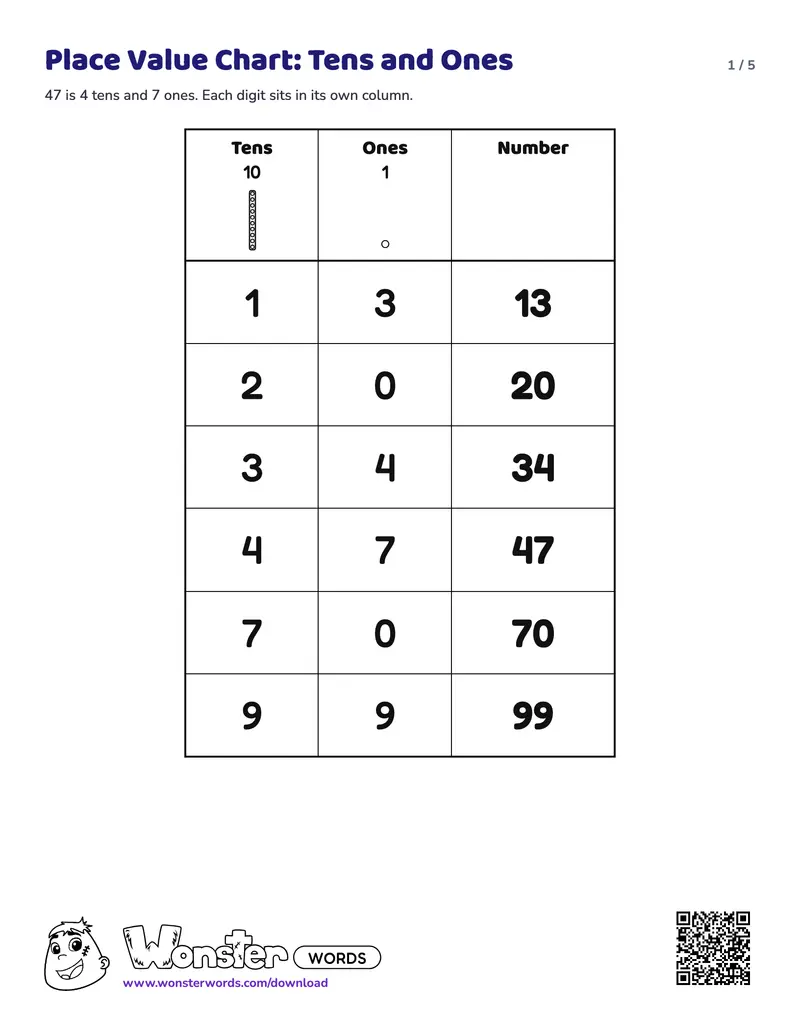
- Place Value Chart, 5 pages. Page 1 is tens and ones, the two-column chart for first grade. Page 2 is hundreds, tens, and ones. Page 3 is thousands, hundreds, tens, and ones, with a bold line between Thousands and Hundreds where the comma goes in 1,045. Each header carries the column’s name, its value, and a quick drawing (a dot for a one, a stick for a ten, a square for a hundred, a cube for a thousand), and example numbers are filled in below. Page 4 shows ten of each place making one of the next. Print this one to read numbers from, or to keep beside homework.
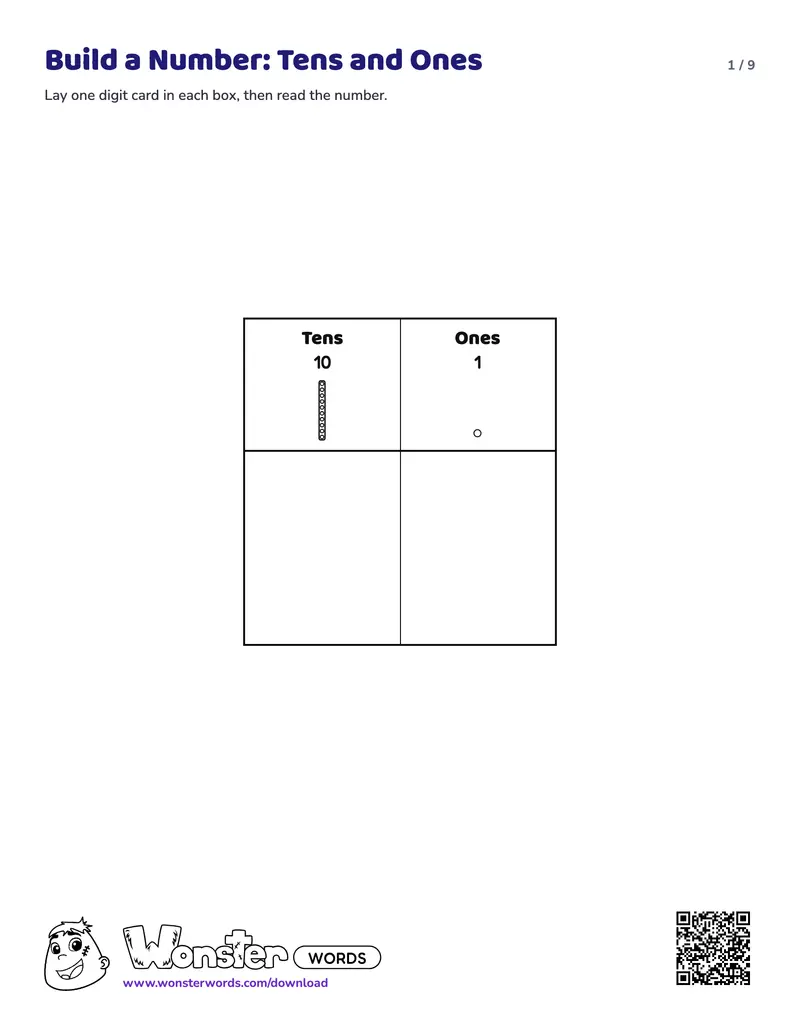
- Blank Place Value Chart, 9 pages. One large chart for each range, with cells sized for the digit cards that come with it: four sets of 0–9 to cut out, enough to build 1,111. Then rowed blank charts in each range, with a line beside each row to write the number. Print this one to build numbers with your child, or when homework says “use your place value chart”.
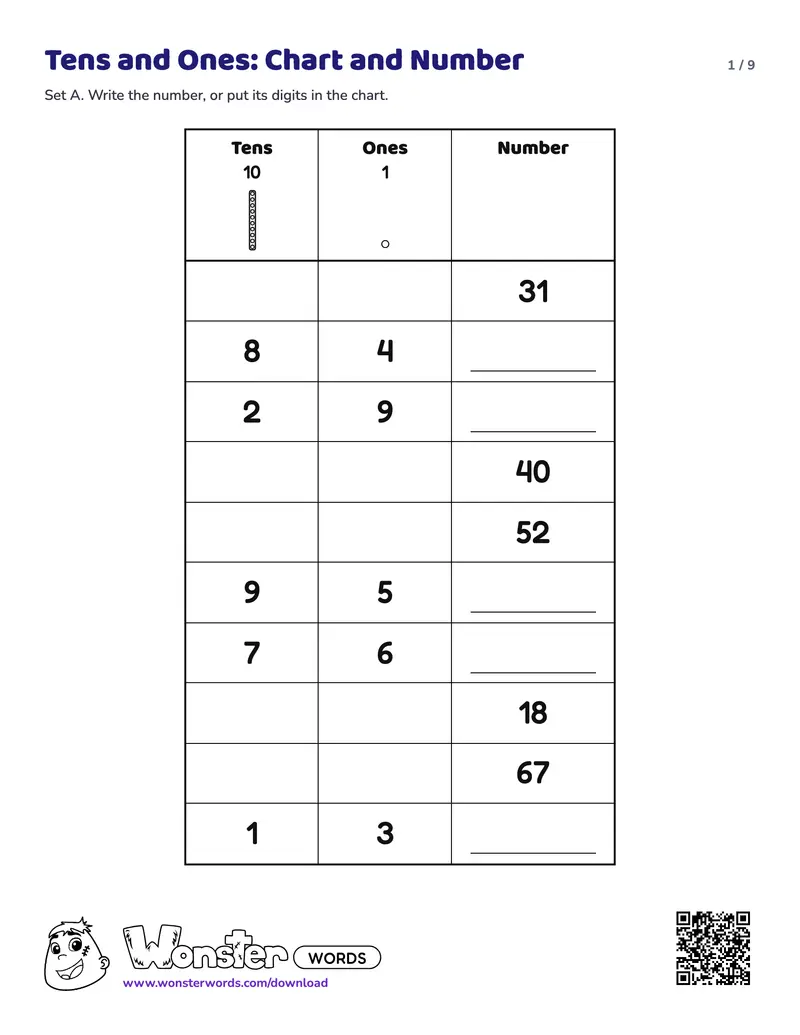
- Tens and Ones Place Value Practice, 9 pages. Numbers from 10 to 99, teens included, with answer keys. Print this one for first grade, or for a second grader still unsure of tens.
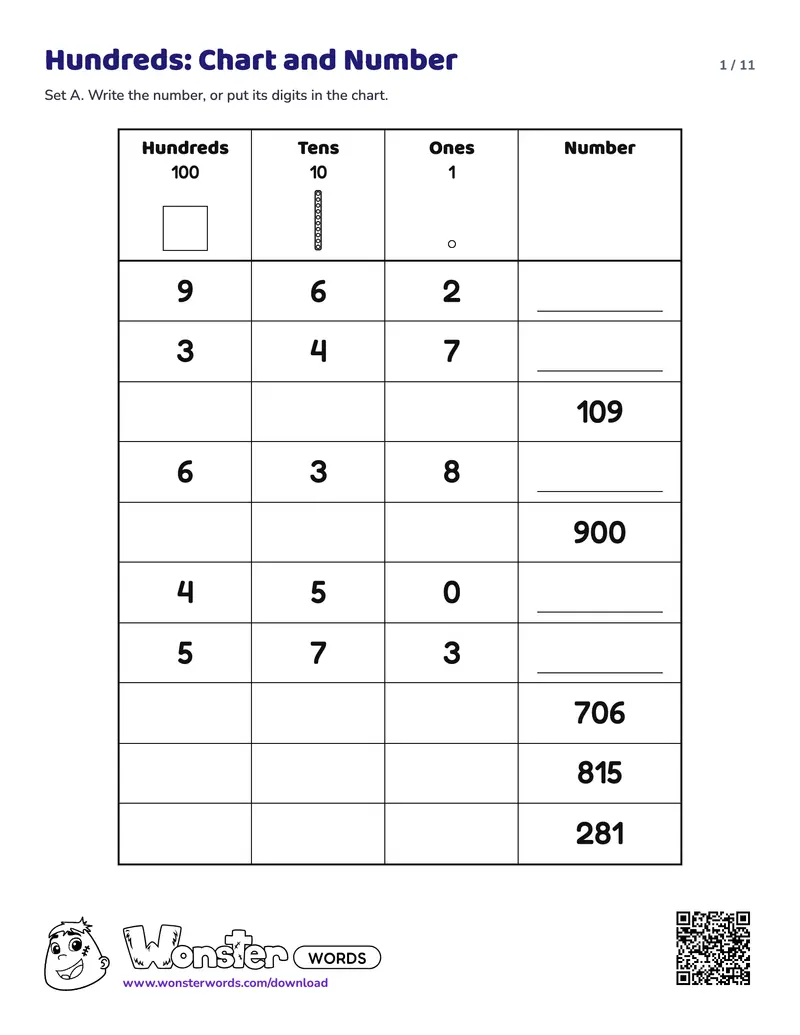
- Hundreds, Tens and Ones Place Value Practice, 11 pages. Numbers from 100 to 999, then the four-column chart from 1,000 to 1,200, with answer keys. Print this one for second grade, or for a third grader reviewing.
Every sheet is black and white by design. The columns are told apart by their labels, the bold line, and the quick drawings, never by color, so a chart prints on any printer. Each PDF ends with a page for grown-ups on what the sheet practices and how to use it. For a classroom-style wall chart, a copy shop can enlarge page 3 of the chart to poster size. Cut-out blocks and a mat to lay them on are on the base ten blocks page.
Free PDF · no sign-up
Free printable place value charts and worksheets
Four free PDFs in black and white, with no account and no email: the filled chart to read numbers from, the blank chart with digit cards to build them, and two practice PDFs by grade, each with its answer key. Print the filled chart first.
- Place Value Chart (PDF)17 numbers · 5 pages
Preview page 1Preview
- Blank Place Value Chart (PDF)6 charts · 9 pages
Preview page 1Preview
The place value chart, to read on screen:
| Thousands 1,000 | Hundreds 100 | Tens 10 | Ones 1 | The number |
|---|---|---|---|---|
| 1 | 3 | 13 | ||
| 4 | 7 | 47 | ||
| 3 | 4 | 7 | 347 | |
| 7 | 0 | 6 | 706 | |
| 1 | 0 | 4 | 5 | 1,045 |
| 1 | 2 | 0 | 0 | 1,200 |
What is a place value chart?
A place value chart is a row of columns, each headed with a place: Ones on the right, then Tens, Hundreds, and Thousands to the left. Each column holds one digit, from 0 to 9, and each column is worth ten of the column to its right. Ten ones make a ten, ten tens make a hundred, and ten hundreds make a thousand. The Common Core progressions call this “repeated bundling by ten: 10 tens make a unit called a hundred” (p. 2). Written in the chart, 347 is a 3 under Hundreds, a 4 under Tens, and a 7 under Ones, so the 4 is worth 40.
A chart shows what a written number hides. The digits in 347 look alike on paper, and the chart shows that one counts hundreds, one tens, and one ones. That is the second-grade standard in the Common Core, which asks children to “Understand that the three digits of a three-digit number represent amounts of hundreds, tens, and ones; e.g., 706 equals 7 hundreds, 0 tens, and 6 ones” (2.NBT.A.1).
The chart makes the zero visible. In 706, the Tens column holds a 0 because there are no tens, and that 0 keeps the 7 in the Hundreds column. Writing 706 as 700 + 6 is expanded form, the next step after the chart. What place value is, and why children learn it, is the subject of the place value guide.
How to use a place value chart with your child
To use a place value chart at home, start with objects your child can count in tens, then write the digits in the chart and say the number two ways. Ten minutes with a handful of straws and a printed chart is enough for one sitting.
Start with things, not digits
Put 3 bundles of ten straws and 4 loose straws on the table, with a rubber band around each bundle. Have your child count the bundles by tens and the loose straws by ones. The chart comes second, to write down what the straws show.
Put the digits in the columns
Write a digit, or lay a digit card, in each column: 3 under Tens and 4 under Ones. One digit goes in each column, and a column never holds 10.
Say it two ways
Have your child say the number in its columns, "3 tens and 4 ones", and then the usual way, "thirty-four". The column way comes first, because a child can say a number's name before seeing its tens.
Ask what a digit is worth
Point at the 3 and ask how much it is worth. It is worth 30, because it is in the Tens column. Then point at the 4, which is worth 4.
Change one digit
Swap the 3 for a 4 and ask what changed. The number is now 44, ten more than before, and only the Tens column moved.
Add a column when the grade does
Add the Hundreds column in second grade, and the Thousands column for 1,000. Ten hundreds trade for one thousand, the same trade as ten ones for one ten.
The objects come first because a number’s name can arrive before its meaning. The Common Core progressions note that saying “five hundred” “doesn’t mean that students automatically understand 500 as 5 hundreds” (p. 8). On the same page, they name what helps: “manipulative materials, math drawings and layered three-digit place value cards afford connections between written three-digit numbers and hundreds, tens, and ones”. The digit cards in the blank chart are those place value cards in their simplest form.
Changing one digit at a time is the quickest way to show ten more and ten less: one column changes, and the others stay put.
Use the numbers already in the house. A house number, a price tag, or a page number read in columns (“4 hundreds, 1 ten, 5 ones”) is the same routine without the chart.
For a game, each player rolls a die three times and writes each roll in a column of their chart, choosing Hundreds, Tens, or Ones as the rolls come. The bigger number wins, which is comparing numbers by their columns. More place value games for home need no chart at all.
What grade uses a place value chart, and when do the thousands come in?
A place value chart starts in first grade with two columns, gains the Hundreds column in second grade, and adds the Thousands column for 1,000. Kindergarten comes before the chart: the Common Core asks them to see the numbers from 11 to 19 as “ten ones and some further ones”, using objects or drawings (K.NBT.A.1).
| Grade | Columns on the chart | Common Core | Texas |
|---|---|---|---|
| 1st grade, about ages 6–7 | Tens and ones | Two-digit numbers as tens and ones (1.NBT.B.2) | Up to 120 as hundreds, tens, and ones (1.2(B)), so the Hundreds column appears for 100–120 |
| 2nd grade | Hundreds, tens, and ones, plus thousands for 1,000 | Hundreds, tens, and ones, to 1,000 (2.NBT.A.1, 2.NBT.A.3) | Up to 1,200 with the thousands (2.2(A)) |
| 3rd grade | Hundreds, tens, and ones, for adding and subtracting | Within 1,000 (3.NBT.A.2) | Up to 100,000 (3.2(A)) |
A place value chart for second grade needs the thousands column, for two reasons. The Common Core’s top number for the year, 1,000, has four digits: its standard reads “Read and write numbers to 1000” (2.NBT.A.3). Texas asks second graders to build numbers “up to 1,200 in more than one way as a sum of so many thousands, hundreds, tens, and ones” (TEKS 2.2(A)). Hundreds are still the year’s work, so most practice stays in three columns, and the Thousands column is there for the edge of the year. The rest of second-grade place value goes beyond the chart.
Charts past the thousands are for fourth grade and up. Ten thousands and hundred thousands come in fourth grade, when the Common Core asks children to “Read and write multi-digit whole numbers” up to 1,000,000 (4.NBT.A.2). Places after the decimal point follow in fourth and fifth grade. Texas starts sooner, with numbers up to 100,000 in third grade (TEKS 3.2(A)).
Place value worksheets by grade: tens and ones, then hundreds, tens and ones
Print the tens and ones worksheets for first grade, and the hundreds, tens and ones worksheets for second grade. The tens and ones sheets also suit a second grader still unsure of tens, and the hundreds sheets a third grader reviewing. The hundreds PDF ends its practice with the four-column chart from 1,000 to 1,200, for Texas second graders and for the number 1,000.
Both PDFs hold the same three activities, on two-digit and on three-digit numbers:
- Chart to number and number to chart. Half the rows give digits in a chart to write as a number, and half give a number to write in the chart.
- What is the underlined digit worth? The 4 in 347 is worth 40.
- Build the number from its parts, given out of order: “6 ones, 3 hundreds, 0 tens is ___” (306).
Each activity prints twice, as set A and set B, with the same numbers in a new mixed order. Do set A, check it with the key, and do set B a few days later. A page at a time, for a few minutes, is enough.
The numbers are chosen to catch the mistakes a chart shows best. Zeros are there on purpose (706, 450, 40), turnaround pairs share a page (31 and 13), and the tens and ones sheet includes the teen numbers. No page runs in counting order, so a child cannot fill it in by counting on. One skill a page, numbers out of order, and an answer key are what make a place value worksheet worth printing.
The answer keys are in the same PDF, after the practice pages. A child who gets the underlined-digit page right with zeros in it knows the columns. A child who writes 76 for 706 is skipping the zero, and saying “7 hundreds, 0 tens, 6 ones” before writing it fixes the slip. A child who wants color can color the columns in.
Worksheets with pictures of blocks to read and draw are on the base ten blocks page. Writing 347 as 300 + 40 + 7, and in words, is on the expanded form worksheets page.
How do you make a place value chart?
To make a place value chart, draw a column for each place on a sheet of paper, label the columns from the right, and make digit cards to go in them. You need paper, a ruler, and a marker, plus three paper cups or envelopes if you want a pocket for each column. Step by step:
- Draw the columns from right to left: Ones, Tens, and Hundreds, then Thousands if your child needs it, with a bolder line between Hundreds and Thousands, where the comma goes.
- Label each column with its name and its value (1, 10, 100, 1,000), and give the first three a quick drawing: a dot, a stick, and a square.
- Make digit cards, 0–9 on small squares of paper, two sets, so a number such as 44 can be built.
- Check it against a printed chart: Ones on the right, and each column worth ten of the one beside it.
Drawing the chart is a first lesson in which way the columns grow: to the left, ten times bigger each step. The blank chart PDF saves the ruler work.
Place value chart or place value mat, blocks or a number line: which helps when?
A place value chart and a place value mat have the same columns and hold different things. A mat holds blocks, rods, units, and flats, each laid in its own column, so a child can see the amounts and trade ten for one. A chart holds digits, one in each column, so the child writes down what the blocks showed. They work best together: build 347 on the mat with 3 flats, 4 rods, and 7 units, then write 3, 4, and 7 in the chart. A free base ten mat prints with the cut-out blocks.
Blocks, the chart, a number line, and an abacus do different jobs, and they come in an order.
| Tool | What it shows | Use it when |
|---|---|---|
| Base ten blocks or bundles of straws | How much a number is, in pieces that trade ten for one | A number is new, or a trade is |
| Place value chart | Where each digit goes and what it is worth | Your child can build the number and needs to write it |
| Number line | Where a number sits and how far apart two numbers are | Comparing, counting on, or adding a jump at a time |
| Abacus | Rods that work like columns, with beads for digits | Your child likes to slide and count |
Start with blocks, then put the chart beside them, then use the chart alone. A number line answers questions a chart cannot, such as how far 47 is from 50. A hundreds chart shows the tens as rows of ten rather than as a column. A worksheet checks what the blocks and the chart taught, and it works best after them, not in place of them.
Common place value chart mistakes, and what to do when it is hard
Three mistakes show up on a place value chart, and each has a one-step fix.
- Skipping the zero. A child writes 706 as 76. Have your child say “7 hundreds, 0 tens, 6 ones” and write a digit in every column, 0 included.
- Two digits in one column. A child writes 14 tens as 14 under Tens. Trade ten of the tens for one hundred: 14 tens is 1 hundred and 4 tens, or 140. That trade is regrouping, and a column of the chart never holds more than 9.
- Reading the columns the wrong way. Ones are always on the right, so start naming from the right if the order slips.
A child who writes 31 for 13 is following the number’s name, which says “thir” first. Why teen numbers get turned around is in the place value guide on teen numbers.
When the chart is hard, go back to two columns and real objects. A common slip for a grown-up is starting with the digits. Cover the columns not in use with a sheet of paper, and lay the chart beside the mat with blocks in each column. A quick drawing in each header, as on the printed charts, gives your child a picture of each place beside the digit. If place value is still hard after a few weeks of this, ask your child’s teacher what the class is using.
Frequently asked questions
What is the place value chart used for?
A place value chart is used to show what each digit in a number is worth. Each digit goes in its own column, Ones on the right, then Tens, Hundreds, and Thousands, so a child can see that the 4 in 347 is 4 tens, or 40. It is the step between counting objects in tens and ones and writing the number down.
What age should students start learning about place value charts?
Children start using a place value chart in first grade, at about 6 or 7, with a two-column chart of tens and ones. Before that, the Common Core asks kindergartners to see the numbers 11–19 as ten ones and some more ones, using objects or drawings rather than a chart. Second graders add the Hundreds column, and the Thousands column for 1,000.
Can you give examples of place value charts for thousands?
In a thousands chart, 1,045 is a 1 under Thousands, a 0 under Hundreds, a 4 under Tens, and a 5 under Ones. The number 1,200 is 1, 2, 0, and 0. The 0 in 1,045 shows there are no hundreds, and the comma marks where the thousands begin. The thousands page of the printable chart has more, from 1,000 to 1,200.
How often should first graders practice with place value worksheets?
Practice one page at a time, for a few minutes, a few times a week, rather than a whole packet at once. Do set A of an activity, check it with the answer key, and do set B a few days later. The two sets hold the same numbers in a new order, so set B shows what stuck.
Is a printed place value chart better than an online one?
For a child learning place value, a printed chart does things a screen cannot. A child can write on it, move digit cards from column to column, lay it beside real blocks or straws, and keep it on the desk during homework. A blank chart in a plastic sleeve becomes a dry-erase chart to use again and again.
Do the place value charts print in black and white?
Yes, by design. The columns are told apart by their labels, by a bold line between Thousands and Hundreds, and by a quick drawing in each header, never by color. Every chart prints clearly on any printer, even one low on ink. A child who wants color can color the columns in.
Are there answer keys for the place value worksheets?
Yes. Both practice PDFs, Tens and Ones and Hundreds, Tens and Ones, have answer keys in the same file, after the practice pages. The filled place value chart is a reference, and the blank chart is for building numbers, so neither needs a key.
Related guides
Last updated