
Math
What Is Expanded Form?
What expanded form is, how it differs from standard form and word form, what to do with a zero, how to spell the number words, what grade learns it, and how to help at home.
Grades: grade 1 to grade 3 · Common Core: 2.NBT.A.3 · Texas: 1.2(C), 2.2(B) · Related: Common Core K.NBT.A.1, 1.NBT.B.2, 2.NBT.A.1; Texas 2.2(A), 3.2(A)
Expanded form writes a number as the value of each of its digits, added together: 362 is 300 + 60 + 2. Standard form is how a number is written (362), expanded form is what each digit is worth (300 + 60 + 2), and word form is how the number is said (three hundred sixty-two). A 0 is worth nothing, so 405 in expanded form is 400 + 5. Writing 400 + 0 + 5 gives the same value and is not wrong, and the worked example on your child’s sheet shows which way their teacher wants it.
Children learn expanded form in second grade in most states, with numbers up to 1,000, and in first grade in Texas, with numbers up to 120. A free expanded form worksheet with standard, expanded, and word form practice and an answer key is at the end of this guide.
What is expanded form in math?
Expanded form is a number written as the sum of the value of each of its digits. That is close to the wording of Illustrative Mathematics, a published curriculum for schools, which calls it “a sum of the value of each of its digits”. The digit tells how many, and its place tells of what.
| Number | Expanded form | What the digits say |
|---|---|---|
| 47 | 40 + 7 | 4 tens, 7 ones |
| 362 | 300 + 60 + 2 | 3 hundreds, 6 tens, 2 ones |
| 1,045 | 1,000 + 40 + 5 | 1 thousand, 0 hundreds, 4 tens, 5 ones |
The expanded form of 72 is 70 + 2. The expanded form of 40 is just 40, because its other digit is a 0 and there is nothing to add to it. Every expanded form can be checked the same way: add the parts, and the sum is the number you started with.
Expanded form is place value written down. The 6 in 362 is worth 60, and writing 300 + 60 + 2 is how a child shows they know it.
Expanded form vs. standard form: what is the difference?
Standard form, expanded form, and word form are three ways to write the same number. Standard form uses digits, expanded form adds up what each digit is worth, and word form spells out what you say. Some sheets add unit form, as Eureka Math does, and Texas adds expanded notation in third grade.
| Form | 405 | 362 | What it shows |
|---|---|---|---|
| Standard form | 405 | 362 | How the number is written, with digits |
| Expanded form | 400 + 5 | 300 + 60 + 2 | What each digit is worth |
| Word form | four hundred five | three hundred sixty-two | How the number is said |
| Unit form | 4 hundreds 5 ones | 3 hundreds 6 tens 2 ones | How many of each place |
| Expanded notation | 4 × 100 + 5 × 1 | 3 × 100 + 6 × 10 + 2 × 1 | Each digit times its place |
To go from standard form to expanded form, write the value of each digit.
Unit form names a number by how many of each unit it has: 3 hundreds 6 tens 2 ones. The Eureka Math parent tip sheet for second grade lists it beside the others, saying children will name numbers “in standard, unit, expanded, and word forms”. Unit form is also where the zero is said out loud. The Common Core’s second-grade standard 2.NBT.A.1 gives the example “706 equals 7 hundreds, 0 tens, and 6 ones”. Eureka has children practice the units out of order too, as in “4 tens 3 ones 2 hundreds”, which is still 243.
Expanded notation writes each part of expanded form as a digit times its place value. For 362, expanded form is 300 + 60 + 2 and expanded notation is 3 × 100 + 6 × 10 + 2 × 1. The values are the same, and only the writing differs. Texas names it in third grade, where children break apart numbers up to 100,000 “including expanded notation as appropriate” (3.2(A), TEKS grade 3). A worksheet that shows times signs wants notation, and one that shows only plus signs wants form.
“Standard form” also means something else in algebra, where it is a way of writing an equation, and in British schools, where it is scientific notation. That is why a search for the words can turn up pages that look like a different subject.
How to write a number in expanded form, step by step
To write a number in expanded form, write what each digit is worth and join the values with plus signs. These five steps use 362 and then 405, and they work for any number on a second-grade sheet.
Read the digits from the left
Look at the number one digit at a time, starting on the left. The number 362 has a 3, a 6, and a 2.
Name each digit's place
Say which place each digit is in. In 362, the 3 is in the hundreds place, the 6 is in the tens place, and the 2 is in the ones place.
Write each digit's value
Write what each digit is worth: 3 hundreds is 300, 6 tens is 60, and 2 ones is 2. The value is the digit followed by as many zeros as there are places to its right.
Skip a 0 unless the sheet asks for it
A 0 is worth nothing, so it can be left out. In 405, the tens digit is 0, and the expanded form is 400 + 5. If the worksheet says to include zeros, write 400 + 0 + 5.
Join the values with plus signs and check
Write the values with plus signs between them, biggest place first: 300 + 60 + 2. Then add them back up. If the sum is the number you started with, the expanded form is right.
A place value chart helps with step 2: each digit goes in a column, and the column’s name is its place.
Any order of the parts adds up to the same number, so 2 + 60 + 300 is also 362. Writing the biggest place first is the usual way. Illustrative Mathematics asks for it: “When a number is written in expanded form the values are written in place value order.” Eureka Math does the opposite on purpose, with practice “out of unit order” such as “40 + 3 + 200 = 243”. If your child’s sheet mixes the order, it is practice, not a mistake.
Going the other way, from expanded form to standard form, takes three moves. Add the parts. Write one digit for each place. Put a 0 in any place with no part. The expanded form 500 + 7 has no tens, so it is 507.
Is 400 + 0 + 5 right? Writing expanded form with a zero
Yes: 400 + 0 + 5 and 400 + 5 are both the expanded form of 405, because they have the same value. Expanded form lists what each digit is worth, and a 0 is worth nothing, so the shorter way leaves it out: 405 = 400 + 5, 760 = 700 + 60, and 203 = 200 + 3. That is how our worksheet’s answer key writes them.
Some worksheets ask for every place, often in so many words: “with zeros included”. On those, 405 is 400 + 0 + 5 and 50 is 50 + 0. Neither the Common Core nor the Texas standards rule on the zero, so the worked example at the top of your child’s sheet is the rule for that sheet. If a sheet marks one form wrong and shows no example, a short note to the teacher settles it.
The zero is optional only in expanded form. In standard form the zero must stay, because it holds the tens place: without it, 400 + 5 would be written 45. Why a zero holds a place is on the place value guide.
How to help your child write numbers in word form
Word form is a number written in words, the way it is said, such as four hundred five. The Common Core asks second graders to read and write numbers to 1,000 “using base-ten numerals, number names, and expanded form” (2.NBT.A.3). Texas asks the same of second graders, with numbers up to 1,200, in “standard, word, and expanded forms” (2.2(B), TEKS grade 2).
Number words are written with a hyphen between the tens and the ones, with no “and”, and with no word for a zero. Every number from twenty-one to ninety-nine that is not a round ten takes the hyphen: “sixty-seven” in the Common Core’s progressions document, “five hundred seventy-six” on Eureka’s tip sheet. American school math leaves out the “and”, so 405 is four hundred five, not four hundred and five. The OpenStax Prealgebra textbook puts it plainly: “the word and is not used when naming a whole number.” Many adults say the “and” anyway. John Algeo, in a usage handbook from Cambridge University Press, finds that “the norm is hundred and” in both countries, with American texts more likely to drop it. Every number to 999 is built from a short list: one to nineteen, the tens from twenty to ninety, and hundred.
The number words are words a child reads and spells, and they do not spell their values the way the digits do. “Eleven” and “twelve” do not say ten and one or ten and two. “Thirteen” to “nineteen” say the ones before the ten, a point the progressions document makes on page 6. “One”, “two”, and “eight” do not sound out. “Forty” drops the “u” of “four”, while “ninety” keeps the “e” of “nine”. Writing them is spelling practice as much as math.
Four ways to practice:
- Say it, then write it. Your child says the number aloud and writes what they said, one chunk at a time: “four hundred”, then “five”.
- Keep the words in sight. A list of the number words beside the sheet turns a spelling problem back into a math one. Our worksheet prints one.
- Read before writing. Match word cards to numeral cards before asking for any writing.
- Write numbers for real. An age on a birthday card, a price on a play shop’s tag, or the amount line of a check are all word form.
Two games: number word memory, with numeral cards and word cards face down, where a turned-up pair that matches is kept; and word form bingo, where you call a numeral and your child covers its words.
These are the misspellings you will see, and each has a quick fix. For “fourty”, show that forty has no “u”. For “ninty”, show that ninety keeps the “e” of nine. For a missing hyphen, join the tens and the ones, as in sixty-seven. For an extra “and”, cross it out. Writing what was heard, such as 4005 for four hundred five, is a place value slip, and the mistakes section has its fix.
Why does my child mix up fourteen and forty?
Fourteen and forty sound alike, so a child can hear one and write the other. The writers of the Common Core’s progressions document say so directly: “‘fourteen’ and ‘forty’ sound very similar, as do ‘fifteen’ and ‘fifty,’ and so on to ‘nineteen’ and ‘ninety.’” The two words differ mostly in their endings and in which part is stressed: four-TEEN and FOR-ty. The teen words also say the ones before the ten, the opposite of the digits. The two pairs to listen for are fourteen and forty, and fifteen and fifty.
Three ways to help:
- Say both, with the stress and the meaning. “FourTEEN is ten and four. FORty is four tens.”
- Build both. Put 1 ten and 4 ones beside 4 tens, with base ten blocks or bundles of 10 straws. The difference is easy to see even when it is hard to hear.
- Play a listening game. Put a 14 card and a 40 card on the table. You say one number and your child points to it. Then swap roles, so your child practices saying them clearly too.
Writing 41 for fourteen is a different mix-up, the digits in the order they are said, and why kids write 31 for 13 covers it. If the mix-ups go well beyond the number words, or your child often seems not to hear the difference between words, mention it to their teacher. Questions about hearing go to your pediatrician.
What grade do kids learn expanded form?
Children learn expanded form in second grade under the Common Core, with numbers up to 1,000, and in first grade in Texas, with numbers up to 120.
| Grade | What children do | Common Core | Texas (TEKS) |
|---|---|---|---|
| Kindergarten | Record a teen number as ten and some ones, such as 18 = 10 + 8 | K.NBT.A.1 (related) | None; composing stops at 10, K.2(I) |
| 1st grade | Tens and ones; Texas writes expanded and standard form to 120 | 1.NBT.B.2 (related) | 1.2(B), 1.2(C) |
| 2nd grade | Standard, expanded, and word form to 1,000 (Texas 1,200), with hundreds, tens, and ones | 2.NBT.A.3, 2.NBT.A.1 | 2.2(A), 2.2(B) |
| 3rd grade | Texas: numbers to 100,000, with expanded notation | No new standard until 4.NBT.A.2 | 3.2(A) |
In Texas, children write numbers in expanded and standard form in first grade, to 120, a year before most other states, and add word form in second grade. The first grade standard reads “use objects, pictures, and expanded and standard forms to represent numbers up to 120” (1.2(C), TEKS grade 1). A Texas first grader with an expanded form sheet is right on schedule.
A kindergartner who writes 18 = 10 + 8 is already doing the first step: the Common Core’s kindergarten standard K.NBT.A.1 uses that exact equation. A preschooler needs counting, not expanded form. In fourth grade, 4.NBT.A.2 takes the same three forms to “multi-digit whole numbers”, past what this guide covers.
Why do schools teach expanded form?
Schools teach expanded form because it makes place value visible on paper. A child who writes 300 + 60 + 2 for 362 shows that the 6 means 60, not 6. The progressions document asks teachers to connect the written number, the words, and the units, as in “456 is ‘Four hundred fifty six’ and ‘four hundreds five tens six ones.’” It also warns that knowing the words does not mean children “automatically understand 500 as 5 hundreds” (page 8). Expanded form is how a teacher sees whether they do.
Expanded form is also how children add bigger numbers, tens with tens and ones with ones: 34 + 25 is 30 + 20 and 4 + 5, which makes 50 and 9, or 59. The same idea runs through money, where three dollars and twenty-five cents is 3 dollars, 2 dimes, and 5 pennies. The homework is checking that your child knows what each digit is worth. It does not ask anyone to unlearn the way they add.
How to help with expanded form homework
The most useful thing to do is read the teacher’s worked example before your child starts. It settles the two questions the forms leave open, whether to write the zero and which order to use. Then:
- Say it in place value. Read 362 as “3 hundreds, 6 tens, 2 ones” as well as “three hundred sixty-two”. The progressions document says that saying 67 as “6 tens, 7 ones” as well as “sixty-seven” helps children see the tens and ones.
- Build it, then write it. Make the number with base ten blocks or bundled straws, which Eureka’s tip sheet suggests, and write one part for each kind of bundle.
- Use place value cards. Write 300, 60, and 2 on strips of paper of three widths, the 300 longest. Stack them, lined up on the right, to show 362, then pull them apart to see 300 + 60 + 2. The progressions document describes these “layered” cards, and how “unlayering” them “reveals the expanded form of the number.”
- Add back to check. Every expanded form adds up to its number, so your child can check their own work.
Eureka’s second-grade module also uses number bonds for the same thing, with 362 as the whole and 300, 60, and 2 as the parts. If your child is stuck, go back to blocks or cards and to two-digit numbers, such as 47 = 40 + 7, before returning to three digits.
Expanded form games and activities
Each of these four expanded form games needs only paper, cards, or dice, and each ends with your child adding the parts back up to check.
- Place value card flip. Use the cards from the homework section. Stack them to make a number, read it aloud, then pull them apart and read the expanded form.
- Roll and build. Roll three dice and arrange the digits to make the biggest number you can. Rolling 2, 5, and 3 makes 532, which your child writes as 532, 500 + 30 + 2, and five hundred thirty-two. Then make the smallest, 235. Comparing the two is greater than and less than practice.
- Say it three ways. You say a number, and your child writes it in standard, expanded, and word form.
- Zero hunt. Write 405, 450, and 504 on cards. Your child writes each one in expanded form (400 + 5, 400 + 50, and 500 + 4) and says why the three are different.
Place value games with cards and dice work for tens and ones too.
Common expanded form mistakes
Five expanded form mistakes show up on homework sheets, and each one has a fix you can make at the table.
- Writing the digits, not their values. Your child writes 362 as 3 + 6 + 2. Point to the 3 and ask, “3 what?” Three hundreds is 300.
- Writing what was heard. Your child writes “four hundred five” as 4005, or 300 + 6 as 3006. A three-digit number has three places, one digit in each: count the places before writing.
- Dropping the zero in standard form. Your child writes 400 + 5 as 45. The zero holds the tens place, as the zero section explains. A ”+ 0” in expanded form is not a mistake.
- Reading the parts in the order they appear. Illustrative Mathematics opens a second-grade lesson by asking whether 407 = 70 + 400 is true. It is not: 70 + 400 is 470. Putting the biggest place first, then reading, catches it.
- Number words. Misspellings such as “fourty” are in the word form section, and writing 40 for fourteen is in the fourteen and forty section.
If your child still writes 3 + 6 + 2 for 362 after weeks of practice, talk to their teacher.
Free expanded form worksheets
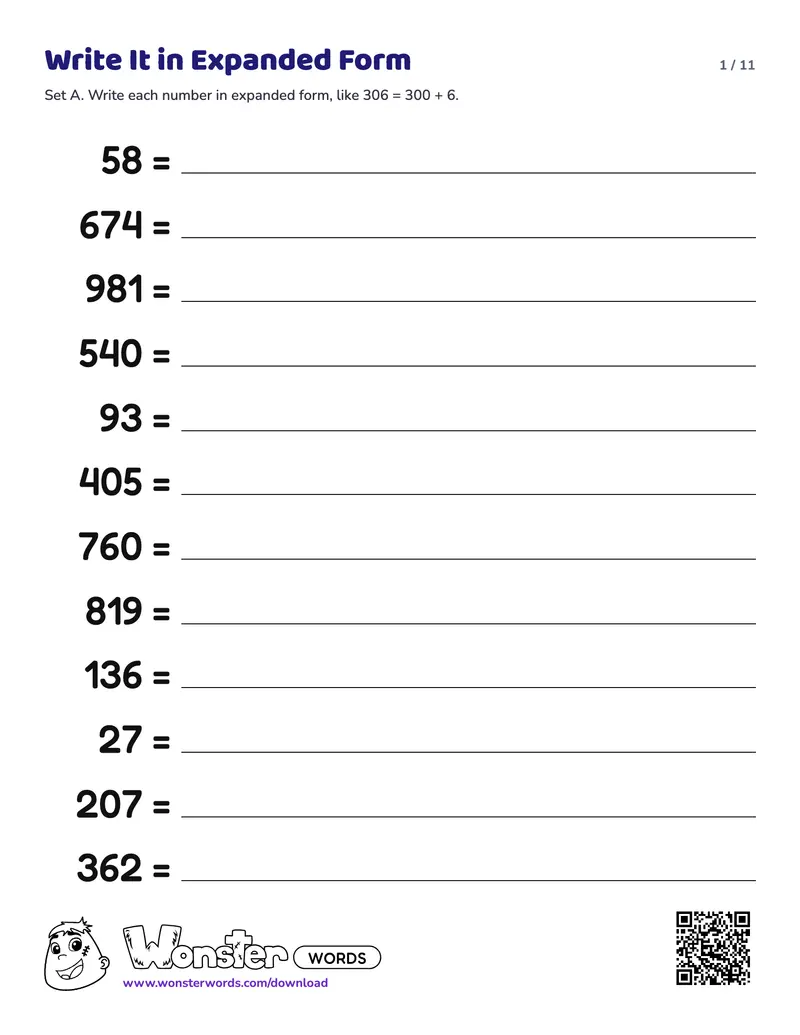
Our free expanded form worksheet is one PDF of 11 pages, for second grade and for late first grade in Texas. It has four activities, and each prints twice, with the same numbers in a new order:
- Write it in expanded form, 12 two-digit and three-digit numbers, four of them with a zero, such as 405 and 760.
- Write the number, 12 expanded forms to turn back into standard form, some with a place missing, such as 300 + 6, and some with the parts out of order.
- Find the missing part, such as 547 = 500 + ☐ + 7.
- Word form, numbers in words to write as numerals and numerals to write in words, with a printed list of the number words. Fourteen and forty appear on the same page. This activity suits second and third grade.
Two answer key pages follow. The key writes 405 as 400 + 5, and the page for grown-ups at the end says that 400 + 0 + 5 has the same value. Every page prints in black and white, with no account and no email.
Free PDF · no sign-up
Free expanded form worksheets
One free PDF in black and white, with no account and no email: four activities on standard, expanded, and word form, each printed twice, with an answer key and a page for grown-ups.
- Expanded Form Worksheets (PDF)96 numbers · answer key included · 11 pages
Preview page 1Preview
Frequently asked questions
What is expanded form in math for kids?
Expanded form is a way of writing a number to show what each of its digits is worth. The number 362 has a 3 in the hundreds place, a 6 in the tens place, and a 2 in the ones place, so in expanded form it is 300 + 60 + 2. Adding the parts back up gives the number again.
What is an example of an expanded form?
The expanded form of 47 is 40 + 7, because 47 is 4 tens and 7 ones. The expanded form of 362 is 300 + 60 + 2, and the expanded form of 1,045 is 1,000 + 40 + 5. In each one, the parts add up to the number.
What is 40 in expanded form?
The expanded form of 40 is just 40. Its digits are a 4 in the tens place, worth 40, and a 0 in the ones place, worth nothing, so there is nothing to add. A worksheet that asks for zeros included wants 40 + 0.
What is the difference between expanded form and word form?
Expanded form shows a number as the value of each digit, added together, such as 400 + 5 for 405. Word form writes the number the way it is said, in words, such as four hundred five. Second graders learn both, along with standard form, the number written with digits.
How do expanded form and expanded notation differ?
They show the same values written two ways. Expanded form adds the values, as in 300 + 60 + 2. Expanded notation writes each value as a digit times its place, as in 3 × 100 + 6 × 10 + 2 × 1. Texas names expanded notation in its third-grade standards. A worksheet with times signs wants notation, and one with only plus signs wants form.
What is unit form in math?
Unit form names a number by how many of each place value unit it has, such as 3 hundreds 6 tens 2 ones for 362. It is the way a number is said when a child counts its blocks or bundles. Unlike word form, unit form says the zero out loud, so 706 is 7 hundreds 0 tens 6 ones.
What grade do kids learn about expanded form?
Most children learn expanded form in second grade, with numbers up to 1,000, under the Common Core. In Texas, children write expanded and standard form in first grade, with numbers up to 120, and add word form in second grade, with numbers up to 1,200. Fourth graders use the same forms for larger numbers.
What age should children start learning to write numbers in word form?
Children usually learn to write numbers in word form in second grade, at about 7 or 8, when both the Common Core and the Texas standards ask for it. Younger children read and say the number words long before they spell them, and that is the right order.
How does expanded form support addition and subtraction?
Expanded form lets a child add or subtract by place value, tens with tens and ones with ones. To add 34 and 25, a child adds 30 + 20 to make 50 and 4 + 5 to make 9, which gives 59. Mental math strategies and the written method for regrouping are both built on this idea.
Related guides
Last updated