
Math
Rounding Numbers for Kids
What rounding is, the rounding rule and what to do with a 5, rounding on a number line, the nearest hundred, the rounding hill, what grade learns it, and how to teach it at home.
Grade 3 · Common Core: 3.NBT.A.1 · Texas: 3.2(C), 3.4(B) · Related: Common Core 3.OA.D.8
Rounding a number means replacing it with the nearest ten or the nearest hundred, a “friendly” number that is easier to work with. Rounded to the nearest ten, 43 is 40, because 43 is closer to 40 than to 50. The rounding rule is the shortcut: look at the digit just to the right of the place you are rounding to. A 0, 1, 2, 3, or 4 rounds down, and a 5, 6, 7, 8, or 9 rounds up, so 47 rounds to 50. A number exactly halfway, such as 45, rounds up to 50, the way children are taught in school.
Children learn to round to the nearest 10 and 100 in third grade, under the Common Core and in Texas. A free rounding chart and rounding worksheets with answer keys, in black and white with no sign-up, are described in this guide.
What is rounding?
Rounding a number means replacing it with a nearby number that is easier to work with: the nearest ten, or the nearest hundred. Rounded to the nearest ten, 43 becomes 40. Rounded to the nearest hundred, 430 becomes 400. A rounded number means “about”: two classes of 21 and 22 children make about 40 children, not exactly 40. Rounding gives an approximation, never the exact answer.
A number rounded to the nearest ten has no ones, so it ends in 0. A number rounded to the nearest hundred has no tens and no ones, so it ends in 00. The Common Core Standards Writing Team puts it the same way in its Progressions: the goal is “the closest number with no ones or no tens and ones”. Its example is 456, which is 460 to the nearest ten and 500 to the nearest hundred.
Rounding is place value work. The third-grade standard reads “Use place value understanding to round whole numbers to the nearest 10 or 100” (3.NBT.A.1). To round 43, a child has to see it as 4 tens and 3 ones, which puts it between 4 tens and 5 tens: 40 and 50. The place value guide covers the tens and ones underneath. Children learn to round so they can estimate, and an estimate such as “about 700” tells a child whether an exact answer is reasonable.
Free rounding worksheets and a rounding chart
The free rounding sheets are three PDFs: a rounding chart to keep, and two sets of worksheets with answer keys.
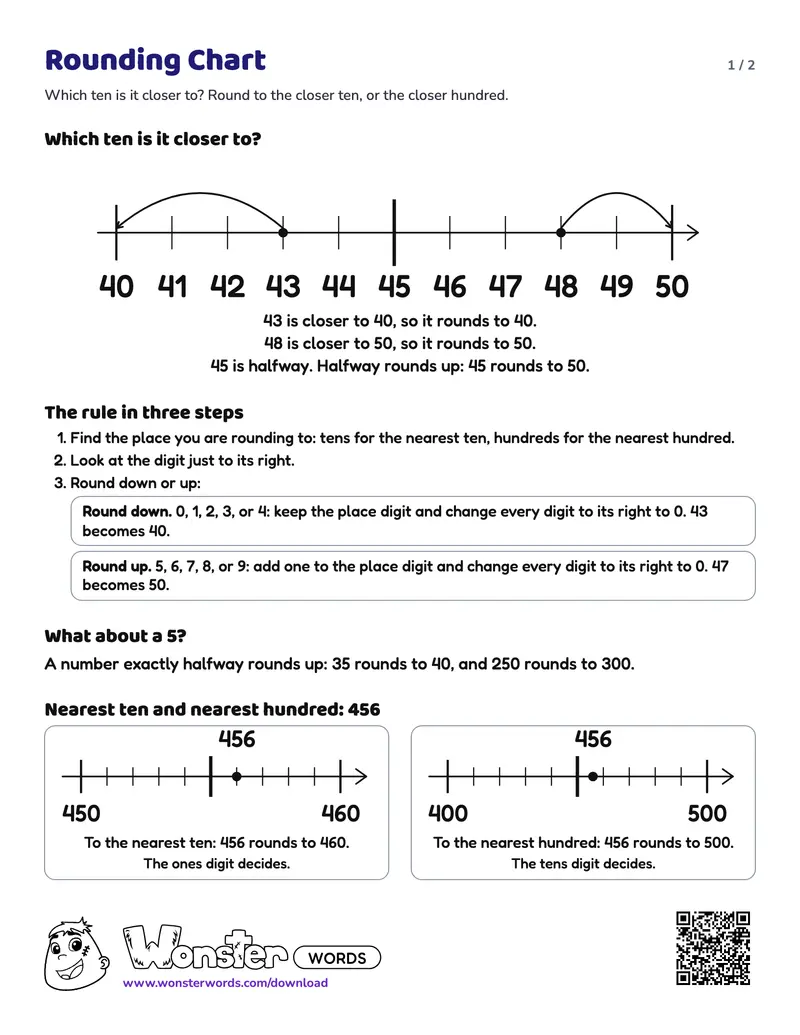
- Rounding Chart, a one-page reference. It shows a 40–50 number line with 43 and 48 marked and the halfway mark drawn heavier, the three-step rule, what to do with a 5, and 456 rounded both ways. It is the home version of the rounding anchor chart a classroom keeps on the wall. Print it for the fridge or the homework folder.
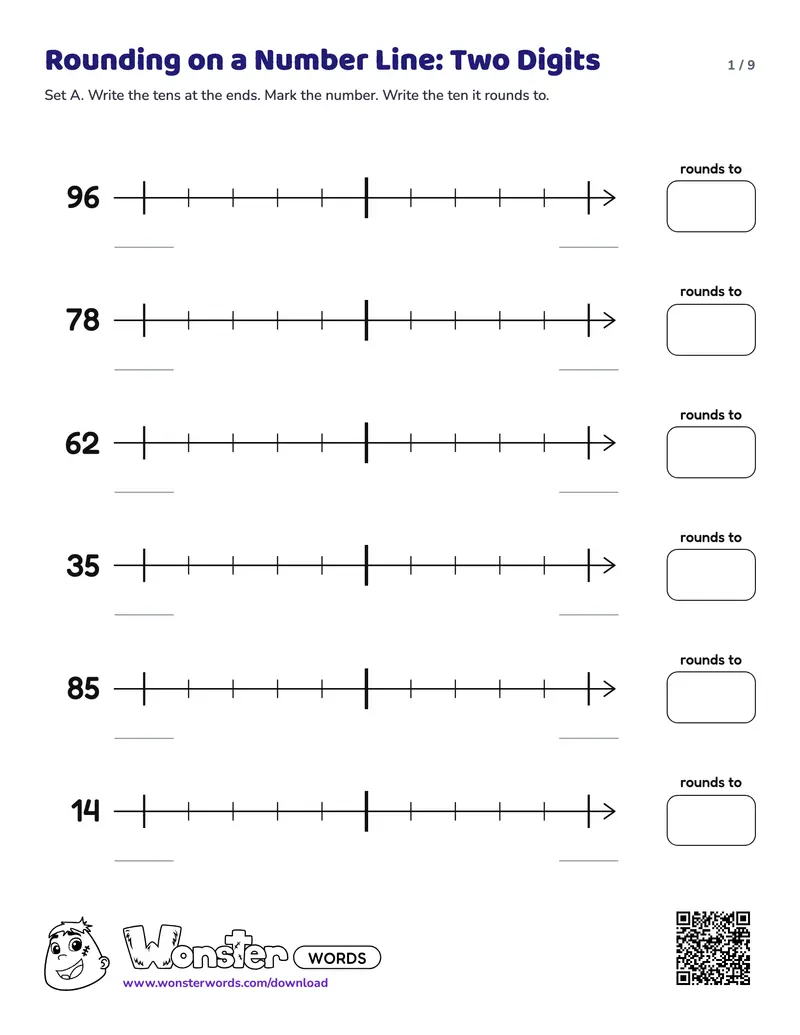
- Rounding on a Number Line, for a child who is learning. Each item is a short line with its ends left blank: your child writes the two tens or hundreds, marks the number, and writes the rounded number. The activities go from two-digit numbers to the nearest ten, to three-digit numbers to the nearest ten, to numbers to the nearest hundred.
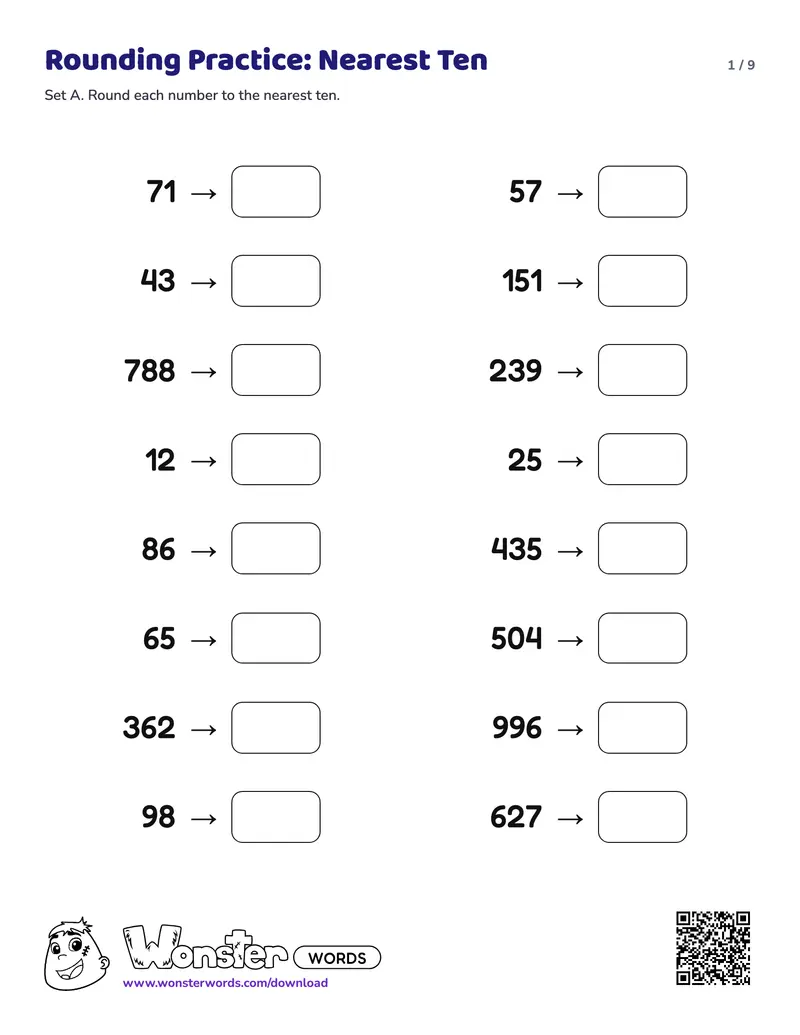
- Rounding Practice, once your child can round without drawing a line. Its three activities round numbers to the nearest ten, to the nearest hundred, and both ways side by side in two columns.
Each practice page prints twice, with the same numbers in a new order, and the numbers never run in sequence. Answer keys follow the practice pages. Every page includes two or three halfway numbers, such as 35 and 250, and the keys round them up, as school does. The page for grown-ups at the end of each PDF says so, and explains why schools teach the number line first. Every page prints in black and white.
Free PDF · no sign-up
Free rounding worksheets and a rounding chart
Three free PDFs in black and white, with no account and no email: the rounding chart to keep first, then the number line worksheets while your child is learning, then the practice worksheets. Each worksheet prints every activity twice, with its answer key and a page for grown-ups at the back.
- Rounding Chart (PDF)9 worked examples · 2 pages
Preview page 1Preview
- Rounding on a Number Line (PDF)36 numbers · answer key included · 9 pages
Preview page 1Preview
- Rounding Practice (PDF)84 numbers · answer key included · 9 pages
Preview page 1Preview
What are the rules for rounding numbers?
To round a number, look at the digit just to the right of the place you are rounding to, and let that one digit decide. The rule takes three steps:
- Find the place you are rounding to: the tens place for the nearest ten, the hundreds place for the nearest hundred.
- Look at the digit just to its right.
- Round down or up. If that digit is 0, 1, 2, 3, or 4, keep the place digit and change every digit to its right to 0: 43 becomes 40. If it is 5, 6, 7, 8, or 9, add one to the place digit and change every digit to its right to 0: 47 becomes 50.
Rounding down keeps the tens digit, and it never lowers it. Rounded down, 43 is 40, not 30. Rounding up raises the tens digit by one, so 47 becomes 50. The word “down” sounds like “one less”, so say “stay at 40” when you round down together.
Rounded to the nearest ten, 7 is 10, not 5. Rounding goes to a ten or a hundred, never to a 5. A one-digit number sits between 0 and 10, so 4 rounds to 0. Children find that odd, but it is right: 4 is closer to 0 than to 10.
A number exactly halfway, such as 35 or 250, rounds up in school: 35 becomes 40, and 250 becomes 300. The number sits exactly between the two tens, so the rule has to pick one, and school rounds up. That is a convention, not a fact about numbers. The writers of the Common Core note in the Progressions that “15 might be rounded to 20 or to 10” and that “the Standards do not specify a method”. A parent tip sheet from Great Minds, the publisher of the Eureka Math curriculum, gives the school answer. It lists the numbers that round to 20 as “15, 16, 17, 18, 19, 20, 21, 22, 23, and 24”, so 15 rounds up. If your child’s homework ever treats a halfway number differently, follow the class.
The rule is a shortcut for “which ten is closer?” A 5, 6, 7, 8, or 9 in the ones place means the number is at or past the halfway mark, the 5, so it rounds to the next ten. On a line from 40 to 50, 47 sits past 45, nearer 50.
What is a rounding hill?
A rounding hill is a picture of the same rule, drawn for one ten. The numbers from 40 to 50 run up one side of a hill and down the other, with 45 at the top. A number from 41 to 44 rolls back down to 40, and a number from 46 to 49 rolls forward to 50. The 45 at the top rolls forward too, which is the halfway number rounding up. A rounding hill is a number line bent into a hill, so it gives the same answers as the rule, and neither is better. To explain it at home, draw the straight line from 40 to 50 and ask which ten the number is closer to. ArtsNOW, an arts education nonprofit, publishes a third-grade module built on the same slope, “Rounding Roller Coasters”. In it, children “label the roller coaster like a number line” and watch a marble roll forward “rounded up” or backwards “rounded down”. If your child learned a rhyme such as “five or more, let it soar; four or less, let it rest”, it is a memory aid for the same rule.
How do you round to the nearest ten on a number line?
To round to the nearest ten on a number line, find the two tens the number sits between, mark the halfway number, and see which ten the number is closer to. For 43:
- Find the two tens. The number 43 has 4 tens, so the ten below is 40 and the ten above is 50.
- Draw a short line with 40 at one end and 50 at the other.
- Mark the halfway number, 45, in the middle.
- Put 43 on the line. It falls between 40 and 45.
- Pick the closer ten. The number 43 is closer to 40, so it rounds to 40.
The halfway mark at 45 splits the line in two. A number on the 40 side of it rounds to 40, and a number on the 50 side rounds to 50.
The same line answers the harder cases. On it, 48 sits past 45, so it rounds to 50, and 45 sits exactly on the halfway mark, where school rounds up to 50. A number near the top of a hundred crosses into it: 96 sits between 90 and 100, past 95, so it rounds to 100.
A number line works because it shows distance, so “closer” is something a child can see and check with a finger. The number line guide explains how the line itself works. Texas names this step in its standards (TEKS 3.2(C)). Its third graders “represent a number on a number line as being between two consecutive multiples of 10; 100; 1,000; or 10,000” in order to round.
Eureka Math draws the line up and down instead. Its third-grade lessons round “using a vertical number line”, in the words of the Eureka tip sheet for parents. With the higher ten at the top, rounding up means moving up the line. The answer is the same either way.
A hundreds chart shows it too. On the chart, 43 sits in the row that runs from 41 to 50, three squares after 40 and seven before 50. The Rounding on a Number Line worksheet gives your child short lines like the one above to fill in.
How do you round to the nearest hundred?
To round to the nearest hundred, find the two hundreds the number sits between, then ask which one is closer. That is the sentence to say aloud. The number 340 sits between 300 and 400, the halfway mark is 350, and 340 is below it, so it rounds to 300. Counting by 100s is how a child finds the two hundreds. In expanded form, 456 is 400 + 50 + 6, which shows the 4 hundreds that put it between 400 and 500.
For the nearest hundred, the tens digit decides, not the ones. In 349, the tens digit is 4, so it rounds down to 300, and the 9 in the ones place does not matter. The number 350 rounds up to 400, and 251 rounds up to 300. A two-digit number rounds to the nearest hundred too, to 100 or to 0.
| Number | Nearest ten | Nearest hundred |
|---|---|---|
| 456 | 460 | 500 |
| 349 | 350 | 300 |
| 251 | 250 | 300 |
| 970 | 970 | 1,000 |
| 72 | 70 | 100 |
| 38 | 40 | 0 |
The 349 row shows the hundreds mistake to watch for. Rounded to the nearest ten, 349 is 350, and rounding that 350 again gives 400, which is wrong. Round once, from the number you started with: 349 is closer to 300.
Third grade stays with two-digit and three-digit numbers. The Progressions say that “rounding three-digit numbers to hundreds and two-digit numbers to tens should be emphasized”. Thousands come in fourth grade, when children round “multi-digit whole numbers to any place” (4.NBT.A.3), and fifth graders round decimals (5.NBT.A.4).
What grade do kids learn rounding?
Children learn to round in third grade, under both the Common Core and the Texas standards. No second-grade standard in either framework names rounding.
| Grade | What children do | Common Core | Texas (TEKS) |
|---|---|---|---|
| 1st and 2nd | Place value to 120 and then 1,000, and numbers on a line: the ground rounding stands on. No rounding standard | None | None |
| 3rd | Round whole numbers to the nearest 10 or 100, and estimate to check answers | 3.NBT.A.1; 3.OA.D.8 | 3.2(C), 3.4(B) |
| 4th | Round multi-digit whole numbers to any place | 4.NBT.A.3 | Not covered here |
| 5th | Round decimals | 5.NBT.A.4 | Not covered here |
In Texas, third graders place a number between two tens or two hundreds on a number line in order to round it (3.2(C)), and round to the nearest 10 or 100 to estimate sums and differences (3.4(B)).
A first or second grader who is not rounding yet is on time. What helps at that age is tens and ones and counting on a number line, the two skills rounding is built on.
How to teach rounding at home
Teach rounding at home in routines of a few minutes, in this order: find the two tens, decide which is closer on a line, check with the rule, do the same with hundreds, then round the numbers around you. A pencil and paper are enough.
Find the two tens
Say a number, such as 43, and ask your child for the ten below it and the ten above it: 40 and 50. If your child is stuck, ask how many tens are in 43. Four tens is 40, and one more ten is 50. Get this step right first, because a child who starts from the wrong tens rounds to the wrong answer.
Decide which ten is closer
Draw a short line with the two tens at its ends, and mark the halfway number, 45, in the middle. Your child puts 43 on the line and says which ten it is closer to: 40.
Check with the rule
Look at the ones digit together. A 3 means round down, so 43 rounds to 40, and the rule agrees with the line. Try 48 and 45 the same way, and check each one both ways.
Round to the nearest hundred
Do the same three steps with hundreds. The number 340 sits between 300 and 400, with 350 halfway, so it rounds to 300. Then try 451 and 349, and point out that for hundreds the tens digit decides.
Round the numbers around you
Ask "about how much?" about the numbers you meet: a price in a shop, a page number, the miles on a road sign. Saying the nearest ten or hundred out loud is the practice.
Step 1 is the one that fails without anyone noticing. A child who names 30 and 40 for 43 can follow every other step correctly and still round to the wrong ten. When rounding goes wrong, go back to step 1 with numbers under 100 and a printed line. For tonight’s five minutes, one page of the Rounding on a Number Line worksheet is enough.
Rounding in real life, and using it to check an addition answer
Rounding is one way to estimate, and an estimate is any sensible “about” answer. Rounding each number to its nearest ten or hundred before adding is the estimate third graders learn. A $38 toy and a $21 game cost about $60 together. A drive of 287 miles is about 300 miles.
Estimating checks an addition answer. Say your child adds 289 + 412. Rounded to the nearest hundred, that is 300 + 400 = 700. An answer of 601 or 1,701 is too far from 700 to be right, and 701 is close enough to believe. The Common Core asks third graders to “assess the reasonableness of answers using mental computation and estimation strategies including rounding” (3.OA.D.8). Texas asks them to “round to the nearest 10 or 100 or use compatible numbers to estimate solutions to addition and subtraction problems” (TEKS 3.4(B)).
An estimate shows whether an answer is about right, and it does not replace the adding. The Progressions point out that “Rounding two numbers before computing can take as long as just computing their sum or difference”. To check a sum exactly, subtract back: 701 − 412 = 289. How children add bigger numbers in their heads, and on paper, has its own steps.
For third-grade homework, round each number to its nearest ten or hundred. Real life sometimes rounds up on purpose, to bring enough money or set out enough chairs, and that is a choice rather than the rounding rule.
Common rounding mistakes, and how to fix them
The rounding mistake to watch for first is looking at the wrong digit, and the Common Core’s writers name the cause. Each fix follows its mistake.
- Looking at the wrong digit. To the nearest hundred, your child rounds 345 by its 5 and writes 400. The Progressions note that rounding to a place in the middle of a number “may be more difficult for students (the surrounding digits are sometimes distracting)”. Underline the place you are rounding to and circle the digit just to its right. Only that digit decides, and the 4 says 300. Writing the number in a place value chart puts each digit in its own column.
- Reading “round down” as “go down one”. Your child rounds 43 to 30. Say “stay at 40”: rounding down keeps the tens digit.
- Keeping the ones. Your child writes 47 rounded to the nearest ten as 57 or 507. Every digit to the right of the place becomes 0, so it is 50.
- Rounding twice. Your child rounds 248 to 250, then 250 to 300. Round once, from the number you started with: 248 is closer to 200.
- Stalling at a crossing. Rounded to the nearest ten, 96 is 100, and to the nearest hundred, 970 is 1,000. Your child stops there, or writes 96 as 910. A line from 90 to 100, or from 900 to 1,000, makes the answer plain.
- Unsure about the 5. Halfway rounds up in school. On a line, the halfway number sits exactly in the middle, so the rule decides.
When rounding is hard, go back to two-digit numbers on a printed line, and check that your child can say how many tens are in a number. Base ten blocks show 43 as 4 rods and 3 units, between 4 rods and 5. The place value mistakes that come first have their own fixes. If rounding is still hard after a few weeks of short practice, talk to your child’s teacher.
Rounding games
These three rounding games need only digit cards or two dice, and each one has your child saying which ten is closer.
- Closer to? Write each digit from 0 to 9 on a card. Turn over two to make a two-digit number, such as 6 and 3 for 63. Your child names the two tens and says which is closer: 60. A right answer scores a point.
- Round and win. Each player rolls two dice and makes a two-digit number from them: a 4 and a 6 make 46 or 64. Both players round to the nearest ten, and the bigger rounded number wins the round. When 64 meets 61, both are 60, and both players score.
- Guess my rounded number. Say “I am thinking of a number that rounds to 60. What could it be?” Every answer from 55 to 64 wins. Eureka Math’s tip sheet for parents asks the same question about 20.
For more games with a board and dice, see math board games.
Frequently asked questions
What is the easiest way to round numbers?
The easiest way to round a number is to find the two tens it sits between and ask which one is closer. The number 43 sits between 40 and 50 and is closer to 40, so it rounds to 40. The rule gives the same answer faster. Look at the ones digit, and round down for a 0, 1, 2, 3, or 4 and up for a 5, 6, 7, 8, or 9.
Is 7 rounded to 5 or 10?
Rounded to the nearest ten, 7 is 10. Rounding goes to the nearest ten or hundred, never to 5, and 7 is closer to 10 than to 0. A 5, 6, 7, 8, or 9 rounds up to 10, and a 1, 2, 3, or 4 rounds down to 0.
What is the difference between rounding up and rounding down?
Rounding up moves a number to the next ten or hundred, as when 47 becomes 50. Rounding down moves it back to the ten or hundred it already has, as when 43 becomes 40. Rounding down keeps the tens digit the same and never makes it one smaller, so 43 never rounds down to 30.
What are the exceptions to the basic rounding rules?
For whole numbers in third grade there is one hard case, a number exactly halfway, such as 45 or 250. School rounds it up, so 45 becomes 50 and 250 becomes 300. The Common Core standards do not specify a method for a halfway number, so if your child's class rounds one differently, follow the class.
Rounding to the nearest ten vs. rounding to the nearest hundred: what is the difference?
Rounding to the nearest ten looks at the ones digit and gives a number ending in 0. Rounding to the nearest hundred looks at the tens digit and gives a number ending in 00. The same number can round two ways, so 456 is 460 to the nearest ten and 500 to the nearest hundred.
What age should children learn rounding rules?
Children learn to round to the nearest 10 and 100 in third grade, at about 8 or 9 years old, under both the Common Core and the Texas standards. Fourth graders round larger whole numbers to any place, and fifth graders round decimals.
Rounding numbers vs. estimating: what is the difference?
Rounding is one way to estimate. An estimate is any sensible answer that is close, and rounding gets one by replacing each number with its nearest ten or hundred before adding or subtracting. For 289 + 412, rounding gives 300 + 400, an estimate of about 700.
Can you explain how place value affects rounding numbers?
Place value tells a child which two tens or hundreds a number sits between. The number 43 is 4 tens and 3 ones, so it sits between 4 tens and 5 tens, which are 40 and 50. The place you round to decides which digit to look at, the ones digit for the nearest ten and the tens digit for the nearest hundred.
Is rounding introduced in 2nd grade or 3rd grade?
Rounding is introduced in third grade. The Common Core standard for rounding to the nearest 10 or 100 is a third-grade standard, and so is the Texas one, and no second-grade standard in either names rounding. Second graders build the place value to 1,000 that rounding needs.
Why does 45 round up to 50?
The number 45 is exactly halfway between 40 and 50, so it is not closer to either one. School rounds a halfway number up, so 45 becomes 50. That is a convention, because the Common Core standards leave the method for a halfway number open, so if your child's homework ever does it differently, follow the class.
What is a rounding hill in education?
A rounding hill is a drawing of the rounding rule for one ten. The numbers from 40 to 50 run up one side of a hill and down the other, with 45 at the top. A number from 41 to 44 rolls back down to 40, and a number from 45 to 49 rolls forward to 50. It is a number line bent into a hill, and it gives the same answers as the rule.
How can rounding help confirm addition accuracy?
Rounding gives an estimate to compare with the exact answer. For 289 + 412, rounding to the nearest hundred gives 300 + 400 = 700, so an answer of 701 is believable, and 601 or 1,701 must be wrong. An estimate shows whether an answer is about right, and subtracting back, 701 − 412 = 289, checks it exactly.
Should my kindergartner or first grader be rounding?
No. Rounding is a third-grade standard, and a kindergartner or first grader who is not rounding is on time. What helps at that age is counting, tens and ones, and finding numbers on a number line, which are what rounding is built on later.
Are there rounding apps or online games?
Yes, several websites and apps offer rounding games and practice. A printed number line, a pencil, and a pair of dice do the same job, and a printed line lets your child see the halfway mark and write on it.
Related guides
Last updated