Foundations
Reading levels explained for parents
What a guided reading letter, a DRA number, and a Lexile score each mean, the kindergarten–second grade levels by grade, and what to practice when your child's level is low.
Reading levels are ratings that appear on reading logs, report cards, and computer test reports such as NWEA MAP Growth. They come up at parent-teacher conferences and show up on books sent home from school and in libraries. Many library books show a Lexile measure, while some early readers print their own level on the cover.
A reading level rates how difficult a book is to read, and your child’s level is the most challenging level of book they can read with a little help. What makes a book difficult depends on the system. A Lexile measure is calculated from how common a book’s words are and how long its sentences are. A guided reading level is judged from many features of the book, including its words, its sentences, its pictures, and how familiar its topic will be to a young reader.
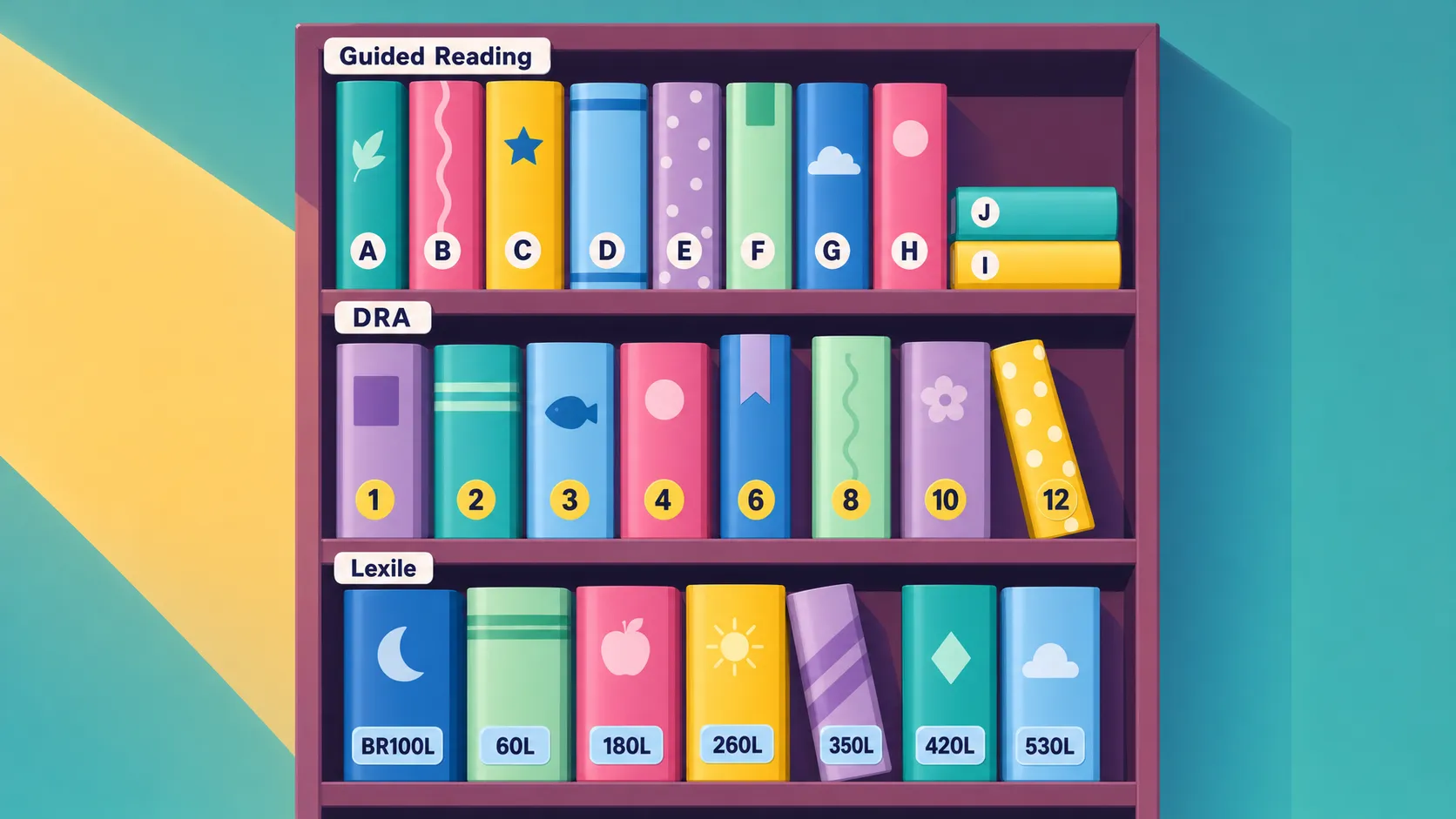
In kindergarten through second grade, your child’s level comes in one of three forms: a letter from A to Z (a guided reading level, such as one from the Fountas and Pinnell system), a number (a level on the Developmental Reading Assessment, or DRA), or a score ending in L (a Lexile measure). A teacher finds a letter or a DRA number by listening to your child read short books aloud. A Lexile comes from a reading test.
A level describes books. The skill underneath it is what your child practices. The level tells you roughly which books will feel comfortable, but not why your child reads at that level. Ask the teacher which reading skill is holding the level where it is.
What is a reading level?
A reading level is the school’s starting point for choosing books and teaching groups, not a grade on your child. Each system sorts books from easiest to hardest, then places a child at the point where they can read with some support.
Fountas and Pinnell judge a book’s guided reading level on ten factors, set out in their guide to the F&P Text Level Gradient: genre, text structure, content, themes and ideas, language and literary features, sentence complexity, vocabulary, the words a child must recognize or sound out, the illustrations, and the book’s length, print size, and layout. A book whose topic is familiar, whose sentences are short, and whose common words repeat sits low on the scale.
A book’s Lexile measure uses two of those factors and calculates them. MetaMetrics, the company behind Lexile, bases a book’s measure on word frequency and sentence length, so a Lexile and a guided reading letter weigh the same book differently.
How are guided reading, DRA, and Lexile levels different?
Your child’s level usually tells you which system your school uses from its shape, and none of the three is a test score out of 100. The one overlap is A: DRA’s first level is also A, so a kindergartner’s “A” can come from either.
| Kind of number | What it means | How your child gets one | Example |
|---|---|---|---|
| Guided reading letter, such as D or J | A band of books, from A, the simplest, to Z. Moving from D to E means slightly harder books, not a set number of points | Reading leveled books aloud to a teacher. The letter is the hardest band they read accurately and understand with a teacher’s help | Level D is an end-of-kindergarten goal |
| DRA level, such as 3 or 16 (or A, the first) | The level of a benchmark book in Pearson’s Developmental Reading Assessment. The levels start at A and skip as books get harder: A, 1, 2, 3, 4, then by twos to 20, then 24, 28, 30, 34, 38, 40, and on by tens to 80 | Reading benchmark books aloud to a teacher, scored for accuracy, fluency, and understanding | Level 16 is two benchmark books past level 12 |
| Lexile measure, such as 300L | A point on one scale that measures both children and books. A higher number means a harder book or a stronger reader | A reading test | Are You My Mother? is 140L, and Charlotte’s Web is 680L |
| BR code, such as BR100L | A Lexile measure below zero, for a beginning reader. Like temperatures below zero, BR100L is higher than BR300L | The same reading test, taken by a child still learning to read | BR120L is the low end of the middle half of first graders |
A Lexile match means about 75 percent understanding. MetaMetrics, the company behind Lexile, says the scale runs “from beginning reader measures below 0L to above 1600L,” and that when a child’s measure matches a book’s, the child is expected to understand about 75 percent of it. The table’s two example books are MetaMetrics’ own. Seeing BR on a kindergarten or early first grade report is ordinary.
Conversion charts between the systems exist, and none is exact. Letters from different leveling systems only roughly line up. The correlation chart from Learning A–Z, which publishes Reading A–Z, puts its own levels A–J beside Fountas and Pinnell’s A–J. Above J the two drift apart, and Reading A–Z’s level M sits beside Fountas and Pinnell’s L.
What reading level should my child be at? Reading levels by grade, K–2
Reading levels by grade are goals and typical ranges, and each system publishes them for different points in the school year. Fountas and Pinnell give a guided reading goal for four points in the year, DRA’s publisher sets a minimum for each testing season, and MetaMetrics publishes one Lexile range, for the middle of the year.
| Grade | Start of year (Aug–Sept) | Nov–Dec | Feb–Mar | End of year (May–June) |
|---|---|---|---|---|
| Kindergarten | No goal yet | B | C | D/E |
| 1st grade | D/E | F | H | J/K |
| 2nd grade | J/K | K | L | M/N |
Each guided reading letter in the table is the “meets expectations” goal for that point in the year, from the Instructional Level Expectations for Reading chart by Fountas and Pinnell. A kindergartner reading at level C in February meets it, and the chart describes itself as “general guidelines for grade-level goals, which should be adjusted based on school/district requirements and professional teacher judgement.”
| Grade | Fall | Winter | Spring |
|---|---|---|---|
| Kindergarten | A | 1 | 3 |
| 1st grade | 3 | 10 | 16 |
| 2nd grade | 16 | 20 | 28 |
Each DRA2 level in the table is a floor, not a goal. It is the lowest benchmark book a child should read well at that test, from the threshold table published by the Nebraska Department of Education. A child reading below that level, or at it only with help, is flagged as at risk.
MetaMetrics publishes one Lexile range per grade, for the middle of the year. In the middle of first grade, the middle half of children in its national sample measured BR120L–295L: a quarter measured below BR120L and a quarter above 295L. In the middle of second grade the middle half measured 170L–545L. A first grader measured at 140L would be expected to understand about three quarters of a 140L book such as Are You My Mother? MetaMetrics says the ranges are “for descriptive purposes only and should not be interpreted as a prescribed guide,” and it publishes no kindergarten range.
Your school’s own goals win. Districts set their own targets, and the report card or reading log usually says which level is expected at each point in the year. Holley Central School District in New York, in its 2017 kindergarten report card guide, set guided reading level B as the second-quarter goal and level D for the fourth. Both match the Fountas and Pinnell chart.
Is my child’s reading level good or low?
A level is good or low only against the goal for that point in the year, and the typical range is wide. In MetaMetrics’ figures, the middle half of second graders spans 375 points, from 170L to 545L, so two ordinary readers in the same class can be hundreds of points apart. Fountas and Pinnell’s chart sets no kindergarten goal for the start of the year. Its first one is level B, for November and December, so a kindergartner at level A in October is not behind.
“Below level” means below the school’s goal for now, and the useful next step is finding out why. A child can sit below level because they cannot yet hear the separate sounds in words, because they do not know some letter sounds, because they cannot blend sounds into a word, or because they have not met many common words yet. Each of those has a different fix. Ask the teacher what your child does when the reading breaks down. Our list of questions to ask at a parent-teacher conference covers that conversation, and what “behind in reading” means explains what a school’s concern does and does not tell you.
How does the school find my child’s reading level?
A teacher finds a guided reading or DRA level by listening to your child read a short book aloud, one level at a time. The teacher notes each word read wrongly or skipped, then asks your child to retell the story or answer questions about it. The teacher stops when the books get too hard, and the level is the hardest one your child read accurately with a teacher’s support. In Pearson’s description of DRA, the earliest levels, A–3, check printed language concepts, and the levels above them check oral reading and comprehension. Schools check reading levels 2–4 times a year, so the level on a report can be several weeks old.
Some reports name two or three levels for the same child. A book a child reads alone with very few errors is at their independent level. One they can read with a teacher’s support is their instructional level, and one with too many errors is hard. Ask the teacher which one a report shows.
A Lexile measure comes from a reading test, often one on a computer. A computer test that adjusts each question to the last answer, such as NWEA MAP Growth or i-Ready, can print a Lexile range beside its main score, for choosing books.
What does a reading level not tell you?
Even the publishers of the scales say a level is not a label for a child. A post on the Fountas and Pinnell blog describes their gradient as “a teacher’s tool for assessment and instruction,” says levels “aren’t meant to be shared with the children or parents,” and says they have “no place in teacher evaluation or on report cards.” MetaMetrics says a book’s Lexile measure “refers to its text difficulty only” and “does not address the content or quality of the book.”
Reading researchers disagree about how much to use leveled books, and the disagreement matters less for beginners. Writing in Education Next in August 2026, reading researcher Timothy Shanahan argued that “most kids make greater gains with more-challenging texts,” and added, “I identify beginning readers as an exception,” because beginners first need to learn to decode. Louise Baigelman, answering him, argued that leveled books should supplement a harder shared text. For a kindergartner or first grader, his exception is the one that applies: their own practice books should be ones they can decode.
How can I help my child move up a reading level?
Practice the skill underneath the level, not the level itself. A level rises when your child reads more words accurately and understands them, and that comes from these early reading skills:
| What the teacher says | The skill underneath | Where to start |
|---|---|---|
| Struggles to hear sounds in words | Hearing the separate sounds in spoken words | Hearing sounds in words, then Elkonin boxes |
| Mixes up or forgets letter sounds | Knowing the sound each letter makes | The alphabet and letter sounds |
| Cannot sound out a short word | Blending sounds into words | Teaching CVC words, or when a child cannot blend |
| Stops on common words | Reading frequent words at a glance | How to teach sight words |
| Reads the words but misses the story | Understanding and vocabulary | Read books above their level aloud together and talk about them |
Hearing sounds, letter sounds, and blending are the skills the research backs most directly. The National Reading Panel found that explicit, systematic teaching of phonemic awareness and phonics improves children’s reading. The foundational skills practice guide from the Institute of Education Sciences, for kindergarten through third grade, rates two recommendations as strong evidence: linking the sounds in speech to letters, and teaching children to decode words.
Short daily practice on one skill is the plan to start with. If practice is already daily and the level is not moving, why reading practice is not working covers what to change. To find the shaky skill yourself, the five-minute reading check works through hearing sounds, letter sounds, blending, and common words in order. Stop at the first one that wobbles.
How do I choose books at the right reading level at home?
Use your child’s level as a rough range, and let what your child wants to read lead. For reading on their own, choose books where your child reads almost every word without help. For reading together, go well above the level: a book read aloud builds vocabulary and understanding that your child’s own reading cannot reach yet.
For practice reading in the early grades, books built from sounds your child already knows work best. These are sold as decodable books, and they let a child succeed by sounding out rather than by guessing from the pictures. Our guide to free phonics resources lists two free sources.
The levels printed on early readers are each publisher’s own. Random House sorts its Step into Reading books into five steps with overlapping grade ranges, from “preschool to kindergarten” for Step 1 to “grades 2 to 4” for Step 5, according to a guide from Penguin Random House, its parent company. A Step 2 book is not guided reading level 2 or level B. Read the first page with your child before deciding.
Frequently asked questions
What is a good Lexile score for my child?
It depends on the grade and the time of year, and MetaMetrics, the company behind Lexile, gives a range rather than a target. In the middle of first grade, the middle half of readers in its national sample measured BR120L–295L, and in the middle of second grade 170L–545L. A score inside that range is typical, and MetaMetrics publishes no kindergarten range.
Can my child's Lexile score change over time?
Yes, and in the early grades it changes fast. A Lexile score is a measure of reading ability at the time of the test, so it moves as your child learns to read. MetaMetrics' typical ranges climb by 250–290 points between the middle of first grade and the middle of second. Look at the direction over several tests rather than at one number.
How do I find my child's Lexile level?
Look on the score report from a computer-adaptive reading test such as NWEA MAP Growth or i-Ready, which can print a Lexile measure beside the main score. If your school does not use one, ask the teacher which reading level system the school uses. A kindergartner may have no Lexile at all, since MetaMetrics publishes no kindergarten range, and the school may use a guided reading letter or a DRA number instead.
What DRA reading levels should parents expect in first grade?
Pearson's DRA2 thresholds, as published by the Nebraska Department of Education, put the spring minimum for first grade at level 16 and the winter minimum at level 10. Those are the lowest levels counted as progressing when read well, not targets. Your school may set its own goals, so ask the teacher which levels it uses.
At what age should my child be reading at a kindergarten level?
Reading levels are set by grade, not by age, and the kindergarten goals are for the end of the kindergarten year. Fountas and Pinnell's expectations chart puts the end of kindergarten at guided reading level D or E. The chart sets no goal for the start of kindergarten.
How often should I check my child's reading level?
Leave measuring the level to the school, which usually assesses it 2–4 times a year. At home, check the skills underneath it instead, such as hearing the sounds in words, letter sounds, and sounding out short words. Those change week to week and tell you what to practice, which a level does not.
Can a parent assess their child's reading level at home?
Not in the way the school does it. A level comes from a teacher listening to your child read a set of leveled books and scoring errors and understanding against the publisher's rules. A level guessed at home will not match the school's. What a parent can check at home is which reading skill is shaky, which is the more useful thing to know.
How do I choose the right Step Into Reading level for my child?
Hand your child a book at the step you think fits and listen to a page. If they read almost every word without help, the step is right for reading on their own. If they stop on several words a page, read it together. Random House gives each step an overlapping grade range, from preschool to kindergarten for Step 1 up to grades 2–4 for Step 5. Its steps are not the school's guided reading letters.
Related guides
Last updated