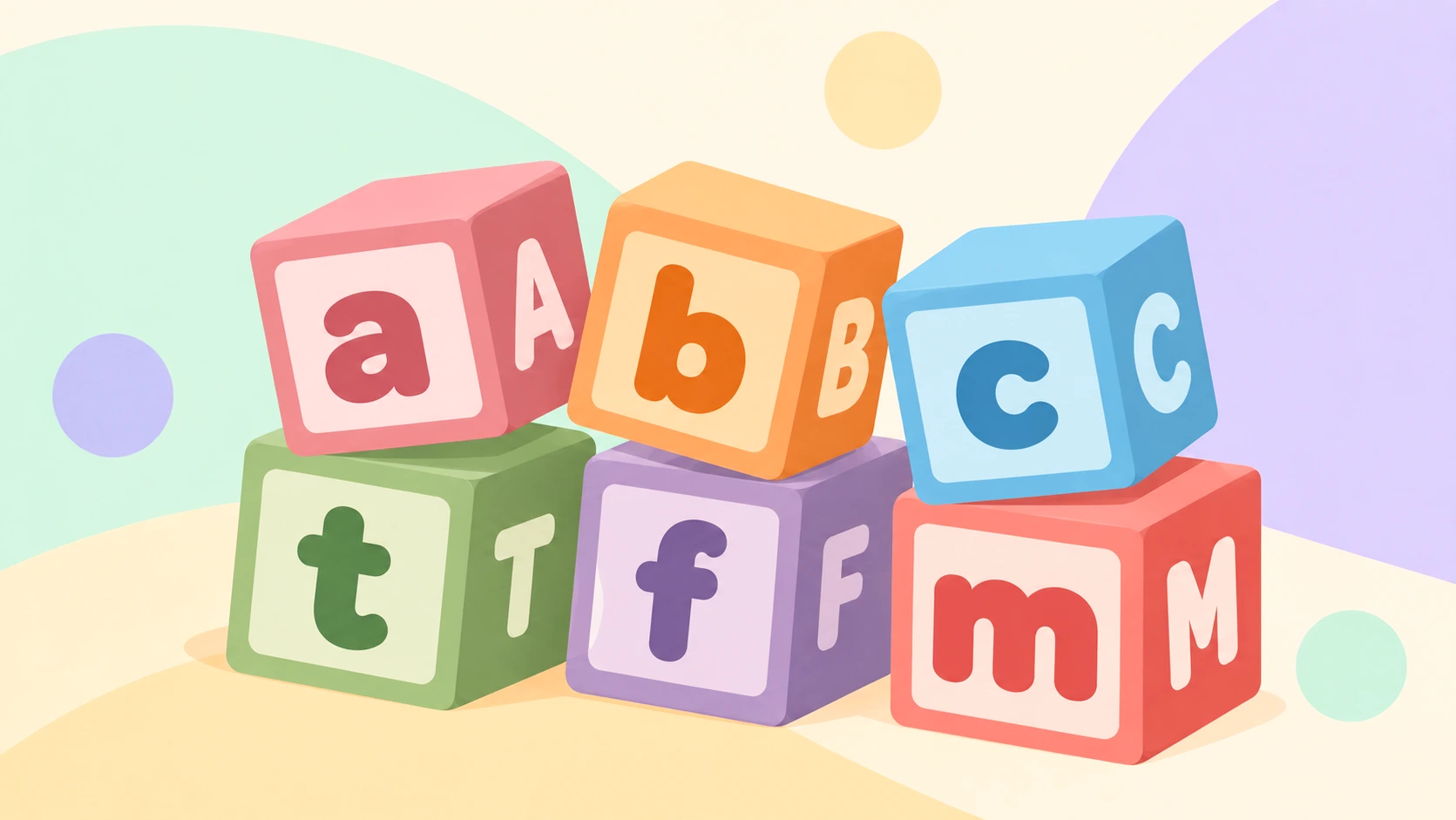
ABC & letters
How to Teach the Alphabet and Letter Sounds
Which letters to start with, how to say each sound, and what to do when they are not sticking.
Every letter has two things to learn: its name and the sound it makes. The letter b is called “bee” and it says /b/. Children learn the names first, usually long before they know a single sound, and the sounds are the half reading runs on.
Say each sound short and clean: /b/, not “buh”. /m/, not “muh”. The payoff comes later, when those sounds have to be blended into words: “buh-a-tuh” does not turn into “bat”, while /b/ /a/ /t/ does. This one takes some attention at first, but that is easier than unpicking the habit once blending has started.
The rest of the method is small. Teach the name and the sound together, 2 or 3 letters at a time, in 3-5 minutes of play on most days, and start with letters that make real words in the first week rather than working through A, B, C. Add a new letter only once the old ones are steady.
Children of 3 and 4 pick letters up in small, uneven bursts, and the normal range is wide: some 4-year-olds know every letter sound and others know 4.
How do you teach letter sounds, step by step?
2 or 3 letters at a time, name and sound together, 3-5 minutes on most days, reviewing the old letters before adding a new one. That is the whole method, and it works at a kitchen table.
Pick 2 or 3 letters
Not the whole alphabet, and not in alphabetical order. Choose a small set that combines into real words quickly, so your child reads something within the first week rather than after all 26.
Say the name, then the sound
Point at the letter, name it, then give its sound: this is m, and m says /m/. Keep the sound short and clean, with no vowel stuck on the end, so /m/ rather than muh.
Tie the sound to something real
Pick one object or picture that starts with the sound and keep using the same one. m for milk, every time. A fixed anchor gives your child somewhere to retrieve the sound from when it will not come.
Practice a few minutes most days
3-5 minutes daily does more than 30 minutes on the weekend. Letters are learned by coming back to them, not by time spent in one sitting.
Review the old letters before adding a new one
Run through the letters already learned at the start of each session. Adding letters while the old ones are still shaky is the most common way home practice stops working.
Build words as soon as you have enough sounds
The moment 2 consonants and a vowel are steady, put them together and read a word. That is what the letters are for, and getting there early is what keeps a child interested in them.
Most of what a preschool teacher does is this, in a group of 12. Explicit modeling rather than exposure, one small set of letters at a time, a picture cue kept fixed for each sound, and a quick review at the start of every session. None of it needs a classroom, and the home version has an advantage a classroom does not: you can stop the moment your child has had enough.
Which one you ask for changes with the activity. When your child is learning to recognize a letter, give the name and the sound together, and ask for both. When you are playing with sounds out loud and there is no letter in front of you, the name has no job to do and only the sound counts. Most of the confusion parents report at this stage comes from mixing the two and then getting inconsistent answers back.
Practice letters both ways, because they do different jobs. A letter on its own, with its sound said clearly, is how a child learns the sound. The same letter noticed in a word on a cereal box is how they learn it is worth knowing. Neither substitutes for the other, and a child who only ever meets letters in isolation treats them as a school thing rather than as how print works.
A tip on step 1: choose letters that make words
Whichever letters you start with, make sure one of them is a vowel. That is the short answer to “vowels or consonants first”: both, together, from the beginning. Five consonants and no vowel is five letters and nothing to read.
m, s, f, t and a is one workable set. Between them they make 5 real words: at, am, mat, sat and fat. It is also the set the five-minute reading check-in uses, so a parent who runs the check and then starts teaching is working with the same letters.
Which letters come after those, and in what order, is a question of its own, and it has a longer answer than it looks.
Free PDF · no sign-up
Free printable alphabet chart and letter sound checklist
Two PDFs, and they do opposite jobs. The chart shows a picture beside every letter, because a picture is what a child reaches for when a sound will not come. The checklist shows none, because there the picture would be the answer. It is for finding out which sounds your child already has. No account, no email, no watermark.
Should you teach letter sounds before letter names?
Teach both, at the same time. Reading runs on sounds, so the sound is the part that does the work. But letter names are not an obstacle, and for many letters the name is how a child finds the sound in the first place.
Rebecca Treiman and colleagues looked at what 660 children aged 3 and a half to 7 and a half knew about letters, and found that whether a letter’s sound appears inside the letter’s name, and whether it appears at the beginning or the end, is one of the main things deciding which letter sounds a child knows. Say the names out loud and you can sort them yourself:
| The letter’s name | Examples | How hard its sound is to learn |
|---|---|---|
| Begins with the sound | b (bee), t (tee), v (vee), z (zee) | Easiest |
| Ends with the sound | f (ef), m (em), s (ess), l (el) | Harder |
| Does not contain the sound | h (aitch), w (double-u), y (wye) | Hardest |
That bottom row is where the extra repetition goes.
Teaching the two together also beats teaching the sound alone, in the one trial that compared them directly. Sonia Piasta and colleagues randomly assigned 58 preschoolers to combined letter-name-and-sound lessons, sound-only lessons, or a numbers group, and the children taught both learned more letter sounds. One trial is not a settled rule, and the same study found the gains did not spread to other early reading skills.
This work is worth the time for a reason beyond the alphabet. The National Reading Panel found that letter knowledge and hearing the sounds in spoken words are the two best predictors, at school entry, of how well a child learns to read over the following two years. The two grow side by side and neither waits for the other: hearing the sounds in words covers the listening half, which happens out loud with no letters involved.
None of this is an argument against sight words, which come later and get easier once letter sounds are in place, or a side in the old phonics-versus-whole-language argument. A child needs the code and the stories.
This is why the alphabet song is fine, and why it is not enough on its own. It teaches 26 names and no sounds, which is where nearly every child starts.
How do songs, stories and everyday life teach letters?
Almost all letter learning at 3 and 4 happens outside anything that looks like a lesson, and the everyday version is the one that sticks.
Songs are worth being precise about. The alphabet song teaches names. Songs built around one sound at a time teach sounds, and those are the ones to add when the alphabet song is already familiar. Both are useful and they are not the same tool.
Shared reading is the easiest teaching moment there is, because you are doing it anyway. Point at the first letter of one word on the page, give its sound, and carry on with the story. One letter per book is plenty. Stopping to teach four turns a bedtime story into a lesson, which costs more than it gains. Rhymes and rhyming games do the ear half of the same work.
Letters in daily routines do more than set-piece practice: the first letter of your child’s own name, the M on a sign they pass every day, the letters on a cereal box they already recognize by shape. A print-rich home is not a wall of posters. It is noticing the print that is already in the room.
What if your child is not interested in letters yet?
Very common at 3 and 4, and it usually says more about how letters are being offered than about your child. Plenty of children who ignore the alphabet at 4 read fluently at 6.
What tends to help is less, not more:
- Shorter. 2 minutes rather than 10, and stopped by you rather than by them.
- Attached to something they already care about. Their own name first, then whatever they are obsessed with this month. Truck starts with /t/, and t is one of the letters worth teaching early anyway.
- Their choice of when, as far as you can manage it. A child who picks the letters up is learning. A child sat down with them is being managed, and at 3 or 4 they can tell the difference.
Drop it for two weeks if it has turned into a fight. Almost nothing is lost, and the fight itself is the thing that does damage, because it teaches a child that letters are a battleground before they have any reason to think otherwise.
If the question underneath this is whether your child is where they should be for their age, that is worth answering properly rather than by comparison with the child next door: our five-minute check-in by age walks through what is typical from 3 to 7.
An app is one option among several here, and it works best when a child reaches for it rather than being handed it. Which reading apps suit which age covers what to look for at 3 and 4.
When should letter sounds click?
Letter sounds become a reasonable focus from around age 4, and kindergarten is when most children move from knowing sounds to blending them into words. The normal range around both of those is very wide.
At 3 and 4, reading is about sounds and stories rather than words on a page. Some 4-year-olds know every letter sound. Others know 4. Both are fine, and rhyming and hearing sounds in spoken words matter more at this age than letter knowledge does.
At 5, in kindergarten, many children move from knowing letter sounds to blending them into simple three-sound words like man and fun. A 5-year-old blending confidently and a 5-year-old still working on letter sounds are both within normal. Children with fall birthdays are often nearly a year younger than classmates in the same grade, which accounts for a great deal of the apparent difference between them.
How much practice. 3-5 minutes on most days, and stop while your child is still willing. Frequency is what moves letter learning; session length is not, and a 30-minute session mostly teaches a 4-year-old that letters are something to escape from.
Worth raising with a teacher by the end of kindergarten: a child who knows very few letter sounds despite regular exposure, or who learns letter sounds and then forgets them repeatedly. Both are on the short list in what is typical at each age, and what “behind in reading” actually means covers what the word means when a school uses it and what happens next.
What if the sounds are not sticking?
Start with how the sounds are being said, because an extra vowel on the end of a consonant is the most common cause. A /b/ taught as “buh” is not the sound in “bat”, and three of those in a row do not add up to a word your child can recognize. Say the consonant and stop: clip it short rather than letting a vowel run on after it. The sounds that invite the extra vowel most, and what to do once the habit has set, are in the guide to blending trouble.
Three more, in the order they usually turn up:
- Too many letters at once. 2 or 3 is a set. 8 is a queue, and a child working through a queue remembers the first 2 and the last one.
- Moving on before the old letters are solid. New letters do not displace old ones on their own; they need the review at the start of each session.
- Sessions that run past the point of willingness. 10 willing minutes beat 30 resented ones, and the resented 30 cost something in addition.
Check without testing. Hold up 3 or 4 letters your child has been working on and ask what sound each one makes, not what it is called. Giving the letter name instead of the sound, “em” for m or “ess” for s, is the thing to notice, and it is check 2 of the check 2 of our reading check-in. Do it once every few weeks rather than weekly. Weekly checking measures the week, not the child, and it worries a parent in both directions.
If letters have been hard from the beginning, or your child’s speech is hard for other adults to understand, those are conversations worth having with a teacher or your pediatrician rather than problems to solve with more practice at home.
Should you teach uppercase or lowercase first?
Lowercase first, and the capital should follow within days rather than months. Lowercase letters are what almost all text is actually made of, which is what makes them the more useful half to know: as literacy researcher Timothy Shanahan puts it, “lower case letters have greater value in reading. You simply see more of them, so the knowledge of such letters is more predictive of eventual reading achievement.” A child who knows only capitals cannot yet read a book.
Capitals arrive early whether you teach them or not, because a child’s own name starts with one, and so do the road signs and half the cereal box. That is the argument for not saving them until the end.
Programs split into two schools on how long the capital waits. One teaches all 26 lowercase letters and comes back for capitals as a separate block later, which is what several widely used programs do. The other pairs each letter with its own capital straight away, so a child meets a and A in the same sitting. Pairing costs a child almost nothing at the time, because a capital is one more form of a letter whose sound they have just learned rather than a twenty-seventh thing to start.
How do letter sounds turn into words?
Knowing the sounds does not by itself produce reading. Pushing them together into a word is a separate skill, and it is the next one, not a bonus that arrives free with the twenty-sixth letter. A child can know every letter sound and still look at “mat” with no idea what to do.
That next step is the one worth watching, because it is where most children stall. Blending, and why it stalls is the page for it, and the six stages of phonics show what comes after that: short words from one family, then any short word, then the letter pairs that make a single sound.
The activities on this page were developed with input from educators and speech-language pathologists.
Frequently asked questions
Should I focus on teaching letter sounds before letter names?
Teach both, at the same time. The sound is what reading uses, so it is the part to make sure of, but names are not in the way. For many letters the name contains the sound, and children use that link to learn it. Rebecca Treiman and colleagues found that whether a letter's sound appears inside its name, and whether at the beginning or the end, is one of the main things that decides which letter sounds a child knows. A smaller study by Sonia Piasta and colleagues found preschoolers taught names and sounds together learned more letter sounds than those taught sounds alone.
Should I teach vowels or consonants first to my child?
Both, together, with at least one short vowel from the very start. Consonants on their own cannot make a word, so a child who has learned five of them has nothing to read yet. A few common consonants plus one short vowel is enough for real words within days, which is the moment the whole exercise is building toward. Which vowels come next, and how far apart they should sit, is a question about the whole letter sequence rather than about the first week.
What age should children start learning letter sounds?
Around age 4 is a reasonable point to make it a focus, and many children pick some up earlier from songs, signs and their own name. The normal range is very wide. Some 4-year-olds know every letter sound and others know 4, and both are ordinary. Before age 4, rhyming and hearing sounds in spoken words matter more than letter knowledge does.
How often should I practice letter recognition with my child?
3-5 minutes on most days beats one long session a week. Letters are learned by returning to them, so short and frequent wins. Start each session by reviewing the letters already learned before introducing a new one, and stop while your child is still willing rather than when the set is finished.
Should I worry if my child does not recognize letters by age 4?
Usually not. Some 4-year-olds know every letter sound and others know 4, and both go on to read perfectly well. Little interest at 3 or 4 is common. What is worth raising with a teacher is a child at the end of kindergarten who knows very few letter sounds despite regular exposure, or who learns them and then forgets them repeatedly.
Can apps be effectively used to teach preschoolers letter sounds?
Yes, for the half of the job that involves letters on a screen. A good one models each sound short and clean with no added uh, introduces letters in a planned order rather than A to Z, and reviews learned letters before adding new ones. What an app cannot do is the listening work that happens out loud with no letters involved, or the pointing at print during a bedtime story, and a child who is not yet interested in letters is rarely won over by a screen.
Should I teach uppercase or lowercase letters first?
Lowercase first. Almost all reading material is set in lowercase, so lowercase knowledge is what predicts reading, and every good sequence starts there. The question worth asking is how long the capital waits. Some programs teach all 26 lowercase letters and come back for capitals as a separate block later; others pair each letter with its own capital straight away, which is the easier one to defend at home, because a child's own name, road signs and shop fronts are full of capitals and they meet those between lessons.
Letter sounds vs. sight words: which is better for early readers?
Letter sounds, first and by a distance, for a child who is 3 or 4. Memorizing whole word shapes before a child knows letter sounds means asking them to remember pictures with nothing to anchor them to. Most of the words on a school sight-word list can in fact be sounded out once a child has the letter sounds, so the letter work makes the sight-word work smaller rather than competing with it.
Related guides
Last updated