Foundations
Questions to ask about reading at a parent-teacher conference
Find out which reading skill your child needs next, how to help at home, and when to check progress.
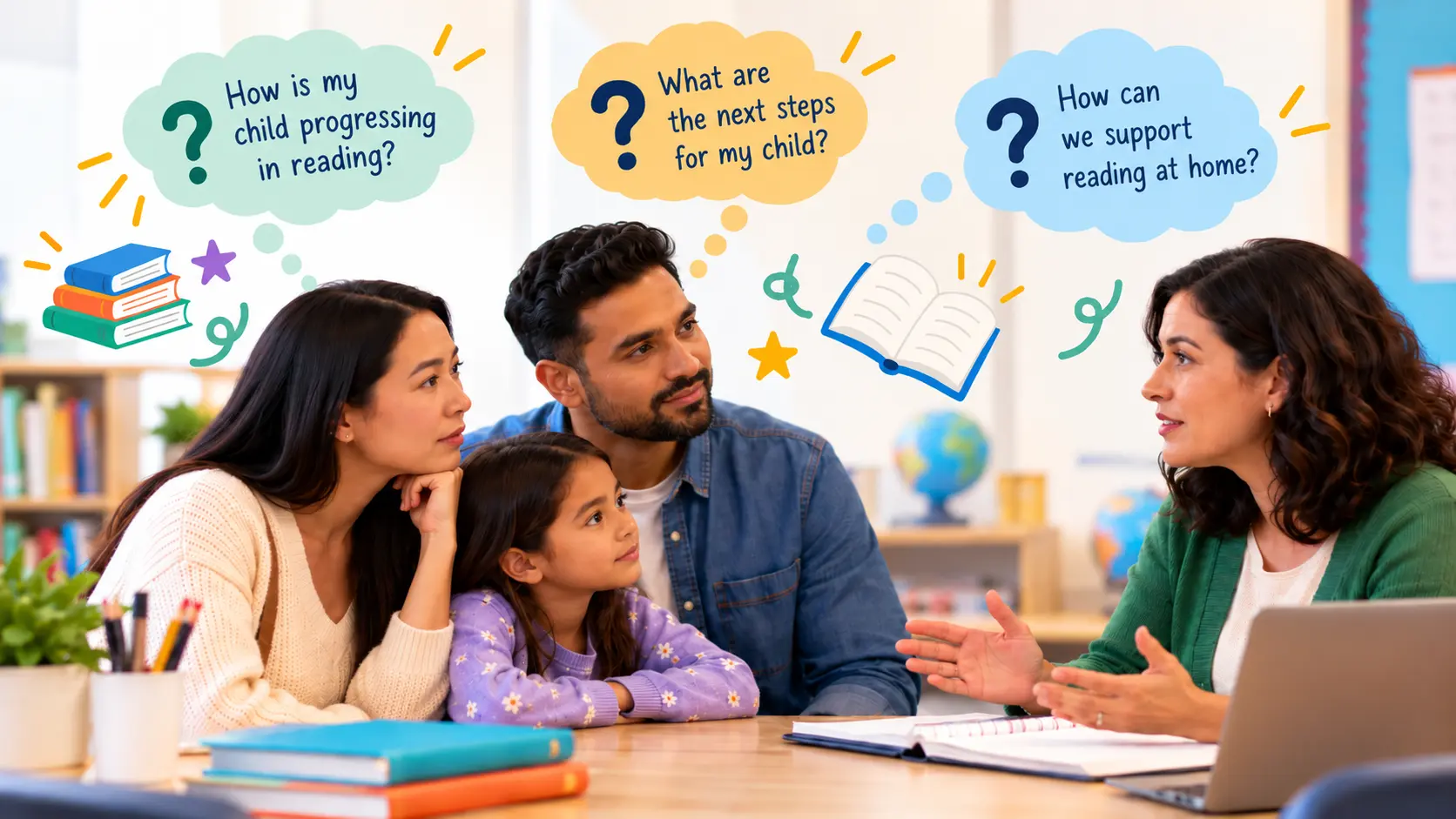
At your kindergarten parent-teacher conference, ask which reading skill your child is working on, how to help at home, and when to check progress. Start with these 3 questions:
- Which specific skill is my child working on right now?
- When my child gets stuck on a word, what should I prompt them to do?
- What is the one thing we should practice at home?
The first question does the most work. A skill, such as blending three sounds into a word, is something you can practice at the kitchen table that evening. A reading level is a label, and there is nothing to practice in it. If time is short, ask the first question and have the teacher show you an example.
If the teacher has said your child is “behind”, read what “behind in reading” means. The next step depends on whether your child needs help with one skill or broader reading support.
What questions should I ask about my child’s reading progress?
Ask your kindergartner’s teacher which reading skill your child needs next. A reading level alone does not tell you what to practice.
Use these questions:
- Which specific skill is my child working on right now?
- Can they sound out a word they have not seen before?
- Are they reading the words, or recognizing books they know?
- What is the one thing we should practice at home?
- What would you expect to see change by the next time we talk?
A useful answer names something your child does. “She knows most of her letter sounds, but she stops when she has to put three of them together” tells you exactly what to practice. “She is doing fine” is kind, and it leaves you with nothing to do at home.
When an answer is vague, one follow-up question usually turns it into a skill and a date. These are the answers kindergarten parents hear most, and what to ask next:
| If the teacher says | Ask |
|---|---|
| ”She is doing fine." | "What is she working on next?" |
| "We’re keeping an eye on it." | "What will you look for, and when should we talk again?" |
| "He is a level C." | "Which skill would move him to the next level?" |
| "Just keep reading with her every night." | "What should I do when she gets stuck on a word while we read?" |
| "She will catch up." | "Which skill does she need to catch up on, and by when?” |
Before the meeting, try a five-minute check at home to find a skill to ask about. The same page sets out what is typical at 5, so you walk in knowing roughly what kindergarten is aiming at.
To ask how your child compares with classmates, ask about expectations for this time of year. Try: “Is my child where you would expect at this point in the year? If not, which skill needs work?” A class ranking alone does not tell you what help your child needs. Reading Rockets, hosting the US Department of Education’s guide to helping children become readers, notes that children develop and learn at different rates. A child at the back of one class can be right in the middle of the next.
If the teacher mentions a test or a score
A number on a page can sound more final than it is. When the teacher shares a reading test score, ask:
- Which assessment is this, and how often is it given?
- Which part of it was lowest?
- When will you check again, and what would you expect to be different by then?
Many US schools screen reading 3 times a year, so one score is a single point on a line rather than a verdict. Ask how the result compares with earlier checks. If your child has a DIBELS report, read what each kindergarten subtest measures for 4 more questions to ask with the report in hand. Our guides to i-Ready scores and NWEA MAP scores do the same for those two reports.
What should I ask about how the school teaches reading?
Ask how reading is taught so you can use the same prompts at home. A child who is taught to sound words out at school, and then told to guess from the picture at bedtime, is getting two different answers to the same problem. Have the teacher show you what to say when your child gets stuck on a word, and try it once in the meeting so it feels natural that night.
These questions cover the program, practice books, and daily instruction:
- Which phonics program do you use, and in what order does it teach the sounds?
- When my child gets stuck on a word, what should I prompt them to do?
- What kind of books come home for practice?
- How much of the reading block is spent on phonics each day?
- Are apps or screens part of class reading, and is there one you would suggest for home?
Listen for how children connect sounds to letters, sound out words, and spell them. You do not need to recognize the program’s name to judge the answer, because instruction that matches the research sounds much the same from one classroom to the next. The What Works Clearinghouse makes 4 recommendations in its practice guide for kindergarten through grade 3, published in 2016 and revised in 2019:
| What the guide recommends | Evidence rating | What to listen for |
|---|---|---|
| Connect sounds in spoken words to letters | Strong | Children hear individual sounds and match them to letters |
| Decode words, analyze word parts, and write and recognize words | Strong | Children sound out words, work with word parts, and spell |
| Read connected text every day | Moderate | Every child reads sentences daily |
| Teach vocabulary and language for explaining, inferring, and storytelling | Minimal | Children learn new words, discuss stories, and explain their thinking |
The first 2 rows carry the strongest evidence, so ask for a classroom example of each. An answer like “we practice hearing each sound in a word, then the children write the letters for it” is what a good one sounds like. What research-aligned reading instruction looks like explains the evidence, and the usual order phonics sounds are taught in helps you follow the class’s sequence.
If the teacher suggests “look at the picture” or “guess what would make sense,” that is worth knowing rather than worth arguing about. It is an older approach, many schools are moving away from it, and a child who guesses at home is doing exactly what they were taught. Read what to do when a child guesses at words instead of sounding them out.
What should I ask if my child is struggling with reading?
Hearing a reading concern about your 5-year-old can sting. In kindergarten it means the teacher has spotted something early, and early is when you have the best chance to get help that works. You already know there is a concern. What you need from the rest of the meeting is the plan, so ask for one that names the skill, the support, and a date to check progress:
- Which specific reading skill needs work? Could you show me a word or reading task my child finds difficult?
- What is the support, how often, and who delivers it?
- How will we know whether it is working, and when will we look again?
- What should we do at home, and what should we not do?
The “what should we not do” half of that last question is easy to skip, and it matters. A well-meant prompt at home, such as “just guess,” can pull against what the class is practicing. Ask the teacher to demonstrate the home activity and name any prompts to avoid. What extra support at school involves explains the kinds of help the school may offer. If your child has already been placed in a small group, what a reading intervention group does covers how it works and how to help at home.
If you are concerned but the teacher has not raised it, bring what you have seen rather than a conclusion: “She knows a word on one page and not the next. Do you see that in class?” A specific example gives the teacher something to confirm or correct, where “is she behind?” tends to get reassurance. The signs that are worth acting on can help you decide what to raise.
What should I do after the parent-teacher conference?
Write down your reading practice plan before you leave the conference, or that evening while it is fresh. Save these notes on your phone:
- The skill we will practice: ___
- The activity or words we will use, and how often: ___
- When we will check progress: ___
The Harvard Family Research Project recommends writing down what you will do, when, and how often in its 2010 conference tip sheets. It also recommends another conversation within the next few months.
Start short daily practice on the skill the teacher named. Aim for 10 minutes a day. A short session your child finishes happily does more than a long one that ends in tears. Slower progress than you hoped for is not the same as none, but if a month or more of consistent practice brings no movement at all, tell the teacher and change what the practice involves at the same time: why a child is not improving despite daily practice covers what to change. Tell your child what you agreed on, such as “We’re going to practice putting sounds together, just like you do at school.”
Tonight, start with the activity the teacher showed you. Make a note of what your child finds easy and where they need help, then share it at your next check-in.
Frequently asked questions
How should I approach discussions about reading with my child's teacher?
Start with something you have noticed at home: 'He stops at any word he has not seen before. Do you see that in class?' Then ask which reading skill your child is working on and what to practice at home.
How closely should I coordinate with my child's teacher about reading?
Ask which reading skill to practice and what to say when your child gets stuck, so you can use the same prompts at home and at school. Agree on a follow-up date to compare progress.
What should I say to my child's teacher about reading?
Ask: 'Which specific reading skill is my child working on? Can they sound out an unfamiliar word? What should I say when they get stuck? What is the one thing we should practice at home?' Ask the teacher to show you an example.
What should I know about phonics before meeting the teacher?
Phonics teaches how letters represent sounds so children can sound out unfamiliar words. Ask which phonics program the class uses, in what order it teaches the sounds, and how to help when your child gets stuck. You do not need to know the program beforehand.
What reading milestones should I expect in kindergarten?
Most kindergartners move from knowing some letter sounds to blending them into short words, and read a few common words on sight. Children reach these steps at different times. Ask which skill your child is working on and what the teacher expects at this point in the year.
What are common concerns parents have about kindergarten reading programs?
Ask whether children are taught to sound out words or guess from pictures and context, how much time is spent on reading instruction, and what support a child receives if they fall behind. Ask for examples of what happens in class.
What can I do if my child struggles with reading at this age?
Ask the teacher which reading skill needs work, what support the school is providing, and what to practice at home for 10 minutes a day. Agree on a follow-up date. If a month or more of consistent practice on that skill brings no movement at all, tell the teacher and change what the practice involves, both at once.
Related guides
Last updated