Foundations
Reading on the kindergarten report card
The reading skills a kindergarten report card marks, where those marks come from, what a mark like "approaching" means, and what to practice at home.
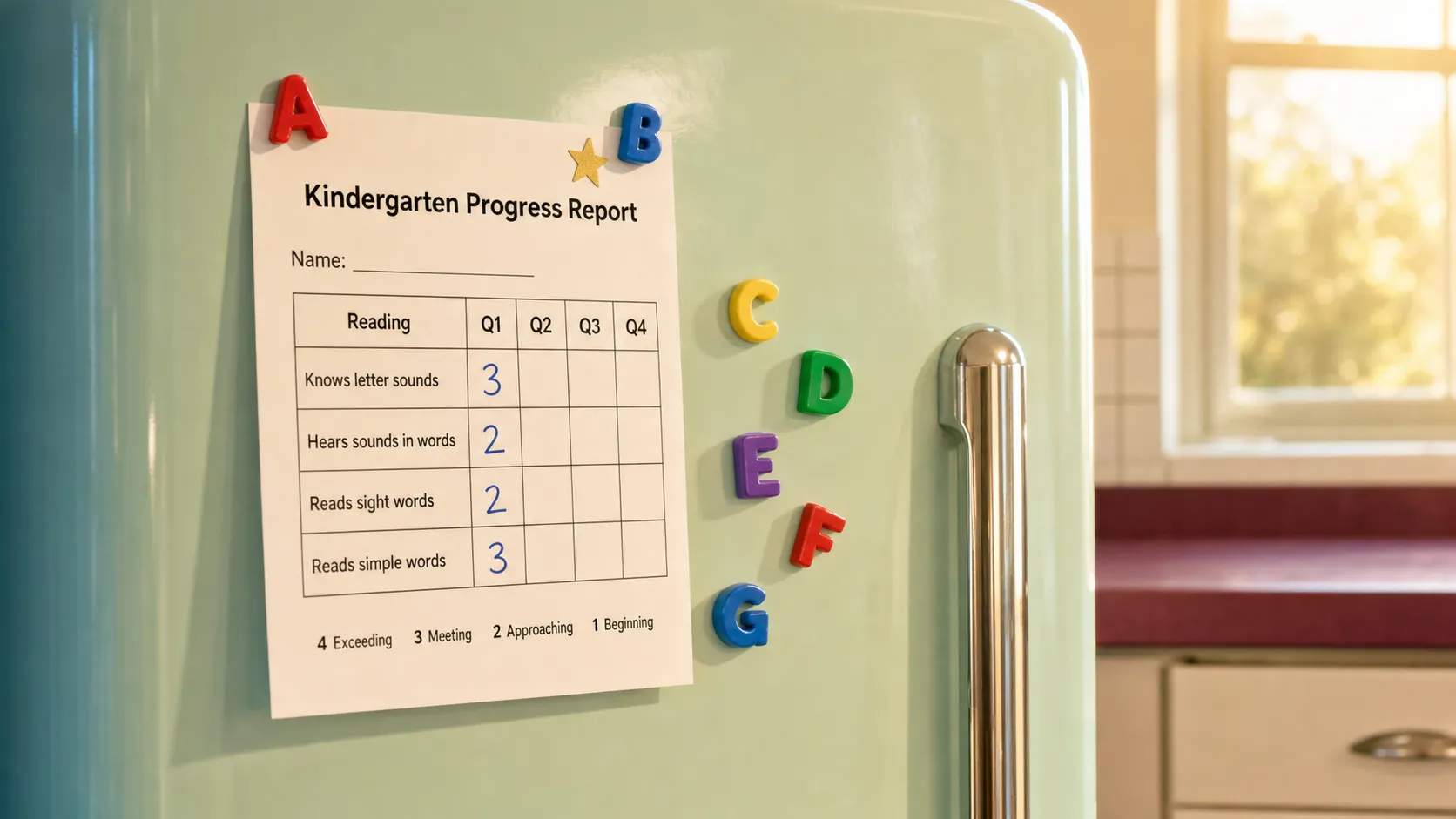
In many US public schools, the kindergarten report card is standards-based. Instead of one reading grade, it lists the reading skills the class is working on, such as naming letters, letter sounds, rhyming, and sight words, each on its own line with a mark beside it. The mark is usually a number on a 1–3 or 1–4 scale, and a key on the card gives each number a label. “Approaching” is one of those labels, usually for a 2, and some cards use “progressing” or “developing” for the same step.
“Approaching” means your child is working toward that skill and has not met it yet. Whether that is expected depends on what the card measures against. Some districts mark against the goal for the end of the year, so most children are “approaching” until spring: Princeton Public Schools in New Jersey tells parents that a 2 “is the expectation in Trimester 1 and 2.” Other districts mark against the goal for each quarter, where a 2 means short of this term’s target. The key on your child’s card says which kind it is.
Then look at which line the mark is on. Each line is a different skill, and each one is practiced differently.
What does a kindergarten report card show?
A standards-based report card marks each skill on its own line instead of averaging a child’s work into one letter grade. A kindergarten card has no overall reading grade, so read it one line at a time.
The standards come from the state, and each district chooses which ones go on the card, so not every standard appears. The 2017 kindergarten parent guide from Holley Central School District in New York, for example, says its card is aligned to the New York State Learning Standards.
A blank, gray, or N/A line is not a low mark. Princeton grays out a standard “Not Assessed At This Time,” and Holley marks N/A where a standard was not taught that quarter. On Holley’s card, changing one sound in a word to make a new word, such as mat to cat, is not marked until the third quarter.
Which reading skills are on a kindergarten report card?
The reading lines on a kindergarten card usually follow the state’s foundational reading skills. In the Common Core State Standards, which many states adopted or adapted, those cover print, the sounds in spoken words, phonics and sight words, and reading simple books. A card words each line its own way, and its own wording wins.
| What the card line may say | The kindergarten standard | Where to start at home |
|---|---|---|
| Recognizes and names upper- and lowercase letters | RF.K.1d: “Recognize and name all upper- and lowercase letters of the alphabet” | The alphabet and letter sounds |
| Tracks words left to right | RF.K.1a: “Follow words from left to right, top to bottom, and page by page” | Read together and point under each word |
| Recognizes and produces rhyming words | RF.K.2a: “Recognize and produce rhyming words” | Hearing the sounds in words |
| Isolates the sounds in three-letter words | RF.K.2d: the first, middle, and last sounds in a three-sound word like sit | Elkonin boxes |
| Produces consonant and vowel sounds | RF.K.3a–b: the main sound for each consonant, and the long and short sounds of the five vowels | Teaching letter sounds |
| Reads common sight words | RF.K.3c: “Read common high-frequency words by sight” | How to teach sight words |
| Sounds out simple words | RF.K.3: phonics “in decoding words” | Teaching CVC words |
| Reads simple books with understanding | RF.K.4: “Read emergent-reader texts with purpose and understanding” | Read together daily and talk about the story |
Some lines are marked by a count. On Holley’s card, meeting the standard on consonant sounds means naming 10 in the first quarter and all 21 by the fourth, so the mark tells you how many sounds are left to learn.
A card can also carry a reading level, a letter or number from a book-level system such as Fountas and Pinnell. Holley’s card marks the child’s Fountas and Pinnell level in the second and fourth quarters. Our guide to reading levels explains what the letter means and gives the kindergarten targets.
Where do the reading marks come from?
Kindergarten reading marks come from what the teacher checks and sees, not from an average of work. Holley’s guide says the marks are “based on teacher observation and/or benchmark assessments rather than an ‘average’ of the student’s work.” Each kindergarten teacher there “meets individually with his or her students at the end of every quarter” to decide which skills are mastered and which are still developing.
Many schools also give a reading screener, usually three times a year. Its results can inform the marks, but the screener’s report is a separate document with its own scale. Three of them have their own guides here:
- DIBELS, short timed checks of letter names, the sounds in spoken words, and sounding out: DIBELS explained for parents
- i-Ready, an online test that places your child by grade level, and whose report uses “approaching” with its own meaning: i-Ready scores explained
- NWEA MAP, an online test scored in RIT points: MAP scores explained
Acadience Reading and mCLASS are two other screeners, each with its own report.
A test report and a report card answer different questions. NWEA’s guide to its family report says that the MAP Growth Family report “is not a report card.” The test compares your child with a scale or with other children on one day; the card says whether your child has met the school’s standard for each skill. When the two seem to disagree, ask the teacher what the report-card mark was based on.
What do approaching, meeting, and exceeding mean on a report card?
On a kindergarten report card, “approaching” means progress toward a standard your child has not met yet, and “meeting” means they have shown the skill consistently on their own. “Exceeding,” the top step on a 1–4 scale, means going beyond what was taught.
Each district writes its own key, so the word beside a 2 changes from card to card. Here are three: from a Chapel Hill-Carrboro elementary school in North Carolina, from Albuquerque Public Schools, and from Princeton.
| District | 1 | 2 | 3 | 4 |
|---|---|---|---|---|
| Chapel Hill-Carrboro, NC | Developing Towards Grade Level Standards | Approaching Grade Level Standards | Meeting Grade Level Standards | Exceeding Grade Level Standards |
| Albuquerque, NM | Beginning to demonstrate understanding of the standard | Developing proficiency of the standard | Meeting proficiency of the standard | Exceeding proficiency of the standard |
| Princeton, NJ | Progressing Inconsistently Towards End Of Year Learning Standards | Progressing Consistently Towards End of Year Learning Standards | Meeting End of Year Learning Standards | No 4 on this scale |
The same word can sit on different steps. “Developing” is a 1 in Chapel Hill-Carrboro and a 2 in Albuquerque, so read your child’s mark against your own card’s key rather than by the word alone.
The same mark means different things depending on what the card measures against:
| The card marks against | What “approaching” or a 2 means in the fall | Example |
|---|---|---|
| The end-of-year standard | Expected: your child is on track | Princeton: “Most students will be ‘Approaching/2’ throughout the school year” |
| This quarter’s expectation | Short of this quarter’s target on that line | Holley, NY (2017 guide): “achieving a level 3 is the expectation for kindergarten grade level work” |
On a card marked by quarter, a mark can fall while your child is learning. Holley’s 2017 kindergarten parent guide says “the expectations change from one quarter to the next.” A student, it adds, “might receive a 3 in the first quarter and then receive a 2 in the second quarter.” The guide’s sight-word line shows why. A 3 means reading the 10 sight words taught by the first quarter, 20 by the second, 30 by the third, and 40 by the fourth. A child who reads 18 words in the second quarter knows more than they did in the first, and still gets a 2.
Look for “end of year” in the key, as on Princeton’s card, or for marks described against what was “taught during this reporting period,” as on Chapel Hill-Carrboro’s. If the key does not say, ask the teacher whether a 2 is expected at this point in the year.
When is a reading mark worth a conversation with the teacher?
Three patterns are worth raising with the teacher. Each is about one reading line, not the whole card:
- The lowest mark on a sounds line in spring, such as a 1 on letter sounds or on hearing sounds in words.
- The same line below the expectation on two cards in a row.
- A mark that does not match what you see at home, in either direction.
A single drop from 3 to 2 on a card marked by quarter is not one of them on its own, because the target rose. Watch the next card for that line. A low mark on one line describes one skill on one check. It is not a verdict on your child.
When you talk to the teacher, ask what your child does when the skill breaks down. Our questions to ask at a parent-teacher conference cover that conversation. If the school has already placed your child in a small group for extra practice, what a reading intervention group means explains how those groups work. If the school uses the word “behind,” what “behind in reading” means explains what it commits to.
What should we practice at home for each reading line?
Pick the one line the mark is on, and practice that skill for about 10 minutes a day. One skill at a time is easier for a kindergartner than several, and the next card will show whether that line moved. The National Reading Panel found that explicit, systematic teaching of phonemic awareness and phonics improves children’s reading. Those are the skills the rhyming, sounds, letter-sound, and sounding-out lines mark.
Each reading line has a guide to start from. For letter names and sounds, use our step-by-step alphabet guide. For rhyming and the sounds in words, start with phonemic awareness activities, then sound boxes. For sounding out, work through CVC words, step by step. For sight words, follow our sight-word method with the words on the class’s list.
Practice the skill, never the test. DIBELS uses made-up words so that the only way to read one is to sound it out, and its publisher says drilling them invalidates the result. Practice sounding out real short words instead. If the card does not make clear which skill is shaky, the five-minute reading check works through hearing sounds, letter sounds, blending, and common words in order.
Frequently asked questions
Is "approaching" in reading a common evaluation for kindergarteners?
Yes, on report cards that mark against the end-of-year standard. Princeton Public Schools in New Jersey says most students will be "Approaching/2" throughout the school year. On cards that mark against each quarter's goal, a 3 is expected instead, so check the key on your child's card.
What are the differences between "approaching" and "meeting" reading levels?
Meeting means your child has shown the skill at the level the standard asks for, consistently and on their own. Approaching means they are making progress toward it, often with some help from the teacher.
Do different schools use the same grading system for reading?
No. Each district chooses its own scale, labels, and reading lines, so a 2 is "Approaching Grade Level Standards" on one North Carolina card and "Developing proficiency of the standard" in Albuquerque. Read the mark against the key on your child's own card.
What does grading scale 1–4 mean for parents?
On a 1–4 scale, 4 usually means exceeding the standard, 3 meeting it, 2 progressing toward it, and 1 little progress yet. A 2 in the fall is ordinary on a card marked against the end-of-year goal, and short of this term's target on a card marked by quarter.
What can parents do if they disagree with their kindergartner's reading assessment results?
Ask the teacher what the mark is based on, which assessment or observation, and what your child did on it. Then say what you see at home, with an example, such as reading all 10 of the week's sight words at the kitchen table. A kindergarten mark is a snapshot from a short check, so a gap between school and home is worth a conversation, and the next quarter's mark will show whether it lasts.
How can I prepare my child for kindergarten reading assessments?
Practice the skills, never the test items. Short daily practice on letter sounds, hearing the sounds in words, and the sight words the class is learning prepares your child for any of the checks a school uses. Drilling the test itself, such as the made-up words some screeners use, teaches your child to pass that check without building the skill it is there to measure.
Is a reading tutor advisable for kindergartners who are "approaching" proficiency?
Usually not, and not first. If the mark is below the expectation, find out which reading line it is on and practice that one skill for about 10 minutes a day for 6 weeks. A tutor is worth considering if the same line stays low after targeted practice, or if the teacher raises a concern.
Related guides
Last updated