
ABC & letters
Alphabet Dot to Dot
Join the dots in ABC order, A to Z in capitals and a to z in lowercase, plus shorter runs of ten letters for 3- and 4-year-olds.
Grades: pre-K to kindergarten
These free alphabet dot to dots have four pictures joined in ABC order: two from A to Z in capital letters and two from a to z in lowercase, with an answer key. For 3- and 4-year-olds there is a shorter set too, with ten capital letters a picture: A to J, K to T and Q to Z.
A number dot to dot practices counting order. An alphabet dot to dot practices letter order, and finding each letter on a page where it is not beside its neighbor. Say each letter’s name as your child joins it, and its sound too.
Looking for dotted letters to trace instead? Those are on the letter tracing worksheets page.
Free alphabet dot to dot printables: A to Z and a to z
There are two PDFs, and both are free, with no account and no email.
- The short runs are for a child who knows some letters but not the whole alphabet yet. Six pictures, each joined with ten capital letters: two from A to J, two from K to T and two from Q to Z. The last run repeats Q, R, S and T so every picture has ten letters.
- The full alphabet is four pictures. The first two join A to Z in capitals, and the last two join a to z in lowercase.
On every picture a star marks the first letter, and the last letter joins back to the star to close the picture. The pictures are everyday things, and the worksheet never says what they are: the dots reveal them. Each PDF ends with an answer key, every picture finished in red and named, and a page for the grown-up.
Free PDF · no sign-up
Feedback?Free printable alphabet dot to dots
The short runs first, for a younger child or one still learning the second half of the alphabet. Then the full A to Z, capitals and lowercase. Each PDF has its answer key and a grown-up's page. No account, no email.
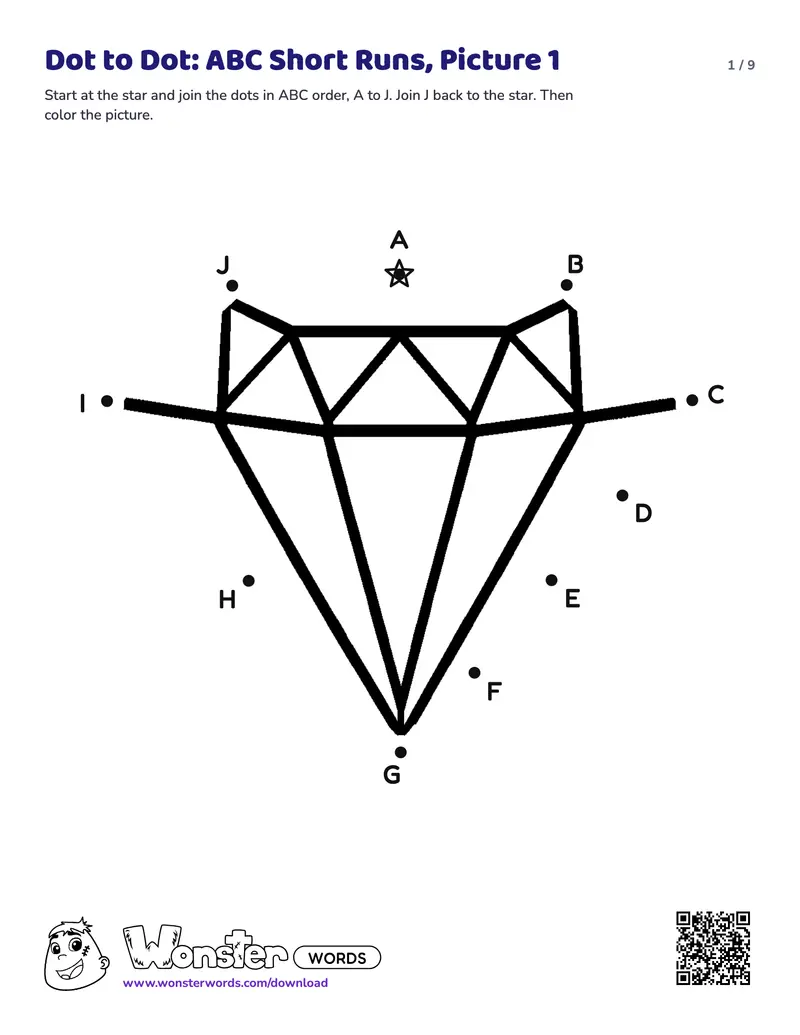
- Dot to Dot: ABC Short Runs (PDF)6 pictures · answer key included · 9 pages
Preview page 1Preview
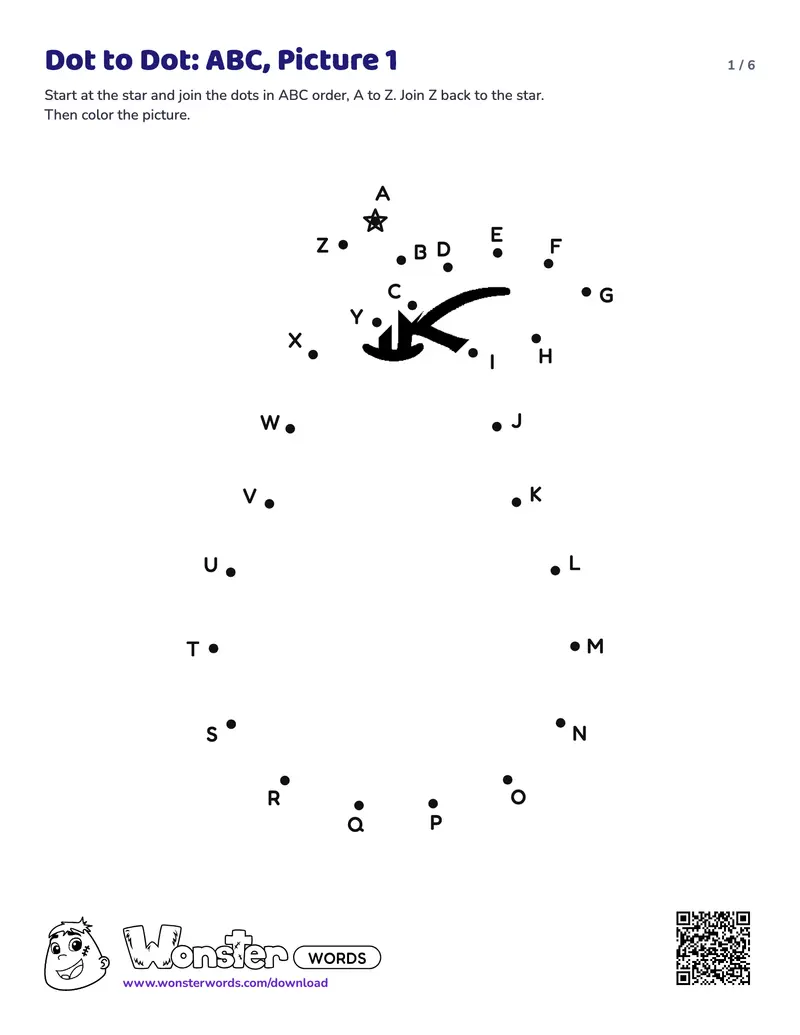
- Dot to Dot: ABC (PDF)4 pictures · answer key included · 6 pages
Preview page 1Preview
What does an alphabet dot to dot practice, and how is it different from a number one?
An alphabet dot to dot practices two things: the letter names in their order, and spotting each letter on a page where it is not next to the letters around it. On the full alphabet pages that happens in both cases, which is the Common Core kindergarten standard RF.K.1d: “Recognize and name all upper- and lowercase letters of the alphabet.”
It is practice, not a way to teach letters. Letters are taught in a teaching order, a few at a time, not A to Z: what order to teach letters explains why, and the alphabet and letter sounds covers how. The A to Z order on this sheet is the order of the alphabet song, which is the job it does.
Add the sound as you go. When the line reaches B, say its name, then its sound: /b/. The name is what the sheet practices, and the sound is the half that helps a child read. The two belong together because for many letters the name carries the sound. Rebecca Treiman and colleagues found that whether a letter’s sound is inside its name is one of the main things that decides which letter sounds a child knows. Our ABC games use the same move on letter cards.
An alphabet dot to dot and a number dot to dot practice the same skill on two different sequences. Each asks a child to find the next item in a sequence they know and draw a line to it. Neither is better: a child who counts confidently can use dot to dots to practice the alphabet, and a child who sings the alphabet easily can move to numbers.
Should your child start with the capital or the lowercase pages?
Start a 3- or 4-year-old on the short runs or the capital pages, and a child who already knows lowercase letters on the lowercase pages. Capitals are easier to tell apart, with far fewer look-alikes and no b, d, p and q to mix up, as our guide to letter formation explains. Most programs teach lowercase first, because almost everything a child will read is set in lowercase, so the lowercase pages are the ones closest to reading. Both cases are kindergarten expectations, and the Common Core standard RF.K.1d does not put one before the other.
| Your child | Start with |
|---|---|
| Is 3 or 4 and knows some capital letters | The short runs, A to J first |
| Knows most of the capital letters | The full alphabet, the two capital pictures |
| Knows the lowercase letters | The full alphabet, the two lowercase pictures |
| Mixes up b, d, p and q | The capital pictures, while the lowercase look-alikes settle |
This is a choice about which dot to dot pages to print first, not about which case to teach first. For that question, see the letter formation guide.
Alphabet dot to dot, letter tracing, coloring or flashcards?
An alphabet dot to dot, letter tracing, flashcards and coloring each do a different job, so use them together rather than more pages of one.
- Tracing practices forming each letter’s shape with a pencil. Dotted letters for tracing are a different sheet: letter tracing worksheets.
- An alphabet dot to dot practices finding and ordering letters someone else wrote.
- Flashcards practice naming one letter at a time, quickly.
- Coloring the finished picture is the reward, not the practice.
Keep the alphabet chart nearby to check a letter against: it shows every letter in both cases with one picture each. For a 3- or 4-year-old, our preschool worksheets put the other kinds of practice in one place: lines and letters to trace, letter names and sounds, and rhyming.
How do you do an alphabet dot to dot with your child?
Say the alphabet together first
Sing or say the letters on the page before your child picks up a pencil, so the order is fresh: A to Z, or the ten letters a short-run picture uses.
Find the star
The star marks the first letter, A or a on the full alphabet pages, A, K or Q on the short runs. Put your finger on it together.
Say the name, then the sound, before each line
Before drawing to a letter, say its name and then its sound: this is b, and b says /b/. The name is the order the sheet practices; the sound is the half that helps with reading.
Sing from the start when a letter cannot be found
If your child is stuck, sing the alphabet from the first letter on the page until you reach the one that comes next, then look for it again.
Close the picture and color it
Join the last letter back to the star, guess what the picture is, then color it. The answer key shows each finished picture.
In lowercase, b, d, p and q are easy to mix up. If your child stops at one, trace it together with a finger before going on. Mixing them up is normal at this age: why kids write letters backwards explains what helps.
To make your own, draw a simple shape lightly in pencil, put dots on its corners and along the long sides, and write the letters in order beside the dots instead of numbers, with a star on the first. Erase the pencil lines and swap: your child joins yours, and you join theirs.
Frequently asked questions
What age group is most appropriate for dot-to-dot alphabet learning?
Most children can do one from about 3 or 4, once they know some of the letter names, and the full A to Z pages fit kindergarten, where recognizing and naming every capital and lowercase letter is a Common Core standard. Start a younger child on the short runs, which use ten capital letters a picture.
Uppercase vs lowercase dot to dot puzzles: which is more beneficial?
Neither is better; they practice different letters. Capitals are easier to tell apart, with no b, d, p and q to mix up, so they make an easier start. Lowercase is what almost all reading material is set in, so a child who already knows it should do the lowercase pages.
Can dot to dot activities also teach letters alongside numbers?
Yes. An alphabet dot to dot and a number dot to dot practice the same skill, joining a sequence your child knows, with letters instead of numbers. A child who is confident counting can use that to practice the alphabet, and the other way round.
Is dot-to-dot teaching better than flashcards for alphabet learning?
They do different jobs. Flashcards practice naming one letter at a time, quickly. A dot to dot practices the alphabet's order and finding each letter on a busy page. Neither teaches letter sounds on its own, so say the sound with the name whichever you use.
How do dot to dot worksheets support fine motor skills in letter recognition?
A dot to dot asks a child to find a letter, hold a pencil and draw a line from one point to the next. That is pencil practice, but it is not how letters are formed: tracing and writing letters is a separate skill, practiced on letter tracing sheets.
How to make your own uppercase and lowercase dot to dot puzzles?
Draw a simple shape lightly in pencil, put a dot on each corner and a few along the long sides, and write the letters in order beside the dots, starting with a star on the first. Erase the pencil lines and swap with your child.
Are there digital applications available for dot-to-dot alphabet games?
Yes, some apps and websites offer alphabet dot to dots to trace with a finger. Paper has one thing a screen does not: a pencil, which is the tool your child will write with.
Related guides
Last updated
Looking for something else?
Looking for something else?