
Word List
Sight Word Bingo
Use free printable sight word bingo to turn the words your child meets most, like said, was, and they, into a game the whole family plays at the kitchen table. Every call is a word read aloud, every cover is a word read back, and the first to fill a line shouts Bingo! The sets cover kindergarten, 1st grade, and 2nd grade, plus the Dolch primer, first grade, and second grade lists, with three boards, covers, and caller cards in each.
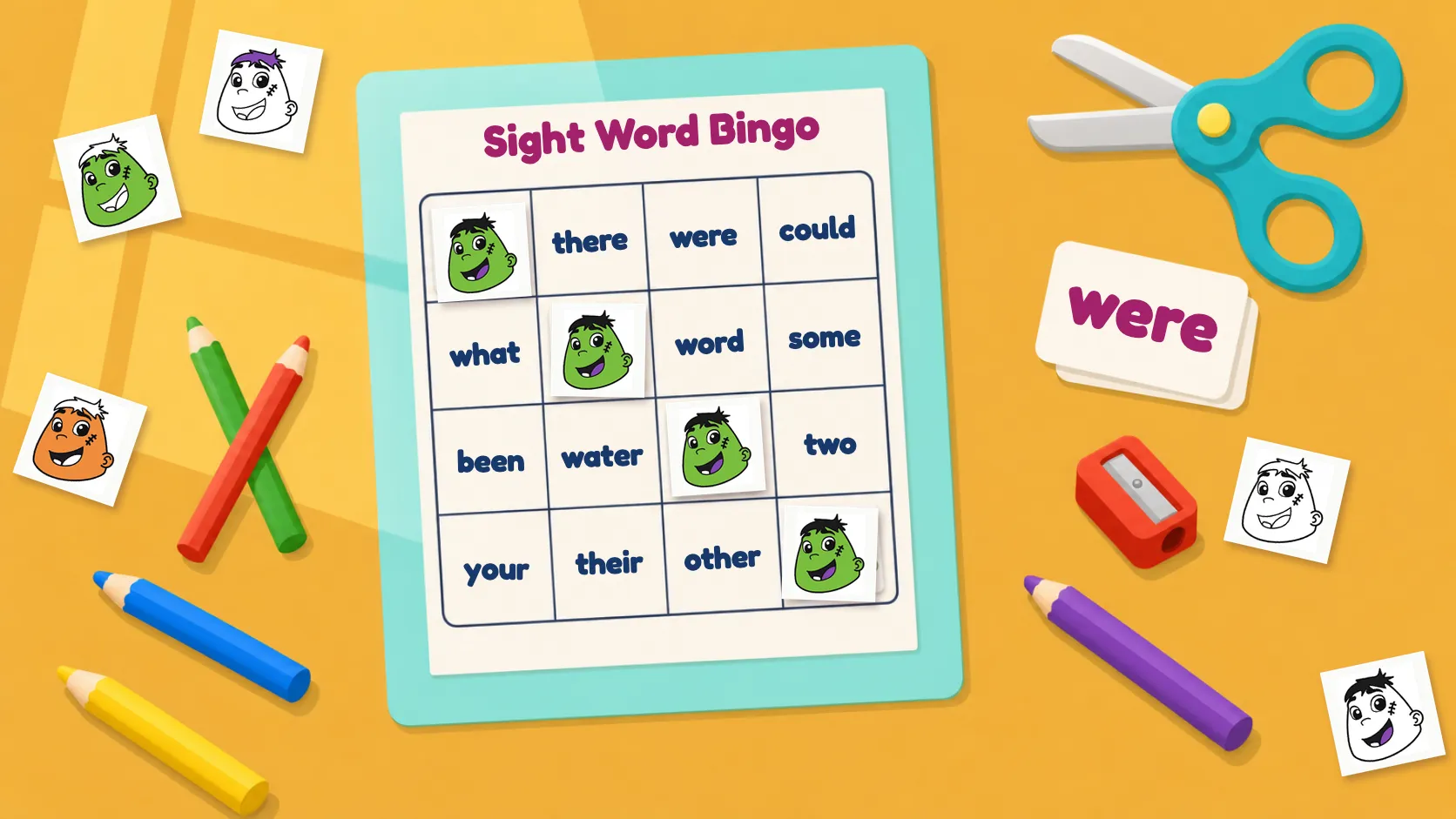
Sight word bingo practises the skill that makes reading flow: knowing a word the instant your child sees it. Reading researcher Timothy Shanahan puts the 100 most common words at about half of all the words a child sees in any text. Of the first 100 words on the Fry list, 30 are heart words: sight words that break the usual spelling patterns, such as said, of, and was. A child who reads those at a glance has their attention free for the words they need to sound out.
Bingo builds that instant reading on every call. The caller turns over a card and reads it, and each player finds the word on their board, reads it back, and covers it. Take turns being the caller, because the caller reads every word. The boards hold heart words only, because the words that follow the spelling patterns are better sounded out than matched on a board.
How do you play sight word bingo at home?
Sight word bingo needs one printed set, 2–4 players, and about 10 minutes.
- Print and cut. A set has three boards, a page of covers for each board, and the caller cards. Coins or buttons make good covers too.
- Call a word. Shuffle the cards, turn one over, and read it aloud.
- Find it, read it, cover it. Each player looks for the word on their board, reads it back, and covers it.
- Win with a line. The first player to cover a whole row, column, or diagonal wins: 3 in a row on a 3x3 board, 4 on a 4x4.
- Swap the caller. Your child takes the cards for the next game and reads every word.
Cover the words rather than crossing them out. A covered board can be played again tomorrow, so the same 9 or 16 words come back across the week. Stop while your child still wants another round. Our guide to teaching sight words covers how many new words to add each week.
Does sight word bingo help children remember words?
Sight word bingo helps a child remember words when the child reads them aloud. Spotting a word on a board is recognition: your child only has to tell said apart from the words around it. Reading it off a caller card is recall: they have to bring the whole word back from memory. A 2014 review of the research on practice tests by Christopher Rowland of Colorado State University, published in Psychological Bulletin, found that recall produced larger learning gains than recognition. That review pooled studies of every kind of learning, mostly with older students. A search of ERIC, the US Department of Education’s research library, finds no study of sight word bingo itself.
The general research points the same way as the read-back rule. When John Dunlosky and colleagues reviewed ten common study techniques in 2013, two earned their highest rating: practice testing (bringing the answer back instead of reviewing it) and distributed practice (spreading sessions out). A game of bingo on 3 or 4 evenings a week, with every covered word read aloud, is both.
Flashcards ask for recall on every card, so for memory alone they are the stronger practice. Bingo’s advantage is that it is a game the whole family plays, and it brings the same words back across the week without feeling like a drill. If your child enjoys flashcards, keep them, and save bingo for the evenings they would rather play. A child who plays happily and still forgets the words from one week to the next has a different problem. Our guide to sight words that will not stick works through it.
Which words go on a sight word bingo board?
Put only heart words on a bingo board: the sight words with a part that breaks the usual spelling patterns, such as said, was, and of. A word like can or went follows patterns your child learns in phonics, so it should be sounded out. Finding it by its shape on a board practises guessing instead. Our heart words guide shows which part of each heart word has to be learned by heart.
Most of a school sight word list can be sounded out. This site’s Dolch sight words page sorts the list’s 220 words into 49 heart words and 171 to sound out. Reading specialists Linda Farrell, Michael Hunter, and Tina Osenga, writing for Reading Rockets, draw the line differently and count 82 heart words. Even by their count, a child can sound out 138 of the 220.
The words to sound out can still be bingo, with your child as the only caller. Write them on a hand-drawn board for yourself and on cards for your child, who sounds out each card before reading it to you. Your child decodes every word, and the matching is your job.
Each set holds one list’s heart words, dealt onto three boards. A board smaller than its list draws its own words, so a called word can be missing from some boards.
| Set | Heart words | Board | Words on each board |
|---|---|---|---|
| Kindergarten | 9 | 3x3 | All 9 |
| 1st grade | 21 | 4x4 | 16 of the 21 |
| 2nd grade | 22 | 4x4 | 16 of the 22 |
| Dolch primer | 12 | 3x3 | 9 of the 12 |
| Dolch first grade | 11 | 3x3 | 9 of the 11 |
| Dolch second grade | 12 | 3x3 | 9 of the 12 |
Which sight word bingo board fits my child's grade?
The grade boards hold the heart words from this site's kindergarten, 1st grade, and 2nd grade sight word lists, which sort the first 200 Fry words by grade. Start at your child's grade, and if most of a board is new to your child, play the grade below first.
Kindergarten sight word bingo (3x3)
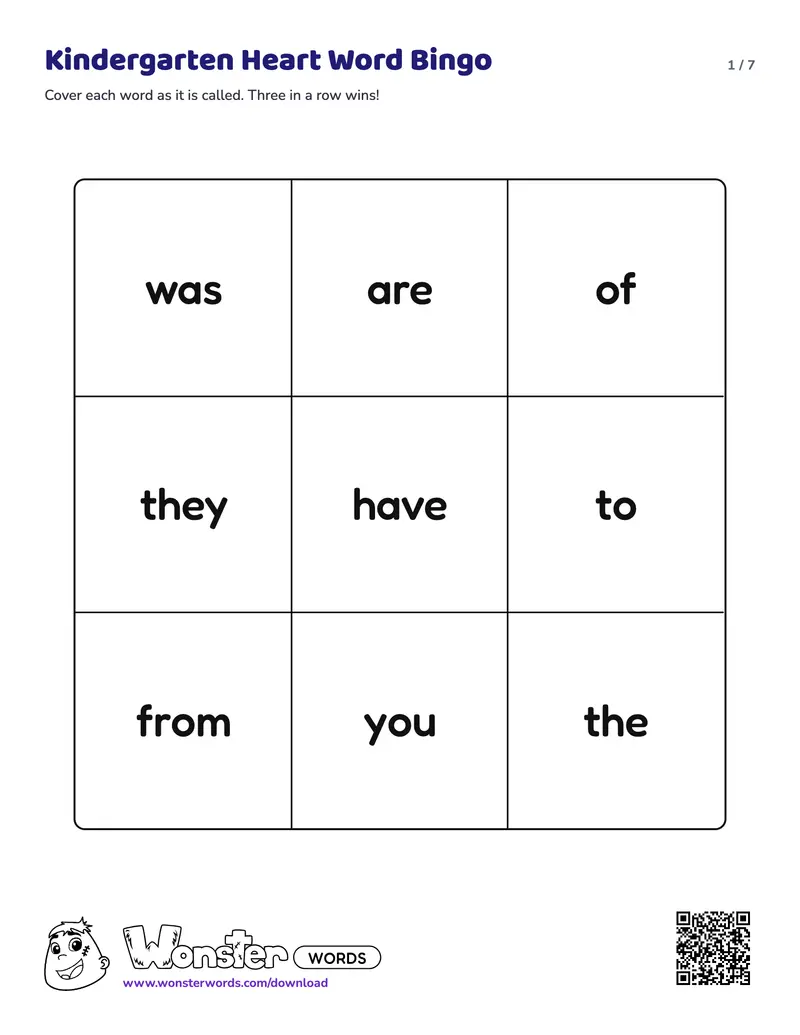
The 9 kindergarten heart words fill a 3x3 board exactly, so all three boards hold the same 9 words in a different order. Who wins depends only on where each word sits. The kindergarten sight words page has the other 16 words, the ones to sound out.
- the
- of
- to
- you
- was
- are
- they
- have
- from
Free PDF · no sign-up
Printables for Kindergarten Sight Word Bingo
From the Kindergarten Sight Words page.
- Kindergarten Heart Word Bingo (PDF)9 words · 7 pages
Preview page 1Preview
1st grade sight word bingo (4x4)
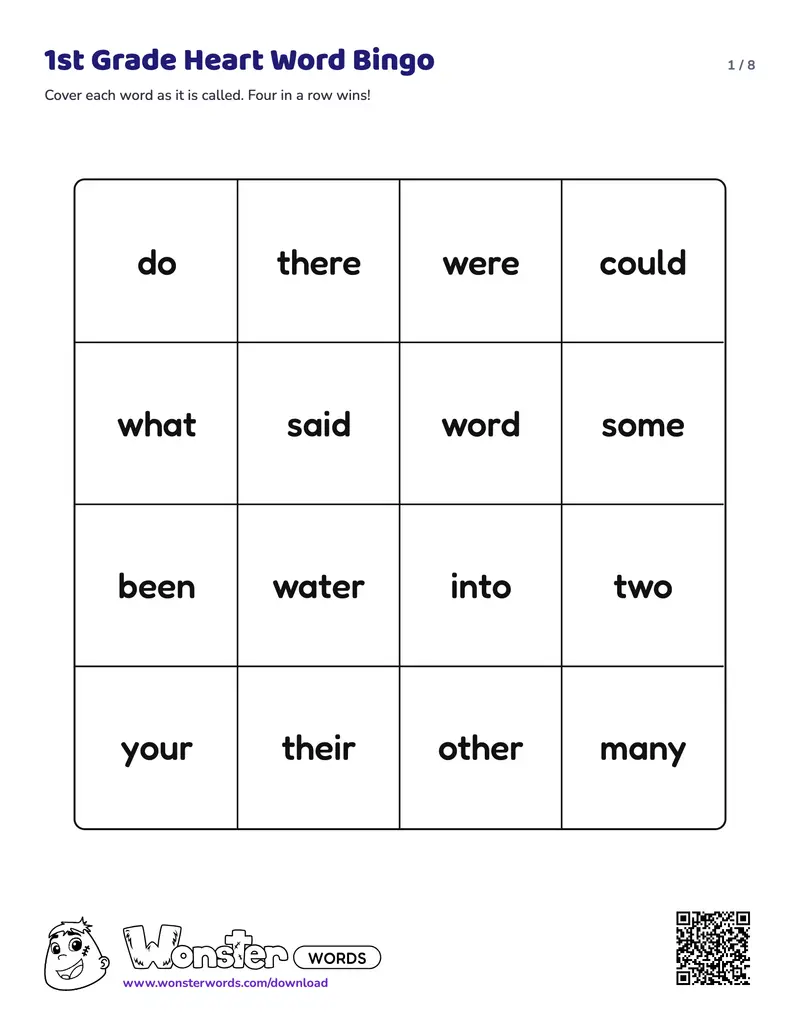
The 21 first grade heart words make 4x4 boards, and each board draws its own 16 of them. A called word is on some boards and not on others. The 1st grade sight words page lists all 75 first grade words, sorted the same way.
- one
- word
- what
- were
- your
- said
- there
- do
- their
- other
- many
- some
- would
- into
- two
- could
- people
- water
- been
- who
- come
Free PDF · no sign-up
Printables for 1st Grade Sight Word Bingo
From the 1st Grade Sight Words page.
- 1st Grade Heart Word Bingo (PDF)21 words · 8 pages
Preview page 1Preview
2nd grade sight word bingo (4x4)
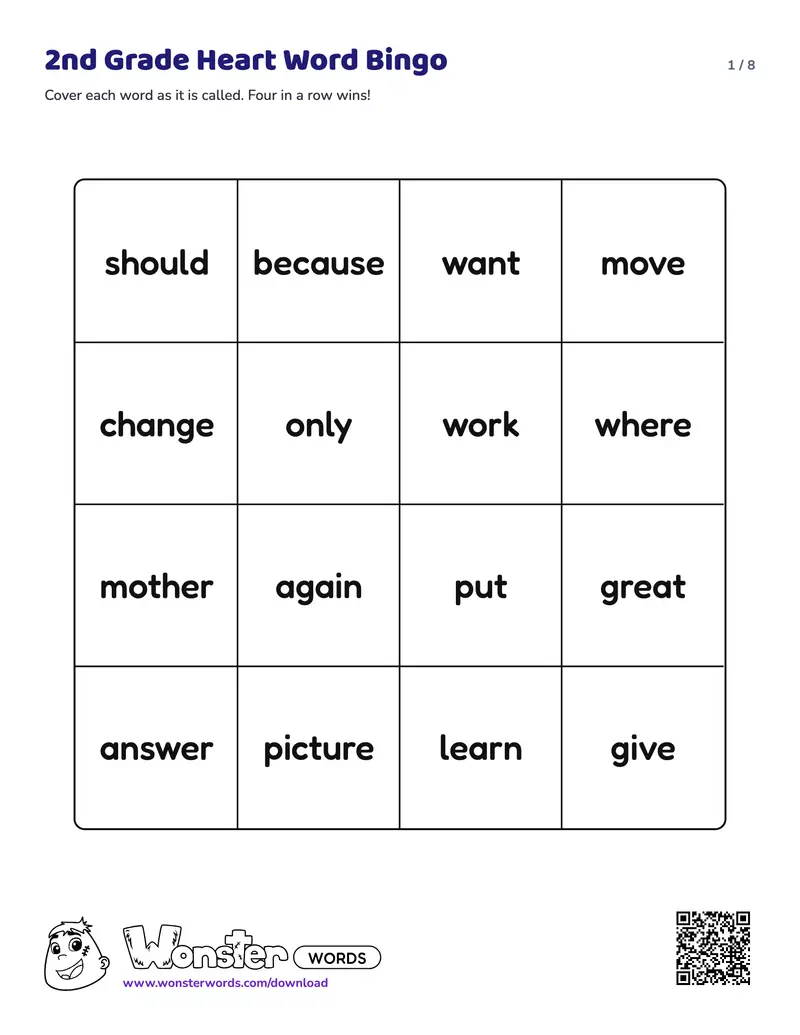
The 22 second grade heart words make 4x4 boards, each drawing its own 16. The 2nd grade sight words page has the rest of the list.
- only
- work
- live
- give
- great
- where
- through
- any
- want
- put
- does
- another
- because
- move
- picture
- again
- change
- mother
- answer
- learn
- should
- world
Free PDF · no sign-up
Printables for 2nd Grade Sight Word Bingo
From the 2nd Grade Sight Words page.
- 2nd Grade Heart Word Bingo (PDF)22 words · 8 pages
Preview page 1Preview
Which bingo boards go with the Dolch sight word list?
The Dolch list sorts its 220 words into five levels, from pre-primer to third grade, and three of them have enough heart words for a board. Pre-primer has 8 heart words and third grade 6, too few for a 3x3 board's 9 squares. For those two, draw a 3x3 grid by hand and fill the spare squares from the next level up.
Dolch primer sight word bingo (3x3)
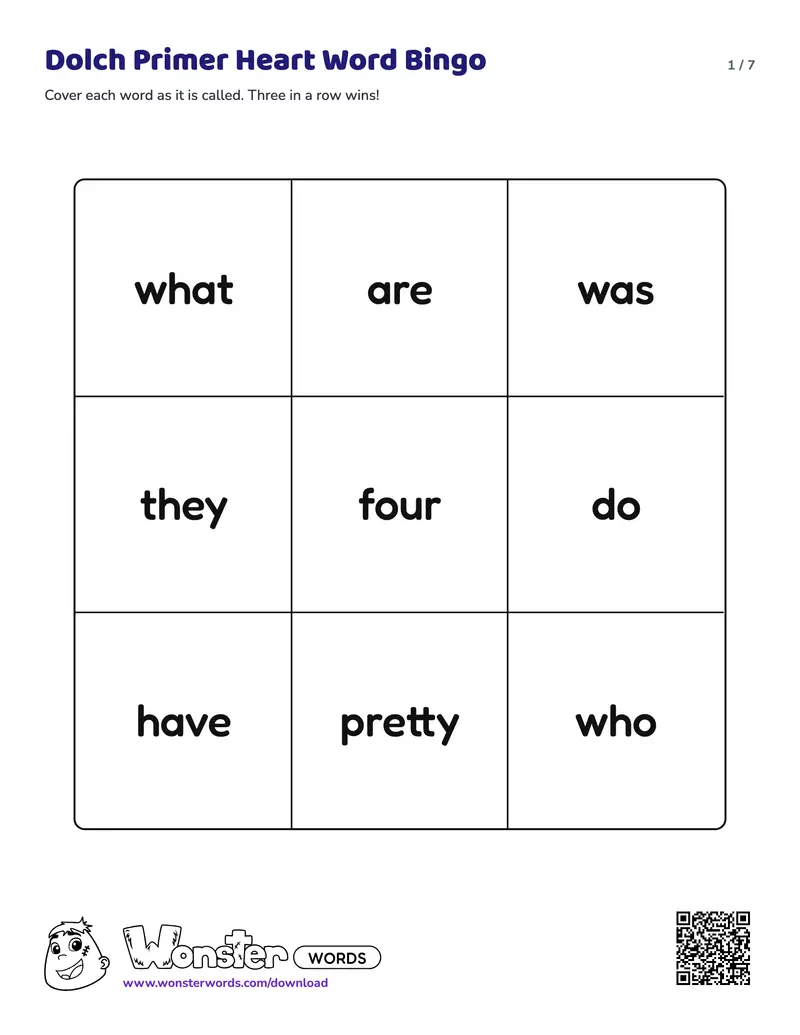
Primer is the Dolch list’s kindergarten level. Its 12 heart words make 3x3 boards, each drawing its own 9, so 3 of the 12 caller cards are missing from any given board. The Dolch page’s primer list has the primer words to sound out as well.
- was
- they
- there
- have
- do
- what
- are
- into
- want
- pretty
- four
- who
Free PDF · no sign-up
Printables for Dolch Primer Sight Word Bingo
From the Dolch Sight Words page.
- Dolch Primer Heart Word Bingo (PDF)12 words · 7 pages
Preview page 1Preview
Dolch first grade sight word bingo (3x3)
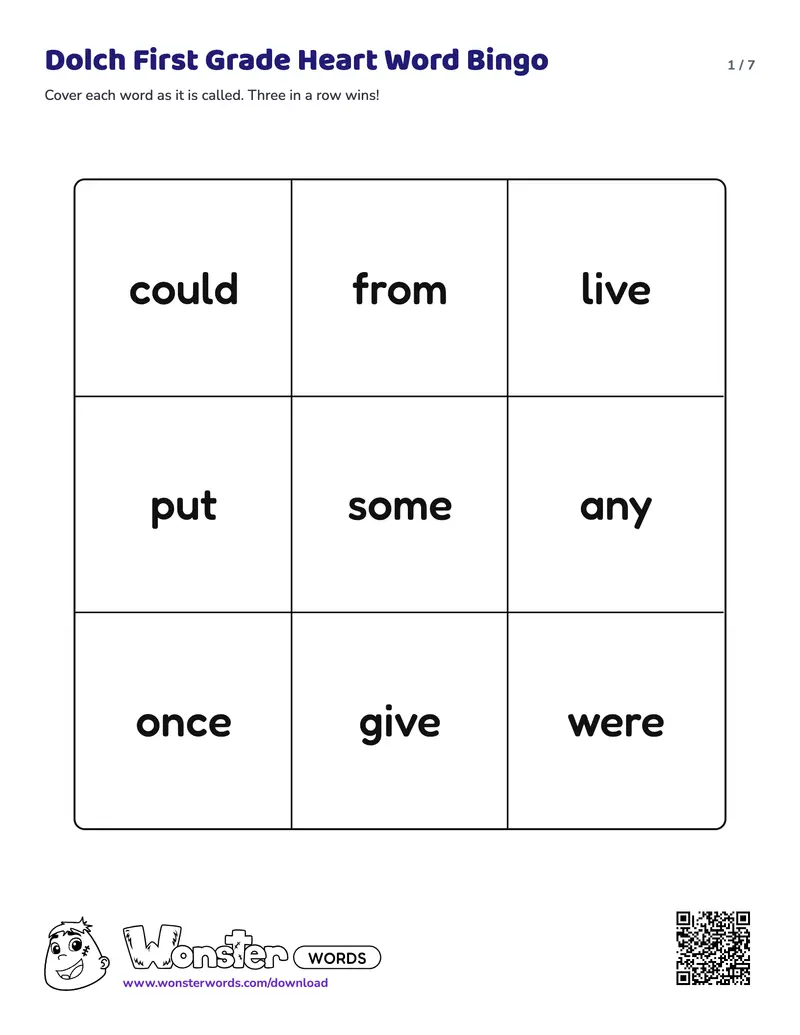
The Dolch first grade level has 11 heart words, and each 3x3 board draws its own 9. Once and live are worth reading aloud slowly: once starts with a sound its letters do not show, and live is said two ways. The Dolch first grade words include 30 more to sound out.
- of
- some
- could
- were
- from
- any
- put
- again
- give
- once
- live
Free PDF · no sign-up
Printables for Dolch First Grade Sight Word Bingo
From the Dolch Sight Words page.
- Dolch First Grade Heart Word Bingo (PDF)11 words · 7 pages
Preview page 1Preview
Dolch second grade sight word bingo (3x3)
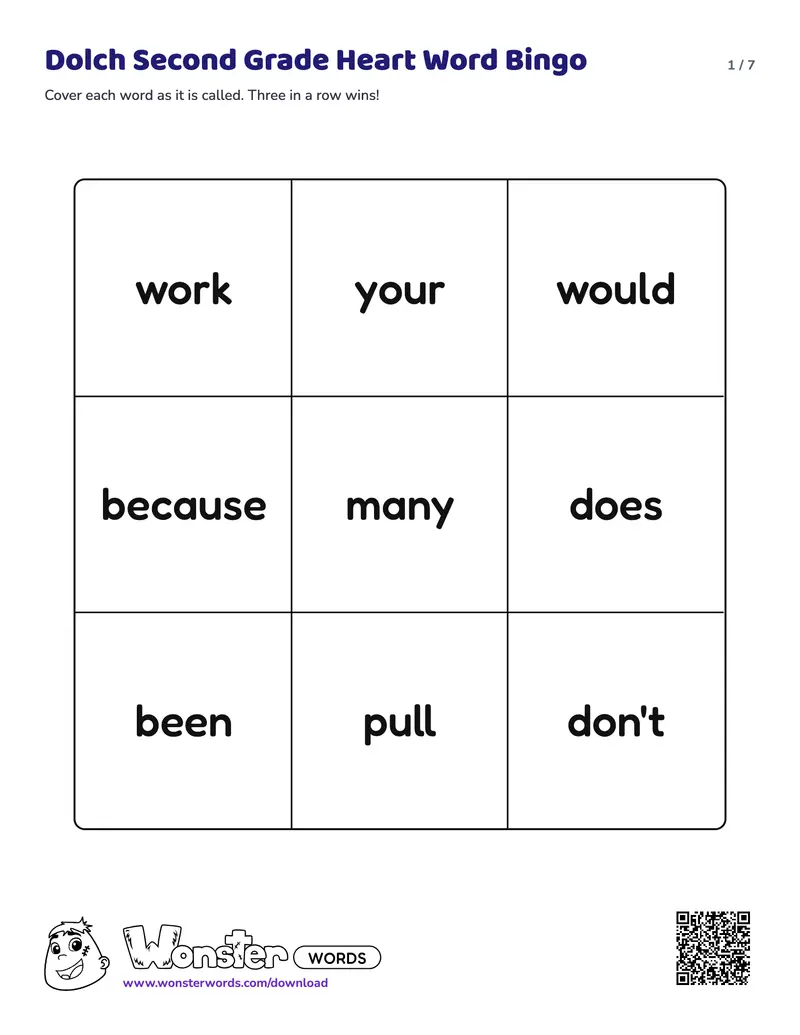
The Dolch second grade level has 12 heart words, and each 3x3 board draws its own 9. The 6 third grade heart words (eight, only, warm, full, done, and laugh) plus 3 from this level fill a hand-drawn 3x3 board. The Dolch second grade words include 34 more to sound out.
- would
- your
- don't
- their
- wash
- been
- work
- does
- buy
- pull
- because
- many
Free PDF · no sign-up
Printables for Dolch Second Grade Sight Word Bingo
From the Dolch Sight Words page.
- Dolch Second Grade Heart Word Bingo (PDF)12 words · 7 pages
Preview page 1Preview
How do you make sight word bingo easier, harder, or your own?
Make sight word bingo easier by showing the caller card as well as reading it, so your child can match the letters while they learn the word. Play to a single line, on a 3x3 board. For a child still learning letter sounds, play the letter bingo on our beginning sounds worksheets instead. Its caller says a letter’s sound, and each player finds the letter.
Make it harder by playing to a full board, so every word on it has to be called and read. For a second step up, the caller says each word in a sentence and the players pick it out.
Play phonics bingo for the words your child should sound out. The r-controlled vowel words and VC words pages each have a bingo set. Every word on it follows the pattern on that page, so a child reads each one by its sounds.
Brothers and sisters at different levels can share one game. Give each child a board from their own grade, shuffle both sets of caller cards together, and have a player read back only the words on their own board.
To make your own board, draw a 3x3 grid and write 9 heart words in it, in a different order on each player’s board. Write the same 9 on cards for the caller. Our sight word games guide has this version and eight more games you can play tonight with things already in the house.
Online sight word bingo games let a child play alone. A printed board keeps you at the table, where you can hear whether your child reads each word or guesses it.
Frequently asked questions
Is sight word bingo better than flashcards for memorisation?
Not for memory alone. A flashcard asks your child to recall the word every time, and recall is the stronger kind of practice. Bingo's advantage is that it is a game the whole family plays, and it brings the same words back across the week without feeling like a drill. It works best when every player reads each word aloud as they cover it.
What age group benefits most from sight word bingo?
Children in kindergarten through 2nd grade, ages 5–8, while they learn their heart words. The kindergarten board's 9 words suit a beginner, and the 4x4 boards suit a 1st or 2nd grader.
Which sight words are most effective to use in bingo games for beginners?
Heart words, the sight words with a part that breaks the usual spelling patterns. For a beginner, start with the 9 kindergarten heart words: the, of, to, you, was, are, they, have, and from. Words a child can sound out, such as can or went, are better sounded out than found on a board.
How long does a typical game of sight word bingo last?
A game can end after as few as 3 calls on a 3x3 board and 4 on a 4x4, since a line is that many words long. Several games fit in one sitting. Keep the whole session to about 10 minutes, as the how-to-play box on every set suggests, and stop while your child still wants another round.
Is sight word bingo suitable for preschoolers as well?
Only once a preschooler can read a few words. Before that, letter bingo practises the step that comes first: the caller says a letter's sound, and each player finds the letter and covers it.
How do I make my own sight word bingo cards?
Draw a 3x3 grid for each player and write 9 heart words in it, in a different order on every board. Write the same 9 on small cards for the caller, and use coins or buttons as covers. Nine words are enough for a real game, because who wins depends on where the words sit.