App Guides
Do Reading Apps Actually Work?
What they do well, where they fall short, and how to tell if they can help your child.
Yes. Good reading apps can help children build early literacy skills, especially the foundational skills that benefit from focused, repeated practice: things like letter sounds, phonics, blending, and sounding out words.
The research is particularly encouraging for younger children. In the largest independent review of the evidence, which pooled 36 studies of children from preschool through third grade, educational apps produced measurable gains in literacy. The strongest results were seen in preschoolers and in targeted skills such as letter-sound knowledge and decoding.
That doesn’t mean an app can do every part of the job. Vocabulary, comprehension, and a lasting love of reading grow through a much wider range of experiences: conversations, books, background knowledge, and reading with other people. Reading apps are best understood as one tool within that larger picture.
So the more useful question isn’t simply “Do reading apps work?” It’s “Is this app helping my child practice the right skills in an effective way?”
Fortunately, you don’t have to rely on an app’s marketing claims to answer that. There are a few simple things you can look for, and a couple of easy ways to tell whether what your child is learning in the app is carrying over into real reading.
The short version
- Yes. Across 36 studies, apps produced a measurable improvement in early literacy.
- Younger children gain the most. Effects were roughly twice as large for preschoolers as for school-age children.
- They’re strongest on foundational skills. Letter sounds and sounding out words, yes. Vocabulary and comprehension come from elsewhere.
- You don’t need to hit a time target. Short sessions and long ones showed no meaningful difference, so consistency matters more than minutes.
- They work best alongside you, not instead of you. The strongest results came from settings where an adult was also involved.
- Ignore claims about your child’s “learning style.” The idea that children are visual or auditory learners, and do better when teaching is matched to it, hasn’t held up in research. What helps every child is teaching that uses sight, sound and movement together.
The rest of this page explains where those come from and what to do with them.
Do reading apps improve literacy skills?
Yes. Research suggests that well-designed reading apps can help children build important early literacy skills, especially phonics, letter-sound knowledge, and decoding.
That makes sense when you look at what we already know about how children learn to read. Decades of research support systematic, explicit phonics instruction: teaching children how letters represent sounds and how those sounds combine to form words. The National Reading Panel found that this kind of instruction improves children’s reading outcomes. A good reading app can provide that same kind of structured practice, in a format children will come back to again and again.
What does the research on reading apps show?
One of the strongest reviews of the evidence is “Measures Matter”, a 2021 meta-analysis published in AERA Open. Researchers combined the results of 36 studies involving children from preschool through third grade.
Their overall finding was encouraging: educational apps produced measurable improvements in children’s literacy skills.
The benefits were especially strong in two areas:
| Apps showed the strongest results for | Benefits were smaller for |
|---|---|
| Preschool-age children | Older elementary-age children |
| Letter sounds and phonics | Vocabulary |
| Sounding out and decoding words | Reading comprehension |
In other words, reading apps appear to work particularly well for the kinds of skills that benefit from lots of focused, repeated practice.
Apps are especially useful for building foundational reading skills
The study found larger gains for narrow literacy skills such as letter-sound knowledge and decoding than for broader skills such as vocabulary and comprehension, and that distinction is worth holding onto. A child can practice hearing the sound /m/, connecting it to the letter m, and blending sounds together dozens of times in a single sitting. Immediate feedback and repetition at that volume are what make digital practice so well suited to these foundational skills.
Vocabulary and reading comprehension develop differently. They depend heavily on conversations, background knowledge, being read to, and discussing books and ideas with other people. An app can contribute, but it cannot replace those experiences.
So the takeaway isn’t that reading apps need to teach everything. It’s that they can be very useful at the part of learning to read they are best designed to teach.
Younger children may benefit the most
The research also found larger effects among preschoolers than among children ages five to eight.
For families introducing letters, sounds, and early word reading, that is encouraging. These are precisely the years when children are laying the foundation for decoding.
That doesn’t mean reading apps suddenly stop helping once a child starts kindergarten. A five- or six-year-old who is still learning to blend sounds or decode unfamiliar words is working on the same foundational skills where apps showed their strongest results.
Our age-by-age guide explains what to look for as children progress, and when it makes sense to move beyond a phonics-focused app.
What should parents expect?
Think of a reading app as a practice tool, not a complete reading curriculum.
The research suggests that apps can meaningfully strengthen the skills they teach directly. What they are less likely to do on their own is produce equally large improvements across every part of reading.
That’s not necessarily a weakness. We don’t expect flash cards, bedtime stories, or conversations with a parent to do every job either. The better question is whether the app is helping your child practice an important reading skill effectively, and for phonics and early decoding the evidence says it can.
More screen time isn’t necessarily better, either. In the meta-analysis, researchers did not find a consistent relationship between outcomes and the number of sessions, minutes per session, or weeks children used an app. Quality and focus appear to matter more than simply accumulating minutes.
What made the research settings work
Ninety-two percent of the studies in the 2021 AERA Open meta-analysis took place in schools rather than homes. That is worth knowing, because it tells you something useful: the conditions that produced those results are ones you can recreate.
Practice happened consistently. In a classroom, the session is on a timetable, so it takes place whether or not anyone feels like it that day. At home, the equivalent is a habit rather than a schedule, and the most reliable way to build one is to keep sessions short enough that your child is happy to return to them. Consistency over weeks is what produced the gains, not any particular session length.
An adult was usually nearby. The researchers suggest that shared attention is part of why results were strongest with preschoolers. They also rated the apps they reviewed on several dimensions of quality, and the lowest-scoring one across the board was whether an app encouraged any interaction between child and adult. That gap is easy to close at home and costs nothing: you don’t need to supervise every session, but sitting nearby some of the time is one of the highest-value things you can do, and you’ll hear exactly what the app is teaching.
Neither of these is a reason to expect less from an app at home. They are simply the two conditions worth copying, and both are within reach of any family.
How can I tell whether an app is working?
You do not need to be a reading expert to get a good sense of whether an app is helping your child. A few simple checks can tell you a lot: what your child is practicing, how actively they are participating, and whether those skills are starting to show up outside the app.
Our full phonics app comparison goes deeper into things like instructional sequence, audio quality, blending practice, and progress reporting.
Watch for ten minutes. Sit with your child and notice what they are actually doing. Are they hearing sounds, choosing letters, blending words, and responding to questions? Or are they mostly watching? Animations, stories, and rewards are part of what keeps practice enjoyable enough to continue, but if most of the time goes on videos, collecting things, and decorating a character, your child may be playing a game with some letters mixed in. The playful elements should support the learning, not replace it.
Look for words your child could not have memorized. Apps are at their best teaching children to decode: turning letters into sounds, and sounds into words. The clearest sign one is doing that, rather than building up a memorized list, is that it regularly asks your child to read something new. Some programs use invented words for exactly this reason, because a word that cannot be memorized can only be sounded out.
Check whether it shows up on paper. This is the one that matters most, and it takes a minute. Write a simple word your child has not practiced in the app and ask them to read it. If what they learn on screen carries over to paper, the app is doing its job. Our reading check-in walks through what to expect at each age.
Apps or books?
Both. Apps and books are good at different things, and your child needs both.
Apps are built for repetition. Sounding out becomes automatic through practice, and that’s the part that’s genuinely hard to keep up at home. An app never gets tired, never mispronounces a sound on the fortieth repetition, and is happy to do it again tomorrow. That’s real value, and it’s the reason a phonics app earns its place.
Books do the things practice can’t. Vocabulary beyond everyday speech, sentences no app will show your child, how stories work, and the reason to want to read in the first place. Plus a person noticing exactly where your child got stuck.
One research finding is worth knowing here. A 2018 meta-analysis led by Pablo Delgado in Educational Research Review pooled 54 studies covering more than 171,000 readers and found better comprehension from paper than from screens reading the same text, with the paper advantage growing rather than shrinking over the years studied.
It’s narrower than it sounds, though. That advantage showed up for informational texts rather than narrative ones, and most of what you read with a five-year-old is a story. It also isn’t a finding about phonics practice, which is a different activity again. Read it as a good reason to keep story books physical, not as a reason to worry about a bedtime story on a screen.
So can an app replace reading with your child? No, and any app suggesting otherwise is overselling. The app handles the drilling. You handle the reading. That division of labour is what makes both of them work.
How do apps compare to a tutor or a classroom?
A good tutor working one-to-one is hard to beat, and if that’s available to you, take it. For most families it isn’t, which makes it the wrong comparison.
A classroom does plenty an app never will. What it can’t do is give your particular child forty minutes of blending practice on the sound they keep missing, because there are twenty-three other children in the room. That’s exactly the gap an app is well suited to fill, and it’s why apps and school work well together rather than competing.
For most families the real comparison is an app against nothing in particular on a Tuesday evening. On that comparison an app does very well.
Do gamified reading apps work better?
Yes, and for a reason that matters more at home than it does in a study: children keep doing them.
Phonics takes repetition, and repetition is boring. Worksheets and flashcards deliver the same content, and plenty of children resist them within two weeks. A program abandoned in week two teaches nothing, however well designed. The best method is usually the one your child will keep coming back to, in much the same way that the best exercise routine is the one you’ll actually do. Games are how you get a four-year-old to do something forty times.
Worth watching for: your child should be enjoying the practice itself, not only the stickers and the character they get to dress up. A child can love an app and learn a little less from it than they could. That’s what the ten-minute watch and the paper test above are for.
Can children learn phonics through play?
Yes, and it’s one reason app effects in the research were largest for the youngest children. The phrase gets used two different ways, though, and the difference matters when you’re choosing an app.
It doesn’t mean children work phonics out for themselves. Phonics should be taught explicitly. Leaving a child to discover that sh says /sh/ is the approach the research moved away from.
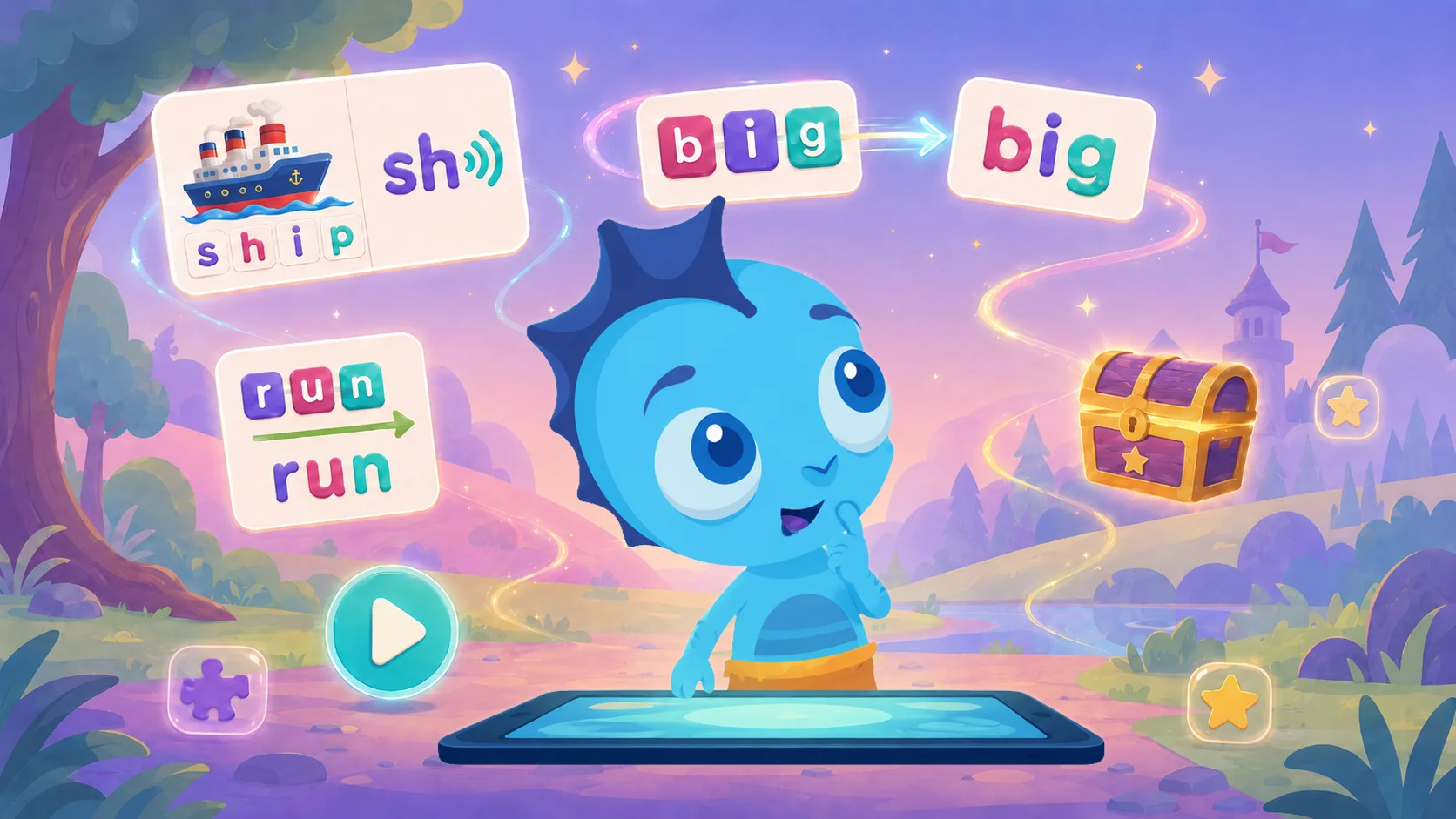
It means the teaching is explicit and the experience is play. Your child is told directly what sh says, then meets it forty times inside something that feels like a game. The instruction is systematic. The wrapper is playful.
That’s what separates a good phonics app from a worksheet. Both deliver the same explicit content, but only one of them gets done again tomorrow. It’s also the design principle behind our own app: the sequence underneath is fixed and explicitly taught, and your child experiences it as a game.
Play does three things here:
- Sustains repetition, which is what phonics practice needs most.
- Lowers the stakes for a child who has already struggled and started to dread it.
- Makes abstract things concrete: letters moving together so a child hears the sounds join.
It was never play versus instruction. The question is whether the instruction arrives in a form a four-year-old will engage with.
Do reading apps support different learning styles?
You’ll see apps advertised as supporting visual, auditory or kinesthetic learners. The idea behind that pitch is that every child has one channel they learn best through, and that teaching delivered through it will work better than the same teaching delivered another way. It’s the second half that hasn’t held up, and that’s good news, because it means one less thing to worry about.
Children do have preferences. Matching the teaching to them doesn’t improve results. A well-known 2008 review led by Harold Pashler in Psychological Science in the Public Interest found that although learning styles are enormously popular, studies designed properly to test the idea almost never show that matching teaching to a supposed style improves anything.
What does work is teaching that uses several senses at once. Seeing a letter, hearing its sound, saying it aloud and moving something with your hands gives your child more routes into the same information. That’s a core principle of structured literacy approaches like Orton-Gillingham, and its strength is that it helps every child rather than a particular type.
So you don’t need to work out what kind of learner your child is before you choose an app, and you don’t need to trust an app that says it has worked it out for you. Look for one that uses more than one sense at a time. That covers it.
How should my child use a reading app?
Short and often, and stop counting minutes. Session length, session count and program duration all failed to predict results consistently, so the clock isn’t the thing to manage. Aim for sessions short enough that your child would happily do it again tomorrow. Coming back matters far more than staying long, and that’s a much easier target to hit.
Sit nearby when you can. As above, this is the one dimension the researchers found apps weakest on, and the easiest for a parent to supply.
Keep checking that it transfers. The paper test above isn’t a one-off. Come back to it every few weeks. It’s the measure that tells you it’s working.
Keep reading together. The research points the same way every time: these tools do their best work alongside an adult. The American Academy of Pediatrics puts reading aloud with your child at the centre of its early-literacy guidance, and asks pediatricians to encourage it from the newborn period onward. It is the one thing on this page that no app is trying to replace.
So should we use a reading app or not?
For a three to six year old working on letter sounds and sounding out words: yes. This is the job apps are demonstrably good at, and it’s also the job that’s hardest to do well at home. Getting a child through a hundred correct repetitions of a sound they keep missing is tedious, easy to get wrong, and the first thing to fall off a busy week. An app doesn’t get tired and doesn’t mispronounce anything on the fortieth try. That’s a genuinely useful thing to hand off. If you’re at the point of picking one, our guide to choosing a reading app walks through the decision.
For vocabulary, comprehension and a love of books: keep doing that yourself. Those grow through being read to, being talked with, and having someone notice what your child didn’t understand. It’s the best-spent time you have, and no app is a substitute for it.
For a child already reading simple text: they’ve probably outgrown it. Phonics apps have done their work by then, and what helps next is volume, which mostly means books.
So the realistic expectation is a real improvement in your child’s early reading skills, for a young child, practicing briefly and often, with you around some of the time. That’s a more specific promise than most of this industry makes, and it’s worth more, because it’s the part that holds up.
The researchers behind the largest meta-analysis put it as moving past whether apps work to how and under what conditions good ones help. On the evidence, those conditions are: a young child, a foundational skill, short sessions, and a parent who stays part of the picture. All four are within reach.
Research cited was reviewed in August 2026.
Frequently asked questions
Do reading apps improve literacy skills?
Yes, and the research is specific about where. Independent analyses of dozens of studies find positive effects, strongest for preschoolers and for narrow skills like letter sounds and sounding out words.
Are apps better than books?
They do different jobs. Apps deliver repetition; books deliver vocabulary, language and the reason to read at all. Children whose parents do both do best. If you are choosing between apps, our phonics app comparison covers the paid ones and there is a separate guide to the free options.
Can an app replace reading with my child?
No, and the research is consistent on this. Digital tools work best alongside adult involvement rather than in place of it.
How much app time is useful?
Less than you would think, and the exact number matters less than you would think. The largest meta-analysis found no consistent link between time spent and results. Keep sessions short enough that your child comes back tomorrow.
How do I tell if an app is research-based?
Almost no individual app has published research on itself. Of the 36 apps in the largest meta-analysis, the authors judged that only six would meet the federal ESSA Tier I evidence standard. Judge the design instead: a visible sequence, clean audio, explicit blending practice, unfamiliar words, and progress you can actually see.
Do gamified apps work better?
They work better if the child keeps using them, which matters more at home than in a study. But enjoying an app is not the same as practicing with it. Watch what your child actually does for ten minutes.
Is screen time bad for early reading?
The research on reading comprehension favors paper over screens, which is a good reason to keep books physical. Practicing letter sounds is a different activity, and the evidence there is positive. Current AAP guidance focuses on content quality and whether screens are crowding out sleep, play and conversation rather than on a fixed number of minutes.
Related guides
Last updated