Phonics
My child knows letter sounds but can't sound out words
The most common place children get stuck learning to read. Why it happens, and the techniques that fix it.
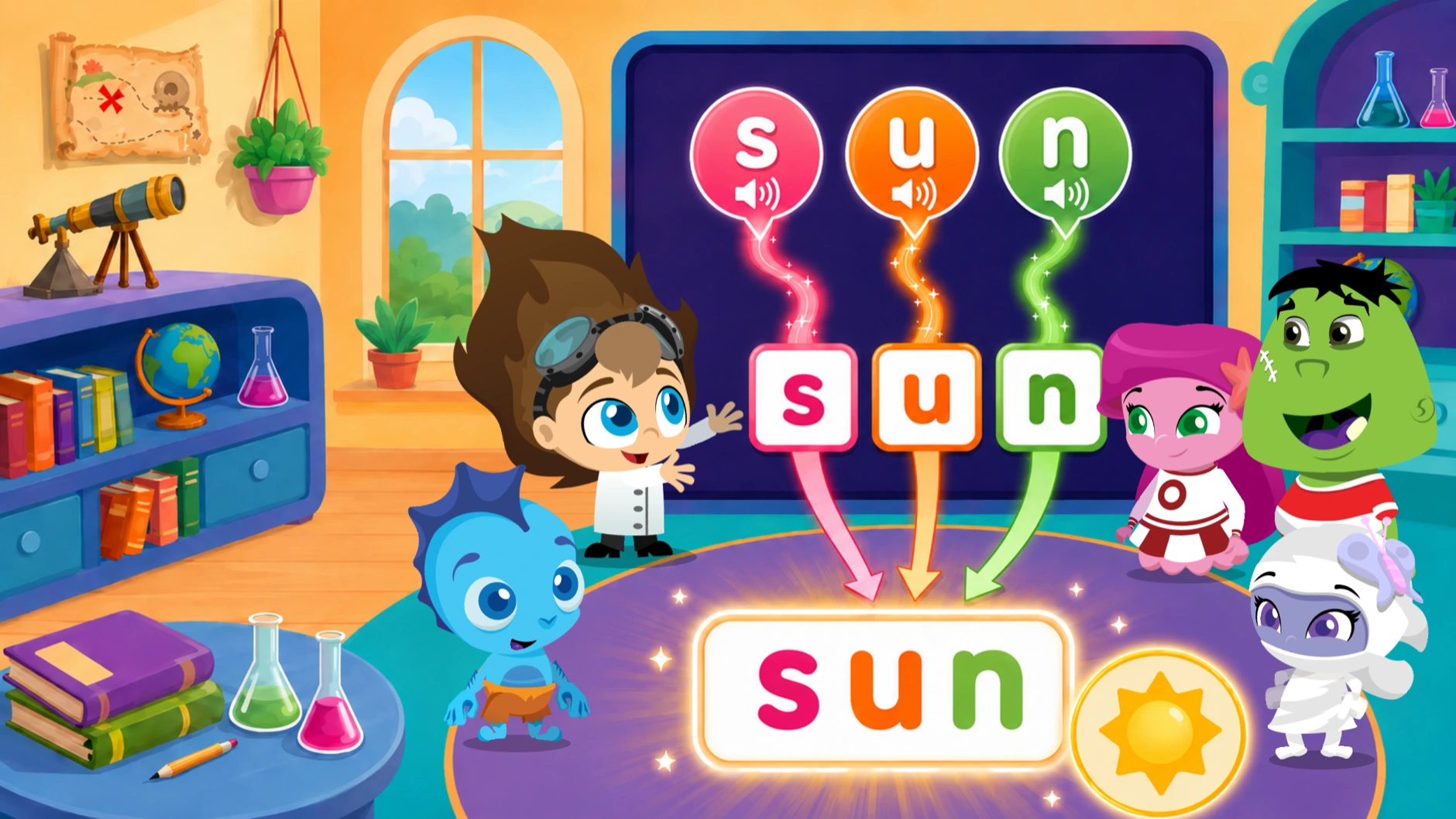
This is the single most common place children get stuck when learning to read, and it is almost always a technique problem rather than a problem with your child. Knowing letter sounds and pushing them together into a word are two different skills, and the second does not automatically follow from the first. Teachers call that second skill blending, and if your child’s teacher has mentioned it, this is what they meant.
The fix is usually smaller than parents expect. Most children who are stuck here are hearing sounds with an extra vowel attached, “buh” instead of /b/, which makes words impossible to assemble. Changing how the sounds are said, and stretching them together without stopping, resolves it for a large share of children within a few weeks.
Here is why it happens, what to do instead, and how to tell whether it is working.
Why children who know their letter sounds still can’t blend
Four causes account for most cases, and more than one can be true at once.
The sounds are being said with an extra vowel. This is the most common cause by a wide margin. If /b/ is pronounced “buh” and /t/ as “tuh”, then “bat” comes out as “buh-a-tuh”, which is not a word and never will be. Children are doing exactly what they were taught and still cannot get to the answer. Say the sounds as cleanly as you can, clipping the consonants short.
Some sounds are harder to say cleanly than others. /b/, /d/, /g/, /k/, /p/ and /t/ almost invite a schwa, because they stop the moment they start. Getting them as short as you can is enough. You do not have to be perfect, only closer.
There is too much space between the sounds. A child who says /c/ … /a/ … /t/ with a pause between each has usually forgotten the first sound by the time they reach the third. Blending needs the sounds close enough together that they overlap into a word.
The underlying sound skill is not there yet. Blending letters is harder than blending sounds. If a child cannot answer “/c/ /a/ /t/, what word is that?” spoken aloud with no letters in front of them, then letters are not the place to start. There is a quick check for this further down.
Too much is being asked at once. Three sounds, unfamiliar letters, and a parent watching is a heavy load for a five-year-old. Reducing to two sounds often unlocks it immediately.
Is this normal at my child’s age?
Yes, at most of the ages parents ask about. The range of normal here is wide.
Age 4. Many four-year-olds can blend sounds spoken aloud but not letters on a page. That is developmentally typical and not a cause for concern.
Age 5. This is the year blending usually clicks, often mid-year. A five-year-old who knows letter sounds but cannot yet blend them is in an extremely common position, which is why this question is asked so often.
Age 6. Most children are blending simple three-sound words by now. If your six-year-old still cannot, it is worth working on deliberately and worth mentioning to their teacher, but it is still fixable and still common.
Age 7 and beyond. Persistent difficulty at this stage is worth a conversation with the school. See the section on when to seek help.
A child can also blend one day and not the next. Early skills are unstable before they are automatic, and a bad session is not evidence of regression.
What to do instead: techniques that actually work
Each of these can be done tonight with no materials.
Stretch the sounds without stopping
Instead of /c/ /a/ /t/ with pauses, say it as one continuous stream: “caaaaaaat”, holding each sound into the next without a break. This is called continuous blending, and it is the technique that most often unlocks a stuck child, because there is no gap in which the previous sound can be forgotten.
Model it
Say the word as one continuous stream, holding each sound into the next without a break: 'caaaaaaat'. Then ask your child what word that is.
Do it together
Say it the same way at the same time as your child, still without pausing between the sounds. Keep going until they can join in comfortably.
Let them lead
Have your child stretch the word on their own while you listen. If they stop between sounds, model that word once more and let them try again.
Start with two sounds, not three
Before “cat”, try “at”, “in”, “up”, “am”, “it”. Two sounds is a much smaller load, and the success matters more than the difficulty. Once two-sound words are reliable, add a sound at the front: “at” becomes “sat”, “mat”, “hat”.
Use sounds that can be held first
Some sounds can be stretched: m, s, f, l, n, r, v, z. Others stop dead and cannot be held without adding a vowel: b, d, g, k, p, t. Starting with words built from stretchy sounds makes continuous blending far easier. “Mom”, “fun”, “man” and “net” are all easier to blend than “bat” or “dog”, even though they look equally simple.
Start specifically with m, n and f. These are the only stretchy sounds that almost every child can already say by age four. Several other stretchy sounds (s, l, v, z, and especially r) develop later, so a young child may know the sound perfectly well and still be unable to produce it cleanly. Save those for once blending is working.
If your child substitutes sounds, that is not a blending problem. Saying “wed” for “red”, “thun” for “sun”, or “wemon” for “lemon” is typical speech development at these ages. Listen to whether they assembled the word, not whether it came out perfectly.
Blend the first two sounds, then add the third
For a child who keeps losing the beginning, blend /c/ and /a/ into “ca” first, then add /t/. Two steps instead of three, and the first sound never has to be held in memory alone.
Make it physical
Blending becomes easier when the child can feel it as well as hear it:
- Tap the sounds. One finger per sound on the table, then slide the hand across while saying the whole word.
- Slide down the arm. Touch the shoulder for the first sound, the elbow for the second, the wrist for the third, then sweep the whole arm while saying the word.
- Move the letters. Physical letter tiles or magnets that can be pushed together as the sounds join make the assembly visible.
These are not gimmicks. Attaching a movement to each sound gives the child something to hold onto while their memory is still doing the hard part.
Use rhythm
Chanting sounds to a beat, or singing them, helps some children who struggle with a spoken version of the same exercise. It works for the same reason the physical techniques do, by giving the sequence a structure that is not purely auditory memory.
How to handle frustration
If your child is upset, nothing else on this page will work until that is addressed. Frustration is not a side issue here. It is the main obstacle for a child who has already tried and failed.
Keep sessions short. Five minutes is enough. Ten is plenty. A child who is practicing for twenty minutes is practicing being frustrated.
Stop while it is still going well. Ending on success is more valuable than one more attempt. If they get three words right, stop at three.
Separate practice from reading together. Bedtime stories should not become work. Keep the practice in its own slot so that books stay enjoyable.
Praise the attempt, not the result. “You held that sound all the way through” is more useful than “correct”, because it tells them what to repeat.
Back off when you need to. Taking a week away from blending and doing oral sound games instead is a legitimate strategy, not giving up. Children often return noticeably better.
Let someone else do it sometimes. Many children will accept from a teacher, a grandparent, or an app the same correction they will fight from a parent. That is about the relationship, not about you doing it wrong.
Games and play that build blending
These need no preparation and work in the car, at the table, or in a queue.
Robot talk. Speak in separated sounds and have your child work out the word. “Pass me the /c/ /u/ /p/.” Their turn next.
I spy with sounds. “I spy something that is /m/ /a/ /p/.” Silly is fine and usually better.
Sound snap. You say a word stretched out, they say it fast, then swap roles.
Guess the animal. “/d/ /o/ /g/.” Categories make the guess easier, which matters for a child who needs early wins.
Storybook stops. While reading together, occasionally sound out a simple word and let your child assemble it. One or two per book, not every page.
The point of all of these is repetition your child does not experience as practice. A child stuck on blending needs more repetitions than a flashcard session will ever deliver without a fight.
The skill underneath: phonemic awareness
Blending letters is built on being able to blend sounds. If that foundation is missing, letter practice will not fix it.
This underlying skill is called phonemic awareness, and it is the strongest early predictor of how easily a child learns to read.
What to avoid
Do not drill flashcards harder. If flashcards were going to work, they would have worked. More repetitions of an approach that is not landing mostly teaches your child that reading practice is unpleasant.
Do not move to longer words. If three sounds are not working, four will not help. Go down, not up.
Do not correct every error. Let the small ones go. Correcting everything stops the child taking risks, and blending requires attempts.
Do not practice when either of you is tired. After school is often the worst time available. Morning, weekends, or straight after a snack tend to work better.
Do not compare with siblings or classmates. The normal range for this skill spans years, and comparison adds pressure without adding information.
Do not let it become the main thing about reading. A child who associates reading with the hardest ten minutes of their day will resist it long after the blending is fixed.
How to tell if it is working
Progress in blending is visible within two to four weeks if the approach fits. Look for these markers, roughly in this order:
- Blending two-sound words without help
- Blending three-sound words made of stretchy sounds
- Blending three-sound words with stop sounds
- Doing it without the physical prompt
- Doing it with a word they have never seen before
That last one is the real test. A child who can blend a word they have not practiced has learned the skill rather than memorized the word. Try an unfamiliar simple word once a week and see what happens.
If four weeks of consistent, short, calm practice produces no movement at all, that is useful information and worth acting on rather than continuing unchanged.
When to seek help
Asking for help early is not an overreaction, and it is much easier than catching up later.
Talk to your child’s teacher if:
- Your child is in kindergarten and cannot blend two-sound words by the end of the year
- Your child is in first grade and cannot blend simple three-sound words
- Progress stops completely for a month despite regular practice
- Your child knew sounds and appears to have lost them
Ask about an evaluation if:
- There is a family history of dyslexia or reading difficulty
- Your child struggles to hear differences between similar sounds
- Letter sounds are learned and then forgotten repeatedly
- The difficulty is out of step with your child’s abilities in other areas
On speech therapists. A speech-language pathologist can help significantly when a child has difficulty producing or distinguishing individual sounds, which underlies blending. They are not usually the right first call for a child whose speech is clear and who simply cannot assemble sounds into words. Start with the teacher, and ask them who else should be involved.
What about apps and other tools?
Tools are worth considering here for one specific reason: blending needs many correct repetitions, and repetitions are the thing that is hard to sustain by hand. What a tool cannot do is replace reading with your child.
If you are weighing options, we compare five reading apps, including our own and where it falls short, in our honest comparison of phonics apps. If flashcards are what you have been using and they have stopped working, the FAQ below covers why more of them is unlikely to help.
Frequently asked questions
How long does it take a child to learn to blend?
With short daily practice using the right technique, many children move from stuck to blending simple words within two to four weeks. Some take a few months. Both are within the normal range.
Should my 5-year-old be blending by now?
Many five-year-olds are and many are not. Blending typically develops during the kindergarten year, so a five-year-old who knows letter sounds but cannot yet blend them is in a very common position.
Are apps or flashcards better for blending?
Neither is inherently better, but they do different things. Flashcards test recall of whole words. Blending needs a child to hear individual sounds combine, which requires either a person modeling it correctly and repeatedly, or a tool that does. If flashcards have already stopped working, doing more of them is unlikely to help.
Can a speech therapist help with blending?
Yes, particularly when a child has trouble producing or distinguishing individual sounds. If your child's speech is clear and they simply cannot assemble sounds into words, start with their teacher instead.
My child blends in practice but not when reading books.
This is normal and means the skill is not automatic yet. Use books with simple, sound-it-out words rather than books whose pictures invite guessing, and keep practicing in short sessions. Automatic comes after accurate.
Should I keep doing letter sounds while we work on blending?
Yes, but briefly. A few minutes of review is plenty. The bottleneck is the blending, not the letters.
What is the schwa, and why does it matter for blending?
The schwa is the neutral "uh" vowel heard at the end of "sofa". It becomes a problem when it attaches to consonant sounds, turning /b/ into "buh". A child blending "buh-a-tuh" cannot arrive at "bat", however hard they try. Saying consonant sounds as cleanly and briefly as possible is one of the fastest fixes available.
Last updated