
Math
Ten Frames Explained, With Free Printable Mats and Cards
What a ten frame is, why schools use one instead of counting by ones, what each grade does with it, and how to make ten at the kitchen table.
Grades: pre-K to grade 1 · Common Core: K.OA.A.3, K.OA.A.4, K.NBT.A.1, 1.OA.C.6 · Texas: K.2(I), 1.2(A), 1.3(C), 1.3(D) · Texas PreK: PK4.V.A.6, PK4.V.A.7 · Related: Common Core K.CC.B.5, 1.NBT.B.2a, 1.NBT.B.2b; Texas K.2(D), 1.2(B)
A ten frame is a rectangle of ten boxes in two rows of five, and a child puts one counter in each box, filling the top row first. Because each row holds five, a number on a ten frame shows its distance from 5 and 10: 7 is a full row and 2 more, with 3 empty boxes left to make ten. It is also called a tens frame or a 10 frame.
Ask your child to read the frame instead of counting it: how many dots, and how many empty boxes? Schools use ten frames so children stop counting by ones and start seeing fives and tens. That is how kindergartners find the partners of ten and first graders add 8 + 6 by making a ten. Free ten frame mats, and ten frame cards from 0 to 20 with answer keys, are in this guide, with no sign-up.
What is a ten frame?
A ten frame is two rows of five boxes, filled one counter per box along the top row, left to right, before the bottom row. A full top row is 5, a full frame is 10, and the empty boxes say how many more make 10. Zero is an empty frame.
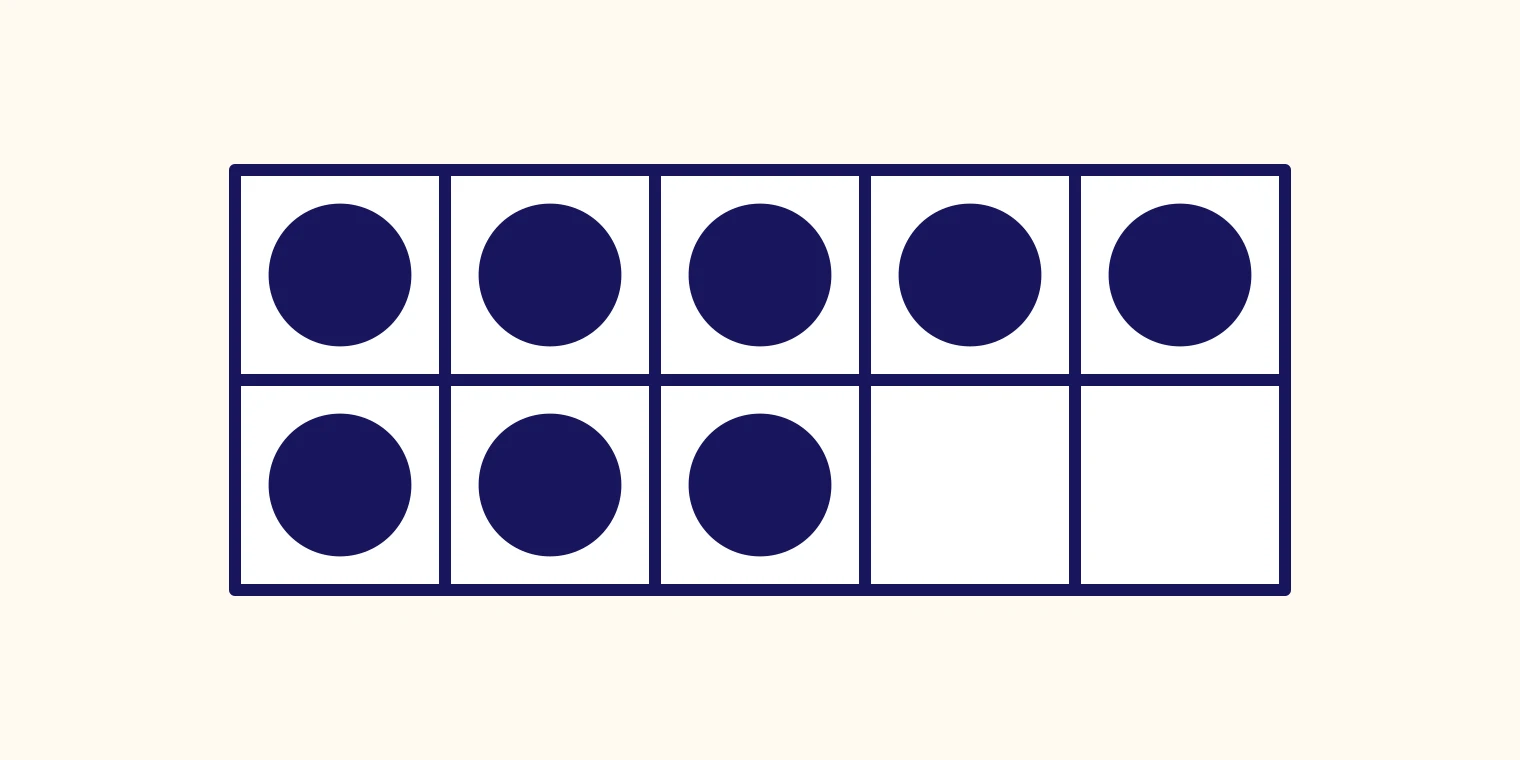
A child who sees the full row as 5 does not need to count it, so 8 reads as 5 and 3. Seeing a small amount at a glance is called subitizing, and the ten frame builds on it by grouping every number in fives. The mathematics educator Janette Bobis describes ten frames as “two rows of five equal-sized boxes” for the numbers up to ten.
Two variants use the same idea:
- The five frame is one row of five boxes, for numbers up to 5, used in pre-K as a counting mat. McGuire, Kinzie, and Berch describe five frames, used with real counters, as a support for preschoolers learning the counting principles.
- The double ten frame is two ten frames, for 11–20. The first frame is always filled before the second, so 14 reads as one full ten and 4 more. The Common Core kindergarten standard K.NBT.A.1 describes the teen numbers the same way, as “ten ones and some further ones”.
Free printable ten frames: mats and cards
Our free ten frames come as three PDFs, because a mat and a card do different jobs: a mat is a board for real counters, and a card is a picture to flash, match, and play with.
- Ten Frame Mats, 5 pages. Two five frames, a ten frame, a double ten frame for 11–20, and a page of 12 small blank ten frames to draw dots in. Every mat box fits a penny or a 2 cm counter. Print this one for counting with beans, coins, or cereal, or as a blank ten frame template.
- Ten Frame Cards, 6 pages. Frame cards and numeral cards from 0 to 10, and an answer key. Print this one for flash cards, matching, and games.
- Double Ten Frame Cards, 6 pages. Frame cards and numeral cards from 11 to 20, the first frame always full, and an answer key. Print this one once 0–10 is easy, and for making ten in first grade.
The frame cards carry no numeral, so your child reads the dots, and each answer key shows the cards in miniature with their numbers. Every sheet prints in black and white, with solid black counters and heavy frame lines.
Free PDF · no sign-up
Free printable ten frames
Three free PDFs in black and white, with no account and no email, in teaching order: ten frame mats for real counters, then ten frame cards from 0 to 10, then double ten frame cards from 11 to 20. Start with the one your child can already do. Both card sets have an answer key, and every PDF ends with a page of instructions for grown-ups on why, what for, and how to use it.
Why do schools use ten frames instead of counting one by one?
Schools use ten frames because a child who can see 5 and 10 inside a number can add without counting every step. Take the first-grade sum 8 + 6.
- Counting on. Start at 8 and count six more: “nine, ten, eleven, twelve, thirteen, fourteen.” That is six counts to keep track of.
- Making ten on two ten frames. Show 8 on the first frame, which leaves 2 empty boxes, and 6 on the second. Move 2 of the 6 across to fill the first frame. Now there is one full ten and 4 more, so 8 + 6 = 14.
Both ways are right, and both are in the Common Core. The first-grade standard 1.OA.C.6 lists counting on and “making ten (e.g., 8 + 6 = 8 + 2 + 4 = 10 + 4 = 14)”, with these exact numbers. Counting on takes more counts as the number added grows, while making ten takes the same two steps for 9 + 7 as for 8 + 6.
The progression for operations by the Common Core Standards Writing Team names three things a child needs before making ten: the partner that makes 10 with any number, the ways to split any number below 10, and the teen numbers as 10 and some more. A ten frame shows all three. The empty boxes are the partner (8 and 2), the two rows split the number (8 is 5 and 3), and the double ten frame is the teen (14 is 10 and 4). Seeing 8 as 5 and 3 is also a number bond, and our guide to new math explains why homework draws models like these.
Teachers have used ten frames “for many years”, in the words of McGuire, Kinzie, and Berch, but the research on the frames themselves is thin: the same authors write that “a lack of systematic research” leaves little known about teaching with five frames. The case for the ten frame is that it draws the structure the standards ask children to use.
What grade uses ten frames?
Children use ten frames from pre-K to first grade: as a counting mat in pre-K, for the partners of ten and the teen numbers in kindergarten, and for making ten in first grade.
| Grade | What children do with a ten frame | Common Core | Texas |
|---|---|---|---|
| Pre-K | Count on five frame and ten frame mats; make numbers to 10 in different ways | None | PK4.V.A.6, PK4.V.A.7 |
| Kindergarten | Split numbers to 10; find the partner that makes 10; see teens as ten and more | K.OA.A.3, K.OA.A.4, K.NBT.A.1 | K.2(I) |
| 1st grade | Make ten to add and subtract within 20; recognize a filled frame at a glance | 1.OA.C.6 | 1.2(A), 1.2(B), 1.3(C), 1.3(D) |
In the Common Core, kindergartners split numbers up to 10 “in more than one way” (K.OA.A.3) and find “the number that makes 10 when added to the given number” (K.OA.A.4). The Texas Prekindergarten Guidelines start a year earlier: 4-year-olds begin to see that numbers from 0 to 10 “can be composed and decomposed in various ways”.
In Texas, seeing teen numbers as a ten and some ones is a first-grade standard rather than a kindergarten one. Texas first graders are also expected to “recognize instantly the quantity of structured arrangements”, such as a filled ten frame. Texas kindergartners compose and decompose numbers up to 10 (K.2(I)).
For a 3-year-old, start with the five frame. In first grade, base ten blocks and number lines to 100 start to take over from the ten frame.
How to use a ten frame at home
Print a mat, find a handful of dried beans, and spend about 5 minutes on one routine. The five routines come in the order a child meets them, from pre-K to first grade.
Fill it, top row first
Your child puts one bean in each box of the mat, along the top row from left to right before starting the bottom row, and says how many. Start a 3- or 4-year-old on the five frame, one row of five, and move to the ten frame when 5 is easy.
Ask how many, and how many empty
Show a ten frame card, or fill the mat, and ask two questions: how many dots, and how many empty boxes? Then ask how many more make ten. These are the questions the mathematics educator Janette Bobis gives for a ten frame flash-and-tell. The empty boxes answer the last one.
Make the same number two ways
Ask for 6 on the mat. A full row and 1 more is one way, and 3 on top with 3 below is another. Say the number sentence for each, 6 is 5 and 1, and 6 is 3 and 3. Keep the arrangements your child can read without counting.
One more, one less
Add one counter and ask how many now, then take one off. Only one box changes, so your child sees the new number without counting the rest again.
Teens on two frames
Fill one ten frame, then put 4 counters on a second and say it together: ten and four is fourteen. Work through 11–20 this way. The Common Core progression for operations notes that teen numbers are harder in English than in languages that say them as ten one, ten two, because fourteen says the four first.
Without a printer, use a dozen egg carton with one pair of cups cut off: two rows of five. More homemade counting tools are in math manipulatives.
How do you make ten with a ten frame?
To make ten with a ten frame, fill the empty boxes of the first frame from the second number, then read one full ten and the ones left over.
- Partners of ten, on one frame. The dots and the empty boxes always make 10: 7 dots and 3 empty, 6 dots and 4 empty.
- Adding past ten, on two frames. For 9 + 5, show 9 on the first frame, which leaves 1 empty box, and 5 on the second. Move 1 counter across. The first frame is full and 4 are left on the second, so 9 + 5 = 10 + 4 = 14.
- Subtracting back through ten. For 13 − 4, show 13 as a full frame and 3 more. Take away the 3 on the second frame, then 1 more from the full frame, which leaves 9. It is the example in the Common Core first-grade standard 1.OA.C.6: “13 - 4 = 13 - 3 - 1 = 10 - 1 = 9”.
Counting on is quicker for adding 1, 2, or 3: 8 + 2 is just “nine, ten”. Neither strategy replaces the other: both are first-grade standards, and children use both. Making ten is the one that turns into mental math, because a child who knows the partners of ten no longer needs the counters.
Ten frame games
Each of these four games uses the ten frame cards, and each ends with your child saying the number aloud.
- Flash and tell. Show a frame card for 2 seconds, hide it, and ask how many. A child who answers without counting is seeing the amount at a glance.
- Match. Lay the frame cards face down and the numeral cards face up. Turn over a frame card and find its numeral.
- Make ten pairs. Play memory or go fish where a pair is two frame cards that make 10, such as 7 and 3. The empty boxes on one card are the dots on the other.
- Numbers to 20, a game from the mathematics educator Janette Bobis. Print the 0–10 frame cards twice and lay them face down, with the numeral cards from 0 to 20, from both card sets, face up. Each player turns over two frame cards, adds them by making ten or counting on, and takes the numeral card for the total, until every numeral card is gone.
Ten frame vs. counters, number line, or rekenrek
A ten frame, counters, a number line, and a rekenrek each show a number a different way.
- Counters are what goes in the frame, and the frame adds the rows that make 5 and 10 visible, so the two work together.
- A number line shows how far apart numbers are and keeps going past 20. A ten frame shows how a number is built from 5 and 10.
- A rekenrek is the same fives-and-tens idea with beads that slide along two rods.
- Fingers are the ten frame a child always has: two hands of five.
Common ten frame mistakes
Each of these ten frame mistakes comes from counting the dots instead of reading them.
- Filling boxes in any order. Scattered counters have to be counted one by one. Fill the top row first, left to right.
- Counting every dot from 1. A child counts eight dots one by one on a card with a full top row. Ask “how many in the top row?” until “five” comes without counting.
- Ignoring the empty boxes. A child says 7 and stops. Ask “how many empty?” every time, because the empty boxes are the partner that makes ten.
- Starting the second frame early. On a double ten frame, a child shows 14 as 7 on each frame. Fill the first frame before any counter goes on the second, so 14 reads as one ten and 4.
- Treating an empty frame as nothing to say. An empty frame is zero. Keep the 0 card in the deck and expect “zero”.
Frequently asked questions
What is a tens frame used for?
A tens frame is used to show a number from 0 to 10 as its distance from 5 and from 10, so a child can see how many there are without counting each one. Children use it to count with real objects in pre-K, to find the partners that make 10 and to see teen numbers as ten and some more in kindergarten, and to add and subtract by making a ten in first grade.
Is it tens frame or ten frames?
Both names are used, and so is 10 frame. A ten frame, a tens frame, and a 10 frame are the same thing, a rectangle of ten boxes in two rows of five, and the plural is ten frames. Ten frame is the name most worksheets and math standards materials use.
How can I explain ten frames to a kindergartener?
Say that the ten frame is a home for ten counters, one in each box, and the top row fills first. Fill it together and stop at the end of the top row to say "five". Then ask two questions about every number you make, how many and how many empty, so your child starts reading the frame instead of counting it.
How do you make ten frames at home?
Cut one pair of cups off a dozen egg carton, which leaves two rows of five. You can also draw two rows of five boxes on paper with a thick marker, or mark them on a table with tape. Make each box big enough for a coin or a dried bean, and fill the top row first.
What is the difference between ten frame cards and ten frame mats?
A ten frame mat is a large empty frame for real counters, such as beans or coins, so a child builds a number by placing them. A ten frame card already shows a number in dots, so a child reads it, matches it to its numeral, or plays a game with it. Use the mat to build numbers and the cards to recognize them quickly.
Can ten frame activities be used for teaching place value?
Ten frames lay the ground for place value without teaching it. A full frame is one ten, so a double ten frame shows 14 as one ten and 4 ones, and ten full frames would make 100. In first grade and after, place value is taught with tools such as base ten blocks, which take over from ten frames.
Are there digital tools available to use ten frames online?
Yes. Several free websites offer an interactive ten frame where a child drags counters into the boxes. A printed mat and a handful of beans do the same job, and a printed mat can be used anywhere, written on, and handled with real objects.
Related guides
Last updated