App Guides
Teach Your Child to Read in 100 Easy Lessons: Does It Work?
What the research says, how the scripted lessons run, how long the book takes, what parents say, what to do when it stalls, and whether an app can help.
Teach Your Child to Read in 100 Easy Lessons is a good fit if you can teach a short, scripted lesson most days and your child is ready to sit for one. It is one book, $29.99 at list price, by Siegfried Engelmann, Phyllis Haddox, and Elaine Bruner. You read each lesson from a script, your child answers, and the publisher says 20 minutes a day takes a child to “about a second-grade level.” Little research has tested the book itself. The method it is built on, Direct Instruction (short, scripted lessons taught in a fixed order), has much more, though the largest review of it comes from the method’s own advocates. When a child stalls or resists, one of its authors, Phyllis Haddox, advises shorter lessons and a steady schedule rather than pushing on.
How we researched it: We make a reading app ourselves, Wonster Words, so we know what goes into teaching a child to read. For this review we read the publisher’s page and the co-author’s website, the studies of the book and the What Works Clearinghouse report on it, and parents’ reviews on Amazon and Goodreads.
The book is a script for you, not practice for your child. Whether it works depends on whether the two of you can keep the daily lesson going.
Does Teach Your Child to Read in 100 Easy Lessons work?
Whether Teach Your Child to Read in 100 Easy Lessons works for your child depends more on the daily lesson than on the research: the book has little research of its own, and the method it uses has a great deal. The What Works Clearinghouse, the US Department of Education’s review of education research, reported in July 2007 that no study of the book met its evidence standards. It was therefore “unable to draw any research based conclusions about the effectiveness or ineffectiveness” of the book. That is no evidence either way, not a finding that the book fails.
Two small studies have tested the book with parents teaching it. In a 2016 study by McConnell and Kubina, parents of kindergartners at risk for reading difficulties taught 30 of its lessons, 15 minutes a night, 5 nights a week. The children read more words correctly, and the parents followed the lessons faithfully. In a 1990 study by Leach and Siddall, the parents of 40 first graders were randomly assigned one of four ways to help at home. The Direct Instruction method and Paired Reading, in which parent and child read aloud together until the child signals to read alone, both led to faster progress than simply hearing the child read. Watson and Hempenstall identify the study’s Direct Instruction method as this book.
The method behind the book has far more research. The book adapts DISTAR, the Direct Instruction reading program Siegfried Engelmann wrote for schools. A 2018 review of 328 studies of Direct Instruction found that “all of the estimated effects were positive,” apart from effects on attitudes and feelings, and called them “moderate to large.” Its lead author, Jean Stockard, works for the National Institute for Direct Instruction, the method’s own advocacy body. The What Works Clearinghouse reviewed DISTAR’s classroom successor, Reading Mastery, in 2013. Of the 154 studies of it for beginning readers, none within its review met its evidence standards.
The book teaches systematic phonics, which is the part of its approach with the firmest backing. The National Reading Panel found systematic phonics instruction significantly more effective than instruction that teaches little or no phonics. That finding is about the method, not about this book. By that standard the book teaches reading the way the research supports, so whether it works for your family comes down to keeping the lessons going.
How do the lessons work?
In each lesson of Teach Your Child to Read in 100 Easy Lessons, you read from a script and your child answers. Every word you say is printed, and the publisher says the lessons are “color-coded for clarity and ease of delivery.” Phyllis Haddox, one of its three authors, says the early lessons may not take 20 minutes and later ones take longer. She notes that the book “was designed to teach one child,” and that you should practice each lesson before you teach it. Beyond the book, you need only a pencil and paper.
Each lesson builds a few skills at once. The psychologist Kerry Hempenstall, writing on Haddox’s website, describes what the lessons contain:
- From lesson 1, blending by ear. In the book’s “say-it-fast” game, you say a word in two parts, such as “motor” and “boat,” and your child says it fast, as one word.
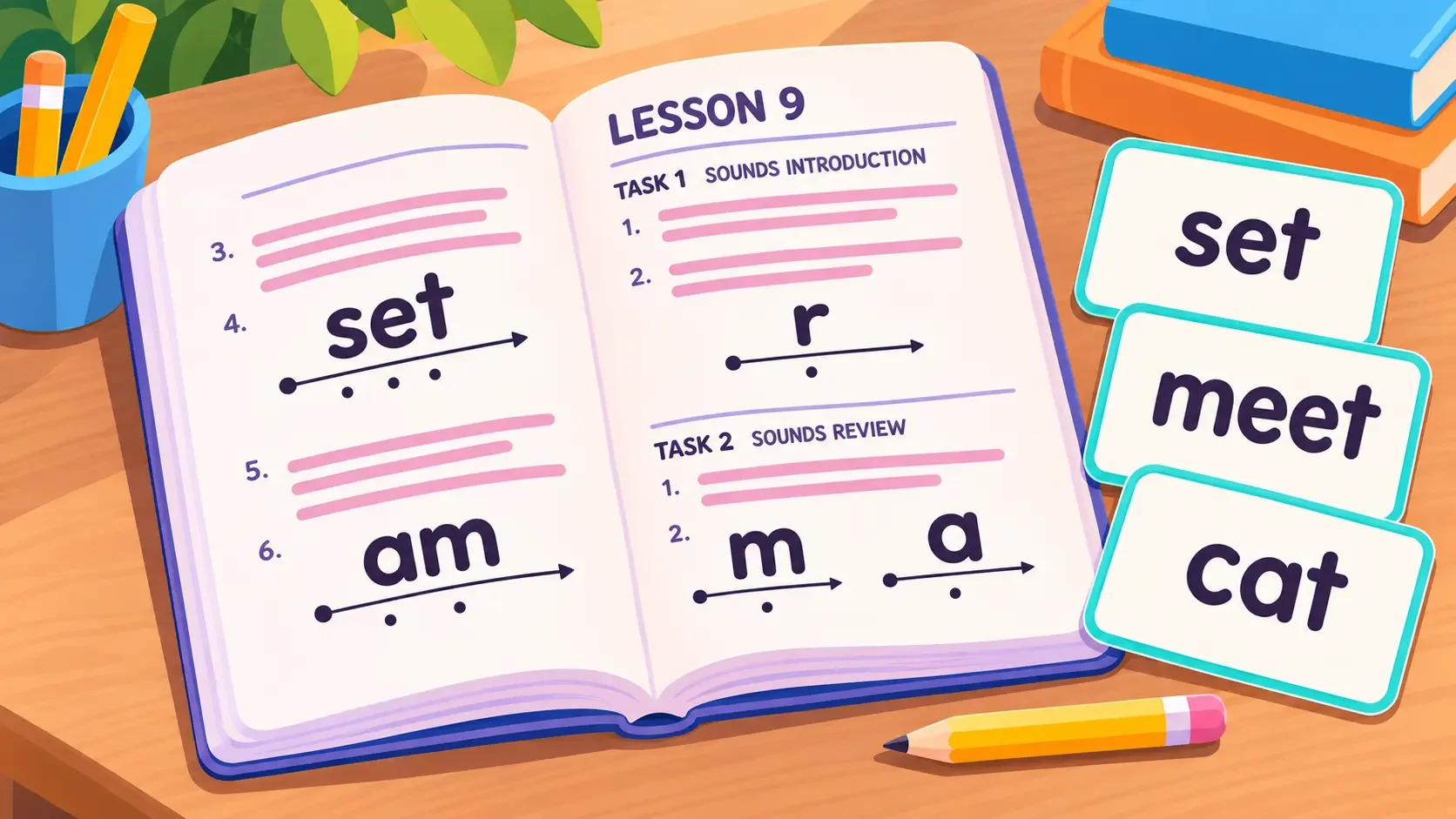
- From lesson 9, sounding out written words. Marks under each word prompt your child to say its sounds one at a time.
- From lesson 13, reading short stories. The picture comes after the story, so it helps your child understand what they read without standing in for the words.
- Along the way, rhyming and writing the sounds.
The book teaches 44 letter-sound correspondences, and it teaches letter sounds before letter names. “Children don’t have to know the alphabet letter names to read, they need to know SOUNDS,” Haddox writes.
For most of the book, the letters are printed in a special way. Haddox says the print is “very purposely designed to make learning as easy as possible.” Long vowels carry a bar over the letter, two letters that make one sound are joined, silent letters are printed small, and some letters are drawn so they are easier to tell apart. The homeschool curriculum reviewer Cathy Duffy gives th as an example of a joined pair. Only lowercase is taught at first, and the special print gives way to ordinary print around lessons 73–76, depending on the edition.
Keep a sheet of paper nearby. The lessons show a story’s picture only after your child has read the words, and Haddox’s instructions for checking an older child’s reading ask for “a paper to cover the story picture.” A sheet over the picture keeps your child reading the words rather than guessing from it.
The current, second edition (2022) adds a Practice Guide for parents. It also puts more emphasis on blending, adds reading with expression, smooths the move to ordinary print from lesson 73, and expands the section on what to do after lesson 100. Haddox’s website, StartReading.com, has free training videos, including demonstrations of lessons 1, 13, 20, 53, and 74, and free printables: sound cards, word cards, and a 100-square Lesson Progress Chart.
What age should you start, and how long does it take?
The publisher gives no age range for Teach Your Child to Read in 100 Easy Lessons, and its co-author, Phyllis Haddox, says the book “was designed to teach four-year-old children and above.” She adds that it “has also been successfully used with precocious three-year-old children.” She names four signs a child is ready:
- They show an interest in learning to read.
- They can listen to, understand, and follow simple spoken English instructions.
- They speak in complete sentences.
- They can work on a task for more than a few minutes.
Starting at 4 puts a child about a year ahead of school. The Common Core State Standards set decoding words with phonics as a kindergarten skill. An early start suits a 4-year-old who is asking to read. Haddox warns that “it is counterproductive to try to teach a child who is too young and does not want to learn to read.”
At 5 lessons a week, the 100 lessons take about 5 months, and at 3 a week, about 8. Haddox says “it is not necessary to teach every day, but it is good to have a consistent schedule.” Parents’ reviews describe a wide range of paces, and many families take breaks along the way.
What do parents say about 100 Easy Lessons?
Teach Your Child to Read in 100 Easy Lessons is rated 4.6 stars from about 17,400 ratings on Amazon, and 4.24 from about 3,100 on Goodreads, as of November 2026. Parents who finished it often say it worked, sometimes quickly, and that the script took the guesswork out of teaching. The complaints are about the effort. The lessons can feel repetitive or boring to a child, often run past 20 minutes, and can get hard in the later lessons. Many treat the book as a starting point and add easy readers or other material alongside it.
Amazon’s own summary of its reviews says much the same. Customers find the book effective, easy to follow, and worth the cost. Some find the lessons hard to understand, and some say it takes more time and energy than they expected.
Two well-known homeschool reviewers come down on different sides. Cathy Duffy’s review lists the book among her “103 Top Picks,” after years in which she “hesitated to recommend” it because of its “distorted” alphabet. She says it “would probably be confusing to use with a child who has already begun reading instruction in another method.” Sarah Mackenzie of Read-Aloud Revival says “It just didn’t work” for her children. Her advice is to stop and use something else if “the lessons are taking too long or ending in tears.”
What should you do if 100 Easy Lessons stalls?
Many parents slow down partway through Teach Your Child to Read in 100 Easy Lessons, and its co-author’s own guidance plans for it. Phyllis Haddox’s advice for a child who is struggling with the lessons:
- Stop when your child is “fatigued and inattentive,” and finish the lesson the next day, after a short review.
- Teach half a lesson. “You may want to teach only one-half of a lesson until your child is able to complete an entire lesson with greater ease.”
- Keep “a consistent schedule,” even if you do not teach every day.
- For a sound your child keeps forgetting, say the sound, then ask “What sound?”, and review it at the end of the lesson and before the next one.
Parents report the later lessons growing longer and harder. Some stop or pause around lessons 70–80, near the change to ordinary print. What to do next depends on what is going on:
- Your child is not ready yet: set the book aside for a few months. Haddox warns that teaching a child who is too young and does not want to learn is counterproductive, and some parents start again a year later.
- Your child is tired or bored: shorter lessons, a short break, or a reward for each lesson finished, which is what the free Lesson Progress Chart on Haddox’s website is for. Our guide to a child who resists reading practice has more ways to keep practice going.
- Your child can already read simple books: add easy readers alongside the lessons, so they read real books between them.
- Your child dreads the lessons: a gentler program with more hands-on work, such as All About Reading, may suit them better.
- Your child needs more practice than the lessons give: add practice they can do on their own between lessons, such as a phonics app.
When the trouble is more than pace, the book may not be enough on its own. A child who still cannot blend sounds into a word after several weeks needs that skill taught directly. Our guide to a child who cannot sound out words shows how. If your child is well behind for their age, our guide to reading help for struggling readers goes through the options. Our list of the signs of dyslexia says what to watch for and when to ask for an evaluation.
What are gentler alternatives to 100 Easy Lessons?
The right alternative to Teach Your Child to Read in 100 Easy Lessons depends on why you are looking.
- You want something gentler and more hands-on: All About Reading. Its publisher calls it a scripted, multisensory program built on the Orton-Gillingham approach, with “lightly scripted lessons that give results with only 20 minutes a day.” The Level 1 materials cost $159.95, returnable within a year. Our guide to choosing an app, a workbook, or a curriculum compares it with the book.
- You still want to teach every lesson, from a phone: Reading.com. It follows a published sequence of 120 numbered lessons, and in our use a parent takes part in every one. It costs $6.99 a week, $12.49 a month, or $74.99 a year, with no free trial.
- You want one set path laid out for you, in print and on screen: Hooked on Phonics. The app is $14.99 a month or $129.99 a year, and its box plans, which ship workbooks, start at $23.96 a month. Our Hooked on Phonics review covers what each costs.
- You want it free: several free apps and sites teach early phonics, and our guide to free phonics apps and resources covers when they are enough.
- You want practice your child can do on their own, alongside the book or after it: a phonics app, such as Wonster Words, at $59.99 a year for up to four children.
For the wider field of apps, our comparison of phonics apps sets them against each other.
Is there an app version, and can an app replace the book?
There is no official app of Teach Your Child to Read in 100 Easy Lessons. Neither the publisher’s page nor Phyllis Haddox’s website offers one, so an app that uses the book’s title is not an official version of it. Her website offers free videos and printables instead.
An app and the book do different jobs, and they can be used together. The book is teaching you deliver, from a script. An app is practice your child does on their own, between lessons or after lesson 100. Haddox’s next step after the book is teaching “new words that contain sound combinations such as al, ee, and igh.” Spellings such as ee, two letters for one vowel sound, are called vowel teams, and our guide to vowel teams lists the common ones.
| Wonster Words | Teach Your Child to Read in 100 Easy Lessons | Reading.com | |
|---|---|---|---|
| Who teaches | The app, as your child plays | You, from a script | You, from the app’s lessons |
| What your child does alone | Practice games | Nothing: you teach every lesson | Nothing: you take part in every lesson |
| Price | $10.99 a month or $59.99 a year | $29.99 list price | $6.99 a week, $12.49 a month, or $74.99 a year |
| Free trial | 7 days | Not applicable | None |
| Children | Up to 4 | One at a time | Up to 3 |
| Ages | 2–8 | 4 and up | 3–7 |
| Where it fits best | Alongside the book, or after lesson 100 | As the teaching | As the teaching, on a phone |
-
Teach Your Child to Read in 100 Easy Lessons: the publisher states no age range. “4 and up” is co-author Phyllis Haddox’s, and “one at a time” is her note that the book “was designed to teach one child.”
-
Reading.com: “nothing alone” is from our use of the app, in which a parent is briefed on each skill and then teaches it.
Whichever program you use, judge it away from the book. Can your child sound out a word they have not practiced, or read a page of an easy reader with less help than last month? That is the sign the lessons are working.
Frequently asked questions
What kind of materials does Teach Your Child to Read in 100 Easy Lessons require?
Only the book. Its publisher says that everything you and your child need is in it, and the lessons include some writing, so keep a pencil and paper nearby. Co-author Phyllis Haddox's website, StartReading.com, offers free extras: training videos, sound cards, word cards, and a 100-square progress chart.
How can parents supplement Teach Your Child to Read in 100 Easy Lessons?
Add practice between lessons without changing the lessons themselves. Easy readers give your child more to read once they can manage the book's short stories. The free sound and word cards on co-author Phyllis Haddox's website give extra practice with the sounds and words, and a phonics app gives your child practice they can do on their own. Keep reading aloud to your child too.
Is Teach Your Child to Read in 100 Easy Lessons suitable for parents who are not educators?
Yes. It was written for parents: every word you say is printed in the lesson script, and the current edition adds a Practice Guide for parents. Co-author Phyllis Haddox recommends practicing each lesson before you teach it, and her website has free videos of lessons being taught to a child.
What should I do after lesson 100 of Teach Your Child to Read in 100 Easy Lessons?
Keep teaching new spelling patterns. Co-author Phyllis Haddox says a child who finishes may not yet be skilled at reading many longer words and irregular words. Her next step is teaching words with sound combinations such as al, ee, and igh. The current edition of the book expands this section, with teaching exercises, vocabulary words, and a recommended book list.
Can I skip lessons in Teach Your Child to Read in 100 Easy Lessons?
Start at lesson 1, even if your child knows some sounds, and move through the early lessons quickly if they are easy. For a first or second grader, co-author Phyllis Haddox describes a short reading check from a story in the book that places a child at lesson 1, 13, or 25, depending on how many errors they make.
Is Teach Your Child to Read effective for children with learning disabilities?
Research cannot say: the What Works Clearinghouse found no study of the book that met its standards, and the studies that exist are small. Some parents of dyslexic children, including Read-Aloud Revival's Sarah Mackenzie, say it did not suit their children. A child who is well behind or shows signs of dyslexia usually needs a skill check and direct teaching from a trained teacher or tutor, with a parent's lessons and practice alongside it.
Related guides
Last updated