
Writing
Cursive Worksheets
Type this week's words, a name or a sentence and print it in joined cursive, to trace and then copy.
Type words, a name or a sentence below, one to a line, and print a cursive practice sheet. Each line comes out in joined cursive as dashed letters to trace, with an empty ruled line under it where your child writes it alone. Tracing shows the shape of the joined word, and copying it on an empty line is where the hand learns to make it without help. That is why every dashed line on the sheet has an empty one underneath.
There is no account and no email box. What you type never leaves your browser: the sheet is built on your computer and printed from it. This week’s spelling list, your child’s name and the alphabet all work, and the alphabet is one button.
What the cursive worksheet generator makes
A cursive worksheet from this generator is one to three pages of three-line ruling, with each typed
line in dashed letters to trace and an empty line under it to copy on. You can type up to 12 lines. A single word
repeats along its dashed line, so jump gives your child four or five goes at it. A line with a space,
such as a sentence or a first and last name, prints once.
You choose between two line sizes:
| Large lines | Standard lines | |
|---|---|---|
| Bottom line to top line | Half an inch | Three eighths of an inch |
| Typed lines on a page | 4 | 5 |
| Who it suits | A child who is just starting cursive | A child who can already join most letters |
The dashed middle line is where the short letters stop: a, c, m and the joins between them fill
the space under it, and the tall letters, b, h, l and the capitals, reach the top line. Tails on
g, j, p, y and z hang below the bottom line by the same height as a short letter.
The letters are set in Learning Curve, a cursive typeface by the designer Jess Latham that, in the designer’s words, “mimics traditional cursive handwriting worksheets”. Every lowercase letter starts with an entry stroke up from the bottom line, which is where a child’s pencil starts too, and the letters to trace are its dashed version. It joins its own letters, so what prints is a connected word rather than a row of separate letters.
The sheet prints exactly what you type, capitals and punctuation included, in the Latin alphabet with accents such as é and ñ. To keep a copy, press Print it and choose Save as PDF in your printer dialog.
A printable cursive alphabet, a to z and A to Z
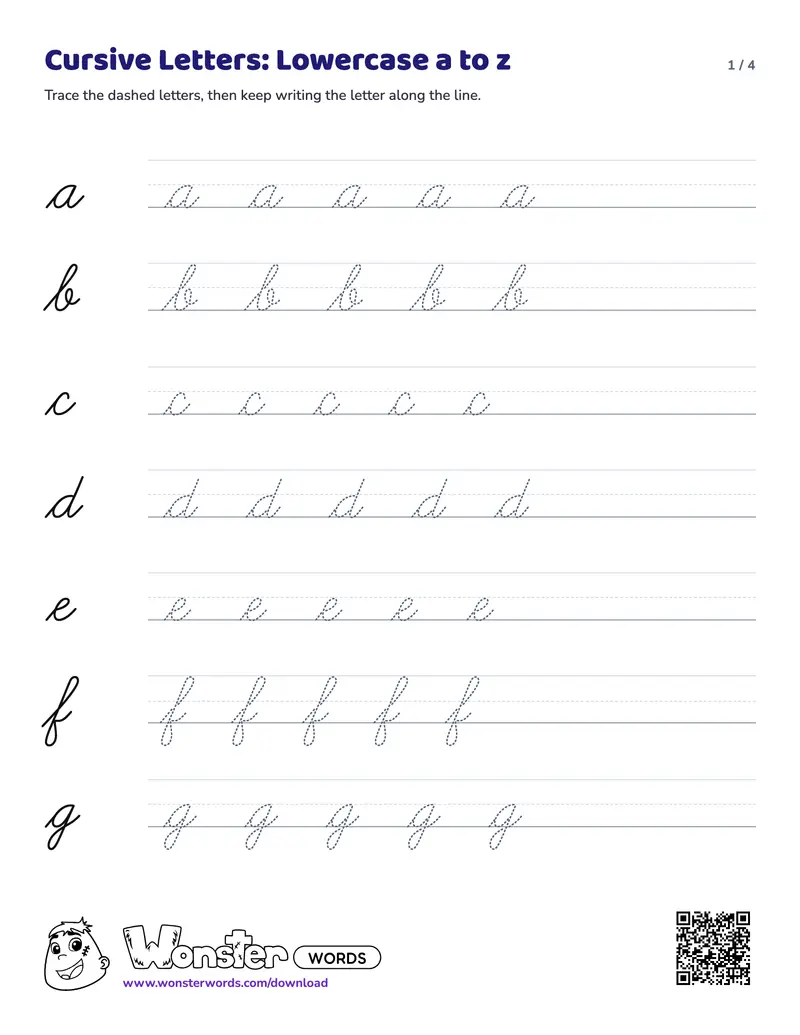
These cursive alphabet worksheets cover every letter in both cases, as two free 4-page PDFs. Each row shows the letter in cursive, then five dashed copies to trace, then the rest of the line empty to keep writing on. Lowercase and uppercase are separate downloads, so you print the one your child needs.
Free PDF · no sign-up
Feedback?Free printable cursive alphabet worksheets
Two PDFs, lowercase first, because lowercase letters are most of what a child writes. Each is the whole alphabet, a letter a row, on the same half-inch lines as the generator's large size. No account, no email, no watermark.
- Cursive Letters: Lowercase (PDF)26 letters · 4 pages
Preview page 1Preview
- Cursive Letters: Uppercase (PDF)26 letters · 4 pages
Preview page 1Preview
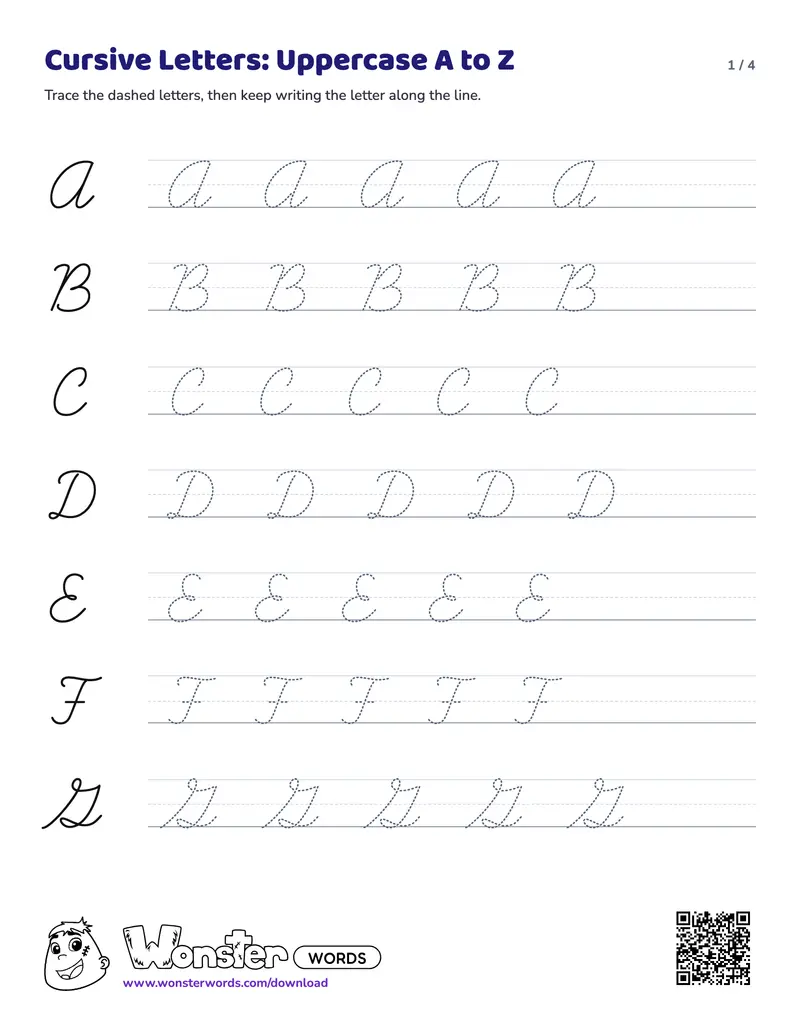
Print the lowercase letters first. They are the letters a child writes most, and most capitals in a word come only at its start. To make a sheet of just a few letters, or of the alphabet in words, type them into the cursive worksheet generator at the top of this page. Its a to z and A to Z buttons type the whole alphabet for you.
The cursive capitals are the letters that look least like their print versions. In the traditional
style these sheets use, the capital Q looks like a large 2, and G, F and Z are drawn with
loops that have no counterpart in print. These capitals have to be learned one at a time, so leave the
uppercase sheet until the lowercase letters are steady.
Trace, copy, then write: the order that works
Cursive practice moves in three steps: letters, then short words, then sentences. Each step uses the same sheet. Only what you type changes.
- Letters. Type one letter per line,
a,canddsay, and the generator fills each line with that letter. - Short words. Once a letter is steady, put it in words:
cat,dad,add. A word is where the joins are, and the joins are what cursive adds to print. - Sentences. Type a short sentence, such as
I can write in cursive.It prints once on its line, and writing it underneath is practice in spacing between words as well as in joining.
Stay with one style of letters until it is comfortable. Steve Graham, a handwriting researcher, advises in American Educator “ensuring that they master one style of handwriting before a second style is introduced”. For a child at home, that means steady print before cursive, and one cursive style rather than two.
Your child’s name in cursive
To make a cursive name tracing sheet, type your child’s name into the generator. A first name on
its own repeats along the dashed line; a first and last name on one line print once, and you can type
them on two lines to practice each separately. A capital at the start of a name is the traditional
cursive capital, which for G, Q or Z is a new letter to learn rather than a bigger copy of the
lowercase one.
For a younger child still writing their name in print, the name tracing worksheets make the same kind of sheet in dotted print letters.
When do kids learn cursive?
Children usually start cursive in second or third grade, at about 7 or 8 years old. In American Educator, Steve Graham writes that print “is usually introduced in kindergarten or grade 1 and the latter in grade 2 or 3”, the latter being cursive. Two widely used school handwriting programs agree:
| Program | Where cursive starts | In the publisher’s words |
|---|---|---|
| Zaner-Bloser | Grade 2 or grade 3, the school’s choice | ”Choose to introduce cursive in grade 2 or grade 3” |
| Learning Without Tears (Handwriting Without Tears) | Grade 2 | Cursive Kickoff, listed under “Grade: Second” |
There is no reason to rush. In a study by Wolf, Abbott and Berninger (2017), second graders who had a further year of print improved more in sustained handwriting than those who moved to cursive in second grade. A child whose print is still slow will get more from steady print practice first. The letter tracing worksheets cover all 26 print letters.
Moving from print to cursive is easier for a child whose program already slants its print letters. D’Nealian is built that way, as our guide to handwriting programs explains, and that guide also covers which cursive program a school might use.
Do schools still teach cursive?
Cursive has come back into many US schools after the Common Core left it out. In the Common Core, kindergarten standard L.K.1a asks children to “print many upper- and lowercase letters” and first grade standard L.1.1a to “print all upper- and lowercase letters”, and the word cursive does not appear anywhere in the standards.
States have since written cursive back in themselves. In March 2026, NEA Today, the National Education Association’s magazine, counted 27 states with laws “mandating or encouraging cursive instruction”. California’s law took effect on January 1, 2024: according to the California Department of Education, schools in grades 1 to 6 must now include “instruction in cursive or joined italics in the appropriate grade levels”.
Whether your child’s school teaches it, and in which grade, is decided by your state and district. A question to the teacher answers it quickly. If the answer is no, these sheets are a way to learn the letters at home, a few lines at a time.
A five-minute daily cursive routine
A cursive routine at home can be five minutes a day with one sheet a week. Make the sheet on Monday with that week’s words, and work through one or two lines a day:
- Day 1: you write the first word slowly while your child watches, then they trace its dashed line.
- Days 2–4: trace one line and copy it on the empty line underneath.
- Day 5: write the week’s words on plain paper without the sheet, and compare them with the dashed lines.
A few minutes most days suits cursive better than one long session a week. Stop while the letters are still careful: once they get faster and larger, the useful part of the session is over.
Traditional or modern cursive?
The cursive on our worksheets is a traditional slanted, looped style, with an entry stroke at the start of every lowercase letter. Other programs draw some letters differently: Handwriting Without Tears keeps its letters simple and its cursive upright, for example. If your child’s school teaches a particular program, have them practice the letters their teacher uses, and use these sheets for the letters the two styles share. Our guide to handwriting programs compares the main programs and when each is the sensible choice.
Tips for left-handed writers
A left-handed child writes cursive more easily with the paper turned the other way. An occupational therapist writing for Learning Without Tears advises that “for a leftie, the left corner of the paper should be placed higher”, and Ireland’s health service, the HSE, says to “tilt the sheet of paper to the right” for a left-handed child.
Two more things help:
- Grip a little higher. The same Learning Without Tears article suggests left-handed children hold the pencil “about 1 to 1.5 inches from the tip”, so the hand does not hide the line they are writing.
- Look up at the dashed line. On this sheet the model is above the empty line, where a left hand does not cover it.
Paper or screen?
For learning cursive, paper and a pencil are the tools. A cursive letter is a movement, and the pencil is where the movement is practiced. There is research on handwriting against typing, though less on cursive itself than on handwriting in general:
- In Berninger and colleagues (2009), children in grades 2, 4 and 6 “wrote longer essays with faster word production rate by pen than by keyboard”. The study compared a pen with a keyboard, not cursive with print.
- A brain-imaging study by Van der Weel and Van der Meer (2024) found more widespread brain connectivity when people wrote in cursive by hand than when they typed. Its participants were 40 university students, not children.
Neither study shows that cursive helps with reading or spelling, and Steve Graham, in American Educator, notes that research does not settle which handwriting style works best. What the sheets give is steady, short practice of joined letters on paper.
How to use a cursive worksheet
Write the word yourself first, slowly
Before your child picks up a pencil, write the word on scrap paper while they watch, and say each letter as you make it. This is where the movement is learned: the sheet shows the finished shape, and you show how it is made.
Trace the dashed letters
Your child goes over the dashed letters with a pencil, without lifting it inside a word. A single word repeats along its line, so there are several goes at it.
Copy it on the empty line underneath
The empty ruled line under each dashed one is where your child writes the word alone, looking up at the dashed line as often as they need. This is the step the sheet is built around.
Stop after a few minutes
One or two lines is a session. Letters that start well and then get faster and larger are a sign to stop, not to push on to the bottom of the page.
A grip that hurts, letters that stay hard to read after weeks of practice, or a child who avoids writing altogether are reasons to talk to their teacher, who can suggest an occupational therapy assessment if one is needed.
Frequently asked questions
What age should children start learning cursive writing?
Most children start cursive in second or third grade, at about 7 or 8. Zaner-Bloser lets a school introduce it in grade 2 or grade 3, and Learning Without Tears starts its cursive in second grade. A child who still forms print letters slowly gains more from another stretch of print than from an early start.
Is cursive still taught in schools today?
In many states it is again. The Common Core standards ask children to print letters and never mention cursive, but about half the states now have their own law. NEA Today counted 27 states mandating or encouraging cursive in March 2026, and California has required it in grades 1 to 6 since January 2024.
How do I make a cursive name tracing worksheet?
Type your child's name into the generator at the top of this page and press Make the sheet. A first name repeats along its dashed line; a first and last name together print once. The name stays in your browser and is never uploaded.
Are these cursive worksheets free?
Yes. There is no account, no email address and no limit on how many sheets you make. The sheet is built and printed in your own browser.
Can I save the cursive worksheet as a PDF?
Yes. Press Print it and choose Save as PDF as the destination in your printer dialog. The file is made on your computer.
Why do left-handed students struggle with cursive writing?
Cursive slants to the right and moves left to right, so a left hand can end up covering and smudging what it has just written. Turning the paper the other way, with its left corner higher, and holding the pencil a little further from the tip both help a left-handed child see the line they are copying.
Related guides
Last updated
Looking for something else?
Looking for something else?