Spelling
Best Spelling Programs and Apps for K-2
The seven things that matter, what to watch while your child practices, and how to pick the best one for you.
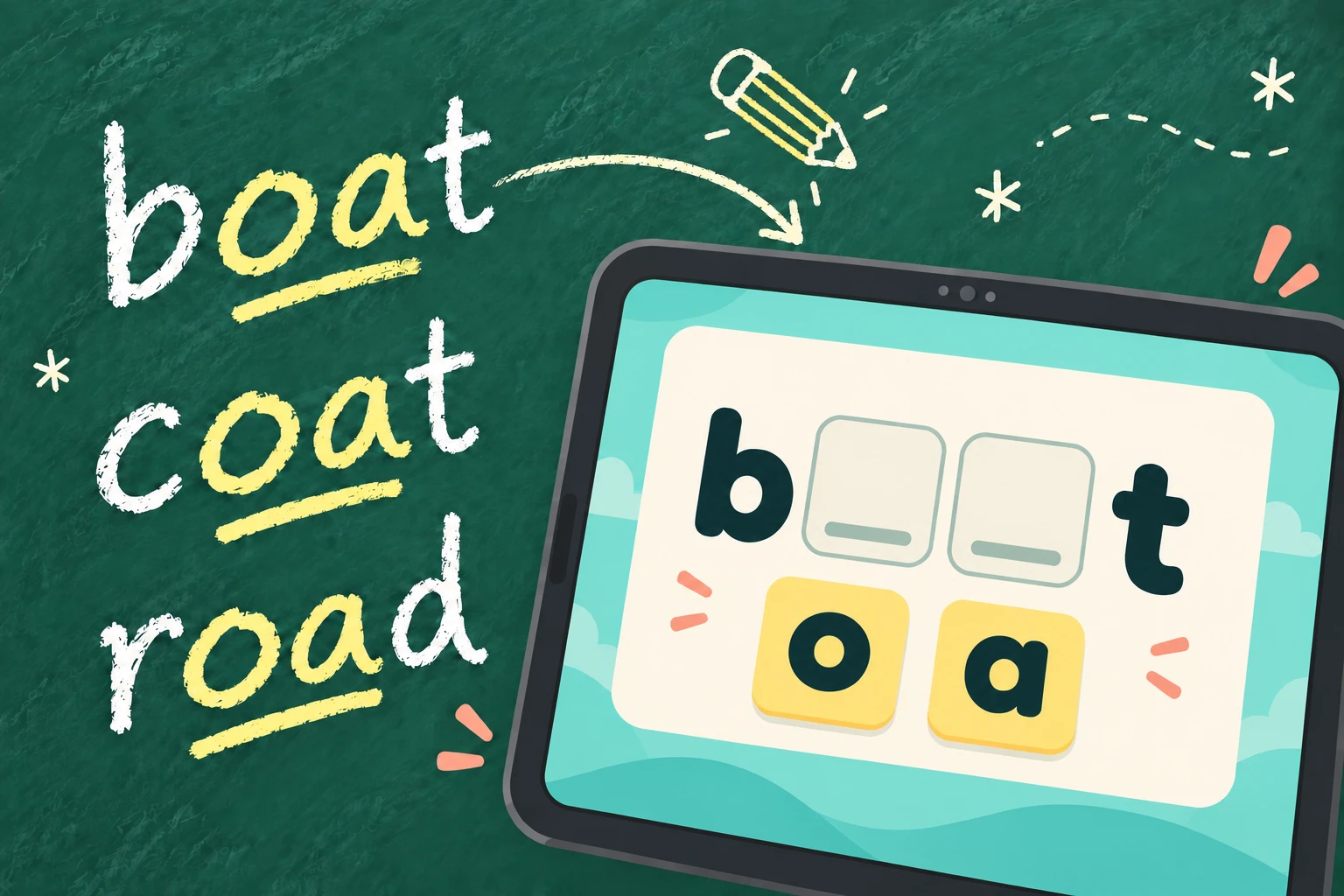
A spelling app is a great tool for practice, especially if it teaches sounds-to-letters rather than only testing recall, says each sound aloud, lets you add your own words, and asks your child to produce the word rather than recognize it. That last one is where they differ most: of the five apps below, two ask your child to build every word, two are partly multiple choice, and one does not say.
An app is great for spelling practice, and teaching spelling takes guidance. The best results come from pairing the two: a parent or teacher is best at explaining why a word works the way it does, and an app is best at reviewing those words over and over.
Below are five spelling apps and programs for kindergarten, first and second grade. We judged them all against the same criteria, including our own app.
What should a spelling app or program have?
We graded every app below on these seven things, in the order they matter in kindergarten, first and second grade.
| What to check | Why it matters | What good looks like |
|---|---|---|
| Teaches encoding, not just recall | Spelling is building a word from its sounds. An app that only tests recognition is a quiz, not a teacher | Your child types or builds the word letter by letter |
| Says the sounds aloud | A child cannot map a sound to a letter without hearing it said the same way every time | Per-sound audio, not just the whole word read out |
| You can add your own words | The list your school sends is the one your child is tested on | A parent can create a list, ideally with audio |
| Builds rather than picks | Picking an answer is recognition; a spelling test asks your child to produce the word from nothing | Letter tiles at least, and typing on a blank keyboard at best. Multiple choice on top of those, not instead of them |
| Adapts to what your child misses | Re-practicing words your child already knows is time they will not give you twice | Missed words come back; known ones drop away |
| Shows patterns, not just scores | ”Wrong on 6 of 20” tells you nothing to act on | Reports group errors by pattern |
| No ads, and a real privacy policy | This is a child using it alone | No third-party ads; a policy that says what is collected |
The one to check first is adding your own words, because it is the difference between an app that helps with Friday’s test and one that runs a parallel curriculum your child does not have time for.
The first two criteria are not preferences. Reading researcher Linnea Ehri’s work on orthographic mapping describes spelling memory as letter-sound connections bonded through use, which is why an app that only asks your child to recognize the right answer is not building the thing it claims to build. And the National Reading Panel found in 2000 that it is systematic phonics instruction, taught in a planned order, that improves spelling. An app that drills a random word list is missing the part that did the work.
We answer the questions next to this one elsewhere. Choosing a reading app covers the general ones, ads, subscriptions and whether your child will use an app at all, so this page does not repeat them. If your child is still learning to read words rather than write them, read our roundup of apps for learning to read instead.
The picks
We scored all five on the seven criteria above.
| What to check | Wonster Wordsour app | Squeebles Spelling Connect | ABCmouse | Starfall | Khan Academy Kids |
|---|---|---|---|---|---|
| Teaches encoding, not just recall | Yes | Partly | Partly | Yes | Partly |
| Says the sounds aloud | Yes | A little | Not stated on the vendor's site | Not stated on the vendor's site | Not stated on the vendor's site |
| You can add your own words | Yes | Yes | No | A little | No |
| Builds rather than picks | Yes | Not stated on the vendor's site | Partly | Yes | Partly |
| Adapts to what your child misses | A little | Yes | A little | A little | A little |
| Shows patterns, not just scores | Partly | A little | Not stated on the vendor's site | No | Not stated on the vendor's site |
| No ads, and a real privacy policy | Yes | Yes | Yes | Yes | Yes |
Wonster Words: best for a child whose school sends a weekly list home
This is our own app, built to teach spelling as a subject in its own right, using American-English audio and US spellings. It is built around your child’s own words. Type in the list school sent home on Monday and every game that week runs on those words, each one read aloud.
If what you have is a pattern rather than a list, describe it instead. Ask for first grade words for practicing silent e, or words with the sh sound, and it builds a set of practice around those words: the same games it makes from a list you typed in yourself, several ways at the same words.
Its own spelling lessons run from pre-K to second grade. Practice the FLOSS rule, or the difference between ck and c, or dge and ge, and work on the letter reversals children trip on, such as b and d. Our spelling rules guide explains the rules themselves and the grades they are taught in.
How ours does on each of the seven:
- Teaches encoding, and builds rather than picks. Its games run all three ways: multiple choice, where the wrong answers are misspellings rather than other words; letter tiles; and, in its spelling game, your child hearing the word and a sentence using it, then typing it out on a blank keyboard.
- You can add your own words. Every word you type gets audio, and the app can email you a printable practice sheet built from the same list.
- Says the sounds aloud. This is the part the app is built around: as a word comes together, your child hears each sound on its own, not just the finished word read out.
- Shows the patterns, in the game. The rule lessons build words from sound units rather than single letters, so a pattern like ff in fluff moves as one tile, and the gaps your child fills are the letters the rule decides. The pattern behind each rule is in front of your child every time they spell.
- No ads, and a privacy policy that says your data is never sold.
- Where it falls short: it adapts only a little. After each round it shows your child the words they missed and offers the round again, but it does not yet bring back just the missed words or carry them into the next session. And the parent report shows time and overall accuracy, not which patterns your child is missing: the patterns live in the game, not yet in the report.
For a weekly spelling test in first, second or third grade, this is the one to try. Words need to be in the app’s dictionary, so an unusual name may not go in.
Try it free for 7 days. That is long enough to run one full week’s list through it before a test and see whether your child will actually use it, before you are charged anything. After the trial it is $10.99/mo or $59.99/yr. No ads, ages 2-8.
Squeebles Spelling Connect: best for a parent who wants to record the words themselves
After ours, this is the most spelling-focused option here, and it is the only one where you can record your own audio for every word. Their own site puts it plainly: “Create your own custom spelling lists with the exact words you want your children need to practice. Record your own audio for each word, or choose from the 8500+ words we already have audio recorded for.”
It is also the only one here that carries your child’s mistakes forward: its Tricky Words test is built from the words they have previously spelled wrong, so the misses come back.
One caveat for learners in the USA: it is a UK app, built to the English National Curriculum and the UK’s “Letters and Sounds” phonics programme, and its 160+ built-in lists follow that sequence. If you are using your own list that is irrelevant, and if you were hoping the built-in lists would match a US scope and sequence, they will not.
Level 1 is aimed at ages 5 to 7. Audio recording works on iOS and Android but not in the web version.
£2.99/mo or £29.99/yr for up to four children, 7-day trial, no ads (~$4/mo or $40/yr as of 2026).
ABCmouse: best for one subscription covering many subjects
This is the broadest option here, and its spelling is real rather than implied: its own first-grade path covers high-frequency words, consonant blends and digraphs, compound words, prefixes and suffixes, through a Learn, Practice, Apply and Reinforce cycle.
Where it falls short: spelling sits inside the reading path rather than standing on its own, and you cannot add your own words. For a parent whose actual problem is Friday’s list, that is the whole ballgame. There is a free basic tier worth trying first.
$14.99/mo or $59.99/yr, 30-day trial on the web, no ads, ages 2-8. Its website advertises $45 for a year, and the company’s own pages say those plans renew at $45 in most cases and $59.99 in some, so check the renewal price before you count on the lower figure.
Starfall: best as an affordable phonics supplement, if spelling is not the main goal
Starfall is long established and inexpensive, and it does have a spelling game: Spelling Composer, a first-grade activity with sets of -ing, -er and ow words plus seasonal sets, where your child types each word on a keyboard. Starfall’s own words for it: “Kids will learn to spell through exciting games using either a keyboard or a mouse.”
Where it falls short: the word sets are Starfall’s, so it cannot practice Friday’s list. The only place Starfall takes your own words is its printable worksheet generators. And it tracks nothing, on purpose. Its help center says plainly that “individualized tracking and reports are not provided by Starfall”, so you will not see which words or patterns your child is missing.
Its strength is phonics, and our phonics roundup covers it on the criteria that actually apply to it.
$35/yr, or $5.99/mo through the app stores. There is also a large free tier, but the spelling game is not in it: Spelling Composer is members-only. No ads, ages 3-8.
Khan Academy Kids: best for spending nothing while you find out if an app helps
Khan Academy Kids is free, well made and ad-free, with no catch. It is a general early-learning app, not a spelling app. It covers early literacy, reading, writing, language and math, and reading is one subject among several rather than its focus. Spelling shows up as word-building and writing activities inside a personalized path that moves across subjects, not as a sequence of spelling lessons taught rule by rule. There are no spelling lists and no way to add your own words.
So it will not solve a weekly-list problem, but it is the right first move if you do not yet know whether your child will use an app at all.
Free, ages 2-8.
What to check for while your child practices
An app marks the answer; it cannot see how your child got there. That is the one real drawback of practicing on a screen, and it is easy to cover. Three things are worth watching yourself, on the app or on paper.
Watch their hand, not just the answer. Sitting next to a child who is writing tells you things a score never will: that they formed b as d, or said “buh” while writing, or hesitated before the vowel. Those are the things that say what to teach next.
Look for the pattern across the week. Most apps report which words were wrong, not the shape of the errors. If every miss this week was the middle vowel, that is one lesson rather than ten words, and you are the one who will spot it.
Check that it transfers. A word spelled right in the app and wrong in your child’s own story has not stuck yet. Read something they wrote for themselves, not for a test, and see which words hold up.
None of that makes an app useless, and the research on whether reading apps do anything at all finds they help most with exactly this kind of repetition. The app is what keeps the practice going on the evenings that get away from you; the five minutes that teach are yours.
Free versus paid: what free versions leave out
The three things most often kept behind a paywall are the three worth paying for: adding your own word list, progress you can actually read, and removing ads. A free app is usually free because it is narrow rather than because it is generous.
Two of the options above are the exception. Khan Academy Kids is free outright, with no ads and nothing held back, and it is also the one with no spelling sequence. Starfall has a large free tier, but its spelling game is not in it.
Wonster Words is a paid subscription, $10.99 a month or $59.99 a year, with a 7-day free trial.
Before you spend anything, play one of the no-prep games for a week and see whether five minutes a day is a habit you can keep. If your child will do that, an app is worth paying for. If they will not, an app will not change that.
Which is better, an app or a spelling program?
A program gives you a sequence; an app gives you practice. They are different purchases and the words get used interchangeably in marketing.
A spelling program is a curriculum: patterns in a planned order, with a scope and sequence you can look at, and at home it is you who teaches it. Buy one if you are teaching spelling yourself and want the order decided for you.
An app is practice on words someone has already chosen, whether that is the app’s sequence or your list. Buy one if the teaching is happening at school and you want the practice to happen at home without a fight.
If a program calls itself phonics-based, the check is whether you can see its scope and sequence before you buy. A real one publishes the order it teaches patterns in. A marketing line does not. Run that check on us too: what Wonster Words teaches lists every spelling rule lesson, and the level each one sits at.
Apps for children who find spelling hard
Look for adjustable pacing, audio on every word, and no timed rounds. A timer converts a child who needs longer into a child who fails, which is the opposite of what a struggling speller needs from practice.
An app supplements whatever a school or specialist has already put in place. If you are wondering whether your child’s difficulty is more than the usual, that is a conversation with their teacher rather than a feature to shop for.
This section is only about what to look for in an app. Why spelling is hard for some kids covers the teaching that goes with it, and the techniques that help a child for whom it does not come easily.
Frequently asked questions
What features should a spelling app for kids have?
Four that matter more than the rest. It should teach sounds-to-letters rather than only testing recall, say each sound aloud, let a parent add their own words, and get your child typing the word on a blank keyboard rather than picking it from options. Multiple choice is the weakest practice an app can offer, not a reason to rule one out. Everything else is polish.
Are free spelling apps for kids effective?
Some are, and the ones that work are narrow rather than broad. The thing free versions most often withhold is the part that matters: adding your own word list, and progress you can actually see. Check that before paying, and check it before assuming free is enough.
Do spelling apps improve writing skills in young children?
Indirectly, and less than the marketing suggests. An app can make individual spellings automatic, which frees attention for composing a sentence. It cannot teach a child what to write, and no app has a way to notice that a word spelled correctly in practice is misspelled in your child's own story.
What age group is best suited for spelling apps?
Kindergarten through second grade, roughly five to seven, is where they fit best, because that is when a child knows most letter sounds and is starting to write words. Before that, hearing the separate sounds in spoken words matters more than any app, and it is best practiced out loud with a person.
Can spelling apps be used for children with learning disabilities?
Often yes, and the features to look for are adjustable pacing, audio for every word, and no timed rounds. A timer turns a child who needs longer into a child who fails. If your child has a diagnosed difference, the app is a supplement to whatever their school or specialist has set up, not a substitute for it.
Can parents customize spelling app settings for their child's needs?
The setting worth checking is whether you can add your own words, because the list your school sends is the one your child is actually tested on. An app that only teaches its own sequence cannot help with Friday's test, however good the sequence is.
How do spelling apps track progress for kids?
Most track which words were right and how often. The more useful thing, which fewer do, is showing you which patterns your child is getting wrong rather than which words. Words tell you what to re-practice; patterns tell you what to teach.
Related guides
Last updated